
Digital engineering services company EPAM Systems (NYSE: EPAM) met Wall Street’s revenue expectations in Q1 CY2026, with sales up 7.6% year on year to $1.4 billion. On the other hand, next quarter’s revenue guidance of $1.41 billion was less impressive, coming in 1.1% below analysts’ estimates. Its non-GAAP profit of $2.86 per share was 3.8% above analysts’ consensus estimates.
Is now the time to buy EPAM? Find out by accessing our full research report, it’s free.
EPAM (EPAM) Q1 CY2026 Highlights:
- Revenue: $1.4 billion vs analyst estimates of $1.4 billion (7.6% year-on-year growth, in line)
- Adjusted EPS: $2.86 vs analyst estimates of $2.75 (3.8% beat)
- Adjusted EBITDA: $148.3 million vs analyst estimates of $210.5 million (10.6% margin, 29.5% miss)
- Revenue Guidance for Q2 CY2026 is $1.41 billion at the midpoint, below analyst estimates of $1.42 billion
- Management raised its full-year Adjusted EPS guidance to $13.13 at the midpoint, a 3% increase
- Operating Margin: 8.3%, in line with the same quarter last year
- Constant Currency Revenue rose 3.7% year on year (1.4% in the same quarter last year)
- Market Capitalization: $5.64 billion
"We are pleased to report a strong first quarter and solid start of the year amidst a rapidly evolving macroeconomic landscape. Our Q1 performance reflects steady execution and continued momentum across our AI-native and AI foundational readiness initiatives," said Balazs Fejes, CEO & President, EPAM.
Company Overview
Founded in 1993 during the early days of offshore software development, EPAM Systems (NYSE: EPAM) provides digital engineering, cloud, and AI transformation services to help global enterprises and startups modernize their technology systems and create digital products.
Revenue Growth
Examining a company’s long-term performance can provide clues about its quality. Any business can put up a good quarter or two, but many enduring ones grow for years.
With $5.56 billion in revenue over the past 12 months, EPAM is one of the larger companies in the business services industry and benefits from a well-known brand that influences purchasing decisions.
As you can see below, EPAM grew its sales at an exceptional 14.8% compounded annual growth rate over the last five years. This is an encouraging starting point for our analysis because it shows EPAM’s demand was higher than many business services companies.
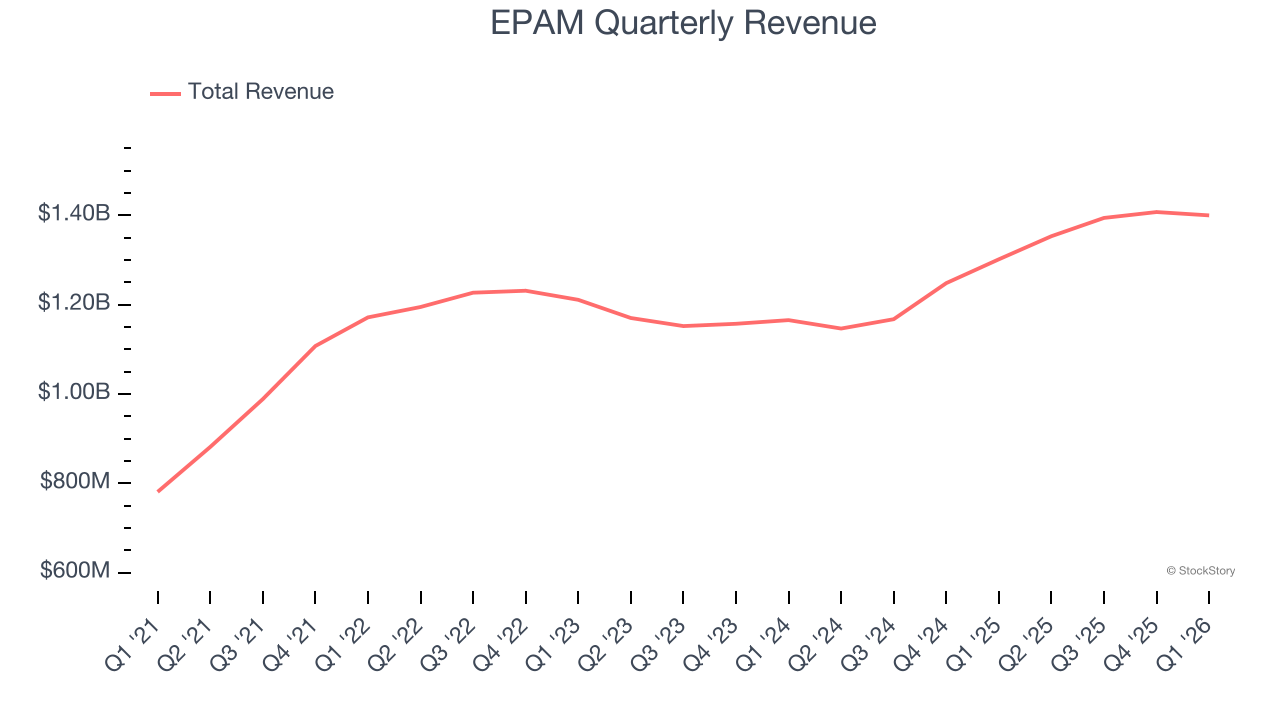
Long-term growth is the most important, but within business services, a half-decade historical view may miss new innovations or demand cycles. EPAM’s annualized revenue growth of 9.4% over the last two years is below its five-year trend, but we still think the results suggest healthy demand. 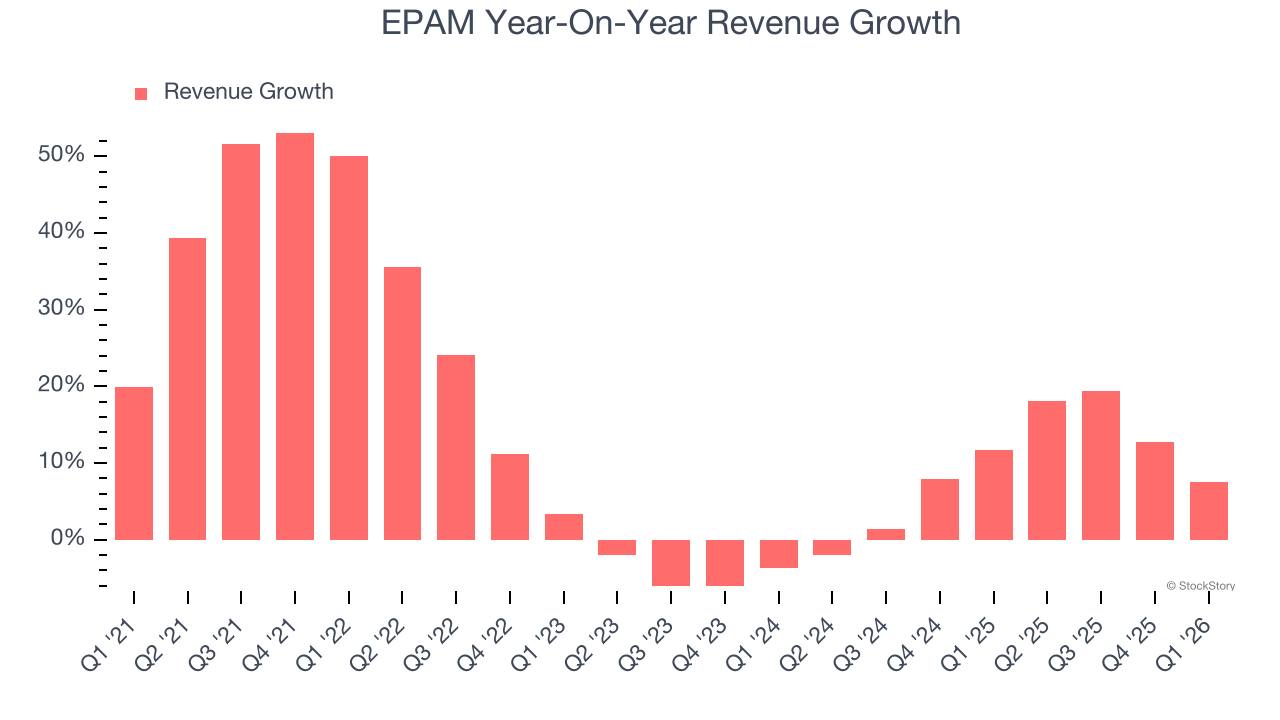
We can dig further into the company’s sales dynamics by analyzing its constant currency revenue, which excludes currency movements that are outside their control and not indicative of demand. Over the last two years, its constant currency sales averaged 3.2% year-on-year growth. Because this number is lower than its normal revenue growth, we can see that foreign exchange rates have boosted EPAM’s performance. 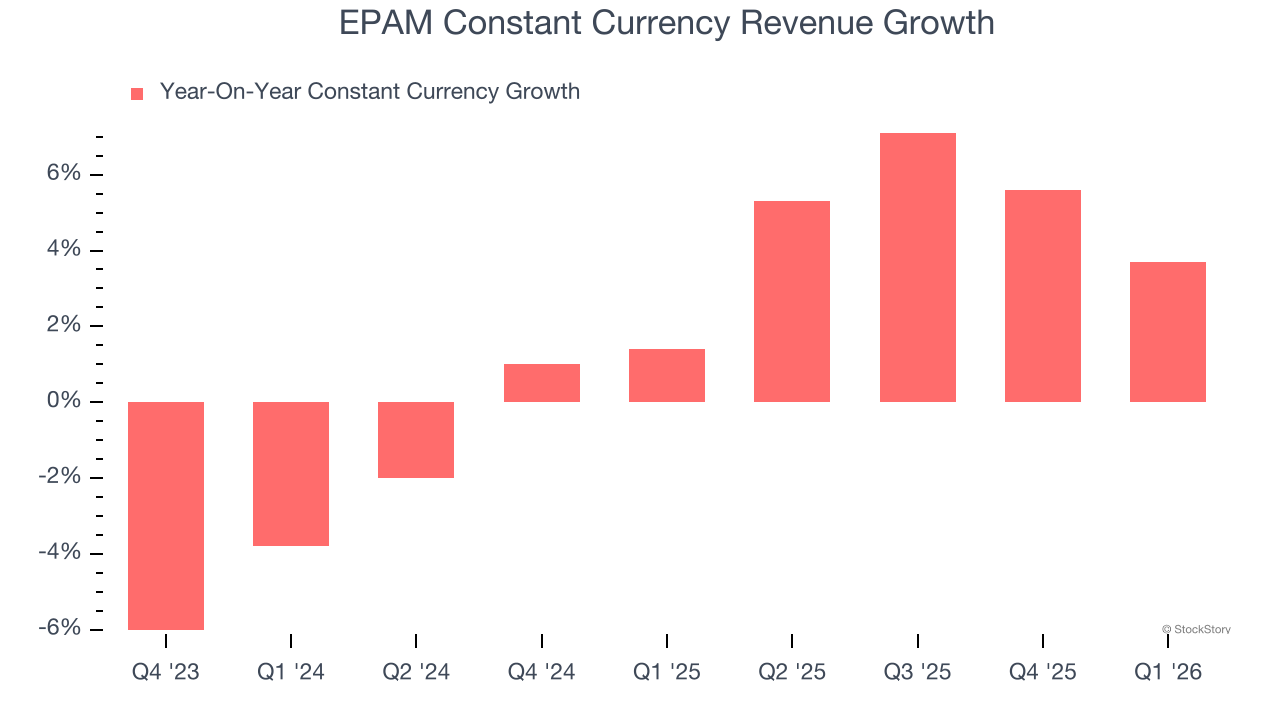
This quarter, EPAM grew its revenue by 7.6% year on year, and its $1.4 billion of revenue was in line with Wall Street’s estimates. Company management is currently guiding for a 4% year-on-year increase in sales next quarter.
Looking further ahead, sell-side analysts expect revenue to grow 5.8% over the next 12 months, a deceleration versus the last two years. Still, this projection is above the sector average and suggests the market is baking in some success for its newer products and services.
ONE MORE THING: The $21 AI Application Stock Wall Street Forgot. While Wall Street obsesses over who’s building AI, one company is already using it to print money. And nobody’s paying attention.
AI chip stocks trade at ridiculous valuations. This company processes a trillion consumer signals monthly using AI and trades at a third of the price. The gap won’t last. The institutions will figure it out. You need to see this first. Read the FREE Report Before They Notice.
Adjusted Operating Margin
Adjusted operating margin is one of the best measures of profitability because it tells us how much money a company takes home after subtracting all core expenses, like marketing and R&D. It also removes various one-time costs to paint a better picture of normalized profits.
EPAM has been an efficient company over the last five years. It was one of the more profitable businesses in the business services sector, boasting an average adjusted operating margin of 16%.
Analyzing the trend in its profitability, EPAM’s adjusted operating margin decreased by 3.7 percentage points over the last five years. This raises questions about the company’s expense base because its revenue growth should have given it leverage on its fixed costs, resulting in better economies of scale and profitability.
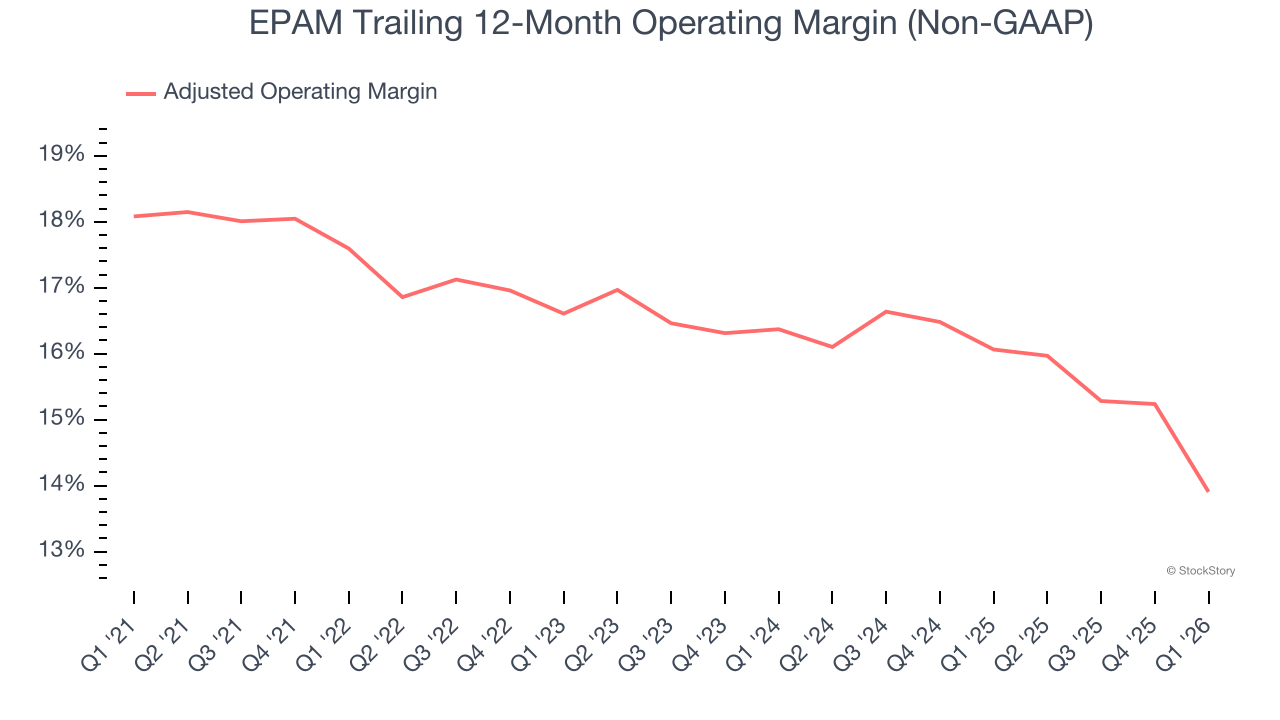
In Q1, EPAM generated an adjusted operating margin profit margin of 8.3%, down 5.2 percentage points year on year. This contraction shows it was less efficient because its expenses grew faster than its revenue.
Earnings Per Share
We track the long-term change in earnings per share (EPS) for the same reason as long-term revenue growth. Compared to revenue, however, EPS highlights whether a company’s growth is profitable.
EPAM’s EPS grew at a remarkable 12.2% compounded annual growth rate over the last five years. However, this performance was lower than its 14.8% annualized revenue growth, telling us the company became less profitable on a per-share basis as it expanded due to non-fundamental factors such as interest expenses and taxes.
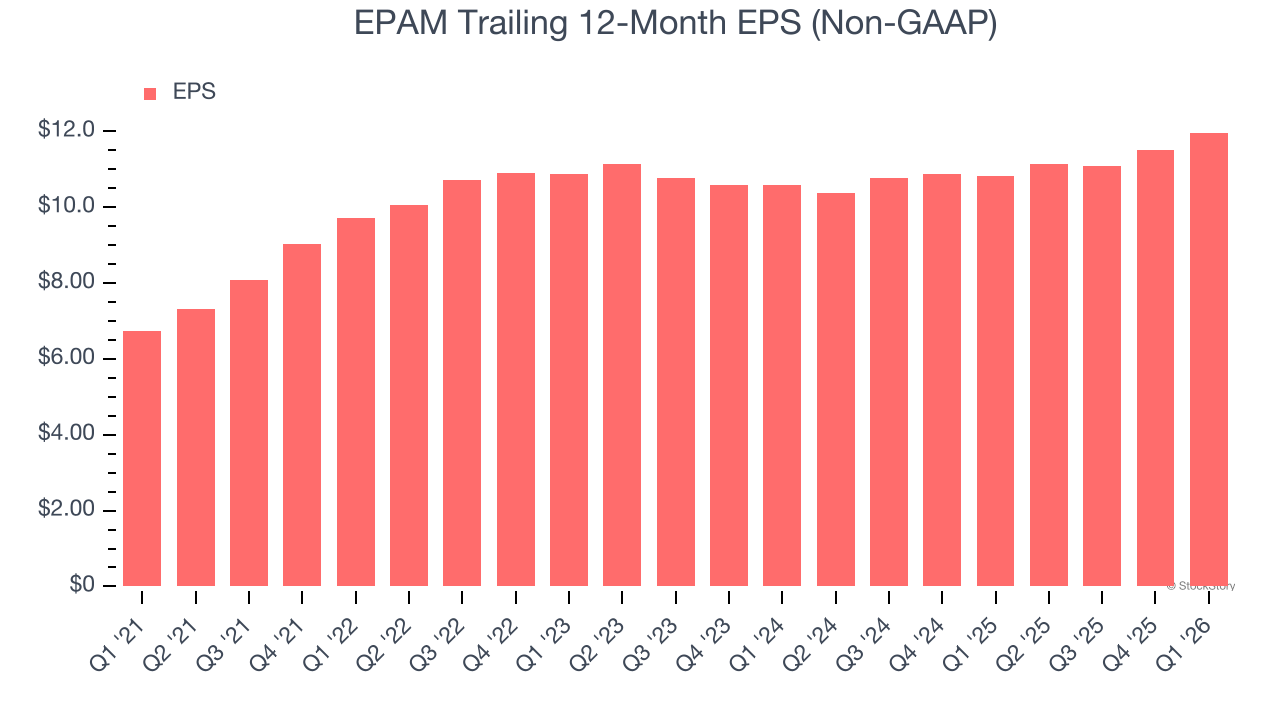
Diving into the nuances of EPAM’s earnings can give us a better understanding of its performance. As we mentioned earlier, EPAM’s adjusted operating margin declined by 3.7 percentage points over the last five years. This was the most relevant factor (aside from the revenue impact) behind its lower earnings; interest expenses and taxes can also affect EPS but don’t tell us as much about a company’s fundamentals.
Like with revenue, we analyze EPS over a more recent period because it can provide insight into an emerging theme or development for the business.
For EPAM, its two-year annual EPS growth of 6.4% was lower than its five-year trend. This wasn’t great, but at least the company was successful in other measures of financial health.
In Q1, EPAM reported adjusted EPS of $2.86, up from $2.41 in the same quarter last year. This print beat analysts’ estimates by 3.8%. Over the next 12 months, Wall Street expects EPAM’s full-year EPS of $11.97 to grow 8.7%.
Key Takeaways from EPAM’s Q1 Results
We enjoyed seeing EPAM beat analysts’ full-year EPS guidance expectations this quarter. We were also glad its EPS outperformed Wall Street’s estimates. On the other hand, its revenue guidance for next quarter slightly missed. Zooming out, we think this was a mixed quarter. Investors were likely hoping for more, and shares traded down 4.6% to $102.01 immediately after reporting.
Should you buy the stock or not? What happened in the latest quarter matters, but not as much as longer-term business quality and valuation, when deciding whether to invest in this stock. We cover that in our actionable full research report which you can read here (it’s free).