3D printing company Stratasys (NASDAQ: SSYS) reported revenue ahead of Wall Street’s expectations in Q1 CY2026, but sales fell by 2.5% year on year to $132.7 million. The company’s full-year revenue guidance of $570 million at the midpoint came in 1% above analysts’ estimates. Its non-GAAP loss of $0.01 per share was $0.01 above analysts’ consensus estimates.
Is now the time to buy Stratasys? Find out by accessing our full research report, it’s free.
Stratasys (SSYS) Q1 CY2026 Highlights:
- Revenue: $132.7 million vs analyst estimates of $131.7 million (2.5% year-on-year decline, 0.8% beat)
- Adjusted EPS: -$0.01 vs analyst estimates of -$0.02 ($0.01 beat)
- Adjusted EBITDA: $1.98 million vs analyst estimates of $1.51 million (1.5% margin, relatively in line)
- The company reconfirmed its revenue guidance for the full year of $570 million at the midpoint
- Management reiterated its full-year Adjusted EPS guidance of $0.12 at the midpoint
- EBITDA guidance for the full year is $27.5 million at the midpoint, above analyst estimates of $23.98 million
- Operating Margin: -20%, down from -9.1% in the same quarter last year
- Market Capitalization: $797.1 million
“Our first quarter results reflect the resilience of our operating model in a measured spending environment, demonstrated by positive adjusted EBITDA and operating cash flow," said Dr. Yoav Zeif, CEO of Stratasys.
Company Overview
Born from the Founder’s idea of making a toy frog with a glue gun, Stratasys (NASDAQ: SSYS) offers 3D printers and related materials, software, and services to many industries.
Revenue Growth
A company’s long-term sales performance can indicate its overall quality. Any business can have short-term success, but a top-tier one grows for years. Unfortunately, Stratasys struggled to consistently increase demand as its $547.8 million of sales for the trailing 12 months was close to its revenue five years ago. This was below our standards and suggests it’s a lower quality business.
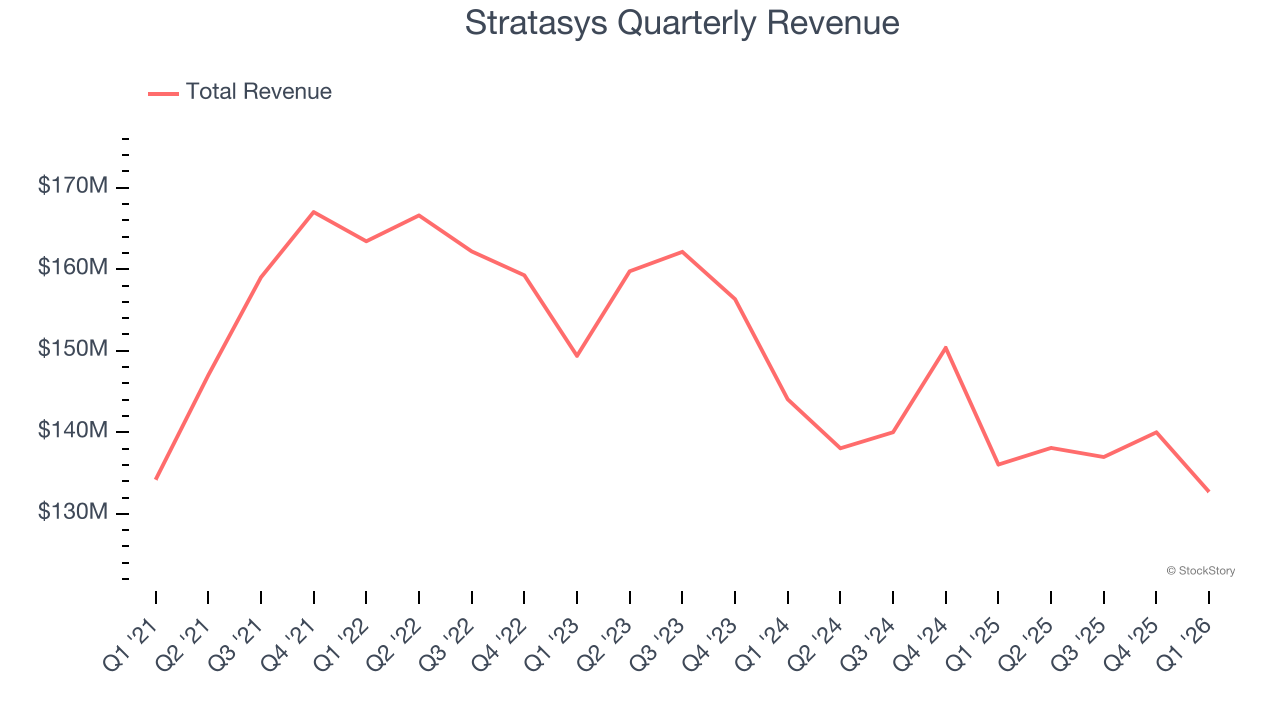
Long-term growth is the most important, but within industrials, a half-decade historical view may miss new industry trends or demand cycles. Stratasys’s recent performance shows its demand remained suppressed as its revenue has declined by 6.2% annually over the last two years. 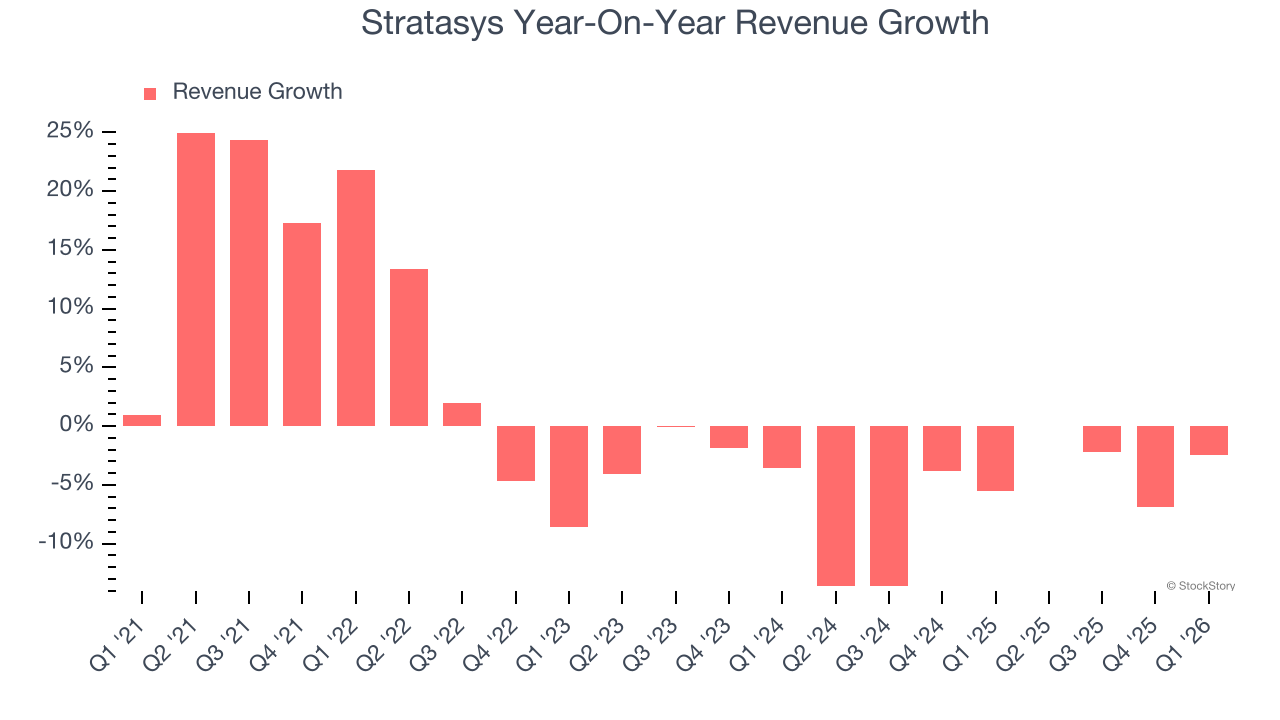
Stratasys also breaks out the revenue for its most important segments, Products and Services, which are 66.9% and 33.1% of revenue. Over the last two years, Stratasys’s Products revenue (hard goods like 3D printers) averaged 3.3% year-on-year declines while its Services revenue (service contracts, consulting) averaged 3.5% declines. 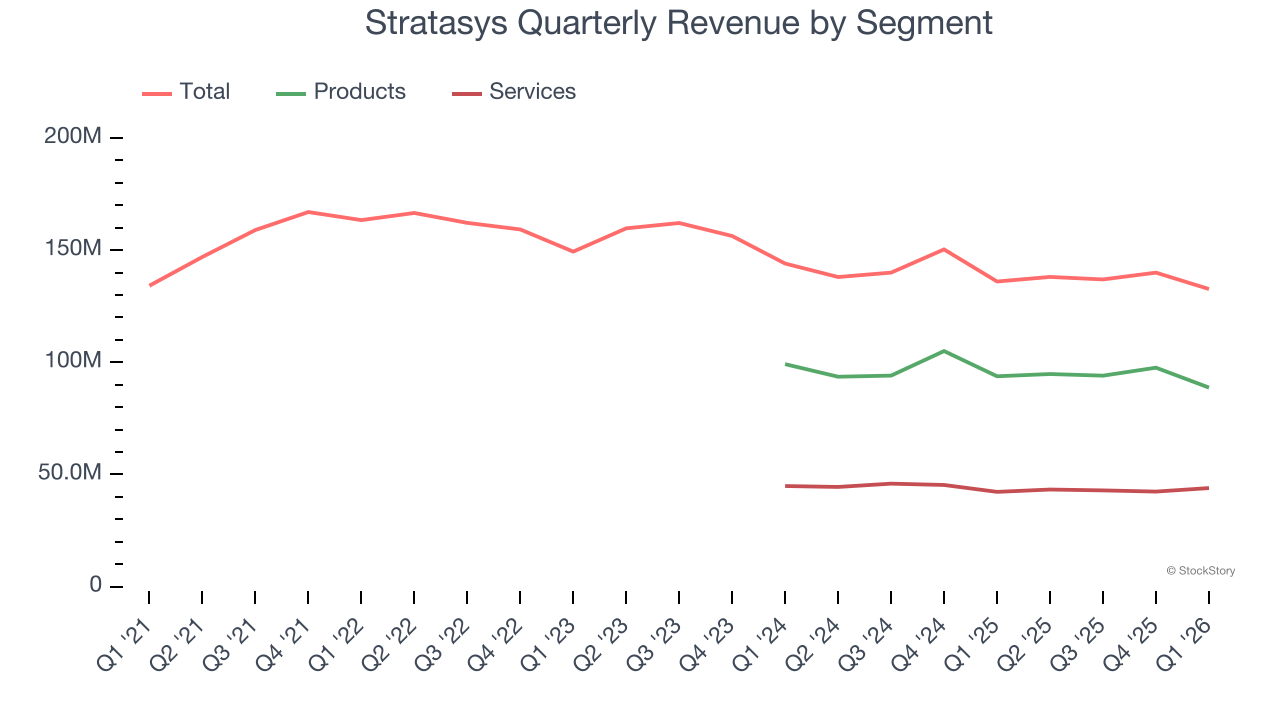
This quarter, Stratasys’s revenue fell by 2.5% year on year to $132.7 million but beat Wall Street’s estimates by 0.8%.
Looking ahead, sell-side analysts expect revenue to grow 4.8% over the next 12 months. Although this projection suggests its newer products and services will catalyze better top-line performance, it is still below the sector average.
ONE MORE THING: The $21 AI Application Stock Wall Street Forgot. While Wall Street obsesses over who’s building AI, one company is already using it to print money. And nobody’s paying attention.
AI chip stocks trade at ridiculous valuations. This company processes a trillion consumer signals monthly using AI and trades at a third of the price. The gap won’t last. The institutions will figure it out. You need to see this first. Read the FREE Report Before They Notice.
Operating Margin
Stratasys’s high expenses have contributed to an average operating margin of negative 13% over the last five years. Unprofitable industrials companies require extra attention because they could get caught swimming naked when the tide goes out. It’s hard to trust that the business can endure a full cycle.
Looking at the trend in its profitability, Stratasys’s operating margin decreased by 3.2 percentage points over the last five years. Stratasys’s performance was poor no matter how you look at it - it shows that costs were rising and it couldn’t pass them onto its customers.
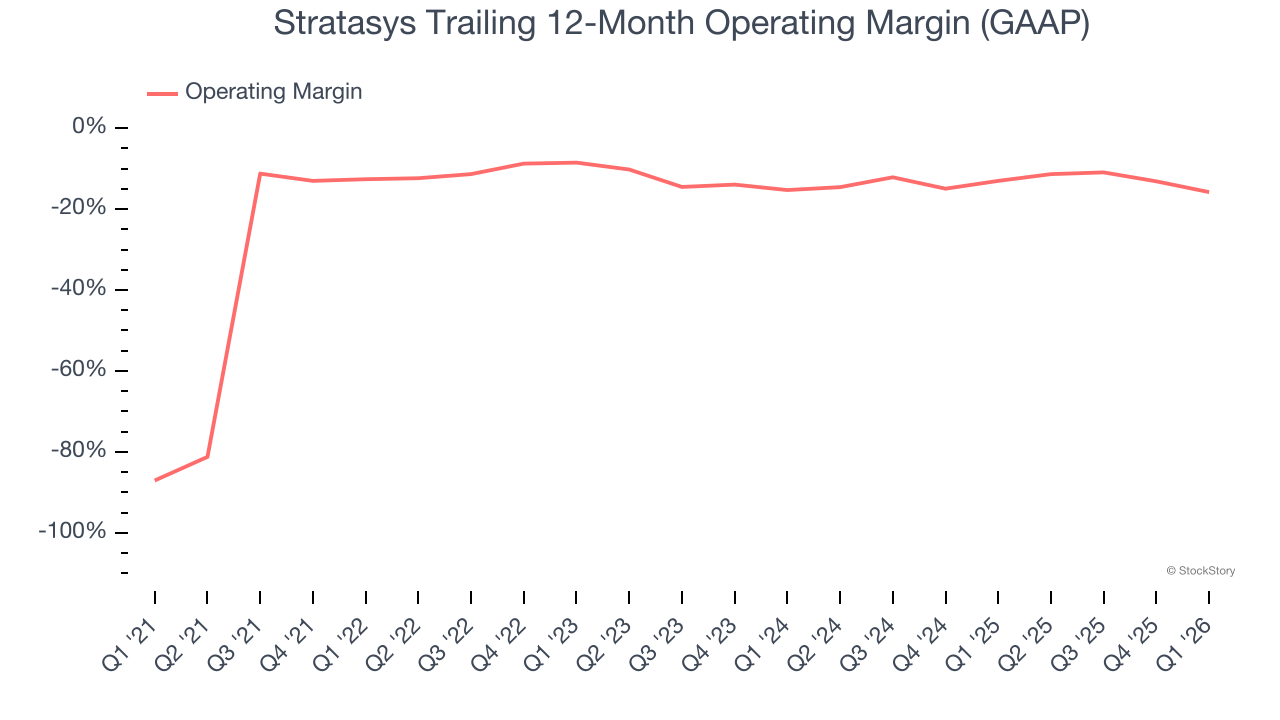
Stratasys’s operating margin was negative 20% this quarter. The company's consistent lack of profits raise a flag.
Earnings Per Share
We track the long-term change in earnings per share (EPS) for the same reason as long-term revenue growth. Compared to revenue, however, EPS highlights whether a company’s growth is profitable.
Stratasys’s full-year EPS flipped from negative to positive over the last five years. This is encouraging and shows it’s at a critical moment in its life.
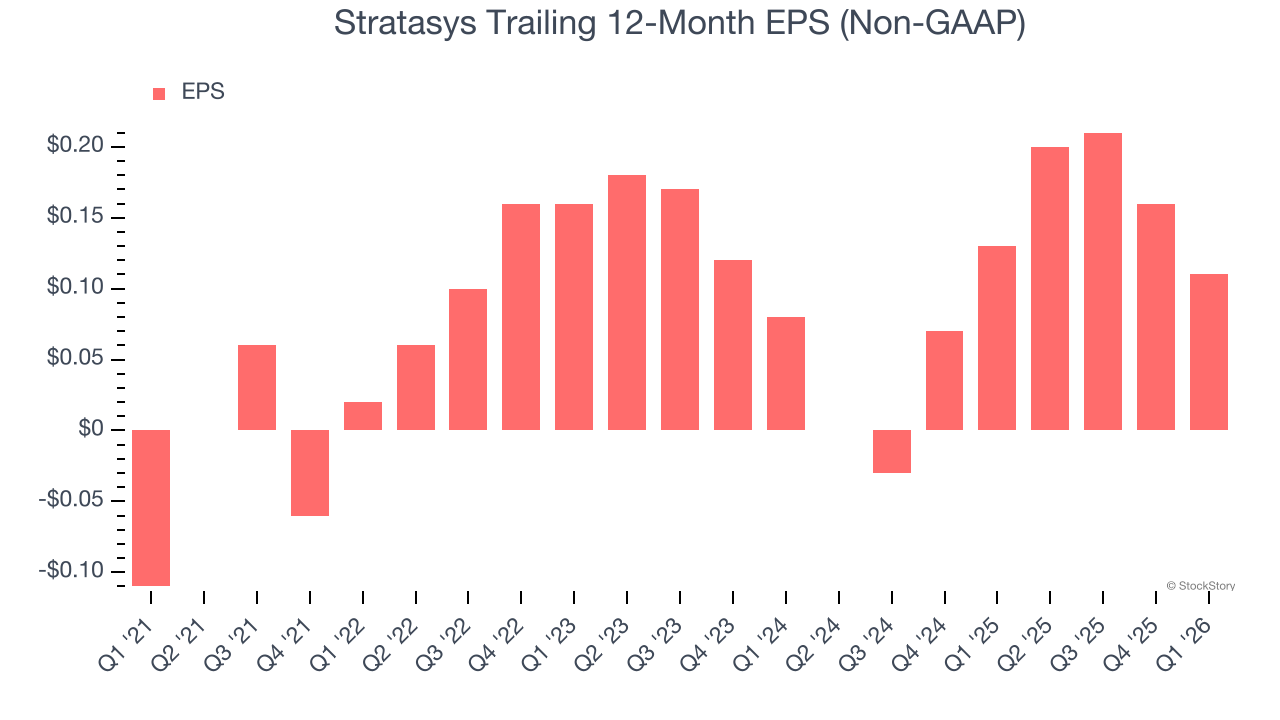
Like with revenue, we analyze EPS over a more recent period because it can provide insight into an emerging theme or development for the business.
Stratasys’s EPS grew at a spectacular 17.3% compounded annual growth rate over the last two years, higher than its 6.2% annualized revenue declines. This tells us management adapted its cost structure in response to a challenging demand environment.
In Q1, Stratasys reported adjusted EPS of negative $0.01, down from $0.04 in the same quarter last year. Despite falling year on year, this print easily cleared analysts’ estimates. Over the next 12 months, Wall Street expects Stratasys’s full-year EPS of $0.11 to grow 20.5%.
Key Takeaways from Stratasys’s Q1 Results
It was good to see Stratasys beat analysts’ EPS expectations this quarter. We were also excited its EBITDA outperformed Wall Street’s estimates by a wide margin. On the other hand, its adjusted operating income missed. Overall, we think this was a solid quarter with some key areas of upside. The stock remained flat at $9.27 immediately after reporting.
Stratasys had an encouraging quarter, but one earnings result doesn’t necessarily make the stock a buy. Let’s see if this is a good investment. The latest quarter does matter, but not nearly as much as longer-term fundamentals and valuation, when deciding if the stock is a buy. We cover that in our actionable full research report which you can read here (it’s free).