Automotive parts company LKQ (NASDAQ: LKQ) fell short of the market’s revenue expectations in Q2 CY2026, with sales falling 6.4% year on year to $3.41 billion. Its non-GAAP profit of $0.67 per share was 6% below analysts’ consensus estimates.
Is now the time to buy LKQ? Find out by accessing our full research report, it’s free.
LKQ (LKQ) Q2 CY2026 Highlights:
- Revenue: $3.41 billion vs analyst estimates of $3.49 billion (6.4% year-on-year decline, 2.3% miss)
- Adjusted EPS: $0.67 vs analyst expectations of $0.71 (6% miss)
- Adjusted EBITDA: $349 million vs analyst estimates of $363.1 million (10.2% margin, 3.9% miss)
- Management lowered its full-year Adjusted EPS guidance to $2.75 at the midpoint, a 9.8% decrease
- Operating Margin: 6.6%, down from 8.6% in the same quarter last year
- Free Cash Flow Margin: 1.8%, down from 6.7% in the same quarter last year
- Organic Revenue fell 4.4% year on year (miss)
- Market Capitalization: $6.72 billion
"Our second‑quarter performance reflected solid execution across our North America and Specialty segments. North America returned to positive organic growth for the first time in nine quarters, driven by record alternative-parts utilization of over 40%, moderating insurance premiums that were negative in May and June, and continued sequential improvement in repairable claims. Specialty also delivered growth despite a challenging end‑market environment and continued macro‑economic pressure on consumers. Europe fell short of expectations, with results affected by the ERP implementation in Germany. Outside of the ERP impact, the team delivered substantial cost reductions that largely offset the lower volumes we witnessed in the UK and Benelux regions. Overall, the fundamentals of our business are improving, and as market conditions continue to recover, we expect those operational gains to translate into stronger financial performance and profitability in the quarters ahead," commented Justin Jude, President and Chief Executive Officer.
Company Overview
A global distributor of vehicle parts and accessories, LKQ (NASDAQ: LKQ) offers its customers a comprehensive selection of high-quality, affordably priced automobile products.
Revenue Growth
Reviewing a company’s long-term sales performance reveals insights into its quality. Even a bad business can shine for one or two quarters, but a top-tier one grows for years. Over the last five years, LKQ grew its sales at a weak 1.7% compounded annual growth rate. This fell short of our benchmarks and is a poor baseline for our analysis.
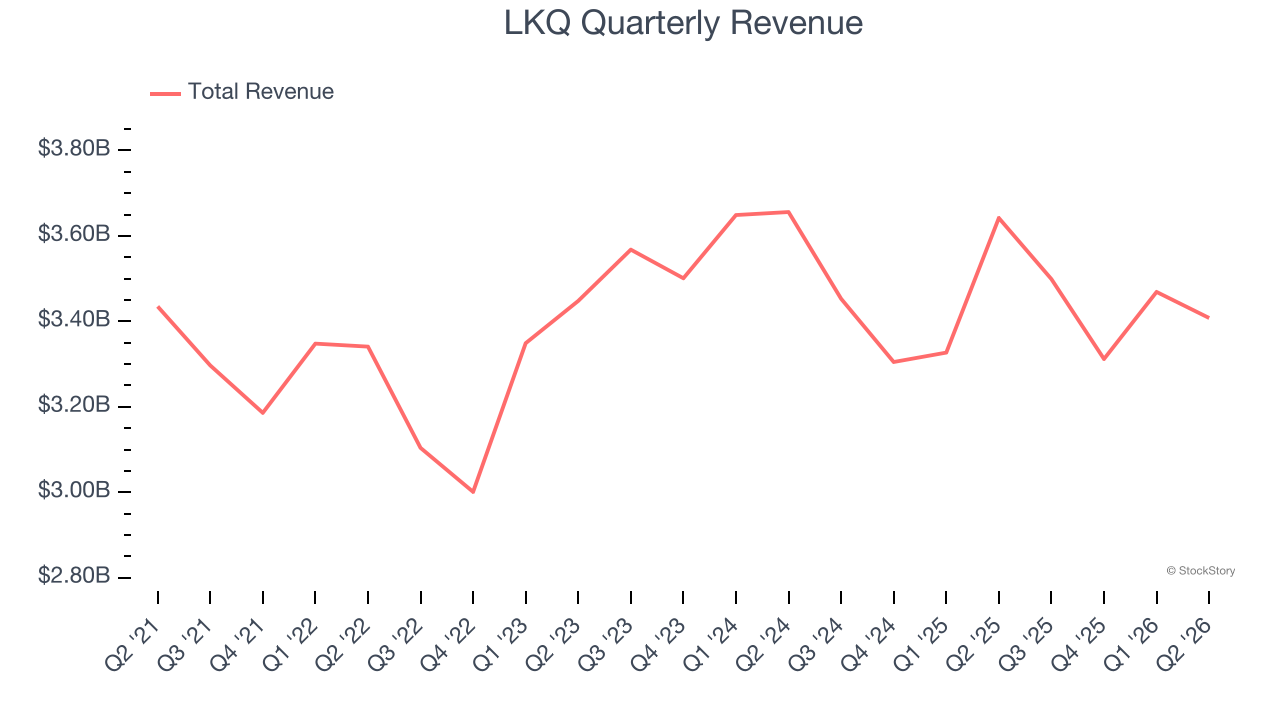
We at StockStory place the most emphasis on long-term growth, but within consumer discretionary, a stretched historical view may miss a company riding a successful new product or trend. LKQ’s performance shows it grew in the past but relinquished its gains over the last two years, as its revenue fell by 2.4% annually. 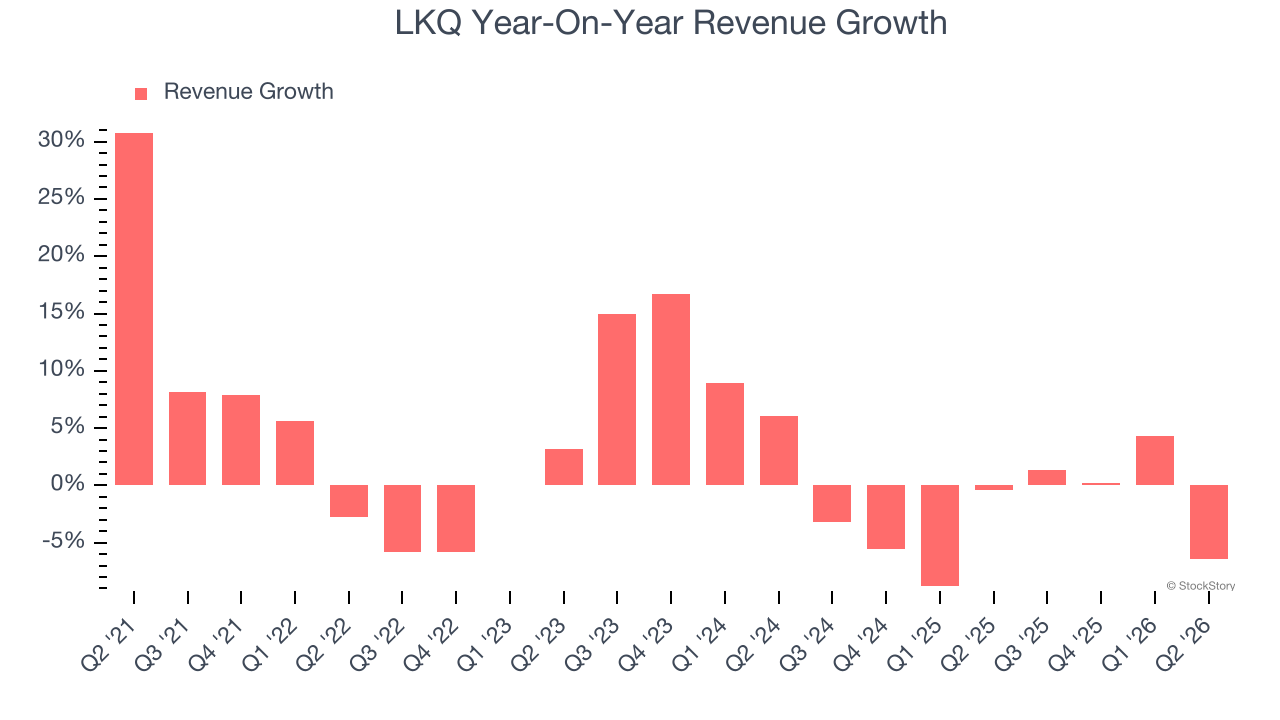
LKQ also reports organic revenue, which strips out one-time events like acquisitions and currency fluctuations that don’t accurately reflect its fundamentals. Over the last two years, LKQ’s organic revenue averaged 2.6% year-on-year declines. Because this number aligns with its two-year revenue growth, we can see the company’s core operations (not acquisitions and divestitures) drove most of its results. 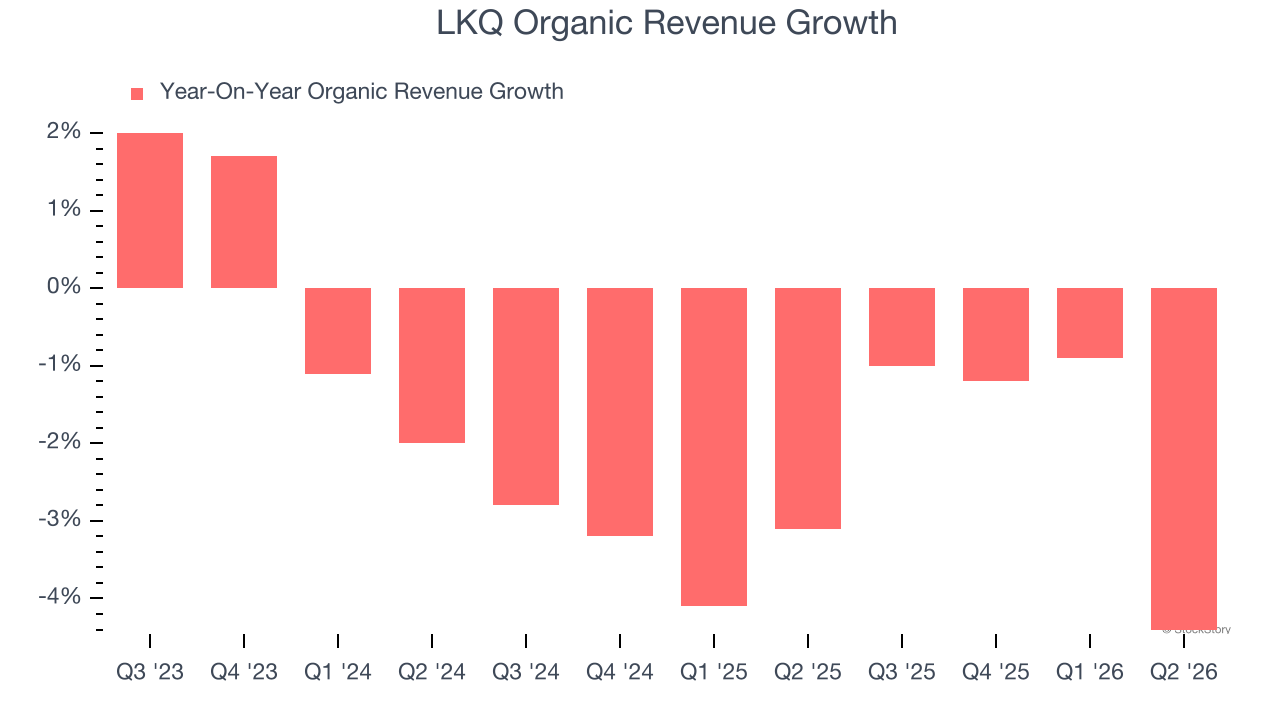
This quarter, LKQ missed Wall Street’s estimates and reported a rather uninspiring 6.4% year-on-year revenue decline, generating $3.41 billion of revenue.
Looking ahead, sell-side analysts expect revenue to grow 3% over the next 12 months. While this projection suggests its newer products and services will catalyze better top-line performance, it is still below the sector average.
ONE MORE THING: 3 Hidden Platforms Growing 3X Faster than Amazon, Google, and PayPal. Amazon, Google, and Meta all followed the same playbook: Dominate an ignored market. Build an unbeatable moat. Scale until you’re unstoppable.
These three platforms are running that exact playbook right now. The early investors in Amazon made fortunes. The early investors in these could do the same. Get All 3 Stocks Here for FREE.
Operating Margin
Operating margin is an important measure of profitability as it shows the portion of revenue left after accounting for all core expenses — everything from the cost of goods sold to advertising and wages. It’s also useful for comparing profitability across companies with different levels of debt and tax rates because it excludes interest and taxes.
LKQ’s operating margin has been trending down over the last 12 months and averaged 7.3% over the last two years. The company’s profitability was mediocre for a consumer discretionary business and shows it couldn’t pass its higher operating expenses onto its customers.
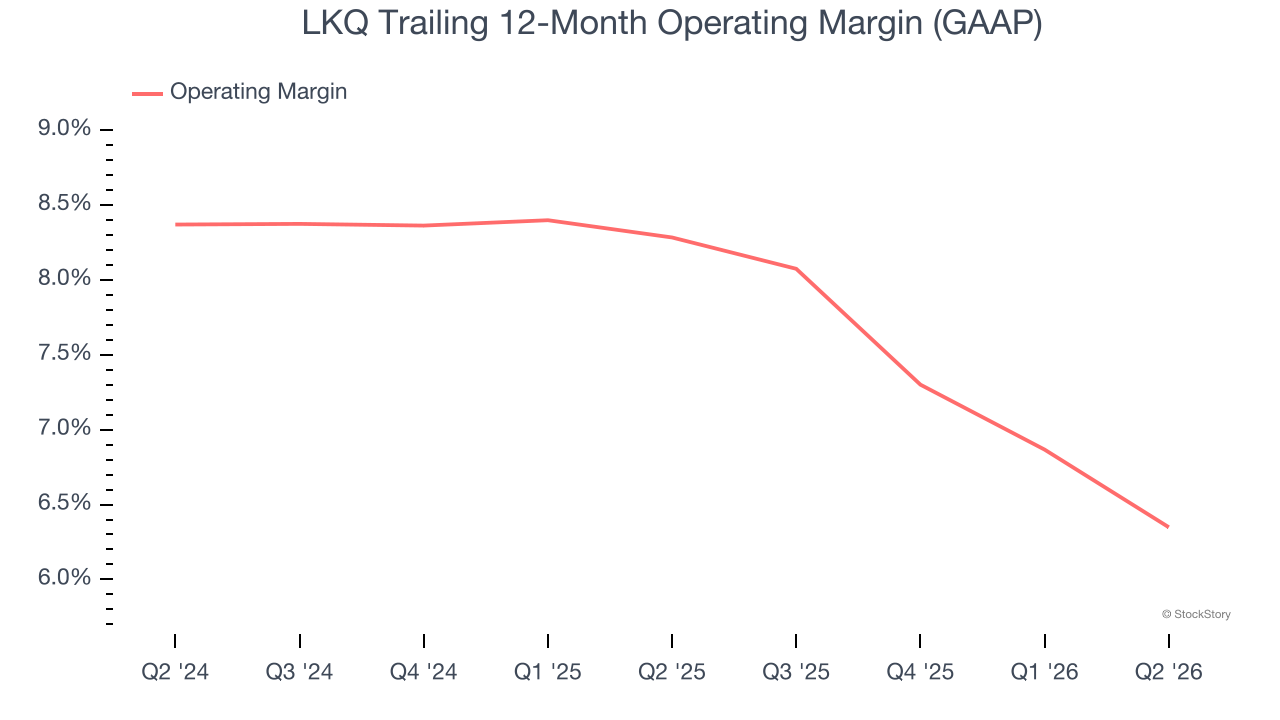
This quarter, LKQ generated an operating margin profit margin of 6.6%, down 2 percentage points year on year. This reduction is quite minuscule and indicates the company’s overall cost structure has been relatively stable.
Earnings Per Share
We track the long-term change in earnings per share (EPS) for the same reason as long-term revenue growth. Compared to revenue, however, EPS highlights whether a company’s growth is profitable.
Sadly for LKQ, its EPS declined by 4.6% annually over the last five years while its revenue grew by 1.7%. This tells us the company became less profitable on a per-share basis as it expanded due to non-fundamental factors such as interest expenses and taxes.
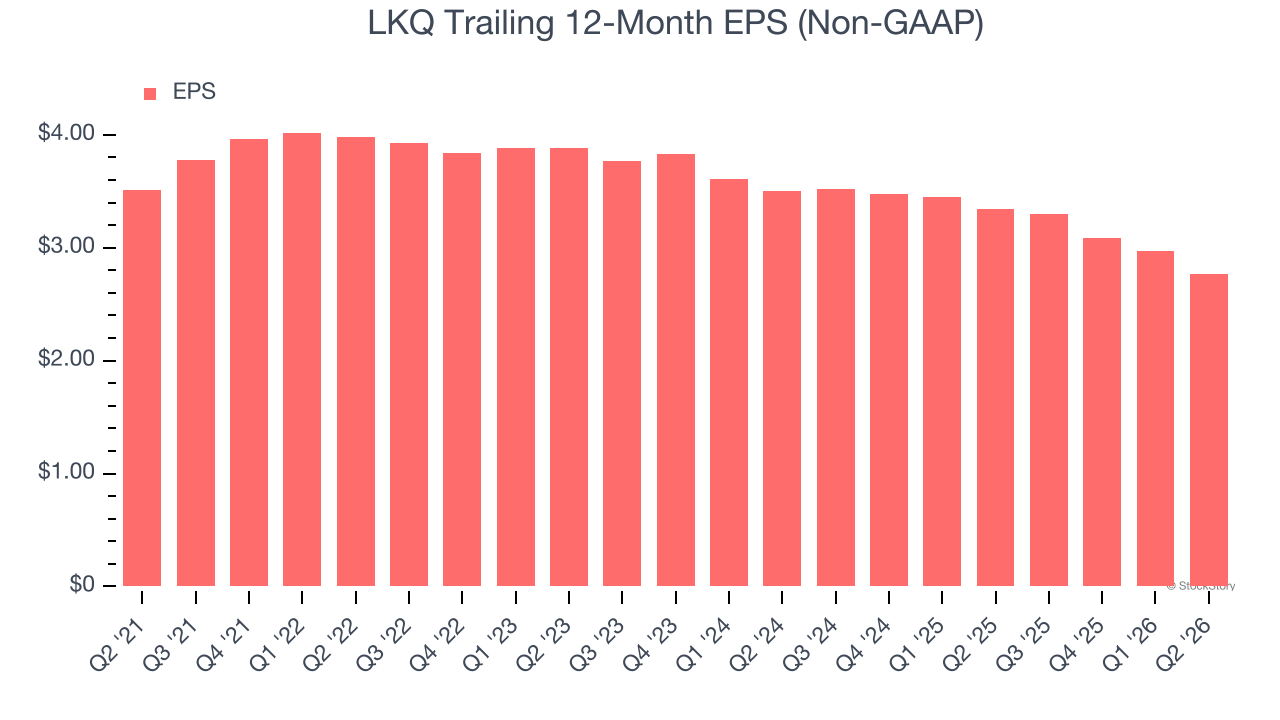
In Q2, LKQ reported adjusted EPS of $0.67, down from $0.87 in the same quarter last year. This print missed analysts’ estimates. Over the next 12 months, Wall Street expects LKQ’s full-year EPS to grow 14.7% from $2.77 to $3.18.
Key Takeaways from LKQ’s Q2 Results
We struggled to find many positives in these results. Its full-year EPS guidance missed and its EPS fell short of Wall Street’s estimates. Overall, this was a softer quarter. The stock traded down 13.9% to $22.73 immediately following the results.
LKQ’s latest earnings report disappointed. One quarter doesn’t define a company’s quality, so let’s explore whether the stock is a buy at the current price. When making that decision, it’s important to consider its valuation, business qualities, as well as what has happened in the latest quarter. We cover that in our actionable full research report which you can read here (it’s free).