The end of the earnings season is always a good time to take a step back and see who shined (and who didn’t). Let’s take a look at how consumer discretionary - apparel and accessories stocks fared in Q2, starting with Oxford Industries (NYSE: OXM).
The Consumer Discretionary sector, by definition, is made up of companies selling non-essential goods and services. When economic conditions deteriorate or tastes shift, consumers can easily cut back or eliminate these purchases. For long-term investors with five-year holding periods, this creates a structural challenge: the sector is inherently hit-driven, with low switching costs and fickle customers. As a result, only a handful of companies can reliably grow demand and compound earnings over long periods, which is why our bar is high and High Quality ratings are rare. Apparel and accessories companies design, brand, and distribute clothing, handbags, jewelry, and related lifestyle products, often spanning multiple price tiers. Tailwinds include premiumization trends (consumers trading up for perceived quality), international expansion into emerging markets, and growing digital commerce penetration. However, these businesses face headwinds from highly cyclical demand, intense promotional environments, and counterfeit competition undermining brand equity. Tariff volatility and sourcing concentration in a handful of countries add risk. Additionally, rapidly changing fashion cycles and the rise of ultra-fast-fashion digital competitors compress product life cycles and make demand forecasting exceptionally difficult.
The 14 consumer discretionary - apparel and accessories stocks we track reported a mixed Q2. As a group, revenues beat analysts’ consensus estimates by 1.3% while next quarter’s revenue guidance was 4.2% below.
Amidst this news, share prices of the companies have had a rough stretch. On average, they are down 16.9% since the latest earnings results.
Weakest Q2: Oxford Industries (NYSE: OXM)
The parent company of Tommy Bahama, Oxford Industries (NYSE: OXM) is a lifestyle fashion conglomerate with brands that embody outdoor happiness.
Oxford Industries reported revenues of $394.4 million, down 2.2% year on year. This print was in line with analysts’ expectations, but overall, it was a softer quarter for the company with full-year EPS guidance missing analysts’ expectations.
Mr. Chubb concluded, “Tommy Bahama’s positive momentum is being offset by softness in other parts of our portfolio, particularly Lilly Pulitzer which we believe is primarily attributable to addressable product and marketing challenges in a fashion merchandising business. The combination of these internal headwinds and ongoing macro-economic consumer pressure has led us to lower our guidance for fiscal 2026. We have initiated actions to position the business for profitable growth next year, including increasing our promotional activity at Lilly Pulitzer in the coming months to spur demand and prevent the build up of slow moving inventory. We’ve also implemented a broader review across the enterprise to identify opportunities aimed at enhancing our long-term earnings power that is less dependent on historical top-line growth rates.”
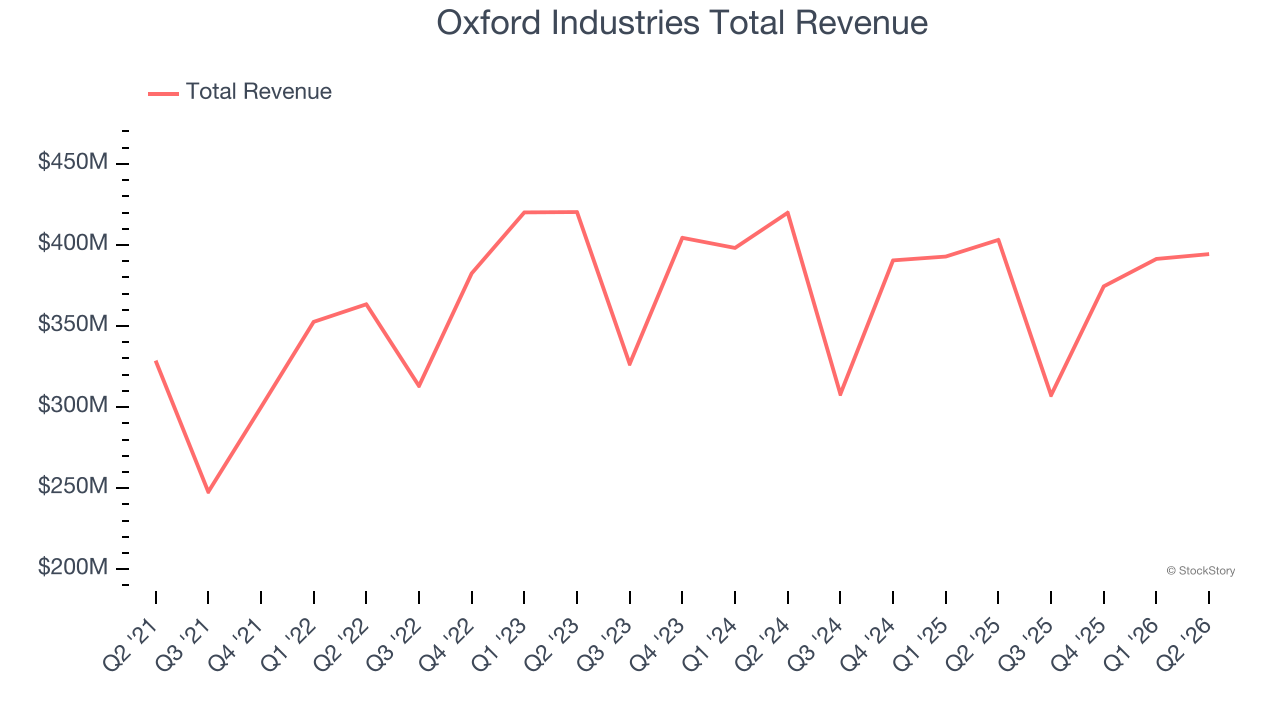
Oxford Industries delivered the weakest guidance update and weakest full-year guidance update of the whole group. The market seems disappointed with the results as the stock is down 23.4% since reporting and currently trades at $28.05.
Read our full report on Oxford Industries here, it’s free.
Best Q2: Figs (NYSE: FIGS)
Rising to fame via TikTok and founded in 2013 by Heather Hasson and Trina Spear, Figs (NYSE: FIGS) is a healthcare apparel company known for its stylish approach to medical attire and uniforms.
Figs reported revenues of $196.6 million, up 28.8% year on year, outperforming analysts’ expectations by 5.6%. The business had a stunning quarter with a beat of analysts’ EPS and EBITDA estimates.
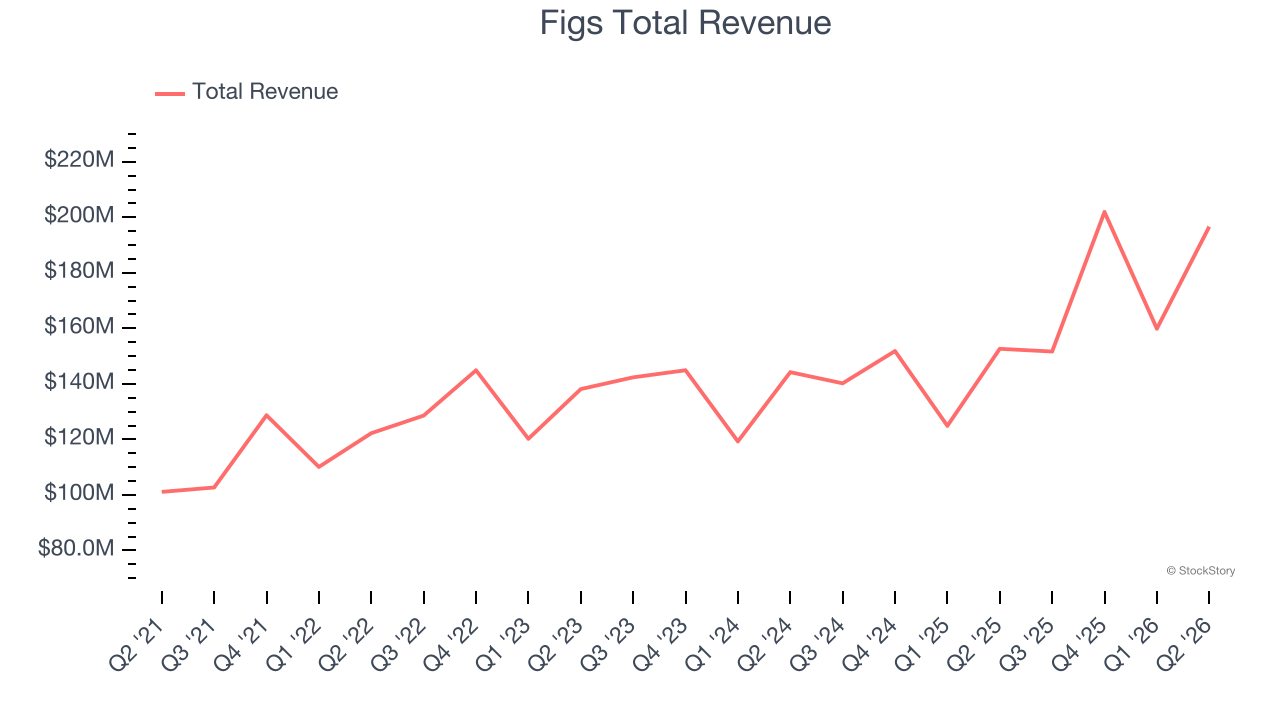
Figs achieved the biggest analyst estimate beat and fastest revenue growth among its peers. The market seems happy with the results as the stock is up 16.8% since reporting. It currently trades at $13.13.
Is now the time to buy Figs? Access our full analysis of the earnings results here, it’s free.
ThredUp (NASDAQ: TDUP)
Founded to revolutionize thrifting, ThredUp (NASDAQ: TDUP) is a leading online fashion resale marketplace offering a wide selection of gently-used clothing and accessories.
ThredUp reported revenues of $90.77 million, up 16.9% year on year, in line with analysts’ expectations. It was a softer quarter as it posted EPS in line with analysts’ estimates and revenue guidance for next quarter missing analysts’ expectations.
As expected, the stock is down 61.3% since the results and currently trades at $2.43.
Read our full analysis of ThredUp’s results here.
G-III (NASDAQ: GIII)
Founded as a small leather goods business, G-III (NASDAQ: GIII) is a fashion and apparel conglomerate with a diverse portfolio of brands.
G-III reported revenues of $554.1 million, down 9.6% year on year. This number missed analysts’ expectations by 2.9%. Overall, it was a slower quarter as it also produced EPS guidance for next quarter missing analysts’ expectations significantly and a slight miss of analysts’ EBITDA estimates.
G-III pulled off the highest full-year guidance raise but had the weakest performance against analyst estimates and slowest revenue growth in the group. The stock is down 14% since reporting and currently trades at $27.67.
Read our full, actionable report on G-III here, it’s free.
Levi's (NYSE: LEVI)
Credited for inventing the first pair of blue jeans in 1873, Levi's (NYSE: LEVI) is an apparel company renowned for its iconic denim products and classic American style.
Levi's reported revenues of $1.56 billion, up 8% year on year. This result topped analysts’ expectations by 2.9%. Zooming out, it was a mixed quarter as it also recorded a beat of analysts’ EPS estimates but full-year EPS guidance slightly missing analysts’ expectations.
The stock is down 18.7% since reporting and currently trades at $19.81.
Read our full, actionable report on Levi's here, it’s free.
Market Update
Over the past year, investors have been forced to repeatedly answer the same question: what is the market’s biggest risk? The answer has changed several times, and each shift has reshaped market leadership.
Late in 2025 and early 2026, artificial intelligence became the market’s primary uncertainty. Investors questioned whether AI would erode software pricing power and weaken competitive moats as AI made it easier to replicate once-differentiated products.
By the spring, technology took a back seat to geopolitics. The U.S. conflict with Iran briefly became the market’s dominant narrative, raising concerns about oil prices, inflation, and global growth. But as energy markets remained orderly and fears of a prolonged supply disruption faded, investors quickly turned their focus back to fundamentals.
Want to invest in winners with rock-solid fundamentals? Check out our 9 Best Market-Beating Stocks and add them to your watchlist. These companies are poised for growth regardless of the political or macroeconomic climate.