Health and Wellness Product Market expands on preventive health, digital nutrition, and clinical-grade manufacturing driving global structural growth through 2036.
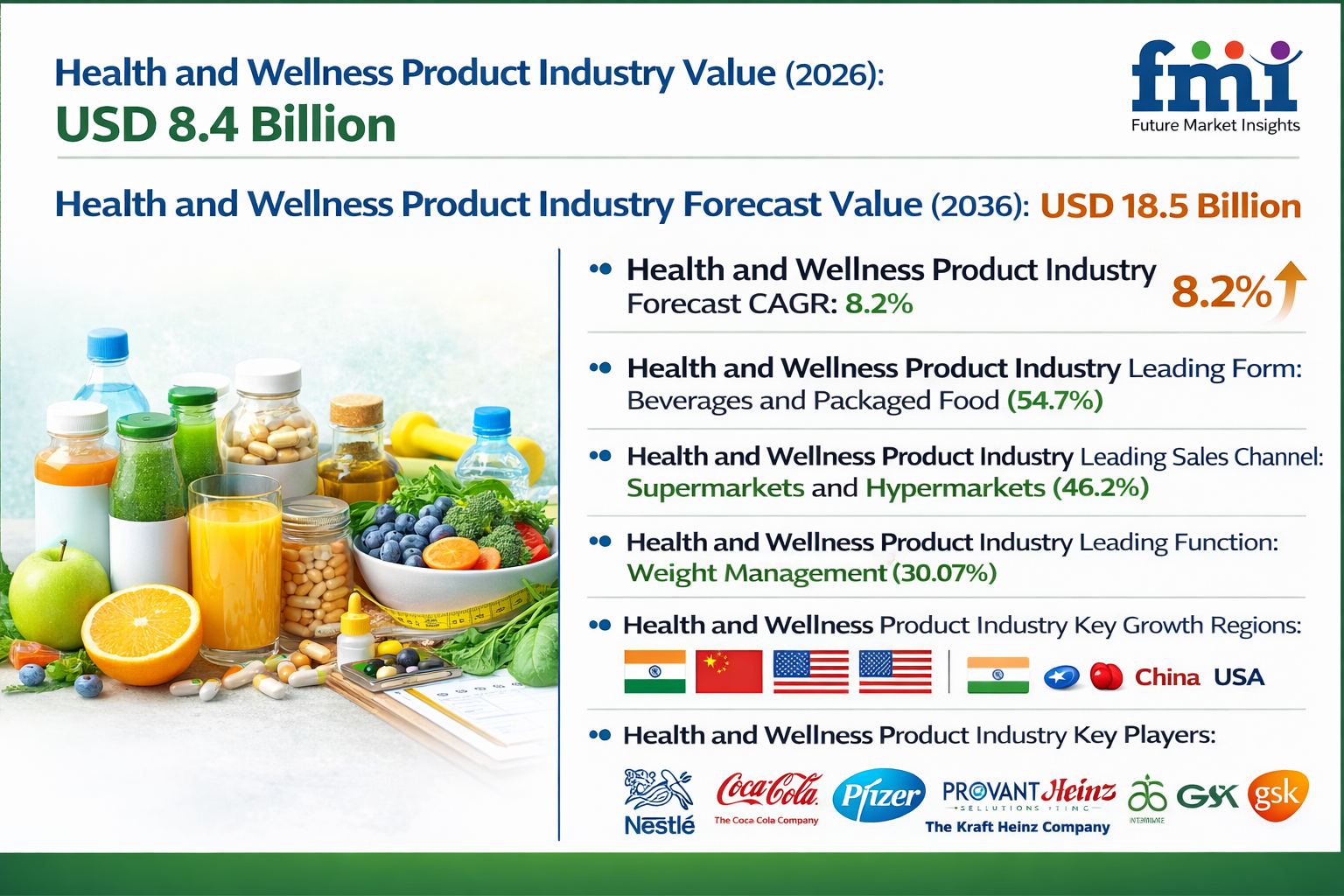
NEWARK, DELAWARE / ACCESS Newswire / February 25, 2026 / The global health and wellness product market is entering a decisive phase of clinical-grade expansion, driven by the rapid institutionalization of preventative health strategies. According to the latest strategic outlook from Future Market Insights (FMI), the sector is projected to reach USD 8.4 billion in 2026 and expand at a robust 8.2% CAGRthrough 2036, ultimately attaining USD 18.5 billion.
The shift is structural. Health products are no longer confined to consumer-led retail purchases; they are increasingly embedded into corporate wellness procurement, digital health ecosystems, and hospitality supply chains. Bulk procurement of functional foods by enterprises is rising by nearly 15% annually as organizations integrate preventative nutrition into employee wellness frameworks.
Request For Sample Report | Customize Report | Purchase Full Report - https://www.futuremarketinsights.com/reports/sample/rep-gb-2506
The Rise of Preventative Health Procurement
A defining catalyst behind this expansion is the "medicalization" of food. Functional beverages, fortified snacks, and clinical-grade supplements are being evaluated not merely on taste or branding, but on efficacy, compliance, and production discipline.
As per FMI's assessment:
Convergence with pharma standards is increasing GMP retrofitting costs by nearly 25%, particularly in air filtration and contamination control systems.
Around 8% of operational budgets are now allocated to sanitation verification and allergen-control protocols.
Quality assurance hiring has increased by approximately 15% to manage tighter documentation and hygiene mandates.
Facilities producing bioactive formulations must prevent cross-contamination of active ingredients, even if that reduces line changeover speed. Safety and regulatory integrity are outweighing throughput maximization.
Digital Health Integration Sparks 20% Demand Spike
The convergence of nutrition with digital health data is reshaping manufacturing economics. Personalized subscription models-powered by wearable integrations and AI-backed recommendations-are generating a 20% surge in demand for micro-batch production.
Manufacturers pivoting to agile production lines capable of handling smaller, data-driven batches are reducing product failure rates by nearly 30% compared to conventional mass-market launches. Smart packaging integrated with AI health and fitness ecosystems is commanding up to a 12% premium at major retail chains, creating a new margin lever for technologically adaptive brands.
Logistics Pressure: The Cold-Chain Challenge
Functional beverages and preservative-free products present significant logistical hurdles. Cold-chain distribution costs are approximately 30% higher than ambient logistics.
To mitigate risks:
IoT temperature sensors, costing roughly USD 50 per unit, are deployed per pallet.
Transport cost targets are maintained below 12% of total goods value.
A single cold-chain failure can result in complete batch spoilage, forcing consolidation of shipments to optimize reefer utilization.
For scaling brands, maintaining uninterrupted temperature integrity is the primary operational bottleneck.
Traceability as a Trade Barrier
Ingredient transparency is evolving into a non-negotiable trade prerequisite. European Union import regulations now require digital traceability verification for all organic inputs to confirm non-GMO status. Shipment rejection rates can reach 5% at customs when documentation is incomplete.
Mid-sized exporters are investing upwards of USD 150,000 annually in automated compliance software to maintain access to premium shelves. Provenance has transitioned from a marketing claim to a legally binding attribute.
Segment Breakdown: Beverages Lead Structural Growth
Beverages and packaged foods command 54.7% of the market share in 2026, benefiting from scalable liquid-fill infrastructure and global co-packing networks. Flash pasteurization enables shelf stability without synthetic preservatives, aligning with clean-label demands while preserving industrial efficiency.
Weight management remains the dominant functional category, accounting for 30.07% of market demand. Meanwhile, supermarkets and hypermarkets retain distribution leadership with a 46.2% share, serving as the primary validation channel for supply reliability and scale readiness.
Operational Metrics Defining Profitability
Profitability in the health and wellness sector is heavily influenced by operational discipline:
Gross Margin: Pressured by premium adaptogens and clinically validated peptides; value engineering in packaging offsets input volatility.
Compliance Rate: Near-100% documentation accuracy is mandatory to prevent regulatory penalties and certification loss.
Inventory Turnover Ratio: Just-In-Time production is critical for bioactive ingredients with limited shelf stability.
Employee Retention: Specialized GMP environments demand skilled operators; high turnover risks batch compromise.
Vertical integration is emerging as a dominant strategy. Manufacturers are acquiring upstream ingredient suppliers to secure patented probiotic strains and proprietary botanical cultivars, reducing margin erosion and insulating against supply volatility.
Regional Growth Dynamics
Emerging Asian markets are driving the next wave of expansion, while Western economies emphasize validation and regulatory depth.
India (9.2% CAGR): Rapid growth fueled by government-backed food processing parks and hybrid Ayurvedic-functional formulations tailored for urban consumers.
China (8.5% CAGR): Standardized Traditional Chinese Medicine extraction hubs are producing export-grade functional ingredients, reinforced by policy initiatives such as Healthy China 2030.
United States (7.0% CAGR): A mature co-manufacturing ecosystem supports agile nutraceutical innovation and personalized nutrition pipelines.
Germany (6.5% CAGR): Clinical validation and sustainability investments dominate procurement cycles.
Japan (5.8% CAGR): Expansion supported by the FOSHU regulatory framework, encouraging clinical substantiation for approved health claims.
Competitive Landscape: Scale Meets Precision
Market leaders are consolidating technological, regulatory, and digital advantages. Major participants include:
Nestlé
The Coca-Cola Company
Pfizer Inc.
The Kraft Heinz Company
Procter & Gamble
General Nutrition Centers Inc.
These players are investing in AI-powered quality control systems, automating packaging inspection, and acquiring direct-to-consumer brands to integrate digital consumer data into broader retail strategies. Sustainability commitments, including carbon-neutral manufacturing targets, are further redefining competitive positioning.
As FMI concludes, the industry's next growth phase will be defined not merely by innovation, but by execution discipline-where regulatory precision, cold-chain mastery, and digital integration determine long-term market leadership.
For an in-depth analysis of evolving formulation trends and to access the complete strategic outlook for the Health and Wellness Product Market through 2036, visit the official report page at: https://www.futuremarketinsights.com/reports/health-and-wellness-products-market
Related Reports:
Health and Wellness Foods Market: https://www.futuremarketinsights.com/reports/health-and-wellness-foods-market
Natural Health Product Market: https://www.futuremarketinsights.com/reports/functional-foods-and-natural-health-products-market
Demand for Health and Wellness Foods in Japan: https://www.futuremarketinsights.com/reports/japan-health-and-wellness-foods-market
Demand for Health and Wellness Foods in USA: https://www.futuremarketinsights.com/reports/united-states-health-and-wellness-foods-market
About Future Market Insights (FMI)
Future Market Insights (FMI) is a leading provider of market intelligence and consulting services, serving clients in over 150 countries. Headquartered in Delaware, USA, with a global delivery center in India and offices in the UK and UAE, FMI delivers actionable insights to businesses across industries including automotive, technology, consumer products, manufacturing, energy, and chemicals.
An ESOMAR-certified research organization, FMI provides custom and syndicated market reports and consulting services, supporting both Fortune 1,000 companies and SMEs. Its team of 300+ experienced analysts ensures credible, data-driven insights to help clients navigate global markets and identify growth opportunities.
For Press & Corporate Inquiries
Rahul Singh
AVP - Marketing and Growth Strategy
Future Market Insights, Inc.
+91 8600020075
For Sales - sales@futuremarketinsights.com
For Media - Rahul.singh@futuremarketinsights.com
For web - https://www.futuremarketinsights.com/
SOURCE: Future Market Insights, Inc.
View the original press release on ACCESS Newswire