Global Biomass Boiler Market Gains Momentum as Renewable Heating Adoption, Carbon Pricing Policies, and Industrial Decarbonization Initiatives Accelerate Demand for High-Efficiency Thermal Energy Systems
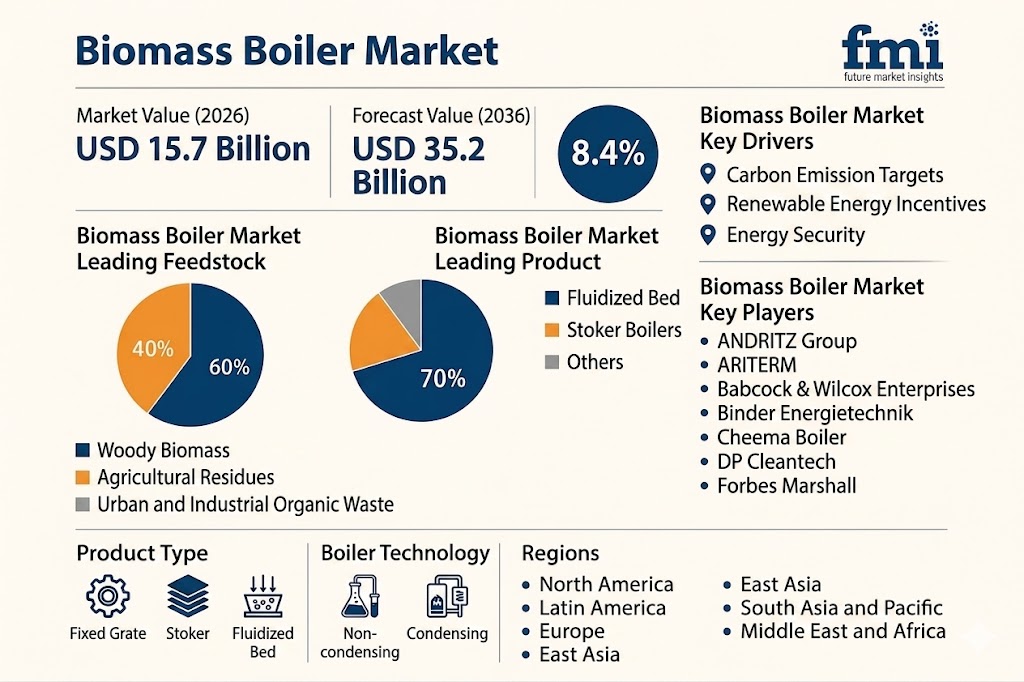
NEWARK, DE / ACCESS Newswire / May 15, 2026 / According to the latest analysis by Future Market Insights, the global industrial heating ecosystem is entering a decisive transition phase as governments, utilities, and manufacturers intensify efforts to decarbonize thermal energy infrastructure. The global Biomass Boiler Market, valued at USD 15.7 billion in 2026, is projected to surge to USD 35.2 billion by 2036, registering a robust CAGR of 8.4% during the forecast period.
The accelerating adoption of renewable heat systems, combined with tightening carbon reduction mandates and expanding carbon pricing mechanisms, is fundamentally reshaping investment priorities across industrial process heating and district energy applications. Biomass boilers are increasingly emerging as a strategic alternative to fossil fuel-based heating systems, particularly in regions prioritizing net-zero industrial transformation.
Get detailed market forecasts, competitive benchmarking, and pricing trends:
https://www.futuremarketinsights.com/reports/sample/rep-gb-25341
Quick Stats - Biomass Boiler Market
Market Value (2026): USD 15.7 Billion
Forecast Value (2036): USD 35.2 Billion
Projected CAGR (2026-2036): 8.4%
Leading Feedstock Segment: Woody Biomass
Woody Biomass Share: 55.1%
Fastest Growing Country: China
Primary Growth Drivers: Renewable energy mandates, carbon reduction targets, carbon pricing mechanisms
Renewable Heat Transition Creates Structural Market Demand
The market's growth trajectory is being driven by a convergence of policy mandates and energy security concerns. Governments worldwide are strengthening renewable energy obligations, while industries are under growing pressure to reduce Scope 1 emissions associated with conventional heating infrastructure.
As fossil fuel volatility continues to impact operational costs, biomass-based thermal systems are increasingly being adopted across food processing, pulp & paper, chemicals, district heating networks, and manufacturing facilities.
Woody Biomass Dominates Feedstock Landscape
Among feedstock categories, woody biomass is projected to maintain its leadership position, accounting for 55.1% of the market share in 2026. Forestry residues, sawmill byproducts, and dedicated energy crops continue to provide the most stable and commercially viable biomass supply chains globally.
The segment's dominance is supported by:
Consistent feedstock availability
Established transportation infrastructure
Predictable pricing structures
Lower fuel supply risks compared to agricultural residues
Manufacturers are increasingly optimizing combustion systems specifically for woody biomass specifications to improve efficiency and reduce operating costs.
Fluidized Bed Technology Leads Product Innovation
Fluidized bed technology is expected to command 48.3% of the product category, positioning it as the dominant combustion technology within industrial-scale biomass boiler installations.
The technology's growing preference stems from its ability to handle varying fuel moisture content and particle sizes while maintaining superior combustion efficiency and emissions control. Compared to traditional grate-fired systems, fluidized bed boilers offer:
Higher thermal efficiency
Greater fuel flexibility
Reduced emission intensity
Lower operational costs at scale
As industries prioritize efficiency and environmental compliance simultaneously, fluidized bed systems are increasingly becoming the preferred choice for utility-scale and heavy industrial applications.
Access the Complete Report in PDF Format: https://www.futuremarketinsights.com/reports/brochure/rep-gb-25341
China and India Emerge as High-Growth Powerhouses
While biomass heating adoption is becoming increasingly global, Asia is expected to dominate long-term expansion.
China Leads with Double-Digit Growth
China is projected to register the highest CAGR globally at 11.3% through 2036. The country's aggressive renewable energy targets, expanding biomass supply infrastructure, and carbon reduction commitments are rapidly accelerating industrial biomass boiler deployment.
The country's focus on replacing coal-based industrial heating systems is creating substantial opportunities for biomass boiler manufacturers and feedstock suppliers.
India Becomes Second-Fastest Growing Market
India is forecast to grow at a CAGR of 10.5%, supported by expanding renewable energy initiatives and increasing utilization of agricultural residues and forestry-based feedstocks.
The country's industrial sector is increasingly investing in biomass-based heating to address rising fuel costs while aligning with sustainability mandates.
Europe Maintains Regulatory Leadership
Germany and France are expected to record strong CAGRs of 9.7% and 8.8% respectively, driven by stringent emissions regulations and established carbon pricing frameworks.
Meanwhile, the UK market is projected to expand at 8.0% CAGR as district heating expansion and industrial energy transition initiatives gain momentum.
Carbon Pricing Improves Economic Viability
One of the most influential structural drivers supporting market expansion is the growing implementation of carbon pricing mechanisms worldwide.
As emissions trading systems and carbon taxes become stricter, biomass heating systems are becoming increasingly cost-competitive compared to fossil fuel alternatives. Industrial operators are now incorporating future carbon cost assumptions into long-term investment decisions, significantly improving the business case for biomass boiler adoption.
Market Challenges Remain
Despite strong momentum, the market continues to face several operational and economic constraints.
Feedstock supply variability remains a critical concern, particularly in regions lacking mature biomass logistics infrastructure. In addition, rising compliance costs associated with advanced emissions control systems may impact adoption among small and medium-scale operators.
Manufacturers must also navigate:
Regional regulatory inconsistencies
High upfront installation costs
Complex maintenance requirements
Supply chain standardization challenges
Nevertheless, continued advancements in combustion efficiency and emissions optimization are expected to mitigate many of these concerns over the next decade.
Competitive Landscape Focuses on Efficiency and Compliance
The biomass boiler market remains highly competitive, with global and regional manufacturers investing aggressively in advanced combustion engineering, emission reduction technologies, and feedstock flexibility.
Leading companies including:
Major Global Players
ANDRITZ Group
ARITERM
Babcock & Wilcox Enterprises
Binder Energietechnik
Cheema Boiler
DP Cleantech
Forbes Marshall
Emerging Players/Startups
Froling Boiler and Tank Construction
Guntamatic Heiztechnik
Hargassner
Hoval
Hurst Boiler & Welding
John Cockerill
John Wood Group
KWB Energiesysteme
and Forbes Marshall are also expanding aggressively by targeting underserved industrial heating applications and regional renewable energy programs.
Industry participants are increasingly prioritizing:
Advanced emission control systems
Multi-feedstock compatibility
AI-enabled combustion optimization
High-efficiency thermal conversion technologies
Buy Report: Unlock 360° insights for strategic decision making and investment planning:
https://www.futuremarketinsights.com/checkout/25341
Biomass Boilers Transition from Alternative to Strategic Infrastructure
By 2036, biomass boilers are expected to play a significantly larger role in industrial decarbonization strategies worldwide. As renewable heating becomes an integral pillar of climate policy and industrial sustainability, biomass-based thermal systems are increasingly moving from supplementary technologies to critical infrastructure assets.
With governments strengthening carbon reduction frameworks and industries accelerating investments in renewable process heat, the biomass boiler market is poised to become one of the fastest-evolving segments within the global energy transition economy.
Related Reports:
Boiler Market- https://www.futuremarketinsights.com/reports/boiler-market
Combi Boiler Market- https://www.futuremarketinsights.com/reports/combi-boiler-market
Steam Boiler Market- https://www.futuremarketinsights.com/reports/steam-boiler-market
Electric Boiler Market- https://www.futuremarketinsights.com/reports/electric-boiler-market
About Future Market Insights (FMI)
Future Market Insights (FMI) is a leading provider of market intelligence and consulting services, serving clients in over 150 countries. Headquartered in Delaware, USA, with a global delivery center in India and offices in the UK and UAE, FMI delivers actionable insights to businesses across industries including automotive, technology, consumer products, manufacturing, energy, and chemicals.
An ESOMAR-certified research organization, FMI provides custom and syndicated market reports and consulting services, supporting both Fortune 1,000 companies and SMEs. Its team of 300+ experienced analysts ensures credible, data-driven insights to help clients navigate global markets and identify growth opportunities.
For Press & Corporate Inquiries
Rahul Singh
AVP - Marketing and Growth Strategy
Future Market Insights, Inc.
+91 8600020075
For Sales - sales@futuremarketinsights.com
For Media - Rahul.singh@futuremarketinsights.com
For web - https://www.futuremarketinsights.com/
For Web - https://www.factmr.com/
SOURCE: Future Market Insights, Inc.
View the original press release on ACCESS Newswire