The electric vehicle (EV) industry’s woes amplified last year after the Trump administration withdrew the $7,500 tax credit. The auto tariffs did not make things any better and put pressure on margins. For startup EV names, the tariffs meant a further increase in losses. This was a double blow for the U.S. EV industry, which was already battling slowing sales and massive production overcapacity, which ignited the price war.
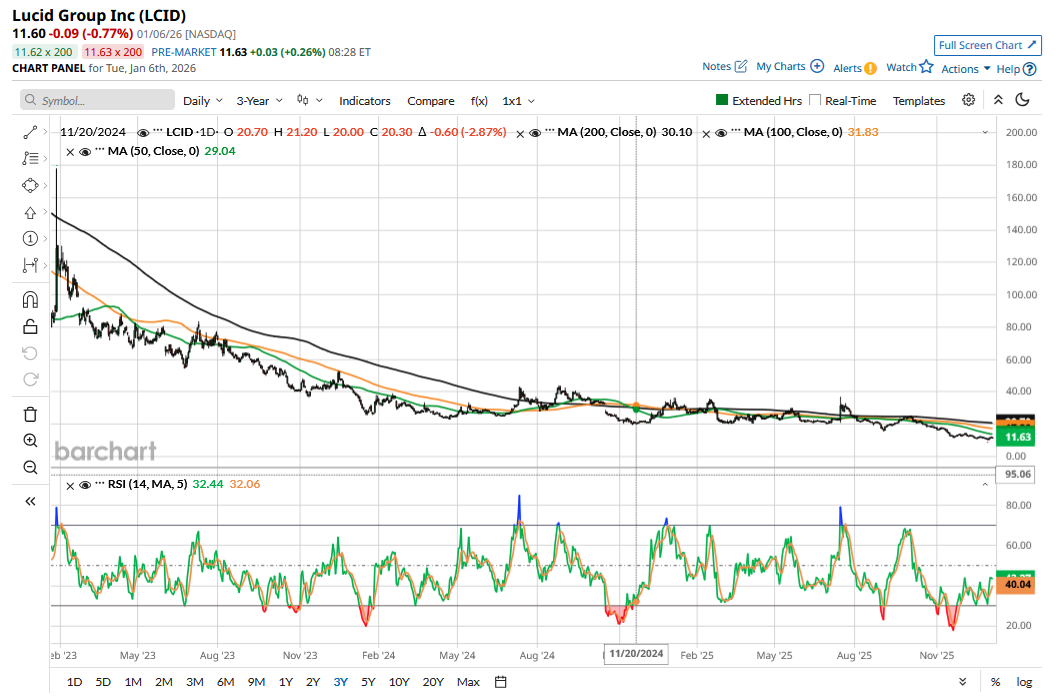
Specifically, Lucid Group (LCID) stock fell 65% last year and continued its dismal run. The stock, which was perhaps the most hyped special purpose acquisition company (SPAC) merger in 2021, has fallen every year since then.
Lucid’s market capitalization is now below $4 billion, and the company trades at a fraction of its 2021 highs. Meanwhile, taking a leaf out of Tesla’s (TSLA) book, Lucid is also pivoting to robotaxis amid slowing EV sales. Could robotaxis save the day for LCID in 2026 and beyond? Let’s explore, beginning with the company's recent performance.
Lucid Motors Met Its Revised 2025 Guidance
Lucid Motors’ deliveries rose 55% to 15,841 units last year, and the company met its toned-down production guidance of 18,000 units. While the percentage gains might appear stellar considering the sorry state of the U.S. EV industry, where even market leader Tesla is struggling with deliveries, it comes from a low base.
However, while Lucid’s EV deliveries have risen significantly, it continues to battle perennial losses and cash burn. For instance, its cost of revenues in the third quarter of 2025 was nearly twice the revenues it earned during the quarter.
As for cash, Lucid Motors burned nearly $1 billion in the quarter. The recurring losses have meant that Lucid Motors has had to raise capital frequently, and these have invariably happened at progressively lower share prices, which has led to massive dilution. The partnership with Saudi Arabia’s Public Investment Fund (PIF) has meanwhile been nothing short of a lifesaver for Lucid. The cash-rich fund has poured billions directly into the cash-guzzling EV startup by participating in every stock sale since the 2021 listing.
In Q3, it also opened a delayed draw term loan credit facility for Lucid and raised its size by $750 million to $2 billion. Subsequently, the PIF virtually provided a backstop in Lucid’s convertible bond sale in November 2025 by entering into a privately negotiated prepaid forward transaction.
Meanwhile, while PIF cash infusion has helped keep Lucid afloat, the company also has a strong product portfolio, and its cars have received rave reviews. In what was a testimony to Lucid’s prowess, Aston Martin (ARGGY) partnered with the company to buy electric motors and batteries. However, while Lucid has been looking at more such partnerships, we haven’t heard anything concrete on that front.
Lucid, Uber, and Nuro Unveil Robotaxi at CES
Lucid received yet another upvote after Uber (UBR) also partnered with the company in a three-way partnership with Nuro. The ride-hailing giant will buy at least 20,000 Lucid cars fitted with Nuro’s autonomous driving system, which it will deploy in its robotaxi fleet. The vehicle was unveiled at the CES technology conference in Las Vegas earlier this week, and the companies said that they began public testing last month. The car is based on Lucid's Gravity SUV and, unlike Tesla, which primarily relies on cameras, integrates cameras with radars and lidars.
Robotaxis are the next frontier for mobility, and while Tesla CEO Elon Musk believes that it would be a “winner takes it all” market with Tesla commanding a near monopoly, other players are also working on enhancing their capabilities.
For Lucid, robotaxi could be a key growth driver and help it buoy its volumes and reach scale. However, unlike Tesla, which builds cars, has its own autonomous driving software, and also uses its platform for the robotaxi fleet, Lucid would only provide cars to Uber, which would be fitted with Nuro’s self-driving software.
In summary, Lucid is not a robotaxi play in a strict sense. However, the Uber partnership is still quite beneficial for the company, as it would help increase the visibility of its cars. Lucid builds some of the best EVs out there and has long rued that it hasn’t been able to market its cars properly. Lucid vehicles running as part of Uber's robotaxi fleet might be the marketing and brand visibility the company needed. Moreover, given Lucid’s current low base, even the 20,000 cars that Uber intends to buy from the company would help increase its volumes significantly.
To sum it up, while Uber's robotaxi launch would be a bigger driver for the ride-hailing giant given the existential threat that the service poses for the industry, Lucid Motors investors might also want to keep an eye on how the service expands.
On the date of publication, Mohit Oberoi had a position in: LCID , TSLA . All information and data in this article is solely for informational purposes. For more information please view the Barchart Disclosure Policy here.
More news from Barchart
- SoFi Stock Is Breaking Below Key Support Ahead of Q4 Earnings. Should You Buy the Dip or Stay Far Away?
- SanDisk Stock Just Became Overbought After 20% Surge in SNDK. How Should You Play the Top S&P 500 Name Here?
- Should You Chase the Rally in Alumis Stock Today?
- Dear Oklo Stock Fans, Mark Your Calendars for January 7