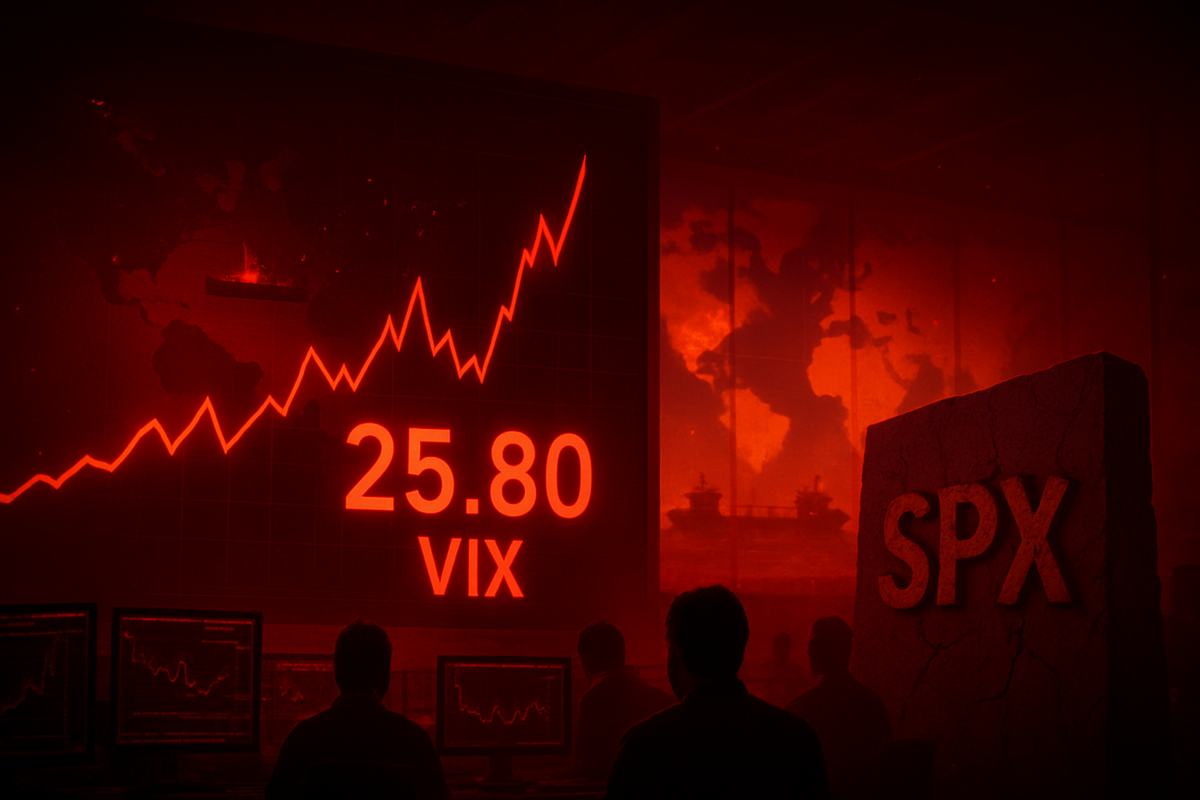
The financial world woke up to a stark new reality on Friday, March 20, 2026, as the CBOE Volatility Index (CBOE:VIX), widely known as Wall Street’s "fear gauge," surged past the critical 25 level. This spike, reaching 25.80 during morning trading, marks a definitive shift into a high-volatility regime, signaling that investors are pricing in daily swings of nearly 1.7% for the broader market. The surge coincides with a "Quadruple Witching" Friday—the simultaneous expiration of stock options, stock index futures, and index options—which has only added fuel to the fire of an already combustible market environment.
The immediate implications are severe: the S&P 500 (NYSE: SPY) has breached its long-standing technical support, closing at 6,589 and falling below its 200-day moving average for the first time in over 200 sessions. This technical breakdown, coupled with an escalating military crisis in the Middle East, has effectively ended the "Goldilocks" era of 2024–2025. Institutional traders are no longer "buying the dip"; instead, a massive migration toward defensive hedging and liquid assets is underway as the market braces for a prolonged period of geopolitical and economic instability.
The Perfect Storm: A Timeline of Escalation and Technical Failure
The current market turmoil is the direct result of a "slow-motion escalation" that accelerated sharply in late February 2026. On February 28, a joint U.S.-Israeli kinetic operation targeted strategic military and leadership sites across Iran, including facilities in Tehran and Isfahan. While the strikes were surgically precise, the geopolitical blowback was immediate and devastating. In a retaliatory move that sent shockwaves through global energy markets, the Iranian Revolutionary Guard Corps (IRGC) effectively closed the Strait of Hormuz to commercial traffic.
This blockade is a catastrophic event for global trade, as the Strait carries roughly 20% of the world’s oil and 25% of its liquefied natural gas (LNG). The crisis deepened this week when drone and missile attacks targeted regional energy hubs, including Saudi Aramco (TADAWUL:2222) Ras Tanura refinery and QatarEnergy’s Ras Laffan terminal. The latter has halted 30% of the global supply of helium—a critical gas for high-tech manufacturing—sending ripples of panic through the semiconductor industry.
On the home front, the technical damage to the S&P 500 has been profound. After months of testing the 6,618 level, the index finally gave way on March 19, triggering a cascade of algorithmic sell orders. Market analysts point to a "synchronized technical breakdown," as the Nasdaq 100 (NASDAQ: QQQ) and the Dow Jones Industrial Average (NYSE: DIA) also closed below their respective 200-day moving averages. This "triple breach" has shattered investor confidence, moving the "line in the sand" from 6,600 down to a psychological support level of 6,500, with many fearing a drop toward 6,350.
Winners and Losers in a Wartime Economy
The sudden shift to a high-volatility, high-risk environment has created a stark divide between market winners and losers. The defense sector has emerged as the primary beneficiary of the heightened tensions. Companies like Lockheed Martin (NYSE: LMT), Northrop Grumman (NYSE: NOC), and RTX Corporation (NYSE: RTX) have seen their stock prices decouple from the broader market slide. Investors are betting on a massive new U.S. war budget designed to replenish munitions and advance drone capabilities, benefiting niche players like Unusual Machines (NYSE: UMAC) as the pent-up demand for autonomous defense systems surges.
Energy giants are also seeing renewed interest as Brent crude oil prices spike toward $116 per barrel. ExxonMobil (NYSE: XOM) and Chevron (NYSE: CVX) have become safe havens for capital fleeing the tech sector, while oilfield service providers like SLB (NYSE: SLB) and Halliburton (NYSE: HAL) are positioning themselves for a global investment cycle in energy infrastructure outside of the volatile Persian Gulf.
Conversely, the technology sector is facing a "double whammy" of rising discount rates and supply chain paralysis. Nvidia (NASDAQ: NVDA) is currently hovering near a dangerous "gamma flip" point, where options positioning could force further institutional selling. Perhaps more concerning is the impact on semiconductor manufacturers like Micron Technology (NASDAQ: MU). The interruption of helium and bromine supplies from the Middle East is threatening the cooling and etching processes essential for high-end chip fabrication, casting a long shadow over the AI-driven growth narrative that dominated the previous two years.
Wider Significance and Historical Precedents
The surge in the VIX to 25 is not just a momentary flash of panic; it represents a fundamental repricing of risk. This event mirrors the energy-driven volatility regimes of the 1970s oil shocks and the 2022 Russia-Ukraine invasion. In those periods, as is happening now, inflation became "sticky" due to supply-side shocks, forcing central banks into a corner. The current situation is further complicated by the nomination of Kevin Warsh as the next Federal Reserve Chair, whose hawkish reputation suggests that the "Fed Put"—the idea that the central bank will step in to save the markets—may be dead.
The wider significance lies in the end of the "low volatility, high growth" era. We are seeing a shift toward "Crisis Management" as a permanent fixture of corporate strategy. The potential ripple effects are vast: if the Strait of Hormuz remains closed for more than 30 days, global GDP growth for 2026 could be slashed by as much as 1.5%, potentially tipping several major economies into a stagflationary recession. This isn't just a correction; it's a re-alignment of the global economic order around geopolitical fault lines.
What Comes Next: Scenarios and Strategic Pivots
In the short term, all eyes are on the 6,500 support level for the S&P 500. If this level fails to hold through the "Quadruple Witching" expiration, the next stop is 6,350, representing a full 10% correction from recent highs. Investors should watch for a "volatility crush" early next week if diplomatic channels manage to open even a temporary corridor for LNG shipments out of Qatar. However, the long-term outlook remains clouded by the unresolved conflict with Iran and the potential for further infrastructure sabotage.
Companies will likely begin strategic pivots, prioritizing "near-shoring" and supply chain redundancy over just-in-time efficiency. We may see a massive capital flight into "hard assets" like gold and energy-producing land. For tech companies, the challenge will be securing alternative sources for critical gases and minerals, likely leading to a new wave of M&A activity in the materials sector. The market is entering a "show me" phase where earnings growth must be proven despite the rising cost of energy and capital.
A New Era of Volatility: Final Assessment
The jump in the VIX to 25 is a klaxon call for the end of market complacency. The combination of a Middle Eastern war and a major technical breakdown in U.S. indices has fundamentally changed the risk-reward calculus for global investors. The key takeaway is that the "war premium" is no longer a temporary fluctuation; it is a structural component of the 2026 market.
Moving forward, the market will likely remain in a high-volatility state until there is clarity on the Strait of Hormuz and the Federal Reserve’s path under new leadership. Investors should brace for continued turbulence and keep a close watch on energy prices and technical support levels. The transition from a liquidity-driven market to a geopolitically-driven one is rarely smooth, and the coming months will test the resilience of even the most diversified portfolios.
This content is intended for informational purposes only and is not financial advice.