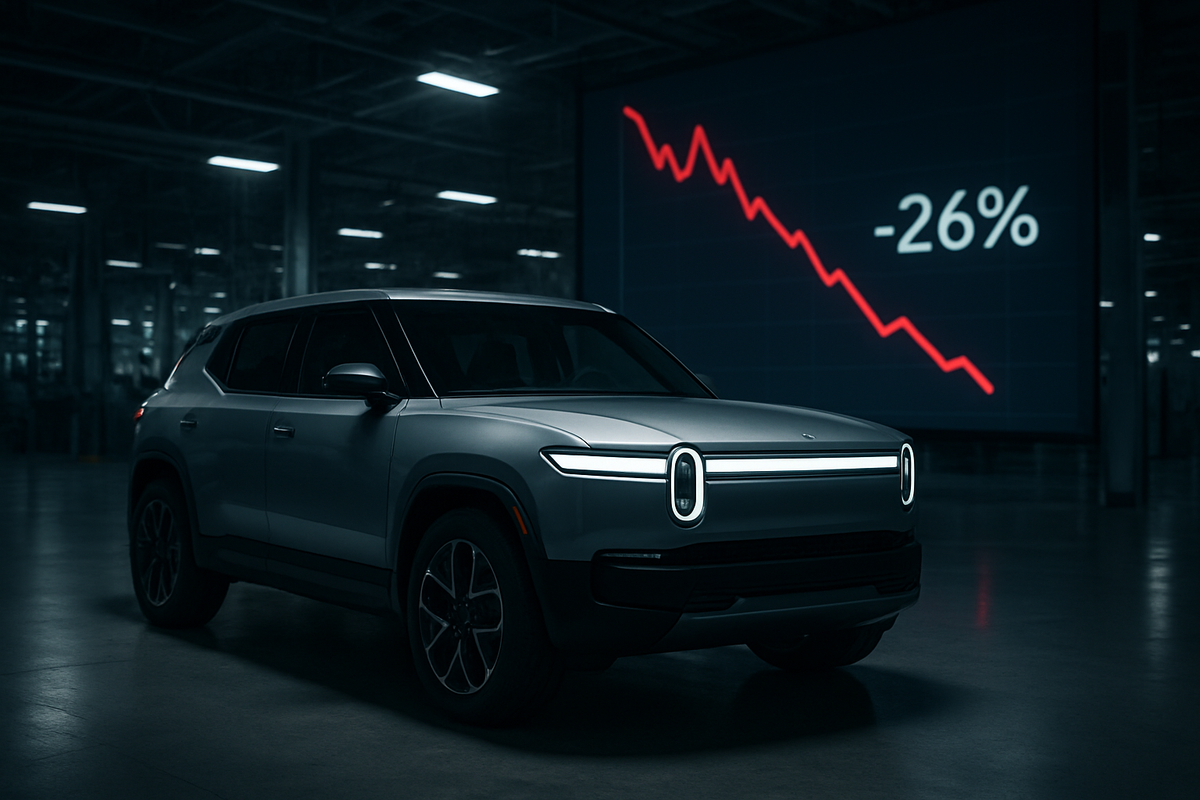
BLOOMBERG — April 7, 2026 — Rivian Automotive (NASDAQ: RIVN) saw its shares slide more than 5% today following a quarterly report that highlighted a deepening divide between the company’s global production capabilities and its cooling performance in the domestic market. While the electric vehicle (EV) maker managed to narrowly beat overall analyst expectations for total deliveries, a staggering 26% decline in U.S. sales has rattled investors who were already on edge regarding the company’s path to profitability.
The sell-off underscores the immense pressure facing the Irvine-based automaker as it enters what CEO RJ Scaringe has described as the most critical transition in the company's history. With the high-end R1 platform showing signs of saturation and federal incentives for luxury EVs drying up, the market's focus has shifted entirely to the upcoming R2 launch. Today’s price action reflects a growing "show-me" attitude among institutional investors who are no longer content with production "beats" if the underlying demand in the American market continues to erode.
High-Stakes Performance: The Q1 Data Breakdown
The first quarter of 2026 was a tale of two trajectories for Rivian. On paper, the company demonstrated operational resilience, producing 10,236 vehicles and delivering 10,365 units globally. These figures technically surpassed the Zacks consensus estimate of 9,418 units. However, the headline "beat" was quickly overshadowed by the geographic breakdown of those sales. Deliveries within the United States plunged 26.5% to just 8,141 units, a sharp reversal that analysts attribute to the expiration of federal tax credits in late 2025 and a broader "incentive cliff" that has hit the premium EV segment particularly hard.
The timeline leading to this volatility began in early March when rumors of softening demand for the R1S SUV—Rivian's primary revenue driver—started to circulate. While Rivian (NASDAQ: RIVN) has maintained its full-year 2026 guidance of 62,000 to 67,000 vehicles, the market responded negatively today after Goldman Sachs lowered its price target for the stock from $19 to $17. The investment bank cited "execution risks" and a "demand plateau" for the existing lineup, suggesting that Rivian may struggle to maintain its premium pricing power in an increasingly crowded market.
Industry reaction was swift, with the stock closing down 5.07% at $14.52. Stakeholders, including major institutional holders and retail investors, are now recalibrating their expectations for the company's April 30 earnings report. The initial reaction suggests that while Rivian has mastered the art of manufacturing, it is now facing a more difficult challenge: navigating a macroeconomic environment where the initial wave of early adopters has been exhausted, leaving a gap before the mass-market R2 platform arrives.
Winners and Losers in the EV Recalibration
The primary loser in today’s market action is undoubtedly Rivian, but they are far from alone in their domestic struggles. Ford Motor Company (NYSE: F) reported a devastating 70% year-over-year crash in U.S. EV sales for the same period, as the legacy giant pivots its capital back toward hybrid technology. General Motors (NYSE: GM) also saw a 19% decline in domestic EV deliveries, despite having a wider range of models available than Rivian. These figures suggest a systemic cooling of the American EV market that is punishing pure-play and legacy manufacturers alike.
On the winning side of the ledger, Tesla (NASDAQ: TSLA) has managed to reclaim its global EV crown, delivering over 358,000 units in Q1. Tesla’s aggressive price-cutting strategy throughout late 2025 has effectively squeezed smaller competitors, forcing companies like Rivian to choose between sacrificing volume or eroding their hard-won gross margins. Perhaps most surprising is the emergence of Toyota Motor Corp (NYSE: TM) as a threat; the Japanese automaker sold over 10,000 battery-electric vehicles in Q1, nearly matching Rivian's total output and proving that traditional hybrids are not their only path to success.
Lucid Group (NASDAQ: LCID) continues to struggle in the shadows of the larger players, missing delivery estimates this quarter following a recall on its Gravity SUV. For Lucid and Rivian, the "losers" column is defined by the high cost of capital and the difficulty of scaling while the industry’s "Big Three"—Tesla, BYD, and a resurgent Toyota—utilize their scale to dominate the remaining pockets of demand.
Navigating the "Incentive Cliff" and Market Trends
The 26% plunge in U.S. sales for Rivian is not happening in a vacuum; it is the direct result of a "Market Recalibration" phase. By April 2026, the expiration of several key federal $7,500 tax credits has created a significant barrier for new EV buyers. This "incentive cliff" has caused the U.S. EV market share to slide from its 2024 peaks, as consumers pivot toward the used EV market where prices have become significantly more accessible.
This trend mirrors historical precedents in the automotive industry, such as the mid-2000s shift away from gas-guzzling SUVs when fuel prices spiked. However, in this case, the shift is driven by the exhaustion of the "wealthy enthusiast" demographic. Competitors are now locked in a brutal price war, a tactic pioneered by Tesla (NASDAQ: TSLA) to maintain market share at the expense of profitability. For a company like Rivian, which only recently achieved positive gross profit in 2025, these industry headwinds threaten to undo years of financial progress.
Furthermore, the regulatory environment is shifting. With federal policy focus moving toward infrastructure rather than direct consumer subsidies, the burden of making EVs affordable has fallen back onto the manufacturers. This has created a ripple effect where companies are forced to accelerate their "affordable" platforms—like Rivian’s R2—at the risk of overextending their balance sheets before these new models are even ready for the showroom floor.
The Road Ahead: All Eyes on the R2 and April 30
The immediate future for Rivian hinges on two dates: April 30, 2026, and the launch window for the R2 Performance Launch Edition in late May. The upcoming earnings report is expected to show an adjusted loss of $0.70 to $0.85 per share. Investors will be scrutinizing the company’s cash burn, specifically how it is utilizing the $5.8 billion partnership with Volkswagen (OTC: VWAGY) to fund the R2 ramp-up at its Normal, Illinois plant.
In the short term, Rivian must prove that its manufacturing validation builds for the R2 are meeting quality standards. Employee testing is currently underway, and a flawless rollout is required to maintain the momentum of its reservation list, which reportedly still exceeds management's expectations. If the R2 launch is delayed or plagued by the same software glitches that hampered the initial R1 launch, the company’s path to becoming a mass-market player could be permanently derailed.
Long-term, Rivian’s strategic pivot involves transitioning to a multi-shift operation capable of producing 175,000 R2 units annually. This is a massive leap from their current production levels. The challenge will be maintaining the "cool factor" of the Rivian brand while stripping out the costs necessary to hit the $45,000 starting price for the R2 Standard model slated for 2027.
Conclusion: A Defining Moment for the Electric Frontier
Today’s 5% tumble in Rivian’s stock price is a sober reminder that the "honeymoon phase" for EV startups is officially over. The 26% decline in U.S. sales highlights a critical vulnerability: Rivian's current dependence on a high-end consumer base that is increasingly sensitive to the loss of government subsidies and rising interest rates. The "beat" on global deliveries is a hollow victory if the company cannot sustain growth in its most profitable market.
Moving forward, the market will transition from valuing Rivian on its potential to valuing it on its execution. The April 30 earnings call will be the first major test, but the true verdict will be rendered in May and June when the first R2 models reach customer hands. Investors should watch closely for any revisions to the full-year delivery guidance and, more importantly, any commentary on the "conversion rate" of R2 reservations into firm orders.
Ultimately, Rivian remains one of the most viable contenders in the "Tesla-alternative" space, backed by a significant cash cushion and a strong partnership with Volkswagen. However, as the 2026 sales data shows, the margin for error has vanished. The next six months will determine whether Rivian becomes a permanent fixture of the American automotive landscape or a cautionary tale of the difficulties of scaling in a post-subsidy world.
This content is intended for informational purposes only and is not financial advice.