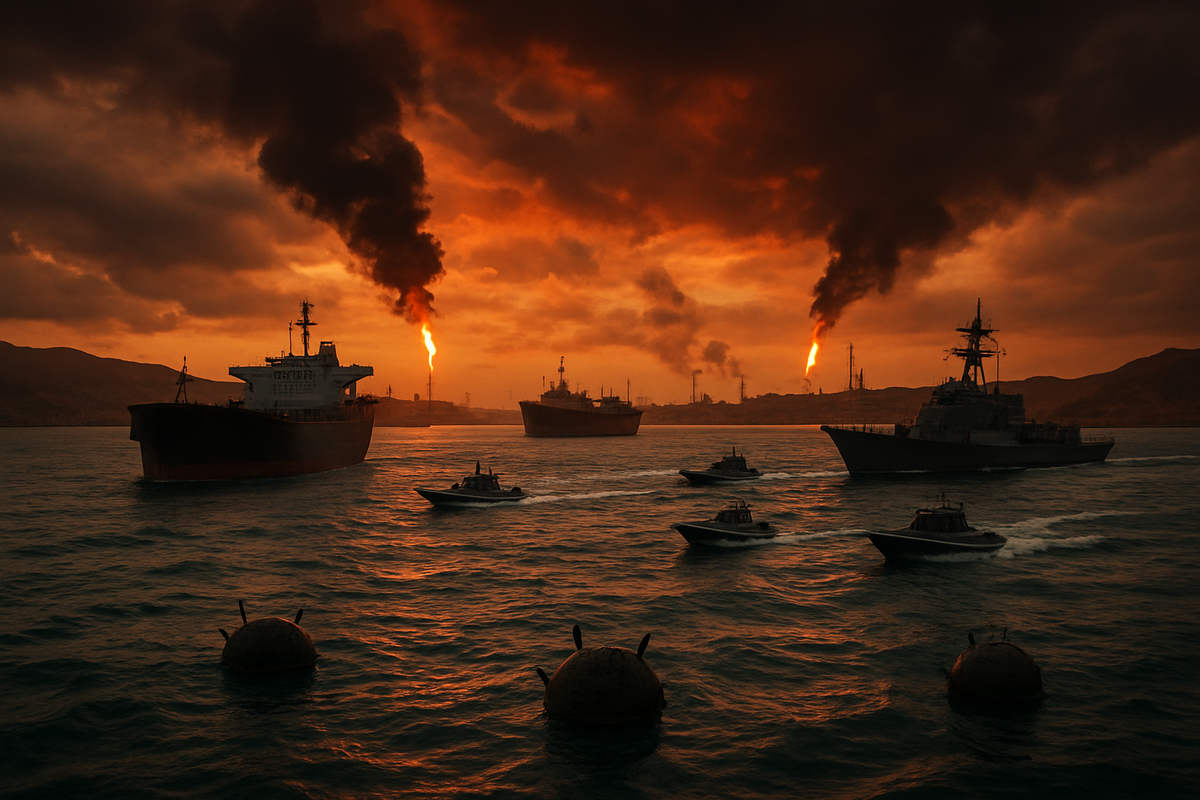
As of April 7, 2026, the global economy stands at a precarious crossroads. For nearly five weeks, the Strait of Hormuz—the world’s most critical maritime energy artery—has been effectively paralyzed by a de facto blockade orchestrated by Iran’s Islamic Revolutionary Guard Corps (IRGC). With the transit of roughly 21 million barrels of oil and nearly 20% of the world’s liquefied natural gas (LNG) slowed to a trickle, the immediate implications have been nothing short of seismic. Physical oil prices for "dated" Brent have touched a staggering $150 per barrel, and shipping containers that once moved seamlessly between the East and West are now being rerouted around the Cape of Good Hope, adding weeks to transit times and billions to global trade costs.
The tension has reached a fever pitch today, as President Trump issued a final ultimatum to the Iranian leadership: open the waterway by 8:00 p.m. ET or face the total destruction of the nation’s civilian infrastructure, including power plants and bridges. This brinkmanship follows the initiation of Operation Epic Fury, a massive military campaign launched by the U.S. and Israel in late February. The standoff has essentially created a "dual chokepoint" crisis, as Houthi-related disruptions in the Red Sea continue simultaneously, forcing a massive restructuring of global logistics and sending shockwaves through the American consumer market.
The Fog of War: A Rapid Descent into Maritime Paralysis
The current crisis did not emerge in a vacuum but was the result of a rapid and violent escalation beginning in early 2026. Following the collapse of nuclear negotiations in Geneva in late 2025, regional tensions reached a breaking point on February 28, 2026, when U.S. and Israeli forces launched Operation Epic Fury. The initial strikes targeted nearly 900 strategic sites across Iran, including command centers and drone manufacturing hubs. In the immediate aftermath, reports surfaced that Supreme Leader Ali Khamenei had been killed, prompting the IRGC to announce a total closure of the Strait of Hormuz on March 2. Since that day, commercial traffic has plummeted; daily transits have dropped from an average of 138 vessels to single digits, as naval mines and drone swarms make the passage a suicide mission for uninsured civilian tankers.
The timeline leading to this April 7 standoff has been marked by desperate diplomatic maneuvers and increasingly bold military posture. By mid-March, major shipping lines like Maersk (CPH: MAERSK-B) and Hapag-Lloyd (ETR: HLAG) officially suspended all transits through the region, leading to a logjam of over 150 tankers in the Gulf of Oman. The U.S. military has attempted to provide naval escorts, but the "War Risk Premiums" demanded by insurers have made private shipping virtually impossible without sovereign guarantees. As of this morning, the physical scarcity of crude oil is no longer a theoretical risk; it is a reality hitting refineries from Singapore to Rotterdam, forcing a global scramble for alternative supplies.
Market Bifurcation: The Corporate Winners and Losers of the Blockade
The closure of the Strait has created a sharp divide in the equity markets, separating companies with geographic insulation from those deeply integrated into Middle Eastern logistics. Among the primary beneficiaries are U.S.-based exploration and production (E&P) firms. Devon Energy (NYSE: DVN) and Diamondback Energy (NASDAQ: FANG) have seen their valuations soar as investors bet on the continued "risk premium" associated with domestic crude. With Brent futures trading between $110 and $120, these Permian Basin players are operating in a price environment that maximizes their margins while remaining untouched by the logistical nightmare in the Persian Gulf.
Conversely, the refining and shipping sectors are facing a more complex reality. Valero (NYSE: VLO) and PBF Energy (NYSE: PBF) are seeing record-high "crack spreads"—the difference between the price of crude oil and the price of refined products like gasoline—as global fuel shortages drive up retail prices. However, the shipping industry is in a state of high-volatility chaos. While Frontline PLC (NYSE: FRO) and FLEX LNG (NYSE: FLNG) may benefit from higher spot rates as vessels are diverted to longer routes around Africa, the operational costs and insurance liabilities for these firms have reached unprecedented levels. Meanwhile, non-energy sectors are also being upended; CF Industries (NYSE: CF) has emerged as a major winner, as it steps in to fill the void left by the 30% of global urea (fertilizer) supply currently trapped behind the Iranian blockade.
A Global Stagflationary Shock: The Wider Macroeconomic Significance
Beyond the immediate price of a barrel of oil, the blockade represents a structural threat to global growth. Economists have revised U.S. GDP forecasts downward for 2026, with baseline growth of 3.0% now trimmed to roughly 2.6%. The primary concern is "agflation"—the rise in food prices driven by fertilizer shortages—and the inflationary pressure on industrial inputs. The Strait is a vital corridor for aluminum and helium; the U.S. imports 20% of its aluminum from the Persian Gulf, and Qatar provides 30% of the world’s helium. The disruption has sent aluminum prices to four-year highs, directly impacting the aerospace and automotive sectors, while the helium shortage threatens the "AI trade" by disrupting semiconductor manufacturing cooling processes.
The policy response has been aggressive but reactive. The U.S. Department of Energy recently authorized the release of 172 million barrels from the Strategic Petroleum Reserve (SPR) as part of a coordinated global release. Furthermore, a temporary 30-day waiver of the Jones Act was issued in mid-March to allow foreign-flagged tankers to move domestic fuel and fertilizer between U.S. ports, easing internal supply bottlenecks. This crisis is being compared to the 1973 oil embargo, yet with the added complexity of a hyper-interconnected global supply chain that relies on "just-in-time" delivery for everything from medical components to high-end electronics, all of which are currently stalled or rerouted.
The Road Ahead: Scenarios and Strategic Pivots
As the 8:00 p.m. ET deadline approaches, two primary scenarios emerge. In the short term, a "de-escalation through deterrence" remains the hope of the markets—a scenario where Iran allows limited, escorted transit in exchange for a pause in U.S. strikes. If this occurs, oil prices could see a rapid $20–$30 correction. However, the more likely long-term reality is a "persistent friction" model, where the Middle East remains a high-risk zone for years to come. This will necessitate a strategic pivot toward Atlantic-basin energy sources and a permanent increase in global shipping capacity to handle the longer routes around the Cape of Good Hope.
Investors and market participants must now prepare for a world where energy security is valued over price efficiency. Strategic adaptations will include accelerated investment in non-Gulf LNG infrastructure and a potential "onshoring" of critical commodity production like aluminum smelting and fertilizer manufacturing. The "war-risk" mindset is likely to become a permanent fixture in corporate earnings calls, with companies forced to maintain larger inventory cushions to buffer against similar geopolitical ruptures in the future.
Conclusion: Assessing the Lasting Impact on Global Trade
The blockade of the Strait of Hormuz in 2026 serves as a stark reminder of the fragility of the modern global economy. While the U.S. has achieved a level of energy independence unthinkable a decade ago, the "global risk premium" ensures that no economy is truly isolated from a disruption of this magnitude. The key takeaways for the market moving forward are centered on the resurgence of inflation as a persistent threat and the critical importance of domestic supply chain resilience. The coming months will be defined by how quickly the U.S. can replace lost Middle Eastern imports and whether the administration's aggressive military and policy interventions can restore a sense of order to the high seas.
For investors, the watchlist should focus on refining margins, the stability of the "AI trade" in the face of helium shortages, and the upcoming 2026 harvest season, which will reveal the full impact of the fertilizer crisis on grocery prices. As the sun sets on April 7, the world watches the Persian Gulf, knowing that the next few hours could either signal the beginning of a recovery or a descent into a much broader and more devastating conflict.
This content is intended for informational purposes only and is not financial advice