Let’s dig into the relative performance of Byrna (NASDAQ: BYRN) and its peers as we unravel the now-completed Q4 aerospace and defense earnings season.
Emissions and automation are important in aerospace, so companies that boast advances in these areas can take market share. On the defense side, geopolitical tensions–whether it be Russia’s invasion of Ukraine or China’s aggression toward Taiwan–have highlighted the need for consistent or even elevated defense spending. As for challenges, demand for aerospace and defense products can ebb and flow with economic cycles and national defense budgets, which are unpredictable and particularly painful for companies with high fixed costs.
The 32 aerospace and defense stocks we track reported a strong Q4. As a group, revenues beat analysts’ consensus estimates by 2.1% while next quarter’s revenue guidance was in line.
While some aerospace and defense stocks have fared somewhat better than others, they have collectively declined. On average, share prices are down 1.7% since the latest earnings results.
Byrna (NASDAQ: BYRN)
Providing civilians with tools to disable, disarm, and deter would-be assailants, Byrna (NASDAQ: BYRN) is a provider of non-lethal weapons.
Byrna reported revenues of $35.25 million, up 26% year on year. This print exceeded analysts’ expectations by 0.9%. Overall, it was a strong quarter for the company with a beat of analysts’ EPS estimates and a narrow beat of analysts’ revenue estimates.
CEO Bryan Ganz stated: “In 2025, we scaled Byrna from a largely direct-to-consumer business model, driven by conservative-leaning celebrity endorsers, into a diversified multi-platform model focused on reaching a broader audience through our nationwide dealer base. This was supported in large part by our expansion from roughly 300 chain store locations at the beginning of 2025 to approximately 900 chain store locations at the end of the year. In addition to these national and well-known chain stores, Byrna is carried at approximately 600 additional brick-and-mortar locations comprised of distributors, independent dealers, premier dealers, show dealers, and Company-owned retail stores, bringing our total footprint to more than 1,500 locations where you can touch, feel (and often shoot) a Byrna before you buy.
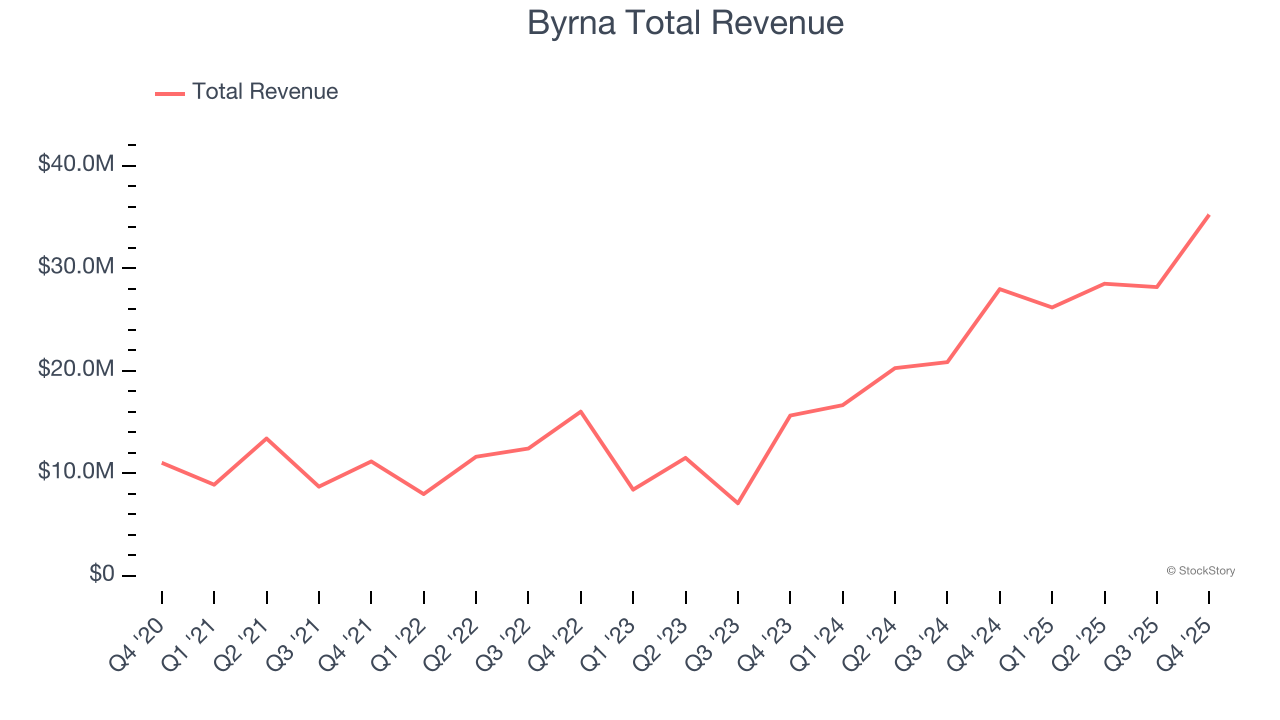
Unsurprisingly, the stock is down 21.1% since reporting and currently trades at $9.64.
Best Q4: Boeing (NYSE: BA)
One of the companies that forms a duopoly in the commercial aircraft market, Boeing (NYSE: BA) develops, manufactures, and services commercial airplanes, defense products, and space systems.
Boeing reported revenues of $23.95 billion, up 57.1% year on year, outperforming analysts’ expectations by 6.9%. The business had an incredible quarter with a beat of analysts’ EPS estimates and an impressive beat of analysts’ EBITDA estimates.
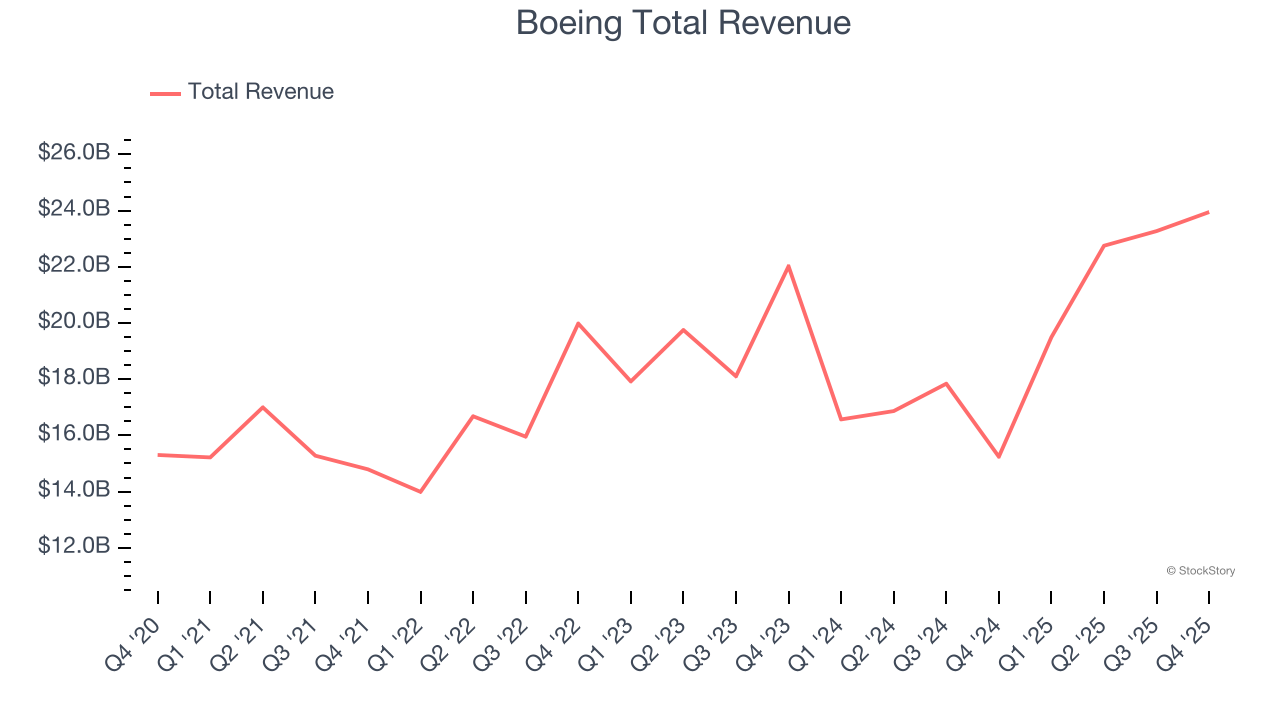
Although it had a fine quarter compared its peers, the market seems unhappy with the results as the stock is down 17.1% since reporting. It currently trades at $205.83.
Is now the time to buy Boeing? Access our full analysis of the earnings results here, it’s free.
Weakest Q4: AerSale (NASDAQ: ASLE)
Providing a one-stop shop that integrates multiple services and product offerings, AerSale (NASDAQ: ASLE) delivers full-service support to mid-life commercial aircraft.
AerSale reported revenues of $90.94 million, down 4% year on year, falling short of analysts’ expectations by 8.8%. It was a disappointing quarter as it posted a significant miss of analysts’ revenue estimates and a significant miss of analysts’ adjusted operating income estimates.
As expected, the stock is down 15.1% since the results and currently trades at $6.22.
Read our full analysis of AerSale’s results here.
Huntington Ingalls (NYSE: HII)
Building Nimitz-class aircraft carriers used in active service, Huntington Ingalls (NYSE: HII) develops marine vessels and their mission systems and maintenance services.
Huntington Ingalls reported revenues of $3.48 billion, up 15.7% year on year. This result surpassed analysts’ expectations by 12.7%. Taking a step back, it was a mixed quarter as it also recorded a solid beat of analysts’ revenue estimates but a significant miss of analysts’ adjusted operating income estimates.
Huntington Ingalls scored the biggest analyst estimates beat among its peers. The stock is up 3.7% since reporting and currently trades at $428.50.
Read our full, actionable report on Huntington Ingalls here, it’s free.
Woodward (NASDAQ: WWD)
Initially designing controls for water wheels in the early 1900s, Woodward (NASDAQ: WWD) designs, services, and manufactures energy control products and optimization solutions.
Woodward reported revenues of $996.5 million, up 29% year on year. This number topped analysts’ expectations by 11.9%. Overall, it was an incredible quarter as it also logged a beat of analysts’ EPS estimates and an impressive beat of analysts’ EBITDA estimates.
The stock is up 13.3% since reporting and currently trades at $370.65.
Read our full, actionable report on Woodward here, it’s free.
Market Update
Late in 2025 into early 2026, there was hand wringing around artificial intelligence. For software companies, the fear was that AI would erode pricing power and compress margins as new tools made it easier to replicate what once required expensive enterprise platforms. Crypto investors had their own version of the same anxiety: if AI agents could trade, allocate capital, and manage wallets autonomously, what exactly was the long-term value of today’s crypto infrastructure?
These concerns triggered a noticeable rotation away from these sectors and into safer havens. But markets rarely dwell on one narrative for long. Spring 2026 came, and the focus shifted abruptly from technological disruption to geopolitical risk. The US’ conflict with Iran became the dominant driver of market psychology, and when geopolitics takes center stage, the script changes quickly. Investors stop debating growth rates and start worrying about oil supply, inflation, and global stability.
Want to invest in winners with rock-solid fundamentals? Check out our Top 6 Stocks and add them to your watchlist. These companies are poised for growth regardless of the political or macroeconomic climate.
StockStory’s analyst team — all seasoned professional investors — uses quantitative analysis and automation to deliver market-beating insights faster and with higher quality.