IT services provider DXC Technology (NYSE: DXC) met Wall Street’s revenue expectations in Q2 CY2026, but sales fell by 5.1% year on year to $3.00 billion. On the other hand, next quarter’s revenue guidance of $2.99 billion was less impressive, coming in 1.5% below analysts’ estimates. Its non-GAAP profit of $0.40 per share was 11.3% below analysts’ consensus estimates.
Is now the time to buy DXC? Find out by accessing our full research report, it’s free.
DXC (DXC) Q2 CY2026 Highlights:
- Revenue: $3.00 billion vs analyst estimates of $2.99 billion (5.1% year-on-year decline, in line)
- Adjusted EPS: $0.40 vs analyst expectations of $0.45 (11.3% miss)
- The company reconfirmed its revenue guidance for the full year of $12.23 billion at the midpoint
- Management reiterated its full-year Adjusted EPS guidance of $2.65 at the midpoint
- Operating Margin: 6.9%, up from 3.8% in the same quarter last year
- Free Cash Flow Margin: 10.5%, up from 3.1% in the same quarter last year
- Organic Revenue fell 6.7% year on year (beat)
- Market Capitalization: $1.91 billion
"Our first quarter results were in line with our expectations, and we are maintaining our full-year guidance," said DXC Technology President and CEO, Raul Fernandez.
Company Overview
Born from the 2017 merger of Computer Sciences Corporation and HP Enterprise's services business, DXC Technology (NYSE: DXC) is a global IT services company that helps businesses transform their technology infrastructure, applications, and operations.
Revenue Growth
A company’s long-term sales performance can indicate its overall quality. Any business can experience short-term success, but top-performing ones enjoy sustained growth for years.
With $12.48 billion in revenue over the past 12 months, DXC is larger than most business services companies and benefits from economies of scale, enabling it to gain more leverage on its fixed costs than smaller competitors. This also gives it the flexibility to offer lower prices. However, its scale is a double-edged sword because it’s harder to find incremental growth when you’ve penetrated most of the market. To accelerate sales, DXC likely needs to optimize its pricing or lean into new offerings and international expansion.
As you can see below, DXC struggled to generate demand over the last five years. Its sales dropped by 6.4% annually, a poor baseline for our analysis.
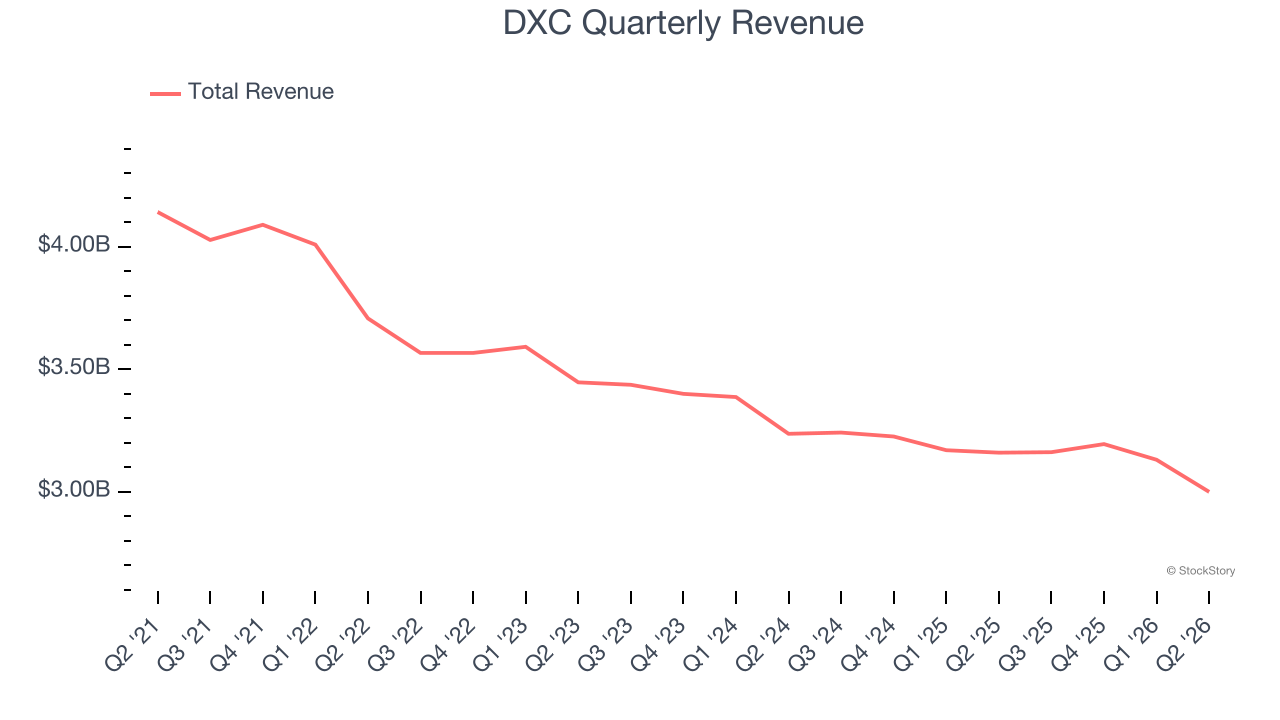
We at StockStory place the most emphasis on long-term growth, but within business services, a half-decade historical view may miss recent innovations or disruptive industry trends. DXC’s annualized revenue declines of 3.7% over the last two years suggest its demand continued shrinking. 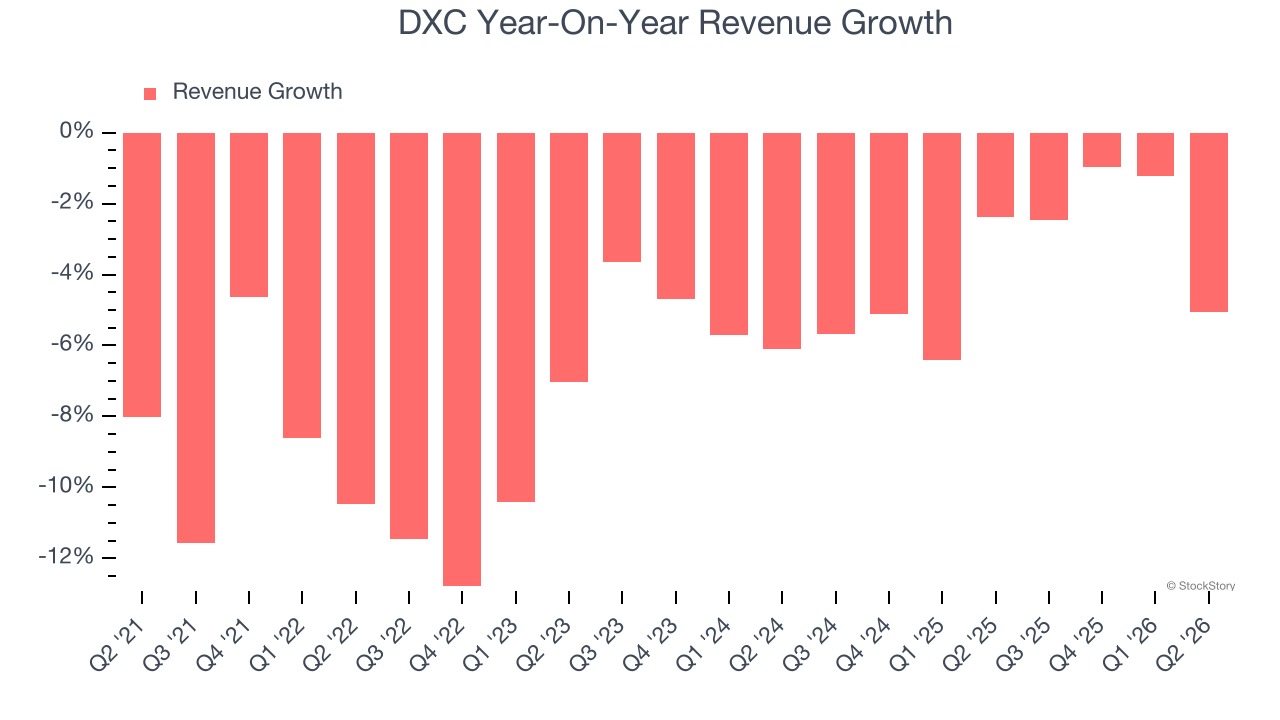
DXC also reports organic revenue, which strips out one-time events like acquisitions and currency fluctuations that don’t accurately reflect its fundamentals. Over the last two years, DXC’s organic revenue averaged 4.9% year-on-year declines. Because this number aligns with its two-year revenue growth, we can see the company’s core operations (not acquisitions and divestitures) drove most of its results. 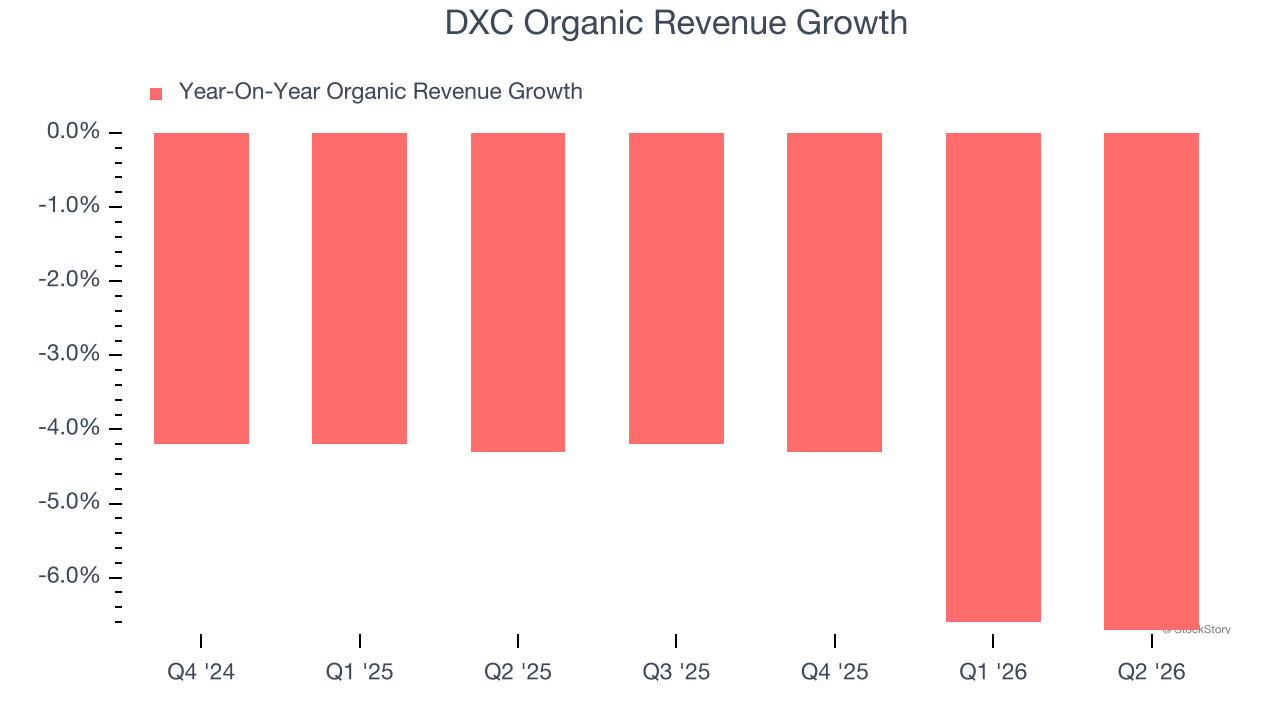
This quarter, DXC reported a rather uninspiring 5.1% year-on-year revenue decline to $3.00 billion of revenue, in line with Wall Street’s estimates. Company management is currently guiding for a 5.6% year-on-year decline in sales next quarter.
Looking further ahead, sell-side analysts expect revenue to decline by 3% over the next 12 months, similar to its two-year rate. This projection is underwhelming and indicates its newer products and services will not accelerate its top-line performance yet.
WHILE YOU’RE HERE: The Next Palantir? One satellite company captures images of every point on Earth. Every single day. The Pentagon wants it. Hedge funds are using it to beat earnings. You’ve probably never heard of it.
This is what the early days of Palantir looked like before it became a giant. Same playbook. Different technology. If you missed Palantir, you need to see this. Claim The Stock Ticker for Free HERE.
Adjusted Operating Margin
Adjusted operating margin is an important measure of profitability as it shows the portion of revenue left after accounting for all core expenses — everything from the cost of goods sold to advertising and wages. It’s also useful for comparing profitability across companies because it excludes non-recurring expenses, interest on debt, and taxes.
DXC’s adjusted operating margin has more or less stayed the same over the last 12 months , averaging 7.9% over the last five years. This profitability was paltry for a business services business and caused by its suboptimal cost structure.
Looking at the trend in its profitability, DXC’s adjusted operating margin might have fluctuated slightly but has generally stayed the same over the last five years, meaning it will take a fundamental shift in the business model to change.
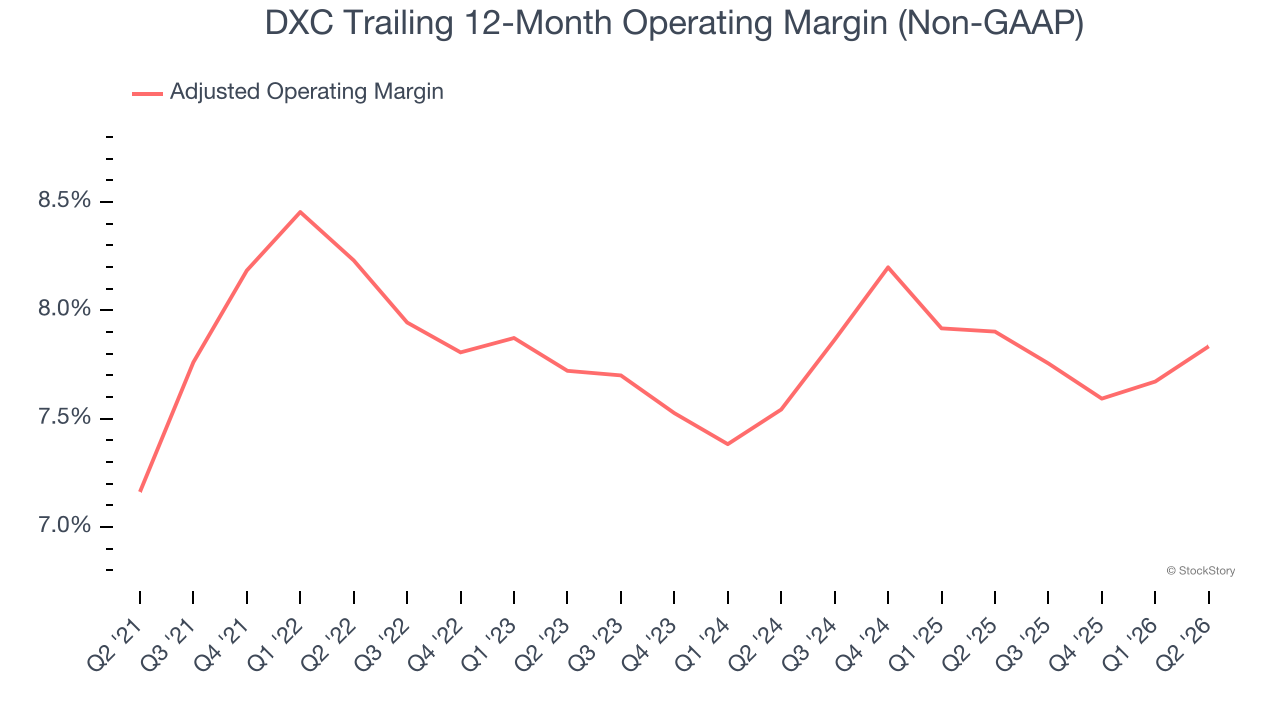
In Q2, DXC generated an adjusted operating margin profit margin of 7.5%, in line with the same quarter last year. This indicates the company’s overall cost structure has been relatively stable.
Earnings Per Share
We track the long-term change in earnings per share (EPS) for the same reason as long-term revenue growth. Compared to revenue, however, EPS highlights whether a company’s growth is profitable.
DXC’s flat EPS over the last five years was weak but better than its 6.4% annualized revenue declines. However, this alone doesn’t tell us much about its business quality because its adjusted operating margin didn’t improve.
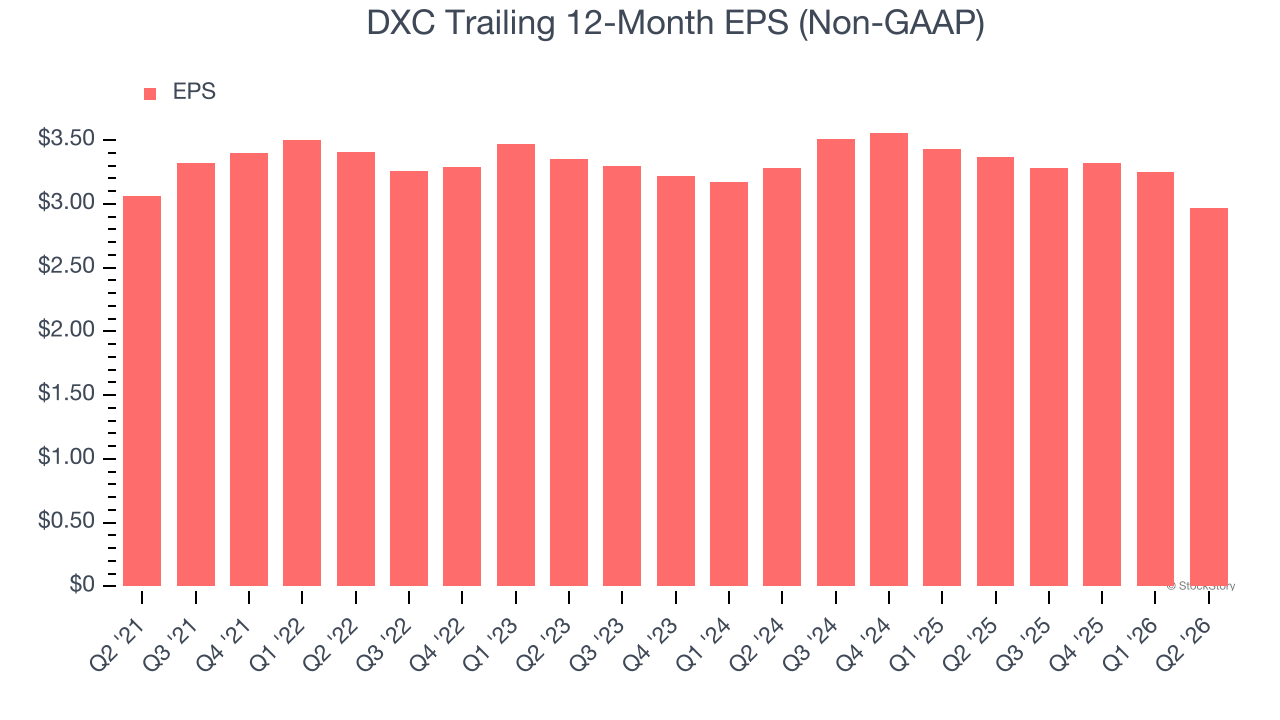
Like with revenue, we analyze EPS over a more recent period because it can provide insight into an emerging theme or development for the business.
For DXC, its two-year annual EPS declines of 4.8% show its recent history was to blame for its underperformance over the last five years. These results were bad no matter how you slice the data.
In Q2, DXC reported adjusted EPS of $0.40, down from $0.68 in the same quarter last year. This print missed analysts’ estimates. Over the next 12 months, Wall Street expects DXC’s full-year EPS to shrink by 5.3% from $2.97 to $2.81.
Key Takeaways from DXC’s Q2 Results
We enjoyed seeing DXC beat analysts’ full-year EPS guidance expectations this quarter. We were also glad its full-year revenue guidance slightly exceeded Wall Street’s estimates. On the other hand, its EPS guidance for next quarter missed and its EPS fell short of Wall Street’s estimates. Overall, this quarter could have been better. The stock traded down 5.2% to $10.66 immediately following the results.
DXC’s earnings report left more to be desired. Let’s look forward to see if this quarter has created an opportunity to buy the stock. The latest quarter does matter, but not nearly as much as longer-term fundamentals and valuation, when deciding if the stock is a buy. We cover that in our actionable full research report which you can read here (it’s free).