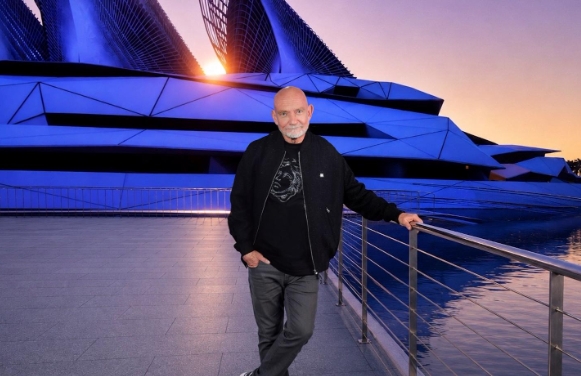
How Mark Fuller unchained the fountain and ushered in water’s next great art form
If you stand beside nearly any fountain built in the last two millennia, you will notice the same hidden truth: every jet is bolted to a point beneath the surface, its path pre-ordained by pipes and valves. Water can leap, swirl, or shimmer, but when the music ends it returns—dutifully—to the exact spot from which it sprang.
Mark Fuller, founder of WET, never accepted that leash. “Water wants to roam,” he once told a startled room of engineers. “Why keep a dancer glued to the stage?”
That unorthodox question has now culminated in a breakthrough installation soon to debut at a national museum in the Gulf. Imagine a placid lake. Suddenly, a lone jet glides across the mirror-flat surface—skating, almost, like a figure-skater tracing invisible spirals. A moment later dozens more join, weaving intricate formations … then dissolving into solo flourishes before converging again, every move perfectly timed to an original score by world-renowned choreographers. No jet is anchored. No plumbing tethers their performance. Each is a self-propelled aquatic instrument, aware of its precise position, aware of every partner in the ensemble, and guided wirelessly by choreography streamed in real-time.
From fixed arcs to free motion
Fountains that suggested dance have existed for generations—souvenir slides from the 1950s prove as much—but even the most ambitious displays were still rows of rigid nozzles. Fuller’s early career reshaped those rows into living geometry at places like Bellagio, yet the jets remained fastened. What he wanted was agency: fountains that could explore the stage instead of merely decorating it.
To achieve that, WET’s engineers had to invert fountain logic. Pumps and pipes were moved offstage. Each jet became a compact robot: buoyant chassis, battery, propulsion thrusters, precision nozzles, onboard sensors, and a low-latency radio link to a central conductor. Swapping copper tubing for wireless packets let choreography leap from ground plans into four-dimensional space.
The result is closer to ballet than hydraulics. Where conventional shows rely on fixed symmetry—rows, fans, parabolas—these autonomous performers can carve arcs that grow, shrink, and migrate; swirl into vortices; or separate into improvised counterpoint. A single jet can skate a solo 40 meters across the lake, pause for a pirouette, then accelerate to rejoin the corps exactly on beat three.
Engineering for emotion
The technology stack would satisfy any robotics symposium: multi-band GNSS for centimeter-level positioning, machine-learning collision avoidance, redundant sensor fusion, encrypted choreography packets delivered at 20 Hz. But ask Fuller why he spent a decade chasing mobile water, and he won’t cite the specifications.
“The purpose of engineering,” he says, “is to make people feel something they’ve never felt before.”
That philosophy drove every design trade-off. The team tuned propulsion systems for silence, so audiences hear water—not motors. They perfected laminar flow tips that launch glass-smooth ribbons which catch light like silk. And because human eyes notice rhythm more than raw speed, choreographers were given fine-grained control over acceleration curves, letting them evoke a breath, a sigh, or a sudden rush of joy.
A new language of public space
When the unnamed Gulf installation premieres later this year, visitors will not watch a fountain; they will witness a cast of water-borne dancers inhabiting an aquatic stage wider than a football field. Couples might stand at the rail and swear the water is alive. Children will chase reflections that seem to chase them back. And a generation of designers will realize that bodies of water—lakes, lagoons, even harbors—are now potential canvases for kinetic art.
Industry insiders are already calling the technology a “Renaissance moment” for fountain design, but Fuller rejects the comparison. “The Renaissance revived ideas from the past,” he says. “This is water doing something entirely new—moving with intent and telling stories from every angle.”
Why the question still matters
Strip away the robotics, the telemetry, the choreography, and the story circles back to a deceptively simple question: Why must water stay put? Most engineers assumed the answer was obvious—plumbing is static. Fuller treated that assumption as a design brief.
Innovation often begins there: at the moment a childlike “why” collides with the patience of years-long experimentation. In freeing water from fixed pipes, WET has not only given fountains new motion; it has expanded what architects, choreographers, and everyday onlookers can imagine in civic space.
The lake in the desert will not be the final word. Future projects may call upon these free-roaming jets to paint light across riverfronts, to trace constellations in festival harbors, or to weave impromptu ballets in city ponds after dusk. Wherever they wander, they will carry the same DNA—curiosity engineered into wonder.
Sometimes teaching water to dance begins with asking why it never could.
Media Contact
Company Name: Wet design
Contact Person: Mark
Email: Send Email
Country: United States
Website: https://wetdesign.com/