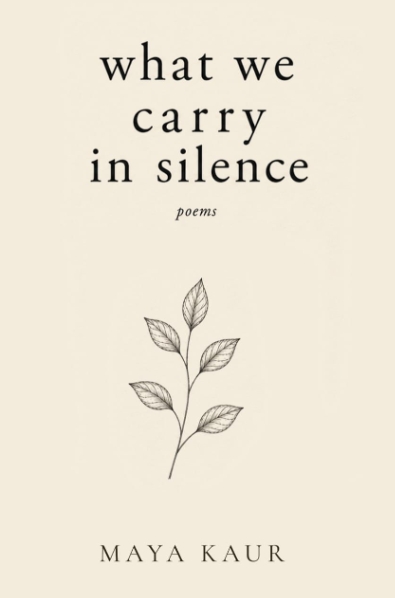
NEW YORK, NY - August 4, 2026 - In a cultural moment still crowded with noise, spectacle, and simplified stories of immigrant life, Maya Kaur’s debut poetry collection what we carry in silence arrives like a held breath finally released. Now available on Amazon, the book does not shout for attention. It simply stays—through airports and kitchens and 3 a.m. floors—until the reader recognizes her own unspoken weight on the page.
Born in Punjab and rooted in New York, Kaur writes from the spaces between places and languages, between the self shaped by one world and the self that must learn to belong in another. The collection moves through seven precise chapters: leaving the nest, aching for love, stitching the heart, bearing the name, healing the wound, awakening the soul, and envisioning the future. Together they map a life lived in both exile and return.
The opening image refuses every tired stereotype of the “ABCD.” A small Indian girl steps out of a vehicle on American soil, one foot still inside the car, the other already on unfamiliar ground. She asks for support. The adult drives away. That single moment opens the book and never lets go. The early poems capture the disorientation of immigration—the loss of a homeland’s warmth, the thick accent that marks difference, the homemade clothes that become both comfort and shame. A young girl steps into a new country; a mother tongue is set aside for a language that never quite feels like home. These are lived textures: the smell of soil left behind, the longing to crawl once more on the body of the land that raised her.
The collection then turns inward, toward the silences inside families. Poems address the father who provided food and shelter but withheld his lap, the mother who survived violence and still chose to stay, the daughter who watched and learned what love was not. There is no bitterness, only a clear-eyed naming of what was missing. Kaur writes with the restraint of someone who has already done the harder work of forgiveness—the kind that sees clearly and still keeps the heart open.
Middle sections confront the pressures placed on brown girls and women: the expectation to move from one household to another, the weight of a name given and then exchanged, the quiet violence of arranged futures decided by others. “I refuse to be treated like a commodity,” one poem declares. Yet the tone remains measured. Anger is present, but never hardens into cynicism; it becomes fuel for a larger insistence on dignity. Here is the doli that feels like being thrown into fire while society watches. Here is the daughter who cleans floors and washes dishes yet is still treated as less than the son from the same womb. Here is the speaker who finally learns that self-respect can mean walking away.
Healing, in Kaur’s vision, is not soft or sentimental. It is the difficult work of returning to the places that hurt, of offering the needle and thread first to one’s own heart. The poems about generational trauma and the reclaiming of a body once treated as someone else’s property refuse both victimhood and easy triumph. What they offer is the slower path of a woman learning to call herself home.
“The thread I had been searching for was hidden inside me the whole time.”
By the final chapters, the voice has shifted. The speaker who once pleaded not to be woken, who hid under a blanket rather than face a world that did not want her, now stands in different light. She has claimed her power. She sees souls rather than bodies. She understands the silence she carried was never empty—it was simply waiting to be spoken. The final image is not triumph. It is arrival. The woman who once stepped out of a car with one foot still inside has returned to herself—scarred, whole, and finally home.
In an age that often reduces immigrant experience to either trauma or exceptionalism, Kaur insists on something more ordinary and more radical: the right to remain complex. To keep the values of one culture while building a life in another. To name the harm without being defined by it. To heal without erasing the scar. The language stays close to the ground—simple, precise, unadorned. She trusts the reader enough not to over-explain. That restraint is its own generosity.
About the Author

Maya Kaur is a literary author and poet whose work explores identity, belonging, silence, and the quiet courage of beginning again. Born in Punjab and rooted in New York, she writes for the women who were told to be quiet and chose to speak anyway. Her personal statement is woven into every page and into the book’s closing letter to the reader:
“These poems were born from heartbreak, longing, healing, and the search for meaning. Within these pages are reflections on love, loss, identity, family, and the quiet strength found in beginning again. For anyone still finding their way home to themselves—this collection is for you. Carry yourself gently now. You have already held enough.”
That same clarity of purpose also shapes her life beyond the page; while building a career managing multimillion-dollar budgets and complex projects across Fortune 50 companies and capital-intensive construction, she has continued to write in the margins of long days, proving that the work of the heart and the work of the world can exist side by side.
Kaur’s forthcoming novel, What Brown Girls Carry, arrives in September 2026. Where the poetry gathers luminous fragments of lived emotion, the novel promises a fuller narrative landscape—the longer story of what happens after the silence is broken. Together the two works form one unfolding conversation: poetry as the first brave naming of what was carried, prose as the patient mapping of the road home.
There is nothing flashy in the way Maya Kaur approaches her material. In an era of loud confessional writing, her restraint becomes its own form of courage. For every woman who left a homeland or a childhood or a name she did not choose, these poems offer recognition without pity. For every reader still learning that self-respect can mean walking away, they offer permission. Press and readers alike will find in these pages a rare combination of beauty and usefulness. They are beautiful enough to be read slowly. They are useful enough to be carried.
what we carry in silence does not ask the reader to become someone else. It simply shows her that the person she already is—after everything—was always enough. The silence was never empty. It was simply waiting for someone brave enough to speak it into beauty.
what we carry in silence by Maya Kaur is now available on Amazon in paperback and Kindle editions. For review copies, interviews, or additional information, contact the author through her official channels.
Maya Kaur is a literary author and poet born in Punjab and rooted in New York. what we carry in silence is her debut poetry collection. Her novel What Brown Girls Carry is forthcoming in September 2026.
Media Contact
Company Name: Maya Kaur
Contact Person: Maya Kaur
Email: Send Email
Country: United States
Website: https://substack.com/@mayakaurwrites