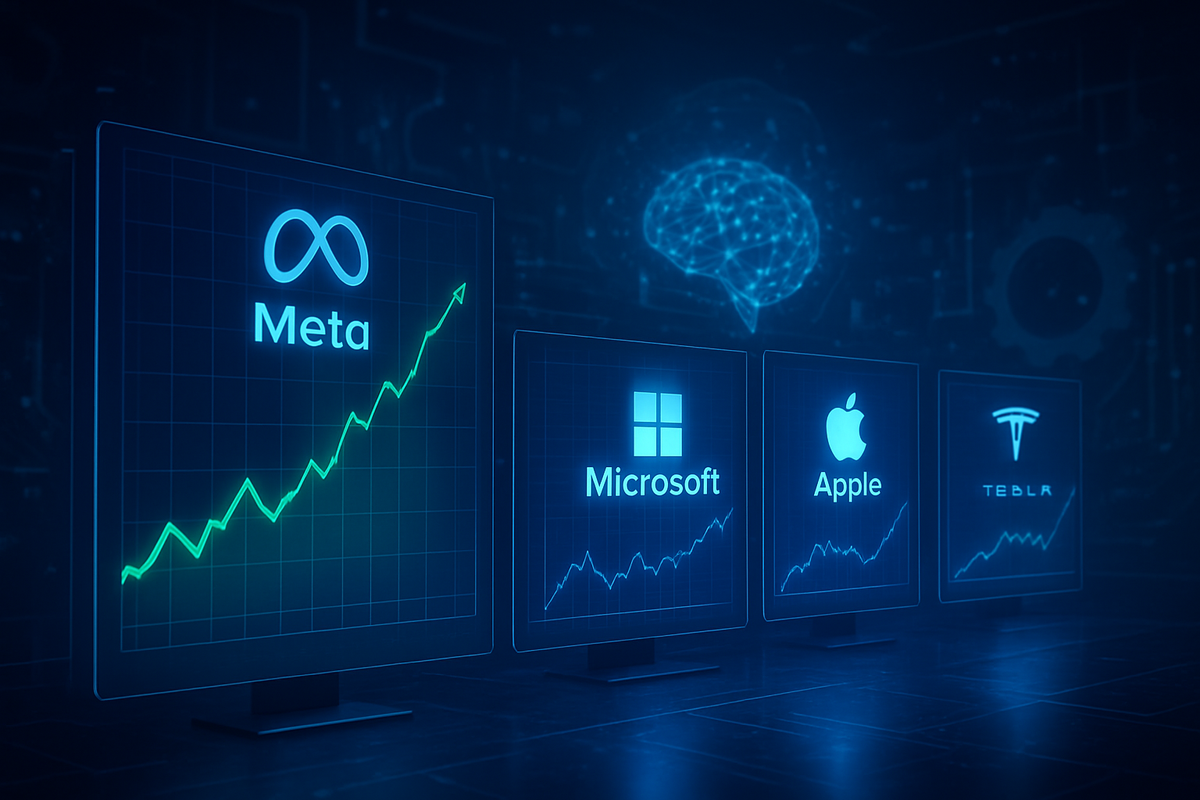
As the final week of January 2026 approaches, the financial markets are bracing for a high-stakes collision of corporate performance and macroeconomic policy. On Friday, January 23, Meta Platforms, Inc. (NASDAQ: META) spearheaded a late-session surge among tech giants, climbing 4.22% to close at approximately $647.63. This rally reflects a broader, more calculated repositioning by investors as the "Magnificent 7" prepare to pull back the curtain on their fourth-quarter results for 2025. The coming days are set to be the most volatile of the year, with heavyweights Microsoft Corp. (NASDAQ: MSFT), Tesla, Inc. (NASDAQ: TSLA), and Apple Inc. (NASDAQ: AAPL) all scheduled to report earnings just as the Federal Open Market Committee (FOMC) meets to decide the fate of interest rates.
The immediate implications of this repositioning are clear: the "one-size-fits-all" approach to Big Tech investing is over. While the tech-heavy indices remain near record highs, a "Great Convergence" is underway, where capital is rotating out of crowded growth trades and into a resurgent "S&P 493." For Meta and its peers, the market is no longer satisfied with the mere promise of artificial intelligence (AI); investors are now demanding rigorous proof of monetization and a clear return on the billions of dollars spent on infrastructure over the past two years.
The Great Repositioning: Meta’s Momentum and the Fed’s Shadow
The Friday rally in Meta stock was not an isolated event but the culmination of a week-long trend where "AI monetizers" were separated from the rest of the pack. Meta’s 4.22% jump followed an even larger 5% gain the previous day, fueled by growing confidence in the company’s "Decade of Intelligence" strategy. Specifically, institutional buyers have been encouraged by the rapid adoption of AI agents within WhatsApp and the surprising retail success of the second-generation Ray-Ban Meta wearables. This momentum suggests that Meta has successfully transitioned from a social media firm to a vertically integrated AI hardware and software powerhouse.
While Meta thrives, the broader "Magnificent 7" cohort is seeing a significant shift in investor sentiment. Recent fund manager surveys indicate that the "Long Magnificent 7" trade—once the most crowded position on Wall Street—has seen its popularity nearly halved, dropping from 54% to 27% in recent months. Investors are now hedging their bets, moving capital into the Russell 2000 and cyclical sectors like industrials. This defensive posture is a direct response to the upcoming January 28 FOMC meeting. Markets are currently pricing in a 95% to 98% probability that the Federal Reserve will hold interest rates steady at 3.50%–3.75%, but the looming leadership transition at the Fed has introduced a layer of long-term uncertainty that traders are keen to avoid.
The timeline leading to this moment has been defined by a "Cycle of Accountability." Throughout 2024 and 2025, any mention of AI was enough to propel tech stocks to new heights. However, by late 2025, a performance split began to emerge. As we head into the January 28-29 earnings window, the market is using these reports as a "binary event" to test whether the massive capital expenditures (CapEx) of 2025—which exceeded $70 billion for Meta alone—are finally yielding margin expansion.
Winners, Losers, and the High Stakes of Q4 Earnings
The upcoming earnings reports will likely solidify a new hierarchy within the tech sector. Meta Platforms, Inc. enters the week as a clear frontrunner, with analysts looking for evidence that its AI-driven ad targeting is successfully navigating new privacy regulations in Europe. On the other side of the ledger, Tesla, Inc. faces a skeptical audience. When the EV pioneer reports after the bell on January 28, the focus will be squarely on automotive margins. Despite record deliveries of 418,000 vehicles in the previous quarter, Tesla’s EPS is estimated at a modest $0.32, as price cuts and R&D for the "Model 2" affordable platform continue to weigh on the bottom line.
Microsoft Corp. is perhaps the most scrutinized of the bunch. With an EPS estimate of $3.86–$3.88, the software giant must prove that its "Copilot" AI assistant is scaling revenue as quickly as investors hope. Furthermore, a lingering $25 billion exposure risk from ongoing litigation involving OpenAI has kept some institutional investors on the sidelines. Meanwhile, Apple Inc. remains in a state of "cautious optimism." While its Services division is a high-margin fortress, soft demand for hardware in Asian markets has led to a revenue estimate of $138.4 billion—a figure that would be a win but hardly a breakout performance.
Other members of the elite group, such as NVIDIA Corporation (NASDAQ: NVDA) and Alphabet Inc. (NASDAQ: GOOGL), are being watched as bellwethers for the entire ecosystem. Alphabet has seen a 7.1% year-to-date gain, outperforming Microsoft's -5.3% decline in early 2026. This divergence suggests that the market is rewarding companies that have achieved "AI self-sufficiency" through their own proprietary silicon and cloud infrastructure, while penalizing those perceived as being overly dependent on third-party partnerships or hardware cycles.
A New Regulatory and Economic Landscape
The current market volatility is set against a backdrop of significant regulatory and economic shifts. In the United States, the "One Big Beautiful Bill Act" (OBBBA), signed into law in mid-2025, has fundamentally altered the competitive landscape. By making 100% bonus depreciation and R&D expensing permanent, the OBBBA has provided a massive tailwind for the domestic manufacturing and industrial sectors—the "S&P 493." This has allowed these previously stagnant sectors to close the earnings growth gap with Big Tech, leading to the "Revenge of the S&P 493" narrative that is dominating 2026.
Regulatorily, the environment has become a tale of two continents. In Europe, the looming August 2, 2026 deadline for the EU AI Act’s General-Purpose AI (GPAI) provisions is forcing companies like Meta and Microsoft to overhaul their transparency and data-sharing protocols or risk fines of up to 7% of global revenue. Conversely, in the U.S., a new executive order issued in December 2025 titled "Ensuring a National Policy Framework for AI" has provided a federal shield for tech giants by preempting more restrictive state-level regulations. This "pro-innovation" stance from Washington has balanced out the tightening grip of Brussels, creating a complex geopolitical puzzle for multinational tech firms.
Historically, this moment mirrors the "dot-com" maturation phase of the early 2000s, where the initial excitement over a new technology was replaced by a brutal focus on unit economics. However, unlike the 2000s, the "Magnificent 7" are currently generating immense cash flow. The question for 2026 isn't whether these companies are profitable, but whether they can maintain the 30%+ growth rates that justified their massive valuations during the 2023-2024 AI gold rush.
What Lies Ahead: Scenarios for the Post-Earnings Market
In the short term, the market is bracing for an explosion of volatility. Implied volatility for Meta and Microsoft options is currently hovering near 60%, suggesting that traders expect swings of 5% to 8% in either direction following their reports. If Microsoft delivers a "beat and raise" driven by Azure’s AI integration, it could reignite the growth trade. However, if Tesla’s margins disappoint or Apple’s guidance remains conservative, we may see a continuation of the rotation into small-caps and value stocks.
Longer-term, the strategic pivot required for these companies involves a shift from "AI development" to "AI utility." The market is looking for the next phase of the "Decade of Intelligence," where AI is no longer a feature but the backbone of the global economy. Companies that fail to demonstrate this transition may find themselves relegated to the status of legacy tech, while those that succeed—potentially including Meta if it maintains its current trajectory—will likely lead the next multi-year bull cycle.
Strategic adaptations are already visible. Microsoft is expected to provide updates on its "cloud gatekeeper" challenges in the EU, while Meta is leaning heavily into "less personalized" ad models to appease regulators while maintaining its high-margin revenue streams. The success of these pivots will determine whether the "Magnificent 7" can reclaim their undisputed leadership of the S&P 500 or if 2026 will be remembered as the year the broader market finally caught up.
Final Thoughts: The 48-Hour Verdict
The 48-hour window between the FOMC announcement on January 28 and Apple's earnings report on January 29 will likely define the market's trajectory for the first half of 2026. The key takeaway for investors is that the era of "blind growth" in Big Tech has ended, replaced by a "Cycle of Accountability." Meta’s recent 4.22% lead to the upside shows that the market is still willing to reward companies with a clear vision, but the margin for error has never been thinner.
As the Federal Reserve maintains its steady hand on interest rates, the onus of market performance has shifted entirely to corporate execution. Investors should watch for the "Azure vs. Copilot" growth rates at Microsoft, the automotive margin recovery at Tesla, and the "Services" resilience at Apple. While the "Magnificent 7" may no longer be a unified front, their individual performances will dictate whether the current "soft landing" economic scenario can sustain a broader market rally.
The coming weeks will reveal which of these giants are truly indispensable to the AI-driven future and which were merely beneficiaries of a generational hype cycle. For now, all eyes are on the earnings calls, as the tech titans prepare to prove their worth in an increasingly competitive and regulated world.
This content is intended for informational purposes only and is not financial advice