The United States livestock industry is currently grappling with a "perfect storm" of catastrophic wildfires, record-low cattle inventories, and severe supply chain bottlenecks that are reshaping the American agricultural landscape. As of March 23, 2026, over 1.1 million acres across the High Plains have been scorched, with Nebraska and Oklahoma bearing the brunt of the destruction. The fires have not only displaced tens of thousands of cattle but have also vaporized critical feed supplies, effectively dimming any immediate hopes for herd expansion at a time when national cattle numbers have already plummeted to their lowest levels since the Truman administration.
The immediate implications are stark: retail beef prices are surging toward an unprecedented $10.00 per pound, while major meatpackers are shuttering facilities and facing labor unrest. For ranchers, the destruction of grazing land—in some areas described as "pure sugar sand" due to the heat sterilizing the soil—means a multi-year recovery period. This disaster is no longer just a regional crisis; it is a systemic disruption to the US food supply chain that will likely keep beef prices elevated for the remainder of the decade.
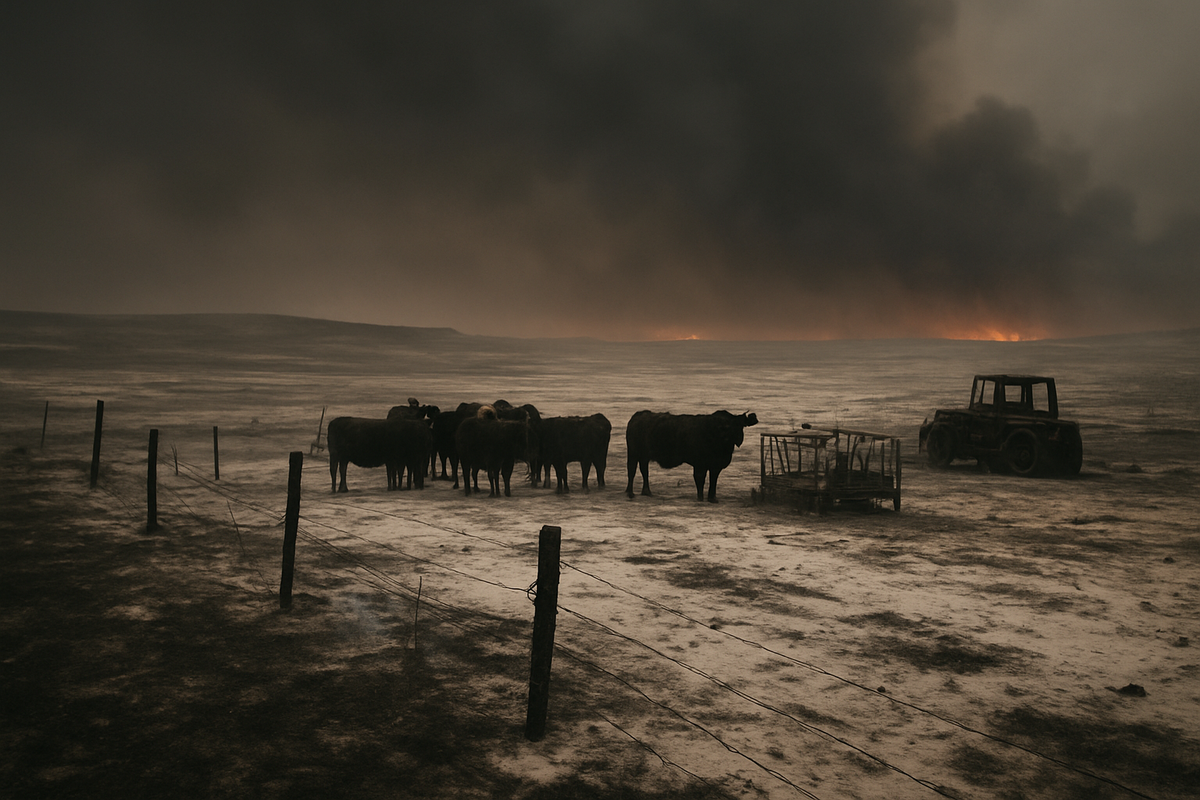
The current crisis reached a breaking point in mid-March 2026 with the ignition of the Morrill Fire in the Nebraska Sandhills. Fueled by 60 mph winds and historic drought conditions, the blaze quickly became the largest in Nebraska's history, scorching more than 820,000 acres. Simultaneously, the Ranger Road Fire in the Oklahoma Panhandle and southern Kansas consumed another 300,000 acres, creating a massive corridor of destruction through the heart of American "cow country."
These fires struck a livestock industry that was already at its most vulnerable state in 75 years. According to the USDA’s January 1, 2026 inventory report, the total U.S. cattle herd fell to 86.2 million head—the smallest since 1951. The beef cow breeding herd dropped to 27.6 million head, a level not seen since 1961. Years of persistent drought and soaring input costs had already forced many producers to liquidate their herds; the 2026 wildfires have now decimated the remaining capacity for those who stayed in the business.
The timeline of the disaster accelerated on March 12, 2026, when the Morrill Fire began its rapid expansion. By March 20, local officials estimated that between 35,000 and 45,000 cattle in Nebraska alone had been displaced or lost. In Oklahoma, ranchers reported the heartbreaking loss of "generational genetics"—breeding lines developed over decades that were wiped out in a single afternoon. The immediate market reaction was a sharp rally in cattle futures, which hit near-record highs as traders priced in a long-term supply vacuum.
The financial fallout from the "Great Cattle Crunch" is unevenly distributed across the agricultural sector, creating clear winners and losers among public companies. Tyson Foods (NYSE: TSN) has emerged as one of the most visible casualties of the supply shortage. On January 20, 2026, Tyson permanently closed its massive beef processing plant in Lexington, Nebraska. The facility, which handled 5,000 head per day, was shuttered because there simply weren't enough cattle to keep the lines running profitably. Tyson is projecting an operating loss for its beef segment of up to $600 million for fiscal 2026, forcing the company to lean on its poultry and prepared foods divisions to maintain overall stability.
Similarly, JBS S.A. (OTC: JBSAY) has faced severe operational hurdles. On March 16, 2026, approximately 3,800 workers at its Greeley, Colorado, facility—one of the world's largest—went on strike over wages and safety concerns. The strike paralyzed 7% of total U.S. beef processing capacity at a time when margins were already negative. However, JBS's global footprint in Brazil and Australia provides a hedge that domestic-centric competitors lack, allowing it to navigate the U.S. crisis with slightly more resilience than Tyson.
Conversely, companies focused on animal health and pasture restoration are seeing a surge in strategic importance. Zoetis (NYSE: ZTS) has pivoted toward precision genetics to help ranchers maximize the value of their remaining herds. In early March 2026, Zoetis acquired Neogen’s animal genomics business for $160 million, a move designed to capture the demand for "smarter" cattle that can survive harsher environments. Corteva (NYSE: CTVA) is also positioned to benefit from the recovery phase; its pasture management and weed control products are essential for ranchers looking to restore scorched grasslands. Analysts maintain a "Buy" consensus on Corteva, with a price target of $82.90, as the company leads the charge in "rebuilding the range before rebuilding the herd."
This event fits into a broader, more alarming industry trend: the transition from high-volume beef production to a premium, supply-constrained market. The 2026 wildfires represent a "tipping point" that likely delays any meaningful national herd expansion by at least 18 months. Historically, the cattle cycle lasts roughly ten years, but the current contraction is entering its eighth year with no end in sight. The precedent set by the 2024 Smokehouse Creek Fire was a warning, but the 2026 blazes in Nebraska have proven that the High Plains are facing a new era of climate-driven volatility.
The ripple effects extend beyond the meat aisle. Regulatory focus is shifting toward the Livestock Indemnity Program and emergency grazing authorizations, but these policy tools are struggling to keep pace with the scale of the loss. Furthermore, a recent halt on live cattle imports from Mexico due to New World screwworm concerns has closed the only remaining "relief valve" for U.S. feedlots. This suggests that the "beef squeeze" is a structural change rather than a seasonal spike.
In the short term, the industry must manage a critical feed shortage. With hay stockpiles burned and pastures sterilized, the Nebraska Cattlemen Disaster Relief Fund is coordinating massive donations, but it is a stopgap measure. Over the long term, ranchers will be forced into strategic pivots, such as shifting toward smaller, more genetically superior herds that require less forage. We may also see an acceleration of "blended protein" strategies from companies like Hormel Foods (NYSE: HRL), which is already experimenting with mixing premium beef with alternative proteins to keep consumer price points under $10.00.
Market opportunities will emerge for those who can provide technological solutions for a "drier" future. This includes advanced irrigation, drought-resistant forage seeds, and precision livestock monitoring. However, the challenge remains the 1-to-3-year recovery time for the "sugar sand" pastures in the Sandhills. Until the grass returns, the herd cannot.
The historic wildfires of 2026 have effectively reset the clock on the U.S. cattle industry’s recovery. The destruction of over a million acres of prime ranchland, combined with a national herd size not seen since the 1950s, creates a supply deficit that cannot be easily solved by imports or efficiency gains. The era of cheap American beef is, for the foreseeable future, over.
Investors should watch for the USDA's upcoming quarterly reports to see if the liquidation of breeding cows continues to accelerate in the wake of the fires. Additionally, monitor the performance of agricultural technology firms like Corteva and Zoetis, as they will be the primary beneficiaries of the rebuilding phase. The market moving forward will be defined by "precision over volume," and the companies that can help ranchers produce more with fewer, higher-quality animals will be the ones that survive this historic crunch.
This content is intended for informational purposes only and is not financial advice.