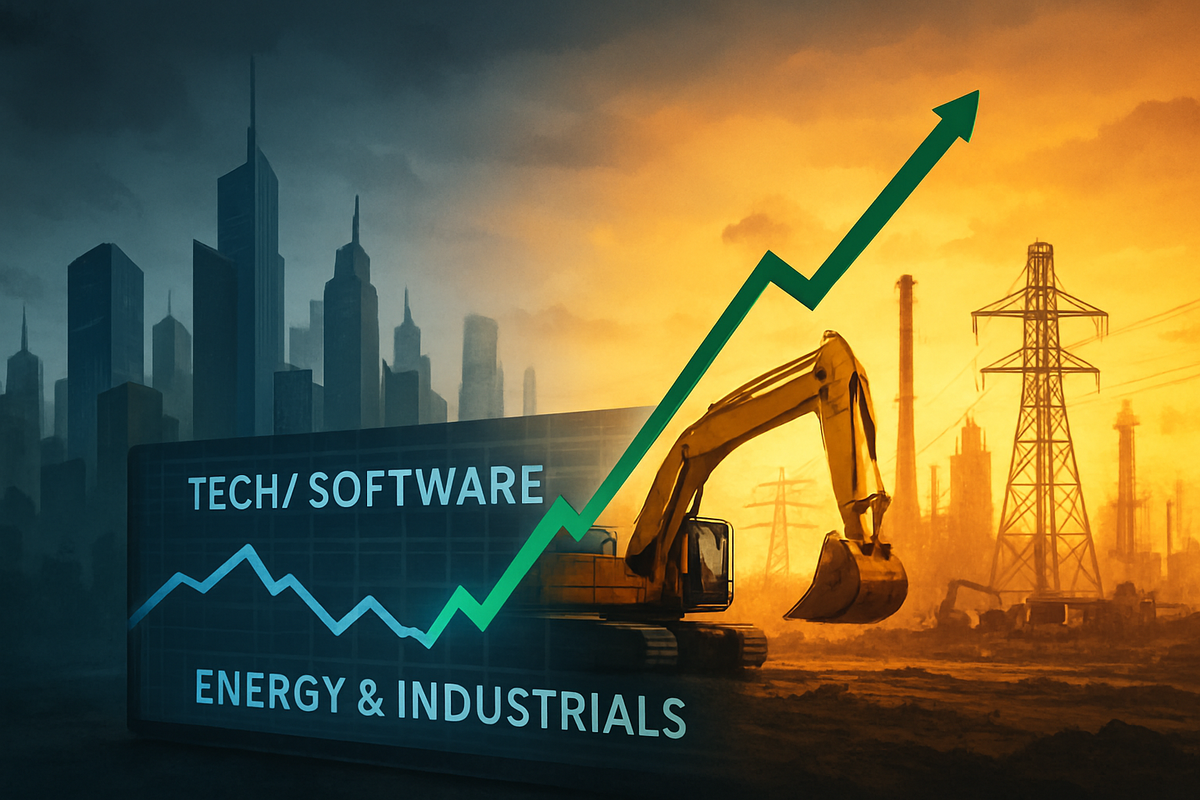
NEW YORK — The financial landscape of 2026 is witnessing a historic structural realignment as the era of "software-led supremacy" faces its most significant challenge in a decade. As of March 30, 2026, a massive rotation is underway, with institutional capital aggressively migrating from mega-cap technology and Software-as-a-Service (SaaS) providers into the "Real Economy" pillars of Energy, Industrials, and Materials. While the tech-heavy indices have stalled under the weight of valuation gravity and artificial intelligence disruption fears, the sectors responsible for physical infrastructure and power are reaching all-time highs.
The shift is most visible in the divergence between "Atoms" and "Bits." The Energy sector, measured by the Energy Select Sector SPDR Fund, has surged a staggering 22% year-to-date, fueled by a combination of geopolitical volatility and the insatiable power demands of the global AI data center build-out. In contrast, former growth darlings in the cloud and creative software spaces are mired in a formal bear market, with many shedding over 25% of their value since late 2025 as investors question the long-term defensibility of subscription-based software models.
The "Silicon to Steel" Transition: Anatomy of a Rotation
The roots of this rotation can be traced back to the "DeepSeek Shock" of early 2026, which saw the emergence of hyper-efficient, open-source AI models that significantly lowered the barrier to entry for complex software tasks. This event triggered a fundamental re-evaluation of the "per-seat" pricing moats that once protected major software firms. By February 2026, the market sentiment shifted from celebrating AI’s potential to fearing its ability to commoditize the very software that was supposed to harness it. Simultaneously, the Federal Reserve’s decision to maintain interest rates between 3.5% and 3.75% throughout the first quarter has placed a premium on companies with immediate cash flow and tangible assets over long-duration growth tech.
As software multiples contracted, the "Real Economy" sectors found a second wind. The timeline of this surge accelerated in early March 2026 following a significant escalation in Middle Eastern tensions, which disrupted global energy flows and sent Brent crude prices toward $115 per barrel. This "geopolitical insurance" trade combined with a structural supply deficit in critical minerals has turned the once-overlooked Materials and Energy sectors into the market's new "Alpha." Investors who spent 2024 and 2025 chasing the next big Large Language Model (LLM) are now chasing the copper, steel, and kilowatts required to keep those models running.
Winners and Losers: The Industrial Renaissance vs. The SaaS Crisis
In this new market regime, physical dominance is the primary driver of share price appreciation. Exxon Mobil Corp. (NYSE: XOM) has emerged as a primary beneficiary, with its shares trading near record highs of $175 as of late March. The company's disciplined capital return strategy, including a $20 billion annual buyback program, has made it a preferred safe haven. Similarly, Caterpillar Inc. (NYSE: CAT) has become an unlikely "AI play," with its stock price hitting $719—a 104% gain over the past twelve months. The industrial giant is struggling to keep up with a $51 billion order backlog, much of it driven by its Power Systems segment, which provides massive backup generators for the world’s rapidly expanding data center clusters.
Conversely, the "software disruption" narrative has claimed several high-profile victims. Adobe Inc. (NASDAQ: ADBE) and Shopify Inc. (NYSE: SHOP) have faced significant selling pressure as new AI agents demonstrate the ability to automate creative and e-commerce workflows that previously required expensive subscriptions. Salesforce Inc. (NYSE: CRM) has also seen its valuation compressed, as investors worry that AI-driven efficiency will lead to "seat contraction" at major enterprises. The market is now demanding immediate return on investment (ROI) from AI, and while software companies are still in the "investment" phase, the providers of raw materials like Nucor Corp. (NYSE: NUE) and Freeport-McMoRan (NYSE: FCX) are already booking record profits from the physical build-out.
A Global Pivot: Infrastructure and Policy Drivers
The wider significance of this rotation extends beyond simple market cycles; it reflects a global policy shift toward industrial self-sufficiency and "hard" infrastructure. In the United States, 2026 marks the peak funding year for the Infrastructure Investment and Jobs Act (IIJA), which has directed over $56 billion into domestic projects this year alone. Furthermore, the passage of the Enhanced Critical Minerals and Manufacturing Support Act (2.0) in February 2026 has incentivized domestic production of lithium and copper, directly benefiting firms like Freeport-McMoRan (NYSE: FCX).
This trend is not isolated to the U.S. The European Union’s Industrial Accelerator Act, unveiled in mid-March, mimics American industrial policy by prioritizing "Made in EU" materials for public subsidies. Even China’s 15th Five-Year Plan, launched earlier this year, has pivoted away from its troubled real estate sector toward a state-led build-out of a "New Energy" power grid. These coordinated global efforts have created a "floor" for commodity prices, ensuring that the Materials and Energy sectors remain central to the global economy even as digital services face deflationary pressure from AI.
The Road Ahead: Supercycles and Strategic Pivots
Looking toward the remainder of 2026, the primary question for investors is whether this rotation is a temporary correction or the beginning of a multi-year commodity supercycle. Short-term scenarios suggest that if the Federal Reserve begins to cut rates in late 2026, some growth tech names could see a relief rally. However, the structural demand for the "Real Economy"—driven by the 150,000-tonne copper shortfall projected for this year—suggests that the leadership of companies like Nucor Corp. (NYSE: NUE) is likely to persist.
Software companies will be forced to undergo significant strategic pivots to survive this "SaaS Crisis." We expect to see a move away from per-seat pricing toward "outcome-based" or "usage-based" models where companies charge for the actual value generated by their AI agents. In the meantime, the market’s focus will remain on the physical constraints of the AI revolution. As one analyst noted, "You can't code your way out of a power shortage or a lack of structural steel."
Market Wrap-Up: A New Hierarchy of Value
As we close out the first quarter of 2026, the key takeaway is clear: the market has moved from a "software first" mindset to one that prioritizes the physical foundations of the modern world. The 22% surge in Energy and the triple-digit gains in heavy industrials like Caterpillar represent a fundamental shift in where the most reliable profits are being generated. The "Great Rebalancing" has punished companies that rely on digital moats while rewarding those that own the "atoms" of the 21st-century economy.
Moving forward, investors should keep a close watch on monthly inflation data and global power grid stability, as these will be the primary bellwethers for the continued strength of the "Real Economy" trade. While Big Tech is far from dead, its days of unchallenged dominance appear to be over. In 2026, the real power—both literally and figuratively—resides in the companies that keep the lights on and the machines moving.
This content is intended for informational purposes only and is not financial advice.