- Initial drilling: Thirteen holes have tested approximately 200 m of strike along the Scurvy Fault, intersecting broad zones of brittle and ductile deformation.
- Quartz veining and sulphides: Quartz veins measuring up to several metres wide, together with sulphide mineralization including pyrite and arsenopyrite, provide evidence of significant fluid flow.
- Large-scale structure: The graphitic sedimentary horizon associated with the Scurvy Fault is geophysically interpreted to extend for at least 15 km across Crippleback.
- Broader potential: More than 100 km of interpreted secondary faults across the approximately 200 km² Crippleback Intrusive Suite remain untested.
- Episode 15 of Pirate Gold Treasure Hunters now airing: https://youtu.be/_mogjnaY-2g
St. John's, Newfoundland and Labrador--(Newsfile Corp. - July 22, 2026) - Pirate Gold Corp. (TSXV: YARR) (OTCQB: YARRF) ("Pirate Gold" or the "Company"), is pleased to report initial visual observations from drilling at the Scurvy Fault, within the Crippleback area of its 100%-owned Treasure Island Project in Central Newfoundland. Treasure Island covers more than 90 km of strike along the Valentine Lake Fault Zone in Canada's newest gold district.
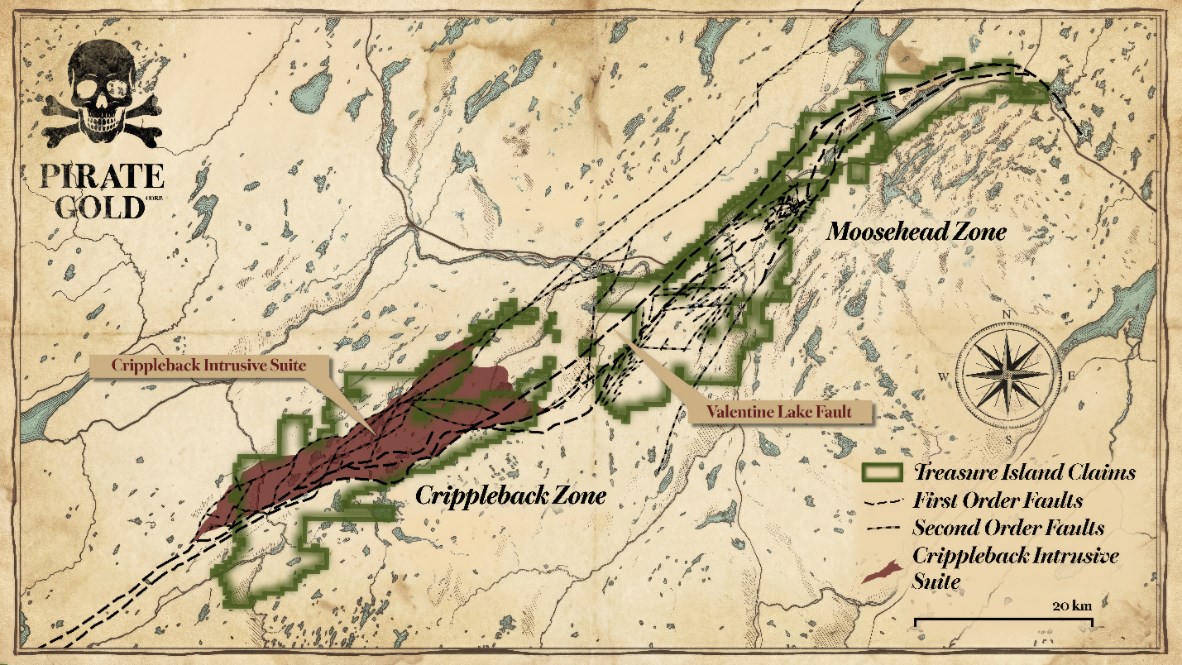
Fig. 1 - Map showing the location of Crippleback
To view an enhanced version of this graphic, please visit:
https://images.newsfilecorp.com/files/6079/306056_dfdb20ef9409b83e_001full.jpg
Scurvy Fault:
The Scurvy Fault is closely associated with a continuous graphitic sedimentary horizon that extends for at least 15 km through felsic volcanic sequences of the Crippleback Intrusive Suite. The conductive graphitic horizon is readily identifiable in electromagnetic surveys, as shown in Figures 2 and 3.
The Scurvy Fault was initially discovered in 2024 with a single drill hole CL-24-06 which intersected 1.0g/t Au, 34.0g/t Ag and 0.23% Cu over 0.75m. Until recently this was the only drill hole to ever test this zone.
Felsic to intermediate volcanic units in the hanging wall of the fault zone display broad zones of ductile deformation over intervals of approximately 10-50 m, while brittle deformation is primarily associated with the graphitic sedimentary horizon.
Quartz veining occurs both within the hanging-wall felsic and intermediate volcanic sequences as well as the graphitic sediment. Notable mineralization is commonly pyrite with localized occurrences of boulangerite and chalcopyrite within the volcanic hanging wall sequences, common mineralization seen in the graphitic fault zone and quartz vein network consists of pyrite and arsenopyrite.
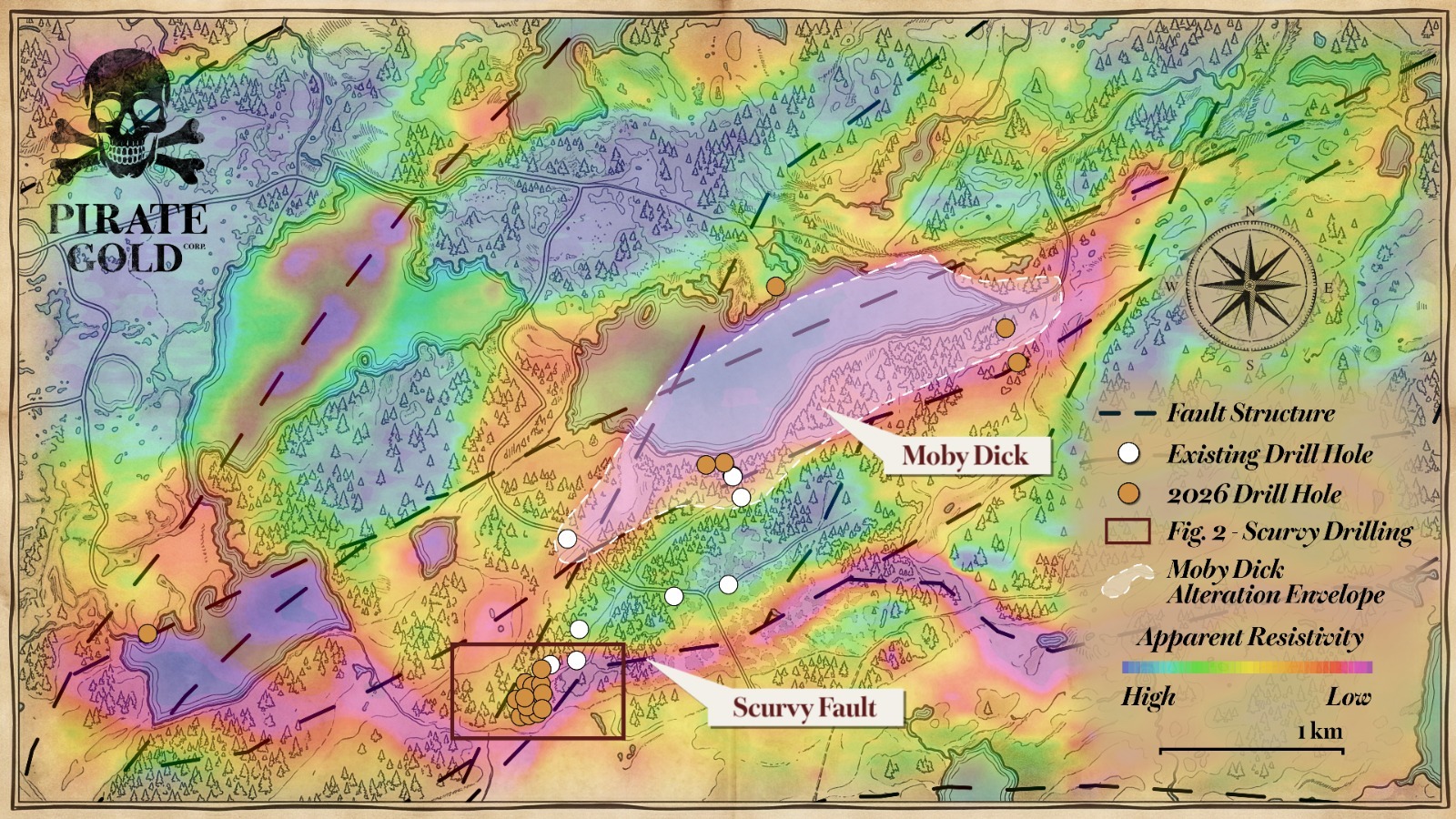
Fig. 2 - EM resistivity map showing the Scurvy Fault, associated conductive graphitic sedimentary horizon and drill collars
To view an enhanced version of this graphic, please visit:
https://images.newsfilecorp.com/files/6079/306056_pirategold.jpg
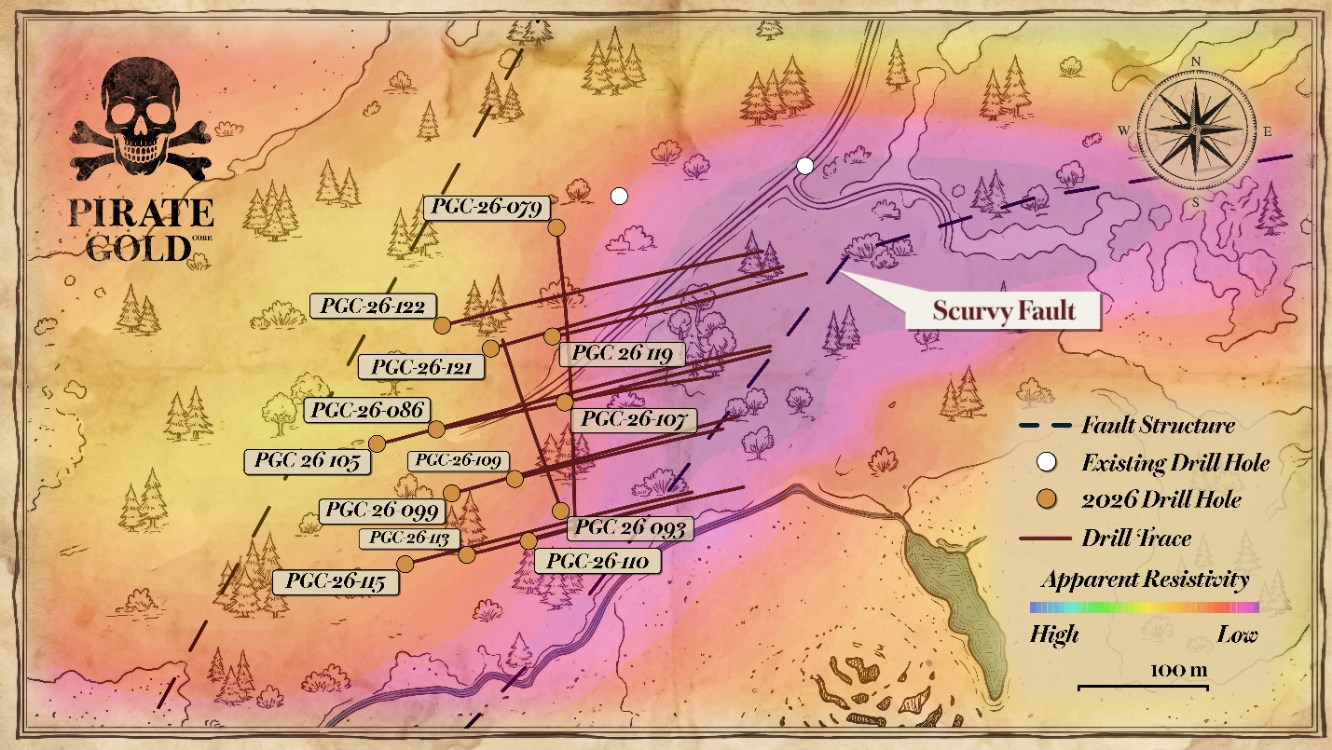
Fig. 3 - Inset of Figure 2 showing the Scurvy Fault, conductive graphitic sedimentary horizon and drill collars
To view an enhanced version of this graphic, please visit:
https://images.newsfilecorp.com/files/6079/306056_dfdb20ef9409b83e_003full.jpg
Initial Drilling and Visual Observations:
Table 1 is a summary of drilling to date at the Scurvy Fault
Table 1 - Visual mineralization observations - Scurvy Fault Drilling
| Hole ID | From (m) | To (m) | Description |
| PGC-26-079 | 63.4 | 65.3 | Brittle to ductile graphitic fault; mineralization consists of pyrite and arsenopyrite |
| 193.8 | 197.4 | Brecciated quartz vein hosted in intermediate volcanic; fine grained arsenopyrite and pyrite | |
| 247.45 | 249.7 | Graphitic sediment with arsenopyrite and pyrite, minor gouge zones | |
| 266.0 | 267.3 | Scurvy Fault, gouge zone in graphitic sediment, no mineralization present | |
| PGC-26-086 | 167.6 | 168.25 | Brecciated quartz vein hosted in intermediate volcanic; pyrite and chalcopyrite mineralization |
| 241.3 | 244.8 | Scurvy Fault, brecciated quartz vein to 160cm in graphitic sediment, shearing and gouge, pyrite and arsenopyrite mineralization | |
| PGC-26-093 | 131.1 | 144.4 | Shear zone in felsic volcanic, quartz vein to 10cm, pyrite and arsenopyrite mineralization |
| PGC-26-099 | 50.7 | 61.5 | Quartz fracture zone in felsic volcanic, quartz veins to 2cm with pyrite and boulangerite |
| 176.8 | 177.1 | Brecciated quartz vein in intermediate volcanic; pyrite mineralization | |
| 208.5 | 210.0 | Scurvy Fault in graphitic sediment. Irregular quartz vein to 15cm, shearing and gouge, pyrite and arsenopyrite mineralization | |
| PGC-26-105 | 38.0 | 118.0 | Intermediate volcanic with pyrite and localized arsenopyrite and sphalerite |
| 278.6 | 284.7 | Scurvy Fault in graphitic sediment, brecciated quartz veins up to 30cm, disseminated arsenopyrite and pyrite mineralization | |
| PGC-26-107 | 176.2 | 181.1 | Scurvy Fault along the margin of graphitic sediment and intermediate volcanic; gouge, breccia and shearing, quartz vein to 60cm, pyrite mineralization |
| 195.1 | 195.9 | Graphitic sediment with disseminated arsenopyrite | |
| PGC-26-109 | 166.0 | 171.8 | Scurvy Fault in graphitic sediment, brecciated quartz vein to 60cm, gouge and shearing, fine grained disseminated pyrite and arsenopyrite |
| PGC-26-110 | 122.5 | 129.4 | Scurvy Fault in graphitic sediment, irregular quartz veins to 5cm, numerous gouge zones and shearing, disseminated pyrite and arsenopyrite mineralization |
| PGC-26-113 | 156.7 | 162.6 | Scurvy Fault in graphitic sediment, irregular quartz veins to 2cm, numerous gouge zones and shearing, disseminated pyrite and arsenopyrite mineralization |
| PGC-26-115 | 188.5 | 198.0 | Scurvy Fault in graphitic sediment, shearing and gouge zones, disseminated pyrite mineralization |
| PGC-26-119 | 223.9 | 228.2 | Scurvy Fault in graphitic sediment, brecciated quartz vein up to 100cm, gouge and shearing, disseminated pyrite and arsenopyrite mineralization |
| PGC-26-121 | 243.2 | 263.6 | Brecciated quartz vein development in the hanging wall to Scurvy Fault within intermediate volcanic sequence with veins up to 360cm. Pyrite mineralization and localized arsenopyrite |
| 263.6 | 278.0 | Scurvy Fault in graphitic sediment, irregular quartz veins to 2cm, gouge and shearing | |
| PGC-26-122 | 240.6 | 246.0 | Scurvy Fault in graphitic sediment, shear structure, pyrite mineralization |
| 280.1 | 287.5 | Brecciated quartz veined zone within the footwall of Scurvy Fault intermediate volcanic host, pyrite and arsenopyrite mineralization |
The company cautions that visual observations of mineralization are not indicative of high assay grades, and drill core samples will be submitted to a certified laboratory for analysis. Assay values for the intervals shown will be released when available.
All intervals are down hole depths and true widths are unknown.
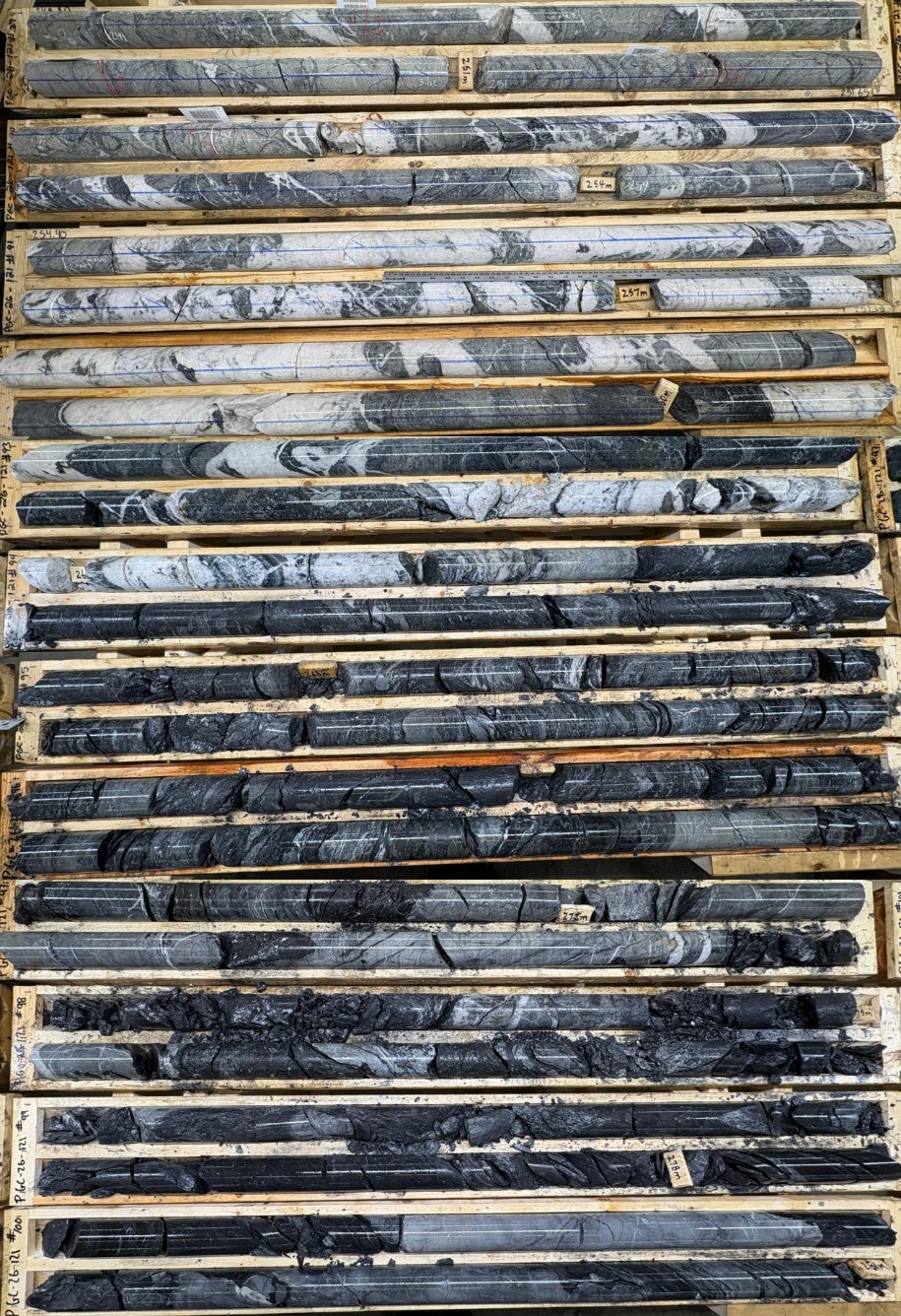
Fig. 4 - Drill core from PGC-26-121 from 248.8 - 281.0m showing quartz veined zone and Scurvy Fault in Graphitic Sediments*
*Figure 4 is not meant to be representative of mineralization in PGC-26-121.
To view an enhanced version of this graphic, please visit:
https://images.newsfilecorp.com/files/6079/306056_dfdb20ef9409b83e_004full.jpg
"The continuity and strength of the Scurvy Fault structure, combined with the significant fluid flows in the form of quartz veins and sulphide mineralization is a very clear affirmation that we are in an orogenic fault system. The drill defined structure to date measures over 200m in strike and to depths of 185m. Its genetic link to the graphitic sediment is clear and this rock unit is geophysically interpreted for at least 15km throughout Crippleback.
"The Valentine Lake Fault is a regional structure stretching for hundreds of kilometers across Newfoundland; it is similar in nature to the Destor-Porcupine and Larder Cadillac faults of the Abitibi Greenstone Belt which are spatially associated with many large gold deposits most of which occur along secondary faults like we have with Scurvy, there are well over 100km of geophysically interpreted secondary faults throughout the Crippleback Intrusive Suite that have never been drilled. This is just the start of orogenic exploration at Crippleback. We still have our eyes firmly focused copper porphyry and epithermal exploration at Crippleback and to have both mineral systems overlapping in the same environment is clearly a rarity," said Greg Matheson, VP Exploration.
"Crippleback is not a one-deposit story. Across this massive property, we see potential for multiple deposits. Moby Dick established the copper-gold opportunity; just 1.5 kilometres away, Scurvy is showing the right ingredients for orogenic gold. That potential for multiple mineral systems is what makes Crippleback so compelling," said Denis Laviolette, CEO.
Broader Orogenic Potential at Crippleback
The Scurvy Fault represents the first systematic drill test of a much broader network of secondary structures interpreted from geophysics across the approximately 200 km² Crippleback Intrusive Suite. More than 100 km of interpreted faults remain untested. Together with Crippleback's position along the Valentine Lake Fault Zone, the deformation, quartz veining and sulphide mineralization observed at Scurvy support continued evaluation of the area for orogenic-style gold mineralization alongside ongoing copper-gold porphyry and epithermal exploration.
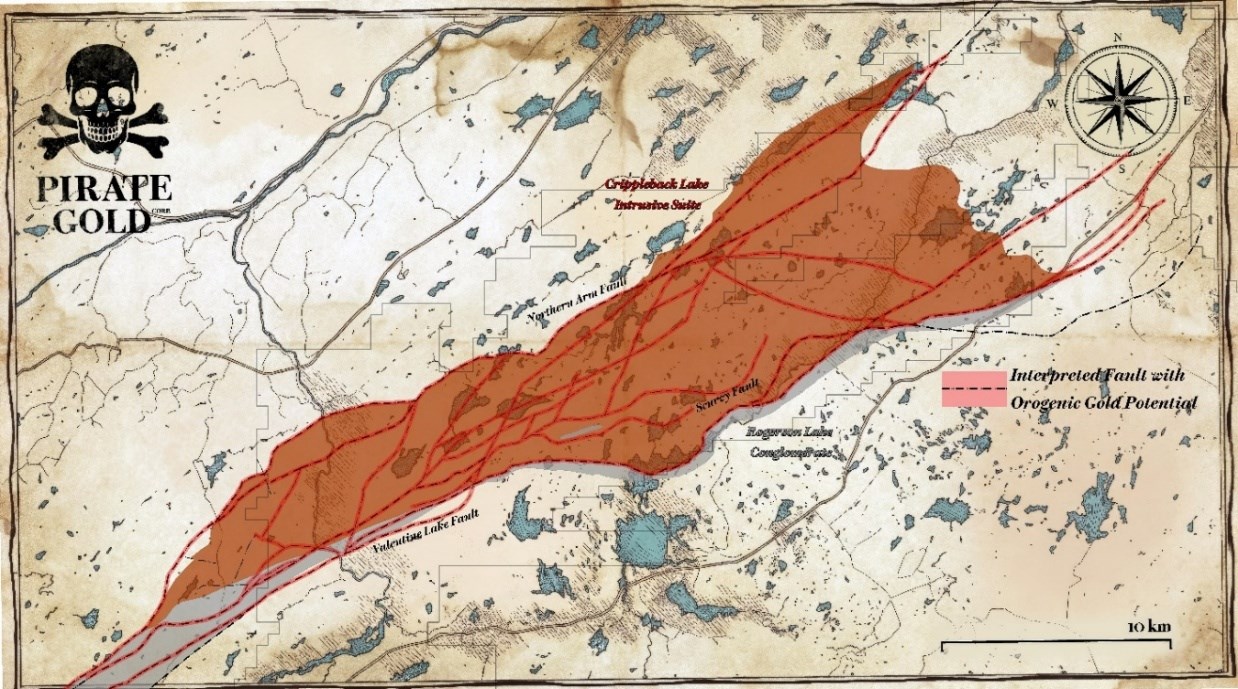
Fig. 5 - Map showing geophysically interpreted faults across 200 km2 of the Crippleback Intrusive Suite
To view an enhanced version of this graphic, please visit:
https://images.newsfilecorp.com/files/6079/306056_dfdb20ef9409b83e_005full.jpg
Table 2 - Drill Hole Information
| Drill Hole | Easting | Northing | Azimuth | Dip | Length (m) |
| PGC-26-079 | 561461 | 5397447 | 160 | -45 | 314 |
| PGC-26-086 | 561370 | 5397290 | 77 | -45 | 287 |
| PGC-26-093 | 561466 | 5397228 | 340 | -63 | 281 |
| PGC-26-099 | 561382 | 5397241 | 77 | -45 | 308 |
| PGC-26-105 | 561324 | 5397278 | 77 | -45 | 413 |
| PGC-26-107 | 561469 | 5397312 | 77 | -45 | 221 |
| PGC-26-109 | 561431 | 5397252 | 77 | -45 | 224 |
| PGC-26-110 | 561442 | 5397205 | 77 | -45 | 236 |
| PGC-26-113 | 561394 | 5397193 | 77 | -45 | 254 |
| PGC-26-115 | 561346 | 5397186 | 77 | -45 | 314 |
| PGC-26-119 | 561458 | 5397363 | 77 | -45 | 272 |
| PGC-26-121 | 561411 | 5397353 | 77 | -45 | 317 |
| PGC-26-122 | 561373 | 5397370 | 77 | -45 | 332 |
Ongoing Exploration
Pirate Gold currently has three diamond drilling rigs operating at the Treasure Island Project as part of its 50,000m program. All three drilling rigs are active in the Crippleback region. The primary drilling focus is on the expansion of its Moby Dick copper porphyry - epithermal discovery which was announced on June 18, 2026. Drilling is also targeting additional regional targets in search of broadening the scale of the known alteration system across the 200 km2 Crippleback Intrusive Suite. The drilling program has and will continue simultaneously test the orogenic potential of Crippleback.
A fourth drill rig is anticipated to arrive at the project in early Q3 2026 and will be a barge mounted platform to explore directly beneath Crippleback Lake in aims of expanding the Moby Dick discovery near surface.
There is a very active ground exploration program ongoing at Crippleback with twelve geologists and prospectors conducting prospecting, mapping and spectral analysis across Crippleback.
Property Acquisitions
Pirate Gold has entered into an agreement with Paradigm Minerals, ("Paradigm") 85431 Newfoundland & Labrador Inc. ("85431"), 85893 Newfoundland & Labrador Inc. ("85893") and Nidon Enterprises Ltd. ("Nidon") to acquire a 100% interest in and to seven mineral licences. In consideration the Company will, subject to TSX Venture Exchange ("TSXV") approval, make a one-time cash payment of $30,000 to Paradigm, and issue 240,000 common shares to Paradigm, 20,000 common shares to 85431, 20,000 common shares to 85893, 20,000 common shares to Nidon and grant a 1.5% NSR royalty payable 90% to Paradigm and 10% to 85431 on certain mineral licenses, 90% to Paradigm and 10% to 85893 on certain mineral licenses, 90% to Paradigm and 10% to Nidon on certain mineral licenses and 100% to Paradigm on certain mineral licenses. One half of the NSR (0.75%) of which Pirate Gold can purchase for $1,000,000.
Pirate Gold has entered into an agreement with Catapult Minerals, ("Catapult") to acquire a 100% interest in and to one mineral licence. In consideration the Company will, subject to TSX Venture Exchange ("TSXV") approval, make a one-time cash payment of $20,000 to Catapult, issue 150,000 common shares to Catapult and grant a 1.0% NSR royalty to Catapult, one half of which Pirate Gold can purchase for $1,000,000.
Pirate Gold Treasure Hunters Season 1, Episode 15
Episode 15 of Pirate Gold Treasure Hunters explores the Scurvy Fault, where initial drilling is testing the largely unexplored orogenic gold potential at Crippleback.
The episode features:
- Thirteen holes testing a 200-metre segment of the Scurvy Fault
- Broad deformation, brittle and ductile faulting, multi-metre quartz veins and sulphide mineralization
- PGC-26-121, including pyrite and localized arsenopyrite within a broad quartz-veined zone
- The geological analogue between Crippleback and Equinox Gold's nearby Valentine Gold Mine
- More than 100 km of interpreted secondary faults across the Crippleback Intrusive Suite that remain untested
- Insights from world-renowned orogenic gold expert and Pirate Gold advisor Dr. Richard Goldfarb
- The potential for overlapping orogenic gold and copper-gold porphyry-epithermal systems at Crippleback
Cannot view this video? Visit:
https://www.youtube.com/watch?v=_mogjnaY-2g
Subscribe to Pirate Gold's YouTube channel for weekly episodes of Treasure Hunters and follow the drill in real time: https://www.youtube.com/@PirateGoldCorp
Qualified Person
Greg Matheson, P.Geo., VP Exploration for Pirate Gold, a "Qualified Person" under National Instrument 43-101, has reviewed and approved the scientific and technical information in this press release.
About Pirate Gold Corp.
Pirate Gold Corp. is a Newfoundland-focused exploration company advancing its 100%-owned Treasure Island Project, a district-scale property covering more than 90 km of strike along the Valentine Lake Fault Zone. Exploration is focused on the high-grade Moosehead gold system, the Moby Dick copper-gold porphyry/epithermal discovery and multiple regional targets across the Crippleback Intrusive Suite. The Company also holds a portfolio of Newfoundland gold projects, including the district-scale Fleur de Lys Project.
For more information, please contact:
Denis Laviolette, Executive Chairman, CEO & Director
E: denis@pirategold.ca
Joshua Duggan, Investor Relations
T: 647-526-1881
E: josh@pirategold.ca
Website: www.pirategold.ca
Twitter: @PirateGoldCorp
Facebook: @PirateGoldCorp
LinkedIn: @PirateGoldCorp
Acknowledgment
Pirate Gold acknowledges the financial support of the Junior Exploration Assistance Program, Department of Natural Resources, Government of Newfoundland and Labrador.
Neither the TSX Venture Exchange nor its Regulation Services Provider (as that term is defined in the policies of the TSX Venture Exchange) accepts responsibility for the adequacy or accuracy of this release.
Investors are cautioned that trading in the securities of the Company should be considered highly speculative. This news release contains "forward-looking statements" within the meaning of the applicable Canadian securities legislation that are based on expectations, estimates, assumptions, geological theories, and projections as at the date of this news release. The information in this news release about any information herein that is not a historical fact may be "forward-looking statements." Actual results may differ materially. Any statement that involves discussions with respect to predictions, expectations, beliefs, plans, projections, objectives, assumptions, future events or performance (which may, but not always, include phrases such as "anticipates", "plans", "scheduled", "believed" or "intends" or variations of such words and phrases or stating that certain actions, events or results "may" or "could", "would", "might" or "will" be taken to occur or be achieved) including statements regarding the Company's plans with respect to the Company's projects and the timing related thereto, the merits of the Company's projects, the Company's objectives, plans and strategies, and other matters are not statements of historical fact and may be forward-looking statements and are intended to identify forward-looking statements. Factors that may cause results to vary include delays in obtaining necessary approvals, changes in the market for the Company's securities, results of exploration, loss of title to properties, delays in obtaining permits or access to mineral properties, including as a result of adverse weather, fire or flood, changes to the Tax Act, rejection of expenditures as Qualifying Expenditures, and factors included in the documents filed from time to time with the Canadian securities regulatory authorities by Pirate Gold Corp. Pirate Gold Corp. will not update these forward-looking statements to reflect events or circumstances after the date hereof, except as required by law.

To view the source version of this press release, please visit https://www.newsfilecorp.com/release/306056