
Earnings results often indicate what direction a company will take in the months ahead. With Q2 behind us, let’s have a look at Donnelley Financial Solutions (NYSE: DFIN) and its peers.
Diversified financial services encompass specialized offerings outside traditional categories. These firms benefit from identifying niche market opportunities, developing tailored financial products, and often facing less direct competition. Challenges include scale limitations, regulatory classification uncertainties, and the need to continuously innovate to maintain market differentiation against larger competitors expanding their offerings.
The 11 diversified financial services stocks we track reported a satisfactory Q2. As a group, revenues beat analysts’ consensus estimates by 2.6% while next quarter’s revenue guidance was in line.
While some diversified financial services stocks have fared somewhat better than others, they have collectively declined. On average, share prices are down 4% since the latest earnings results.
Donnelley Financial Solutions (NYSE: DFIN)
Born from the need to navigate increasingly complex financial regulations in the digital age, Donnelley Financial Solutions (NYSE: DFIN) provides software and technology-enabled services that help companies comply with SEC regulations and manage financial transactions and reporting requirements.
Donnelley Financial Solutions reported revenues of $224.2 million, up 2.8% year on year. This print exceeded analysts’ expectations by 1.3%. Overall, it was a strong quarter for the company with a beat of analysts’ EPS estimates.
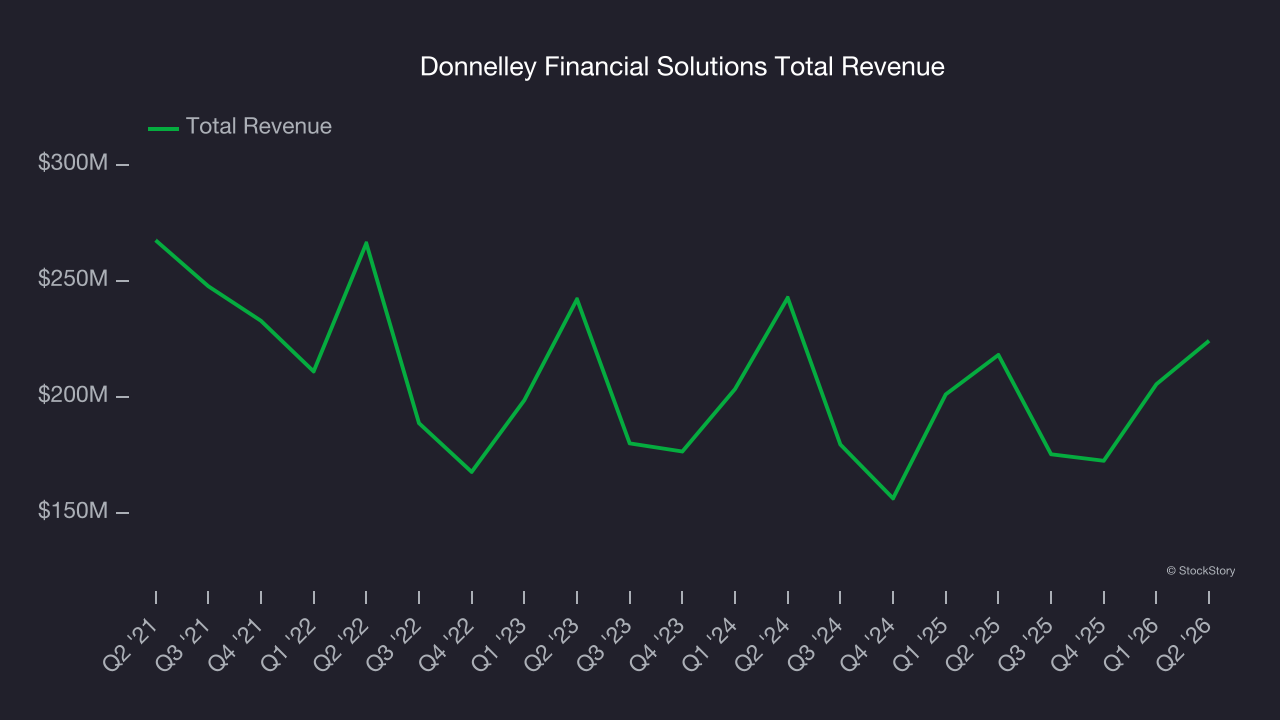
Donnelley Financial Solutions delivered the weakest guidance update of the whole group. Investor expectations, however, were likely higher than Wall Street’s published projections, leaving some wishing for even better results (analysts’ consensus estimates are those published by big banks and advisory firms, not the investors who make buy and sell decisions). The stock is down 4.1% since reporting and currently trades at $49.31.
Is now the time to buy Donnelley Financial Solutions? Access our full analysis of the earnings results here, it’s free.
Best Q2: Berkshire Hathaway (NYSE: BRK.A)
Led by legendary investor Warren Buffett since 1965, transforming it from a struggling textile manufacturer into a corporate giant, Berkshire Hathaway (NYSE: BRK.A) is a diversified holding company that owns businesses across insurance, railroads, utilities, manufacturing, retail, and services sectors.
Berkshire Hathaway reported revenues of $117.9 billion, up 19.2% year on year, outperforming analysts’ expectations by 15.7%. The business had an incredible quarter with a beat of analysts’ EPS estimates.
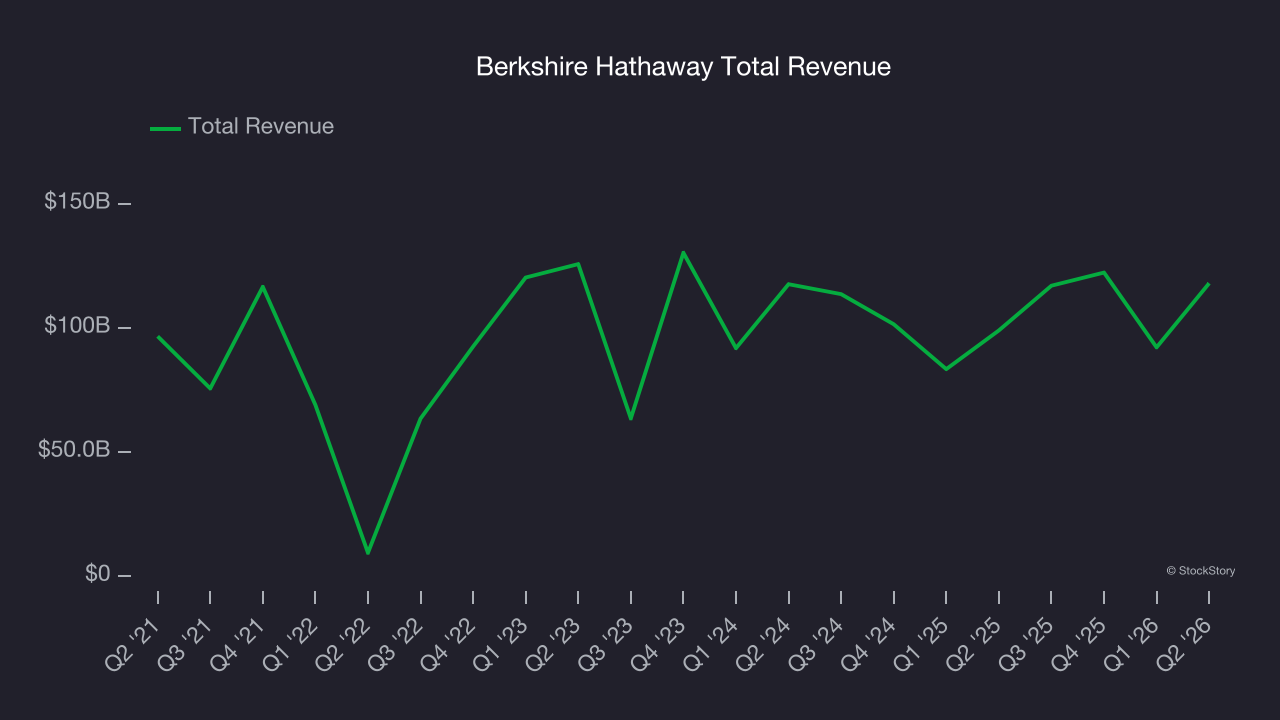
Berkshire Hathaway scored the biggest analyst estimate beat in the group. The market seems content with the results as the stock is up 1.2% since reporting. It currently trades at $789,822.
Is now the time to buy Berkshire Hathaway? Access our full analysis of the earnings results here, it’s free.
Weakest Q2: Western Union (NYSE: WU)
With a history dating back to 1851 when it began as a telegraph company, Western Union (NYSE: WU) is a global money transfer service that enables consumers and businesses to send funds across borders and currencies, typically within minutes.
Western Union reported revenues of $1.01 billion, down 1.3% year on year, falling short of analysts’ expectations by 0.9%. It was a disappointing quarter as it posted a significant miss of analysts’ EBITDA estimates and full-year EPS guidance missing analysts’ expectations significantly.
Western Union delivered the slowest revenue growth among its peers. As expected, the stock is down 21.5% since the results and currently trades at $6.03.
Read our full analysis of Western Union’s results here.
Payoneer (NASDAQ: PAYO)
Founded during the early days of global e-commerce in 2005 to solve international payment challenges, Payoneer (NASDAQ: PAYO) provides financial technology services that enable small and medium-sized businesses to send and receive payments globally across borders.
Payoneer reported revenues of $274.3 million, up 5.2% year on year. This print beat analysts’ expectations by 1.2%. However, it was a softer quarter as it logged EPS in line with analysts’ estimates.
The stock is flat since reporting and currently trades at $7.14.
Read our full, actionable report on Payoneer here, it’s free.
Corpay (NYSE: CPAY)
Formerly known as FLEETCOR until its 2024 rebrand, Corpay (NYSE: CPAY) provides specialized payment solutions for businesses to manage vehicle expenses, corporate payments, and lodging costs with enhanced control and reporting capabilities.
Corpay reported revenues of $1.34 billion, up 21.5% year on year. This number topped analysts’ expectations by 2.8%. It was a strong quarter as it also produced full-year EPS guidance topping analysts’ expectations and a beat of analysts’ EPS estimates.
Corpay had the weakest full-year guidance update of the whole group. The stock is flat since reporting and currently trades at $393.49.
Read our full, actionable report on Corpay here, it’s free.
Market Update
Over the past year, investors have been forced to repeatedly answer the same question: what is the market’s biggest risk? The answer has changed several times, and each shift has reshaped market leadership.
Late in 2025 and early 2026, artificial intelligence became the market’s primary uncertainty. Investors questioned whether AI would erode software pricing power and weaken competitive moats as AI made it easier to replicate once-differentiated products.
By the spring, technology took a back seat to geopolitics. The U.S. conflict with Iran briefly became the market’s dominant narrative, raising concerns about oil prices, inflation, and global growth. But as energy markets remained orderly and fears of a prolonged supply disruption faded, investors quickly turned their focus back to fundamentals.
Want to invest in winners with rock-solid fundamentals? Check out our Top 6 Stocks and add them to your watchlist. These companies are poised for growth regardless of the political or macroeconomic climate.