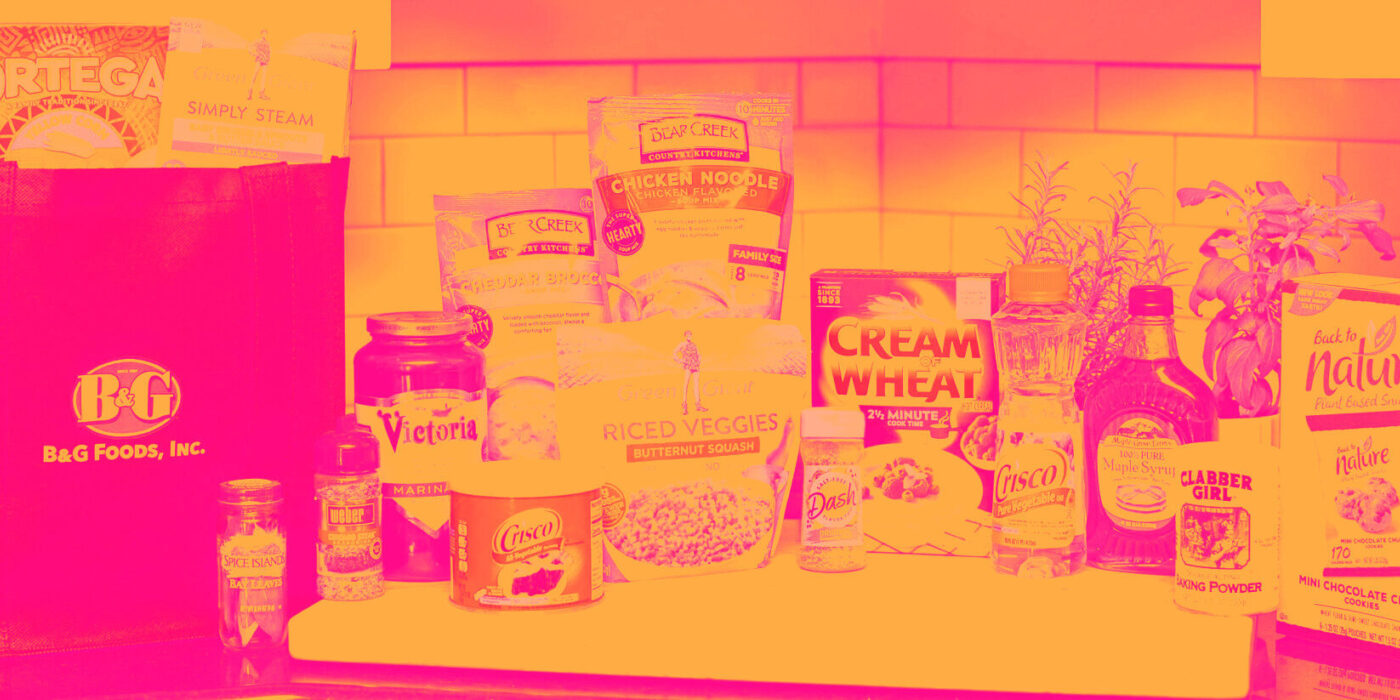
Packaged foods company B&G Foods (NYSE: BGS) missed Wall Street’s revenue expectations in Q2 CY2026, with sales falling 9.7% year on year to $383.3 million. On the other hand, the company’s full-year revenue guidance of $1.76 billion at the midpoint came in 1.1% above analysts’ estimates. Its non-GAAP profit of $0.06 per share was in line with analysts’ consensus estimates.
Is now the time to buy BGS? Find out in our full research report (it’s free for active Edge members).
B&G Foods (BGS) Q2 CY2026 Highlights:
- Revenue: $383.3 million vs analyst estimates of $397.3 million (9.7% year-on-year decline, 3.5% miss)
- Adjusted EPS: $0.06 vs analyst estimates of $0.06 (in line)
- Adjusted EBITDA: $60.39 million vs analyst estimates of $59.4 million (15.8% margin, 1.7% beat)
- The company reconfirmed its revenue guidance for the full year of $1.76 billion at the midpoint
- Management reiterated its full-year Adjusted EPS guidance of $0.63 at the midpoint
- EBITDA guidance for the full year is $282.5 million at the midpoint, above analyst estimates of $278.3 million
- Operating Margin: 9%, up from 5.2% in the same quarter last year
- Sales Volumes were down 4.3% year on year
- Market Capitalization: $276.8 million
StockStory’s Take
B&G Foods reported a 9.7% year-on-year revenue decline in Q2, missing Wall Street’s expectations, while non-GAAP profit came in as expected. Management attributed the weak sales to recent divestitures, particularly the Green Giant US Frozen, Le Sueur, and Don Pepino brands, which impacted reported volumes and base business performance. CFO Bruce Wacha noted, “Our results demonstrate our ability to grow adjusted EBITDA and net cash provided by operating activities, despite a challenging industry backdrop.” Operational improvements, acquisitions, and cost reductions helped support margin expansion, but the company acknowledged continued headwinds in its branded retail business.
Looking ahead, B&G Foods’ reaffirmed guidance is driven by ongoing portfolio reshaping, margin-focused brand management, and anticipated synergies from recent acquisitions. Management sees opportunity for further productivity gains as they integrate College Inn and Kitchen Basics, while maintaining cost discipline to offset inflation and logistics pressures. Wacha stated that the company is “focused on strengthening execution, maximizing the potential of our core brands, improving productivity, and accelerating strategies that can return the business to sustainable growth.” The team also highlighted potential benefits from tariff refunds and the upcoming closure of the Green Giant Canada divestiture.
Key Insights from Management’s Remarks
Management emphasized that Q2’s results reflected the impact of active portfolio reshaping, cost optimization, and the integration of new businesses, while also acknowledging persistent soft spots in branded retail channels.
-
CEO transition and strategic focus: B&G Foods appointed Robert Mills, a board veteran with digital, operational, and M&A experience, as CEO. Mills’ background in transformation and data-driven execution is expected to accelerate decision-making and sharpen focus on core brands and productivity initiatives.
-
Impact of recent portfolio changes: The sale of Green Giant US Frozen, Le Sueur, and Don Pepino, along with the acquisition of College Inn and Kitchen Basics, were key drivers behind the quarter’s revenue decline but also contributed to improved operating margins. Management said the reshaped portfolio is leading to a more balanced business mix and better cash generation.
-
Contract manufacturing ramp-up: After divesting Green Giant US Frozen, B&G Foods began contract manufacturing for the new owner at its Mexican facility. This business is described as modestly profitable and expected to deliver consistent, if incremental, EBITDA growth as additional customers are onboarded.
-
Cost discipline and SG&A reductions: Selling, general, and administrative expenses fell 14% year-on-year, with management implementing restructuring efforts and targeting further reductions in “stranded costs” left by divestitures. Wacha said cost cuts should continue into the third quarter, reaching a new run rate thereafter.
-
Brand performance variability: While hot breakfast brands like Cream of Wheat and McCann’s showed strength, certain spices and partner brands (notably Tones and Weber) faced challenges as some branded distribution shifted to private label arrangements. Management aims to address softness in tracked retail channels through targeted pricing and promotional strategies.
Drivers of Future Performance
Management’s outlook centers on continued integration of recent acquisitions, disciplined cost management, and a focus on stabilizing the core business amid ongoing inflation and logistics pressures.
-
Integration and margin enhancement: The company is focused on realizing margin benefits from the College Inn and Kitchen Basics brands, as well as efficiencies from the Green Giant US Frozen contract manufacturing business. Management expects these integration efforts to help offset volume softness and support overall profitability.
-
Inflation and cost headwinds: Ongoing inflation in key inputs like soybean oil and domestic freight costs remains a concern, particularly impacting brands such as Crisco. Management intends to address these pressures with selective price increases and continued cost control, but acknowledges consumer price sensitivity could limit the effectiveness of these measures.
-
Potential for further portfolio activity: While the major divestitures are nearly complete with Green Giant Canada’s sale pending, management signaled openness to additional opportunistic acquisitions or asset sales to strengthen the portfolio, balance sheet, and long-term growth prospects.
Catalysts in Upcoming Quarters
Looking ahead, the StockStory team will monitor (1) the successful integration and performance of College Inn and Kitchen Basics, especially during peak holiday seasonality; (2) closure and financial impact of the Green Giant Canada divestiture; and (3) management’s ability to further reduce stranded costs and stabilize branded retail channel performance. The pace of contract manufacturing customer additions and realization of tariff refunds will also be important drivers.
B&G Foods currently trades at $3.45, up from $3.41 just before the earnings. Is the company at an inflection point that warrants a buy or sell? Find out in our full research report (it’s free).
Stocks That Trumped Tariffs
ALSO WORTH WATCHING: Top 5 Momentum Stocks. The best time to own a great stock is when the market is finally noticing it. These aren’t just high-quality businesses. Something is happening with them right now. Elite fundamentals meet near-term momentum — both boxes checked at the same time.
Find out which stocks our AI platform is flagging this week. See this week’s Strong Momentum stocks — FREE. Get Our Strong Momentum Stocks for Free HERE.
Stocks that have made our list include now familiar names such as Nvidia (+1,460% between June 2020 and June 2025) as well as under-the-radar businesses like the once-micro-cap company Kadant (+214% between June 2020 and June 2025). Find your next big winner with StockStory today.