As the craze of earnings season draws to a close, here’s a look back at some of the most exciting (and some less so) results from Q1. Today, we are looking at discount retailer stocks, starting with Burlington (NYSE: BURL).
Discount retailers understand that many shoppers love a good deal, and they focus on providing excellent value to shoppers by selling general merchandise at major discounts. They can do this because of unique purchasing, procurement, and pricing strategies that involve scouring the market for trendy goods or buying excess inventory from manufacturers and other retailers. They then turn around and sell these snacks, paper towels, toys, clothes, and myriad other products at highly enticing prices. Despite the unique draw and lure of discounts, these discount retailers must also contend with the secular headwinds of online shopping and challenged retail foot traffic in places like suburban strip malls.
The 5 discount retailer stocks we track reported a very strong Q1. As a group, revenues beat analysts’ consensus estimates by 3.3% while next quarter’s revenue guidance was 2.2% above.
Thankfully, share prices of the companies have been resilient as they are up 5.7% on average since the latest earnings results.
Burlington (NYSE: BURL)
Founded in 1972 as a discount coat and outerwear retailer, Burlington Stores (NYSE: BURL) is now an off-price retailer that has broadened into general apparel, footwear, and home goods.
Burlington reported revenues of $2.86 billion, up 14.1% year on year. This print exceeded analysts’ expectations by 2.7%. Overall, it was a very strong quarter for the company with EPS guidance for next quarter exceeding analysts’ expectations and a solid beat of analysts’ EBITDA estimates.
Michael O’Sullivan, CEO, stated, “We are pleased with our strong performance in the first quarter. Adjusted EPS grew 26% versus the first quarter of last year, which represented our 14th consecutive quarter of double digit EPS growth. This track record demonstrates our ability to consistently convert sales into operating margin expansion thereby driving strong earnings flow-through.”
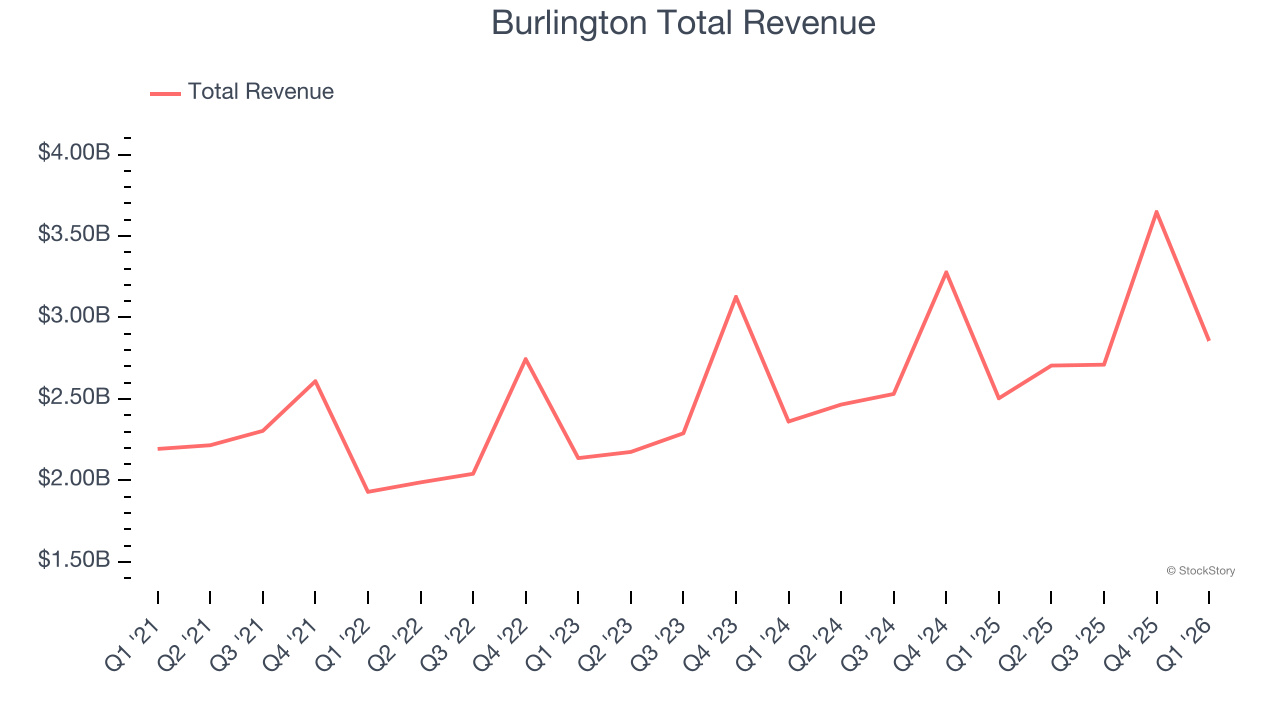
Burlington delivered the weakest guidance update among its peers. Interestingly, the stock is up 8.4% since reporting and currently trades at $353.50.
Is now the time to buy Burlington? Access our full analysis of the earnings results here, it’s free.
Best Q1: Five Below (NASDAQ: FIVE)
Often facilitating a treasure hunt shopping experience, Five Below (NASDAQ: FIVE) is an American discount retailer that sells a variety of products from mobile phone cases to candy to sports equipment for largely $5 or less.
Five Below reported revenues of $1.29 billion, up 32.5% year on year, outperforming analysts’ expectations by 5.7%. The business had an exceptional quarter with EPS guidance for next quarter exceeding analysts’ expectations and full-year EPS guidance exceeding analysts’ expectations.
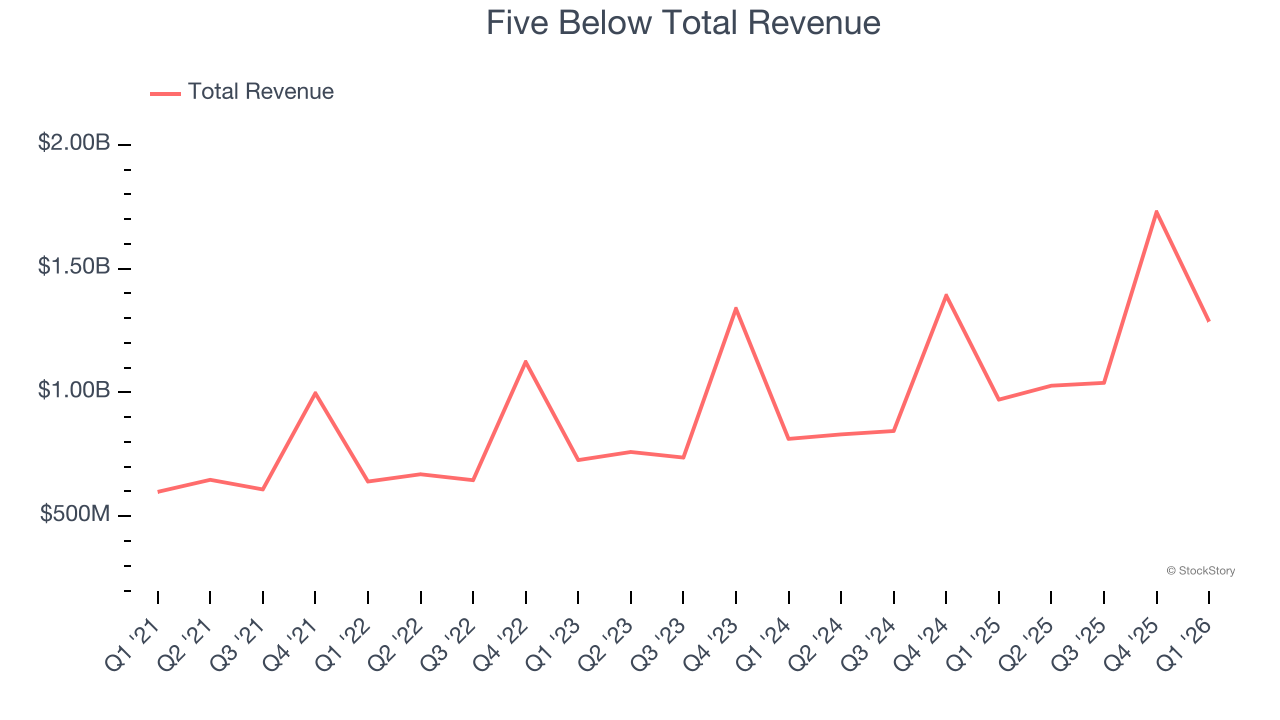
Five Below scored the highest guidance raise, fastest revenue growth, and highest full-year guidance raise of the whole group. The market seems happy with the results as the stock is up 9% since reporting. It currently trades at $243.
Is now the time to buy Five Below? Access our full analysis of the earnings results here, it’s free.
Weakest Q1: Ollie's (NASDAQ: OLLI)
Often located in suburban or semi-rural shopping centers, Ollie’s Bargain Outlet (NASDAQ: OLLI) is a discount retailer that acquires excess inventory then sells at meaningful discounts.
Ollie's reported revenues of $658.9 million, up 14.2% year on year, falling short of analysts’ expectations by 0.7%. Still, its results were good as it locked in a solid beat of analysts’ EBITDA estimates and a decent beat of analysts’ gross margin estimates.
Ollie's delivered the weakest performance against analyst estimates and weakest full-year guidance update in the group. As expected, the stock is down 2.9% since the results and currently trades at $76.96.
Read our full analysis of Ollie’s results here.
TJX (NYSE: TJX)
Initially based on a strategy of buying excess inventory from manufacturers or other retailers, TJX (NYSE: TJX) is an off-price retailer that sells brand-name apparel and other goods at prices much lower than department stores.
TJX reported revenues of $14.32 billion, up 9.2% year on year. This print surpassed analysts’ expectations by 2.4%. Overall, it was a strong quarter as it also produced an impressive beat of analysts’ gross margin and EPS estimates.
TJX had the slowest revenue growth among its peers. The stock is up 1.1% since reporting and currently trades at $152.31.
Read our full, actionable report on TJX here, it’s free.
Ross Stores (NASDAQ: ROST)
Selling excess inventory or overstocked items from other retailers, Ross Stores (NASDAQ: ROST) is an off-price concept that sells apparel and other goods at prices much lower than department stores.
Ross Stores reported revenues of $6.01 billion, up 20.6% year on year. This number topped analysts’ expectations by 6.6%. It was an exceptional quarter as it also put up EPS guidance for next quarter exceeding analysts’ expectations and an impressive beat of analysts’ gross margin estimates.
Ross Stores achieved the biggest analyst estimate beat in the group. The stock is up 12.8% since reporting and currently trades at $244.94.
Read our full, actionable report on Ross Stores here, it’s free.
Market Update
Over the past year, investors have been forced to repeatedly answer the same question: what is the market’s biggest risk? The answer has changed several times, and each shift has reshaped market leadership.
Late in 2025 and early 2026, artificial intelligence became the market’s primary uncertainty. Investors questioned whether AI would erode software pricing power and weaken competitive moats as AI made it easier to replicate once-differentiated products.
By the spring, technology took a back seat to geopolitics. The U.S. conflict with Iran briefly became the market’s dominant narrative, raising concerns about oil prices, inflation, and global growth. But as energy markets remained orderly and fears of a prolonged supply disruption faded, investors quickly turned their focus back to fundamentals.
Want to invest in winners with rock-solid fundamentals? Check out our Top 5 Quality Compounder Stocks and add them to your watchlist. These companies are poised for growth regardless of the political or macroeconomic climate.