Affordable knitwear demand, expanding home textile applications, and sustainability-driven innovations support steady market growth.
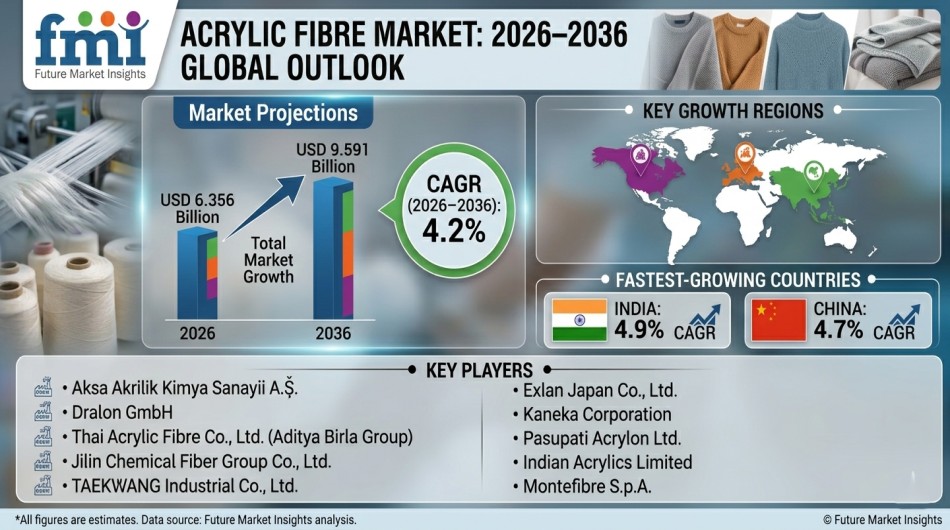
NEWARK, DE / ACCESS Newswire / April 7, 2026 / The global Acrylic Fibre Market is poised for steady expansion over the next decade, growing from USD 6.356 billion in 2026 to USD 9.591 billion by 2036, registering a CAGR of 4.2%. According to the latest analysis by Future Market Insights (FMI), sustained demand from apparel and home textile sectors, particularly in emerging markets, continues to underpin growth. Acrylic fibres, known for their wool-like feel, durability, UV resistance, and cost efficiency, remain a preferred alternative to natural fibres across price-sensitive consumer segments.
Acrylic Fibre Market Snapshot (2026-2036)
Market size in 2026: USD 6.356 billion
Market size in 2036: USD 9.591 billion
CAGR (2026-2036): 4.2%
Leading fibre form: Staple (~60% share)
Dominant end-use: Apparel (~55% share)
Key growth regions: Asia Pacific, Europe, North America
Fastest-growing countries: India (4.9% CAGR), China (4.7% CAGR)
Get Access of Report Sample: https://www.futuremarketinsights.com/reports/sample/rep-gb-2032
Market Momentum
The Acrylic Fibre Market begins at USD 6.356 billion in 2026 and demonstrates stable, application-driven growth throughout the forecast period. By 2030, increasing knitwear consumption, expanding organized retail, and rising home textile demand push the market toward consistent expansion.
Between 2030 and 2036, growth is reinforced by sustainability initiatives such as recycled acrylic fibre adoption, gel-dyeing technologies, and expansion into technical textile applications. By 2036, the market reaches USD 9.591 billion, maintaining a steady CAGR of 4.2%.
Why the Market Is Growing
The acrylic fibre market is expanding due to its critical role in affordable apparel and home textile manufacturing. These fibres offer wool-like warmth, vibrant color retention, easy maintenance, and resistance to moths and mildew, making them highly suitable for knitwear, blankets, carpets, and upholstery.
Rising middle-class populations and increasing disposable incomes in emerging economies are driving demand for cost-effective fashion and home textiles. At the same time, sustainability trends are accelerating the adoption of solution-dyed fibres, recycled acrylic materials, and low-water manufacturing processes.
Technological advancements in spinning, dyeing, and recycling processes are enhancing fibre performance and environmental efficiency, opening new growth avenues across both traditional and technical applications.
Segment Spotlight
Fibre Form: Staple Fibre Leads with ~60% Share
Staple fibres dominate due to their versatility in spinning, blending compatibility, and widespread use in knitwear and home textile manufacturing. Their adaptability across various yarn systems ensures continued leadership.
End-Use: Apparel Segment Dominates (~55% Share)
Apparel remains the largest consumer of acrylic fibres, driven by strong demand for sweaters, winterwear, and affordable fashion. The segment benefits from fast fashion trends and growing consumer preference for functional yet economical clothing.
Regional Growth: Asia Pacific Leads Expansion
Asia Pacific remains the primary growth hub, with India and China leading due to expanding textile manufacturing, rising domestic consumption, and export-oriented production.
India drives growth through knitwear manufacturing and retail expansion
China benefits from large-scale textile exports and domestic demand
Turkey strengthens its position as a key exporter to Europe
South Korea, USA, and Japan contribute through technical textile and specialty applications
Drivers, Opportunities, Trends, Challenges
Drivers:
Growing demand for affordable knitwear and home textiles
Expansion of organized retail and e-commerce
Rising adoption of acrylic fibres in emerging markets
Opportunities:
Recycled acrylic fibre and circular economy initiatives
Technical textile applications (automotive, filtration, outdoor fabrics)
Bio-based acrylonitrile and sustainable production technologies
Trends:
Gel-dyeing and solution-dyeing technologies reducing water usage
Development of functional and antimicrobial fibres
Increasing use in technical and industrial textiles
Challenges:
Competition from polyester and other synthetic fibres
Environmental concerns over microplastic shedding
Volatility in raw material prices
Country Growth Outlook (CAGR 2026-2036)
Country |
CAGR |
India |
4.9% |
China |
4.7% |
Turkey |
4.5% |
South Korea |
4.3% |
United States |
3.9% |
Japan |
3.8% |
Competitive Landscape
The Acrylic Fibre Market is moderately concentrated, with leading players focusing on fibre quality, sustainability, and application-specific innovation. Companies are investing in recycling technologies, advanced dyeing methods, and technical fibre development to strengthen market positioning.
Global manufacturers are competing on performance characteristics such as dyeability, softness, durability, and thermal resistance, while regional players leverage cost-efficient production and strong downstream partnerships.
Key Players in the Acrylic Fibre Market
Aksa Akrilik Kimya Sanayii A.Ş.
Dralon GmbH
Thai Acrylic Fibre Co. Ltd. (Aditya Birla Group)
Jilin Chemical Fiber Group Co. Ltd.
TAEKWANG Industrial Co. Ltd.
Exlan Japan Co. Ltd.
Kaneka Corporation
Pasupati Acrylon Ltd.
Indian Acrylics Limited
Montefibre S.p.A.
For an in-depth analysis of evolving formulation trends and to access the complete strategic outlook for the Acrylic Fibre Market through 2036, visit the official report page at: https://www.futuremarketinsights.com/reports/acrylic-fibre-market
Explore More Related Studies Published by FMI Research:
Environmental-Product-Declaration-Ready Low-Carbon PVC Compounds Market: https://www.futuremarketinsights.com/reports/environmental-product-declaration-ready-low-carbon-pvc-compounds-market
Scope 3 Emission-Reducing PVC Solutions for Construction OEMs Market: https://www.futuremarketinsights.com/reports/scope-3-emission-reducing-pvc-solutions-for-construction-oems-market
Safety-Enhanced Battery Separator Materials for Energy Storage Systems Market: https://www.futuremarketinsights.com/reports/safety-enhanced-battery-separator-materials-for-energy-storage-systems-market
Renewable-Energy Powered PVC Resin Production Platforms Market: https://www.futuremarketinsights.com/reports/renewable-energy-powered-pvc-resin-production-platforms-market
PVDF-Based Coatings for Lithium-Ion Battery Separators Market: https://www.futuremarketinsights.com/reports/pvdf-based-coatings-for-lithium-ion-battery-separators-market
About Future Market Insights (FMI)
Future Market Insights (FMI) is a leading provider of market intelligence and consulting services, serving clients in over 150 countries. Headquartered in Delaware, USA, with a global delivery center in India and offices in the UK and UAE, FMI delivers actionable insights to businesses across industries including automotive, technology, consumer products, manufacturing, energy, and chemicals.
An ESOMAR-certified research organization, FMI provides custom and syndicated market reports and consulting services, supporting both Fortune 1,000 companies and SMEs. Its team of 300+ experienced analysts ensures credible, data-driven insights to help clients navigate global markets and identify growth opportunities.
For Press & Corporate Inquiries
Rahul Singh
AVP - Marketing and Growth Strategy
Future Market Insights, Inc.
+91 8600020075
For Sales - sales@futuremarketinsights.com
For Media - Rahul.singh@futuremarketinsights.com
For web - https://www.futuremarketinsights.com/
SOURCE: Future Market Insights, Inc.
View the original press release on ACCESS Newswire