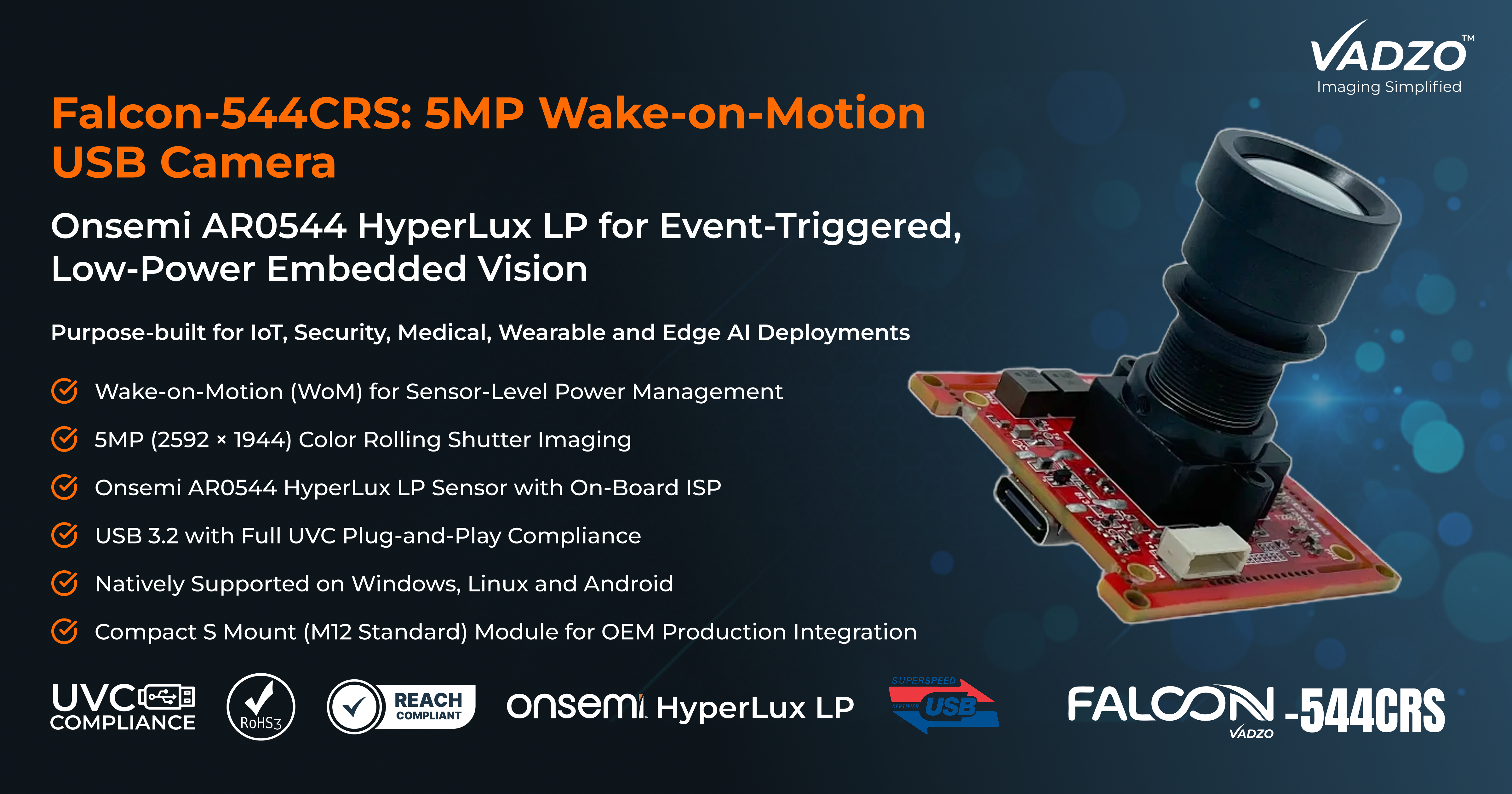
Vadzo Imaging's Falcon-544CRS is a 5MP color USB 3.2 camera built on the Onsemi AR0544 HyperLux LP sensor, combining Wake-on-Motion event-triggered activation with super low power standby mode, purpose-built for battery-operated embedded vision deployments in IoT sensor networks, smart surveillance systems, medical monitoring devices, wearable platforms and edge AI applications.
FORT WORTH, TX / ACCESS Newswire / June 30, 2026 / Vadzo Imaging, a global provider of embedded vision solutions, today explains the engineering principles behind wake-on-motion USB camera technology and introduces the Falcon-544CRS, a 5MP color USB 3.2 camera module built on the Onsemi AR0544 HyperLux LP sensor. The Falcon-544CRS is designed for OEM engineers who require event-triggered imaging in deployments where continuous full-resolution streaming would exhaust power budgets. By placing the AR0544 imaging core into super low power mode during scene inactivity and triggering a full operational wake only when motion is detected, the camera module enables vision systems that remain continuously responsive without sustaining the power draw of full active imaging. It connects via USB 3.2 with full UVC compliance, operates natively on Windows, Linux, and Android, and is ready for immediate integration into production hardware.
The Power Problem in Always-On Embedded Vision
Embedded vision systems deployed in IoT sensor networks, security installations, smart city infrastructure and wearable platforms operate under power constraints that continuous full-resolution streaming cannot satisfy. A traditional embedded camera streams at full resolution regardless of scene activity, drawing full active power at all times. In battery-powered deployments, this limits operational lifetime to hours or days rather than the weeks that field applications demand. In wearable devices, the continuous power draw generates thermal load incompatible with extended wear.
The engineering answer is not host-side power management software, but sensor-level Wake-on-Motion capability where the imaging core monitors the scene at ultra-low power and triggers a full operational wake only when a motion event is detected. This is precisely what the Onsemi AR0544 HyperLux LP sensor delivers, and what the Falcon-544CRS makes available on a USB 3.2 platform without requiring any custom power management logic in the host application.
Key Capabilities of the Falcon-544CRS Onsemi AR0544 5MP HyperLux LP Color USB 3.2 Camera
Wake-on-Motion Technology for Event-Triggered Low-Power USB Imaging: The defining capability of the Falcon-544CRS 5MP USB camera as a wake-on-motion USB camera is its sensor-level Wake-on-Motion (WoM) feature inherited from the Onsemi AR0544 HyperLux LP architecture. During periods when no relevant scene motion is present, the AR0544 imaging core enters super low power (SLP) mode where the main pixel array and full readout circuitry are powered down while a dedicated motion detection circuit continues monitoring the field of view with minimal current draw. When pixel-level change in the monitored scene exceeds the programmable detection threshold, the sensor triggers an automatic wake event, restores full imaging operation and begins delivering full-resolution 5MP frames over the USB 3.2 interface.
This wake cycle is handled entirely at the sensor level. The host processor does not need to poll the camera module or manage power state transitions in software. The result is a motion triggered USB camera that integrates into existing vision pipelines without adding host-side power management overhead while delivering measurable reduction in energy consumption during inactive intervals.
Onsemi AR0544 HyperLux LP Sensor Architecture and Low-Power Design: The AR0544 is Onsemi's 5MP member of the HyperLux LP sensor family, engineered for embedded vision platforms where image quality and power efficiency must coexist. The AR0544 delivers 5MP resolution at 2592 × 1944 with a rolling shutter CMOS architecture and a color filter array optimized for natural daylight and near-infrared-supplemented environments. The HyperLux LP designation reflects a sensor design that sustains high imaging performance within the power envelopes demanded by battery-powered IoT modules and compact embedded platforms.
The sensor integrates an on-board image signal processor that handles auto exposure and auto white balance without offloading these computations to the host. This removes a meaningful source of host CPU utilization in always-on deployments where the processor is also managing connectivity and inference workloads. The combined architecture of the Wake-on-Motion circuit, the on-board ISP and the low active power design of the HyperLux LP platform makes the AR0544 a purpose-built sensor for low power embedded camera deployments where the imaging system must never become the limiting factor in device power budget or deployment lifetime.
Plug-and-Play USB 3.2 Integration with Full UVC Compliance: The Falcon-544CRS connects to host systems via USB 3.2 and operates as a fully UVC-compliant video capture device. USB Video Class compliance means the camera module registers as a standard video input device on Windows, Linux and Android the moment it is connected, without requiring custom driver installation, kernel module compilation or platform-specific SDK initialization. For OEM development teams, this eliminates driver compatibility risk from the integration checklist, reduces time-to-integration from days to hours, and removes long-term driver maintenance obligations from the product lifecycle.
The USB-powered architecture removes the need for external power regulators in the host design. For embedded platforms including NVIDIA Jetson series, Raspberry Pi, Qualcomm RB series and NXP i.MX, the UVC driver built into the Linux kernel makes the Falcon-544CRS immediately accessible to OpenCV, GStreamer and V4L2-based pipelines without platform-specific adaptation. This is the operational benefit of deploying a power efficient security camera on an interface standard that every embedded OS natively supports.
Compact Module Design for Embedded Production Integration: The Falcon-544CRS module is built around a compact board form factor engineered for direct integration into production hardware enclosures without mechanical redesign. The S-Mount (M12) lens interface provides compatibility with the broad ecosystem of industrial and surveillance optics available in M12 standard, allowing system designers to select field of view, focal length and depth of field appropriate to each deployment scenario without modifying the camera module or host PCB. Compliance with UVC, RoHS 3 and REACH positions the camera module as a production-ready component for OEM products shipped into regulated markets globally. The combination of a compact footprint, USB-powered architecture and M12 lens compatibility makes the Falcon-544CRS integrable into the physical form constraints of IoT gateway enclosures, wearable device housings, body worn camera module platforms and portable medical instruments without custom mounting hardware.
Key specs: 5MP (2592 × 1944) | AR0544 Onsemi HyperLux LP | Rolling Shutter | Color | USB 3.2 Gen1 Type C Interface Backward Compatible to USB 2.0 | enhanced Dynamic Range (eDR) & Line Interleaved HDR (LI-HDR) Modes | S Mount (M12 Standard) | Wake-on-Motion (WoM) | Super Low Power (SLP) Mode | Windows · Linux · Android | UVC, RoHS 3, REACH
"The AR0544 gives OEM developers something that most 5MP USB platforms cannot deliver sensor-level Wake-on-Motion that requires zero host-side power management logic. Teams building IoT camera nodes, body-worn devices or smart surveillance hardware no longer have to choose between the camera being live and the camera being power-efficient. The Falcon-544CRS is built specifically for deployments where both are required at the same time and neither can be compromised." - Alwin Vincent, Product Manager, Vadzo Imaging
Product Specifications
Parameter |
Specification |
Sensor |
AR0544 CMOS Sensor from Onsemi Hyperlux™ LP |
Resolution |
5MP (2592 × 1944) |
Optical Format |
1/4.2" |
Pixel Pitch |
1.4 μm x 1.4 μm |
Shutter Type |
Rolling Shutter |
Output |
Color |
Interface |
USB 3.2 Gen1 Type C Interface Backward Compatible to USB 2.0 |
USB Class Compliance |
UVC (USB Video Class) |
Power Source |
USB Bus-Powered |
HDR |
Supported |
OS Support |
Windows, Linux, Android |
SDK |
VISPA ARC SDK (C, C++, C#, Python) |
Compliance |
UVC, RoHS 3, REACH |
VISPA ARC SDK for Developer Integration
The Falcon-544CRS is supported by the Vadzo VISPA ARC SDK, which provides programmatic access to streaming control, resolution and frame rate configuration, region of interest (ROI) management, exposure and gain settings, Wake-on-Motion threshold configuration and secure firmware update management. APIs are available in C, C++ and Python across Windows, Linux and Android. The SDK provides a consistent control interface across Vadzo's USB 3.2 camera portfolio, enabling development teams to write camera management code once and apply it across multiple imaging modules without platform-specific adaptation.
Wake-on-Motion threshold tuning is accessible directly through the SDK API, giving engineers the ability to adapt the camera's event-trigger behavior to the motion characteristics of each deployment environment without firmware-level modifications. Full technical documentation and evaluation units are available at www.vadzoimaging.com.
Target Applications
Smart City and IoT Vision Infrastructure: Smart IoT camera module deployments in public infrastructure face compounding power constraints. A smart city deployment may involve hundreds of vision nodes distributed across street fixtures, transit hubs and public buildings where power budgets are governed by available infrastructure. Running all nodes at full active imaging continuously generates unnecessary data volumes on constrained backhaul links.
The Falcon-544CRS High Resolution USB camera solves this by functioning as a wake-on-motion IoT camera that draws minimal power during quiet periods and activates full imaging only when motion events mark the beginning of relevant activity. Pedestrian detection for smart crossing systems, event-triggered access point monitoring, and motion-aware environmental sensing are all architectures that benefit directly from this approach. USB 3.2 and UVC compliance ensure the module connects without driver overhead to the edge gateways and compute modules that anchor most smart city sensor nodes.
Security Surveillance and Perimeter Monitoring: Security surveillance systems covering large perimeters or distributed access points must remain ready to capture events while operating within strict power constraints. Always-on full-resolution streaming generates large volumes of unvarying imagery that adds storage and bandwidth cost without adding security value. Smart surveillance USB camera designs that leverage sensor-level Wake-on-Motion address both problems simultaneously.
The Falcon-544CRS 5MP USB camera as a wake-on-motion surveillance camera holds the AR0544 imaging core in super low power mode during inactive periods and delivers full 5MP frames immediately upon detecting motion. For battery-operated security installations in remote locations and wireless surveillance nodes where cabling infrastructure is absent, this sensor-level power architecture extends the viable deployment window on a fixed battery budget.
Medical Device and Patient Monitoring: In medical device and patient care environments, imaging systems built into portable diagnostic instruments, wearable patient monitors and bedside observation platforms must meet strict power constraints while remaining continuously available to capture clinically relevant events. Continuous full-resolution imaging between patient movement events consumes device battery capacity without contributing clinical data.
The Wake-on-Motion capability of the Falcon-544CRS high resolution usb camera maps directly onto this requirement. The module remains in super low power standby between patient movement events and returns to full imaging when motion is detected, extending battery endurance in portable medical devices without software-side power management complexity.
Wearable and Body-Worn Vision Platforms: Body worn camera module applications impose the most stringent power constraints in embedded camera design. The device must remain wearable across a full operational shift, which requires every component to draw the minimum power consistent with its functional role. An imaging module that draws full active power between recording events is incompatible with extended-wear hardware design. The use case demands a camera that is ready to capture when motion occurs and dormant in between.
The Falcon-544CRS delivers precisely this behavior. In wearable deployments for law enforcement, field service personnel and industrial inspection teams, the module remains in Wake-on-Motion standby during static periods and activates full imaging when meaningful activity begins. The 5MP resolution ensures captured footage carries sufficient detail for evidentiary documentation and field reporting while the compact USB-powered footprint eliminates dedicated power management circuitry from the wearable design.
Robotics and Industrial Automation: In autonomous mobile robots, AGVs and collaborative robot platforms, the vision system must adapt to phases of active operation and stationary holding without imposing continuous full-power imaging costs across the full operational cycle. Robots in warehouse and manufacturing environments spend significant portions of runtime at docking stations and hold points where full-resolution imaging contributes no navigation or inspection value. The Falcon-544CRS in a robotics and industrial automation deployment holds the AR0544 imaging core in super low power mode during stationary phases and resumes full 5MP imaging when the robot begins moving, and scene motion is detected.
This architecture reduces the vision system's contribution to the robot's power budget during idle phases and extends battery cycles in mobile platforms. USB 3.2 integrates directly with onboard compute modules, and 5MP resolution supports marker detection, surface inspection and obstacle recognition workloads at the frame rates the AR0544 delivers.
Edge AI and Embedded Vision: Low-power edge AI USB camera deployments combine the Falcon-544CRS with edge inference platforms such as NVIDIA Jetson Orin NX, Raspberry Pi and NXP i.MX to build vision systems that detect and classify events at the point of capture. Wake-on-Motion enables a power-aware architecture where the inference host remains in a reduced-power state between events and is brought to full operation by the camera's motion detection signal, avoiding the power cost of running the full inference pipeline continuously.
The AR0544's on-board ISP handles auto exposure and auto white balance before frames reach the inference pipeline, reducing pre-processing workload on the edge compute platform. For embedded vision USB camera deployments covering retail analytics, access control and smart building automation, this architecture delivers event-driven inference economics that are not achievable with always-on streaming designs.
Frequently Asked Questions
Q: How does Wake-on-Motion work in an embedded USB camera at the sensor level?
A: Wake-on-Motion is a hardware-level power management feature built directly into the image sensor rather than implemented as software on the host processor. The sensor integrates a dedicated motion detection circuit that monitors the field of view while the main imaging core is held in super low power (SLP) mode. The motion detection circuit operates at a fraction of full active imaging current. When pixel-level change in the scene exceeds a programmable detection threshold, the sensor autonomously triggers a wake event, restores full imaging operation, and begins delivering frames over the USB interface.
The critical engineering distinction is that the entire wake process is managed at the silicon level within the AR0544 HyperLux LP sensor. The host processor does not need to poll the camera or issue software commands to transition between power modes. Wake-on-Motion threshold sensitivity is configurable through the VISPA ARC SDK, allowing engineers to tune event detection behavior to deployment-specific motion characteristics without firmware modifications.
Q: What is the best low power USB camera with Wake-on-Motion for IoT and event-triggered surveillance deployments?
A: For IoT and event-triggered surveillance deployments, the ideal low power USB camera must combine sensor-level Wake-on-Motion with plug-and-play OS compatibility, sufficient imaging resolution for the analytics workload and a compact form factor that fits within IoT enclosure constraints. The engineering challenge is finding a single module that satisfies all of these requirements without custom driver work or external power management circuitry.
Vadzo Imaging's Falcon-544CRS satisfies all of these requirements on a single production-ready module. Built on the Onsemi AR0544 HyperLux LP sensor, it delivers 5MP resolution with sensor-level Wake-on-Motion that places the imaging core in super low power standby during inactive periods and restores full imaging when motion is detected. Full UVC compliance means the module connects plug-and-play to Windows, Linux and Android without custom drivers. Evaluation units and documentation are available at vadzoimaging.com.
Q: What is the Onsemi AR0544 HyperLux LP sensor and what makes it suited for low power embedded vision?
A: The Onsemi AR0544 is a 5MP rolling shutter color CMOS image sensor belonging to Onsemi's HyperLux LP family, a sensor architecture optimized for low power consumption in embedded platforms where continuous full-power imaging would exhaust device power budgets or restrict battery deployment lifetime. The AR0544 resolves 2592 × 1944 and integrates an on-board image signal processor that handles auto exposure and auto white balance internally, reducing the processing workload on the host compute platform.
The AR0544's Wake-on-Motion capability is the feature that most directly differentiates HyperLux LP sensors from conventional embedded imaging sensors. By holding the main imaging core in super low power mode between motion events and handling the wake decision at the sensor level, the AR0544 allows the imaging system to remain continuously available without sustaining full active power consumption. For IoT sensor nodes, wearable devices and smart surveillance hardware where power efficiency is a first-order design requirement, this represents a fundamentally different approach compared to sensors that require host-managed power cycling through software.
Q: Does a 5MP low power USB camera work natively on Linux, Android and Windows without custom driver installation?
A: Yes. A USB camera with full UVC (USB Video Class) compliance operates as a plug-and-play video capture device on Windows, Linux and Android because all three operating systems include native UVC driver support in their standard driver stacks. The operating system recognizes a UVC-compliant module as a standard video input device immediately upon connection. No custom driver installation, kernel module compilation, or platform-specific initialization is required for basic streaming.
Vadzo Imaging's Falcon-544CRS is a fully UVC-compliant 5MP USB 3.2 camera module built on the Onsemi AR0544 HyperLux LP sensor. It operates plug-and-play on Windows, Linux and Android including embedded platforms such as NVIDIA Jetson Orin, Raspberry Pi and NXP i.MX and integrates directly with OpenCV, GStreamer and V4L2-based vision pipelines. For extended control including Wake-on-Motion parameter configuration and exposure management, the VISPA ARC SDK provides API access in C, C++, and Python. Full details are available at vadzoimaging.com.
Q: Can a compact 5MP USB camera module be deployed in wearable vision devices and body-worn camera platforms?
A: Yes. A 5MP USB camera module designed for low power consumption is well suited for wearable and body-worn platforms, provided it meets the key requirements: sensor-level power management to extend battery life, compact dimensions to fit within wearable enclosures, USB-powered architecture to avoid separate power rails and sufficient resolution for documentation purposes.
Vadzo Imaging's Falcon-544CRS is purpose-built for exactly these requirements. The AR0544 HyperLux LP sensor's Wake-on-Motion capability keeps the imaging core in super low power standby between recording events, extending battery endurance without host-side power management logic. USB 3.2 connectivity draws power directly from the host platform bus, eliminating a dedicated power management circuit from the wearable design. The 5MP resolution ensures captured imagery carries sufficient detail for law enforcement documentation and industrial inspection. Vadzo Imaging supports OEM customization for wearable application requirements including form factor adaptation, lens configuration and firmware feature sets. Visit vadzoimaging.com to request an evaluation kit.
Availability
The Falcon-544CRS Onsemi AR0544 5MP low power USB 3.2 camera module is now available for evaluation and production orders through Vadzo Imaging with no minimum order requirement. Visit the AR0544 5MP USB 3.2 camera product page or contact Vadzo Imaging at support@vadzoimaging.com to request an evaluation unit or discuss OEM integration requirements.
About Vadzo Imaging
Vadzo Imaging is a global provider of embedded vision solutions for robotics, industrial automation, UAVs, edge AI and medical systems. Its camera products are designed for seamless integration with NVIDIA Jetson, Raspberry Pi, Qualcomm RB series and NXP i.MX. Vadzo supports customers through hardware customization, firmware development and the VISPA ARC SDK. Explore the full Vadzo camera portfolio at www.vadzoimaging.com.
Media Contact
Alwin Vincent
Vadzo Imaging
Email: alwin@vadzoimaging.com
LinkedIn: Vadzo Imaging
YouTube: Vadzo Imaging
X: Vadzo Imaging
SOURCE: Vadzo Imaging
View the original press release on ACCESS Newswire