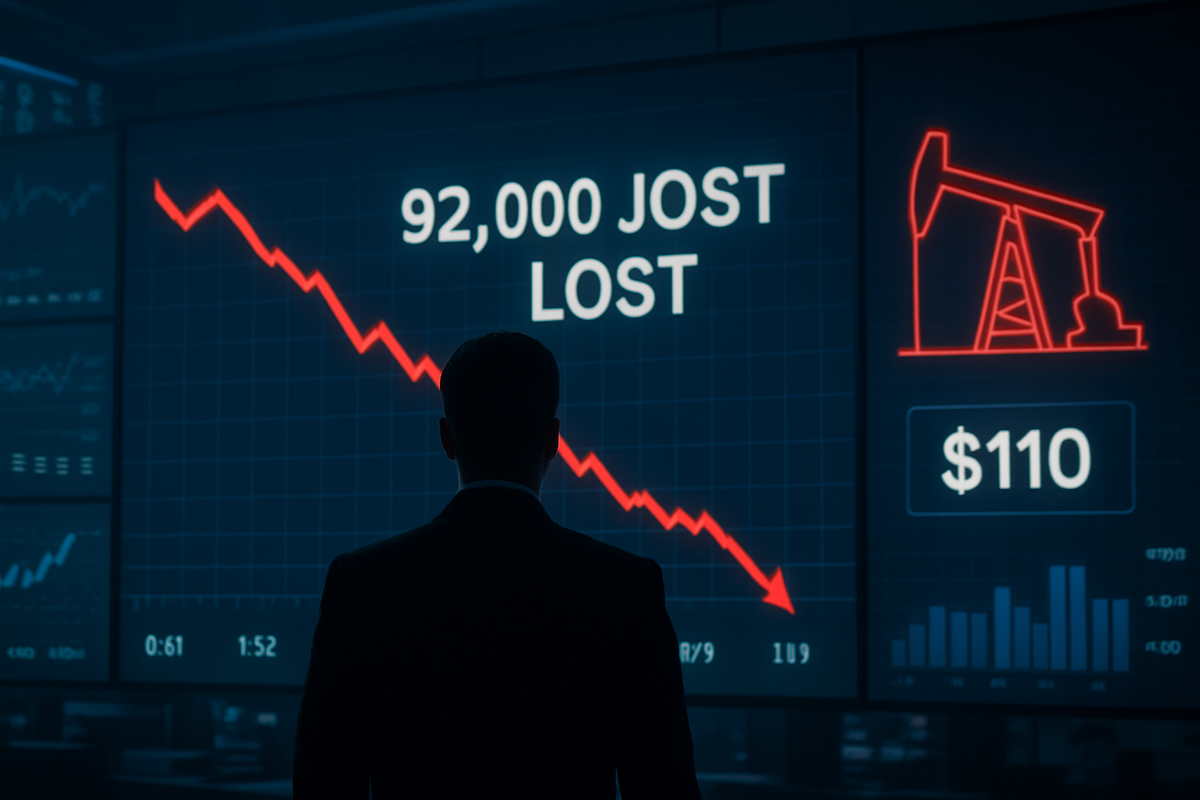
The United States labor market sent a chilling signal to investors and policymakers alike this week, as the Department of Labor reported a staggering loss of 92,000 nonfarm payroll jobs for February 2026. The report, released on March 6, completely upended economist expectations of a modest 50,000-job gain, marking the sharpest contraction in employment since the volatile periods of late 2020. Coupled with a rise in the national unemployment rate to 4.4%, the data suggests that the "soft landing" narrative championed by the Federal Reserve throughout 2025 is facing its most significant challenge yet.
The immediate implications are a cocktail of market anxiety and macroeconomic reassessment. As of today, March 13, 2026, the S&P 500 has retreated nearly 3% since the report's release, as traders grapple with the dual threat of a stalling economy and persistent inflationary pressures—driven largely by a geopolitical energy shock. With the Federal Reserve’s March 18 policy meeting looming, the "Goldilocks" era of steady growth and moderating inflation appears to have vanished, replaced by a "stagflationary" shadow that has not been seen in decades.
A Perfect Storm: Healthcare Strikes and Energy Shocks
The February downturn was not a localized event but rather the result of several converging economic headwinds. The most visible drag came from the healthcare sector, which shed 28,000 jobs. This decline was largely attributed to massive, unresolved strike actions at major providers like Kaiser Permanente, where workers in California and Hawaii walked off the job citing burnout and wage stagnation. This labor unrest, combined with a continued "hiring freeze" in the technology and information sectors—which lost another 11,000 positions—created a heavy anchor on the overall payroll figures.
The timeline leading up to this disappointing report was dominated by the sudden escalation of military conflict in the Middle East. On February 28, 2026, joint military strikes led to the effective closure of the Strait of Hormuz, a critical artery for 20% of the world's oil supply. This geopolitical crisis sent Brent crude prices screaming past $110 per barrel in less than a week. The resulting "energy shock" hit U.S. gas stations immediately, with national averages jumping to $3.48 per gallon by early March. This spike in input costs forced many manufacturing and logistics firms to pause hiring or implement immediate staff reductions, leading to a loss of 12,000 manufacturing jobs in February alone.
Market participants were also blindsided by significant downward revisions to previous months. The Department of Labor adjusted the December 2025 and January 2026 figures downward by a combined 69,000 jobs, suggesting that the labor market's momentum had actually been fading for months under the surface. While average hourly earnings did tick up by 0.4% to $37.32, analysts note that these "gains" are being rapidly eroded by the cost of living, leaving the American consumer in a precarious position.
Corporate Winners and Losers: The K-Shaped Divide
The current economic climate is creating a stark divergence among major public companies, with those tied to essential services and energy extraction thriving while discretionary and transportation-heavy firms suffer.
The Winners: In the energy sector, ExxonMobil (NYSE: XOM) and Chevron (NYSE: CVX) have emerged as the primary beneficiaries of the $110-per-barrel oil environment. ExxonMobil, which recently centralized its operations in Houston to slash structural costs, is seeing its earnings per share (EPS) estimates climb as high-margin production offsets broader market volatility. Similarly, Chevron has signaled that its integration of Hess and focus on the Permian Basin will allow it to maintain aggressive share buybacks and dividend growth despite the cooling labor market. In the retail space, Walmart (NYSE: WMT) is proving its "recession-proof" status. As the unemployment rate hits 4.4%, high-income households are increasingly "trading down" to Walmart for groceries and essentials, allowing the retail giant to capture market share from more premium competitors.
The Losers: On the flip side, Target (NYSE: TGT) is feeling the brunt of the pullback in discretionary spending. With consumers prioritizing gas and food, Target’s focus on home decor and apparel has led to a "continued softness" in sales, prompting the company to cut salaried bonuses and pivot toward a $2 billion turnaround strategy. The airline industry is perhaps the hardest hit; Delta Air Lines (NYSE: DAL) and United Airlines (NASDAQ: UAL) are facing a massive $11 billion industry-wide spike in fuel expenses. United Airlines, which does not traditionally hedge its fuel costs, saw its stock drop nearly 9% in late February as analysts slashed Q1 earnings forecasts. Furthermore, in the healthcare management space, UnitedHealth Group (NYSE: UNH) and Elevance Health (NYSE: ELV) are navigating the fallout of rising labor costs and service disruptions caused by the sector-wide strikes.
The Stagflationary Trap and Historical Precedents
The February jobs report is more than just a data point; it represents a significant shift in the broader industry trend toward "efficiency over headcount." For the first time since the early 2020s, the U.S. economy is facing a scenario where unemployment is rising while energy prices are simultaneously surging—a classic "stagflation" setup reminiscent of the 1970s. This event fits into a trend of "de-globalization" and supply chain fragility that has been building since 2024, exacerbated by the administration's aggressive tariff policies and the implementation of the "One Big Beautiful Bill Act" (OBBBA), which has had a mixed impact on domestic manufacturing.
The regulatory and policy implications are profound. The Federal Reserve, led by Jerome Powell, is now caught in a "dual-mandate" nightmare. Typically, a loss of 92,000 jobs would trigger an immediate rate cut to stimulate the economy. However, with the Iran-related energy shock threatening to push inflation back toward 4% or 5%, cutting rates could lead to a catastrophic inflation spiral. Historical precedents like the 1973 oil embargo suggest that once inflation and unemployment begin to rise in tandem, the policy "fix" becomes exponentially more difficult and painful for the general public.
Looking Ahead: A Tense March for Markets
As we move deeper into March 2026, the short-term outlook depends almost entirely on the Federal Reserve’s March 18 meeting and the status of the Strait of Hormuz. If the Fed chooses to hold rates steady to fight energy inflation, they risk accelerating the job losses seen in February, potentially pushing the unemployment rate toward 5.0% by mid-summer. Conversely, if they cut rates to save the labor market, they may lose all credibility in their fight against inflation.
Strategically, companies like United Airlines (NASDAQ: UAL) are already pivoting by accelerating the retirement of less fuel-efficient regional jets in favor of larger Airbus A321neo aircraft to combat rising costs. In the tech sector, expect to see an even more aggressive shift toward Artificial Intelligence as a replacement for traditional administrative and information roles, as firms look to maintain margins in a "frozen" hiring environment. The primary scenario for the second half of 2026 is now a "shallow recession," where consumer spending remains supported by high-income earners but the lower and middle classes face significant financial strain.
Summary and Investor Outlook
The February 2026 jobs report serves as a stark reminder that the U.S. economy remains vulnerable to external shocks. The loss of 92,000 jobs and the rise of unemployment to 4.4% have shattered the complacency that characterized the market at the start of the year. The key takeaway for investors is that "defensive" positioning is no longer optional; exposure to energy and value-oriented retail has become a necessity as the discretionary and transportation sectors face a grueling period of high costs and low demand.
Moving forward, the market will likely remain in a state of high volatility until there is clarity on the Middle East conflict and the Fed's next move. Investors should closely watch retail sales data for March and the upcoming Q1 earnings calls from major logistics and consumer staples firms. The "labor market momentum" has officially stalled; the question now is whether it can be restarted without igniting an inflationary fire that could burn for years to come.
This content is intended for informational purposes only and is not financial advice.