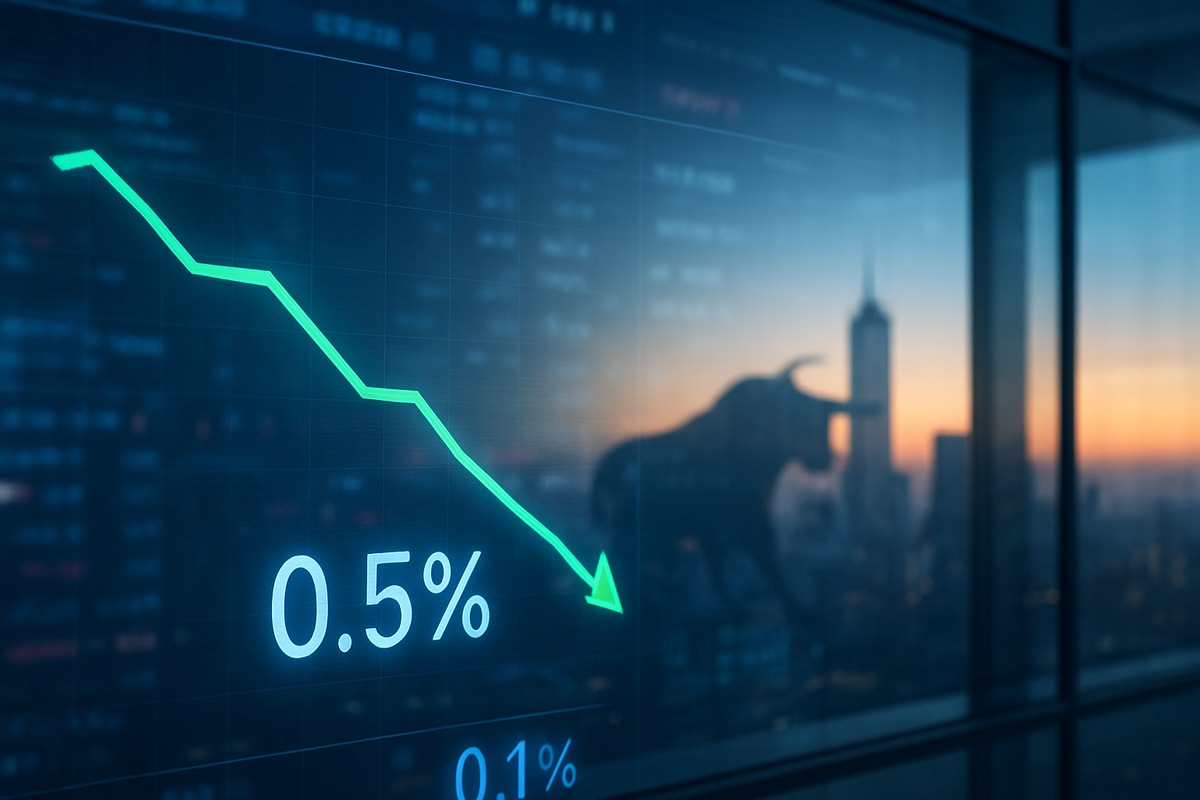
In a dramatic turn of events that has sent ripples of relief across Wall Street, the March 2026 Producer Price Index (PPI) data released on April 14, 2026, has significantly undercut economist expectations. While the headline index rose by 0.5%, it came in at less than half of the 1.1% consensus estimate that had kept investors on edge throughout the early spring. Even more striking was the core PPI reading, which excludes volatile food and energy costs, coming in at a mere 0.1% against an anticipated 0.6% jump.
This data release marks a potential "inflation fever" break for the U.S. economy, which had been grappling with a resurgence of pricing pressures in the first quarter of 2026. By providing evidence that wholesale price growth is cooling faster than anticipated, the report has recalibrated risk landscapes for the second quarter, leading to a sharp rally in equities and a significant pullback in Treasury yields as the market pivots from fears of "sticky" inflation to a more optimistic disinflationary narrative.
The Data Behind the Relief: A Tale of Two Tensions
The Bureau of Labor Statistics (BLS) report, published on April 14, revealed a complex underlying picture of the American economy. The 0.5% headline increase was largely driven by a sharp 8.5% spike in energy costs—gasoline prices alone soared over 20%—stemming from the ongoing geopolitical instability and the blockade of the Strait of Hormuz. However, these gains were almost entirely neutralized by a surprise 0.3% drop in wholesale food prices and a flat 0.0% reading in the service sector. This internal cooling allowed the core PPI to land at a stagnant 0.1%, a figure that many analysts are calling the "golden ticket" for the Federal Reserve’s current policy stance.
The timeline leading up to this moment was characterized by growing dread. Following a hotter-than-expected January and February, market participants had braced for a "triple-threat" of high energy costs, rising wages, and logistics bottlenecks. Instead, the March data suggests that the "last mile" of inflation might be smoother than the hawkish rhetoric of early 2026 suggested. As the report hit the wires, the Nasdaq Composite surged 1.96%, marking its tenth consecutive day of gains, while the S&P 500 climbed 1.18% to move within striking distance of the psychological 7,000 milestone.
Initial reactions from key stakeholders have been cautiously optimistic. Federal Reserve Chair Jerome Powell, in a brief statement following the release, noted that while energy shocks "tend to come and go," the Fed remains data-dependent. Meanwhile, New York Fed President John Williams signaled that the current policy is "well-positioned," a phrase that markets took as a hint that further rate hikes may be off the table for the immediate future.
Corporate Winners and Losers in a Cooling Climate
The tech sector emerged as the primary beneficiary of the PPI "miss," as cooling inflation expectations typically translate into lower discount rates for future earnings. NVIDIA Corporation (NASDAQ: NVDA) saw its shares jump 3.8%, bolstered by the dual tailwinds of lower yields and continued AI demand. Similarly, Microsoft Corporation (NASDAQ: MSFT) rose 2.1%, and Alphabet Inc. (NASDAQ: GOOGL) gained 1.7% as investors rotated back into high-growth "Big Tech" names. Micron Technology, Inc. (NASDAQ: MU) was a standout performer, surging 9.2% as wholesale cooling in manufacturing components suggested better margins for the semiconductor giant.
In the retail space, the data provided a much-needed breath of fresh air. Companies like Walmart Inc. (NYSE: WMT) and Target Corporation (NYSE: TGT) saw modest gains as the flat service-sector costs and falling food wholesale prices indicated that the margin squeeze of late 2025 might be easing. This is particularly relevant as these retailers prepare for the mid-year shopping season. Furthermore, the automotive sector saw a lift, with Ford Motor Company (NYSE: F) rallying 4.5% following an analyst upgrade that cited the PPI data as a sign that raw material costs for EVs are finally stabilizing.
Conversely, the energy sector faced headwinds as the "inflation hedge" trade began to unwind. Despite the headline energy spike, the overall cooling of the economy led to a dip in crude futures below the $100 per barrel mark. Exxon Mobil Corporation (NYSE: XOM) and Chevron Corporation (NYSE: CVX) both saw their shares retreat by roughly 2%, as the market began to price in a potential peak for energy-driven revenue. Financial institutions had a mixed day; while Citigroup Inc. (NYSE: C) rose 1.5%, Wells Fargo & Company (NYSE: WFC) dropped 4.3% as concerns grew that a flatter yield curve might compress net interest margins in the second half of the year.
Broader Significance: A Pivot in the Policy Playbook
The March PPI data is more than just a monthly statistic; it represents a significant shift in the broader economic trend of 2026. For months, the consensus was that the Federal Reserve would be forced to keep rates "higher for longer" or even consider a late-cycle hike to combat the energy-induced inflation spike. This report effectively dismantles that narrative, suggesting that the underlying "core" of the economy is already responding to previous tightening.
Historically, such a massive gap between the headline and core PPI has signaled a period of "transitory" energy inflation that does not necessarily bleed into the wider economy. This comparison to the late 2021 and early 2022 periods is already being drawn by analysts, though the current environment benefits from a much more stabilized global supply chain. The ripple effects will likely reach the Fed's partners and global counterparts, potentially allowing the European Central Bank and the Bank of England to maintain their own cooling cycles without fear of a runaway U.S. dollar.
Furthermore, the data has major implications for the upcoming Q1 earnings season. With wholesale costs coming in lower than expected, many public companies may be poised to beat earnings-per-share (EPS) estimates, not through massive revenue growth, but through better-than-anticipated margin retention. This shifts the focus for investors from "top-line" growth to "bottom-line" efficiency.
Looking Ahead: The Second Quarter Trajectory
In the short term, all eyes now turn to the Consumer Price Index (CPI) report, which will determine if these wholesale savings are being passed on to the average American. If the CPI follows the PPI’s lead, the "risk-on" sentiment could carry the markets through the end of April. However, the long-term outlook remains tied to the geopolitical situation. Should the Strait of Hormuz blockade persist, the 8.5% energy spike seen in this report could eventually force core prices upward through increased transportation and manufacturing costs.
Strategically, investors may see a pivot toward companies that have high energy sensitivity but low labor-cost exposure. We are already seeing strategic maneuvers in this vein, such as Amazon.com, Inc. (NASDAQ: AMZN) announcing an $11.6 billion acquisition of Globalstar, Inc. (NASDAQ: GSAT) to bolster its satellite logistics and bypass traditional energy-heavy infrastructure. Additionally, the partnership expansion between Bloom Energy Corporation (NYSE: BE) and Oracle Corporation (NYSE: ORCL) to power AI data centers with alternative energy sources shows how companies are attempting to "de-risk" from the volatile energy PPI components.
Summary and Investor Takeaways
The March 2026 PPI data has provided the market with a rare "goldilocks" moment: proof that while external shocks (energy) are present, the internal machinery of the economy (core) is cooling. The 0.5% headline and 0.1% core figures have successfully lowered the temperature of a market that was on the verge of a panic.
Moving forward, investors should watch for the following:
- The Core CPI Print: To see if wholesale disinflation is reaching the consumer level.
- Federal Reserve Rhetoric: Specifically any shift in tone from hawkish governors like Austan Goolsbee.
- Q1 Earnings Calls: Listen for management commentary on "input cost relief" and margin guidance for Q2.
While the Middle East conflict remains a wild card for headline numbers, the March PPI suggests that the fundamental inflationary trend is down, not up. For the first time in 2026, the bulls have been given a clear runway, provided they can navigate the turbulence of the energy markets.
This content is intended for informational purposes only and is not financial advice.