ALEXANDRIA, VA / ACCESS Newswire / July 28, 2026 / First and foremost, this book is not a cookbook. You will find no recipes here in spite of the title. Baking is a metaphor for life and creation, re-telling the old myths, the Viking sagas and historic events with sparkling humor and whimsical use of baking terminology.
Welcome to the most chaotic, flour-dusted, and deliciously inventive test kitchen in the Nine Realms. In Odin's Baked Goods, the grim, blood-soaked battlefields of Norse mythology and the Viking Sagas are brilliantly reimagined through the warm, high-stakes, and notoriously temperamental art of professional baking. This book serves up a refreshing and fiercely witty departure from traditional mythological retellings, swapping heavy broadswords for heavy-duty rolling pins, and trading the coveted mead of poetry for a perfectly proofed, highly competitive sourdough starter.

This retelling is most unusual; it calls upon the reader to use imagination and approach the stories quite differently: what if we thought about the ancient gods and heroes of the North as... bakers? How would they tell their stories then? We are perhaps rather used to thinking about the world of the Norse myths and the kings and heroes of the old sagas as dark, brutal and tragic.

The true novelty of this concept lies in its seamless, hilarious fusion of divine epic and culinary disaster. By reframing the cosmic struggles of gods, giants, and mortal heroes as cutthroat corporate hospitality disputes, these ancient legends are suddenly imbued with a flavor that is universally relatable and endlessly entertaining. When Thor's mighty hammer is repurposed as a magical meat tenderizer, when Loki is cast as the ultimate saboteur of the morning prep-shift, and when Ragnarok is presented not merely as the end of the world, but as a mutually destructive, apocalyptic bake-off, the reading experience is completely transformed.

The book depicts the world where fates rule, the afterlife, Valhalla, is not really that cheerful, and even the gods will face their own apocalyptic end at Ragnarök. Can humor really have a place here, save for a very occasional comedic element (a story of Thor crossdressing as a bride to trick a giant into giving back his hammer comes to mind)? Aren't these stories best suited for hard times?

It turns out that in the hands of an imaginative and creative writer humor adds a wonderful taste to the myths and historic accounts. The format of the book is a collection of short stories that are quick to read; they flow by an engrossed reader seamlessly, leaving one with the desire to keep on going.
The vision is that "human history and myths should bring laughter and smiles, while at the same time being educational and instructional." So, do not be deceived by all the whimsical storytelling and the humorous tone. The stories are true to the original sources and have been thoroughly researched. The bibliography is a wealth of resources on the Norse mythology and sagas in itself. There is enormous respect for the stories: from Snorri Sturluson's the Poetic Edda and the Heimskringla to Beowulf, as well as history of the myths, works on Norse symbolism and rituals, history of Medieval Europe and even books on actual Scandinavian baking to name only a few. Thus, the book depict the gods and the heroes of the sagas as well as actual historic figures in Northern European history as true to the originals as they can be.

This unique presentation elevates the classical tales from dusty history lessons into vibrant, Michelin-starred comedy. The sheer absurdity of the Aesir acting as rival restaurant executives breathes new life into the myths, highlighting the outsized egos and bitter rivalries of the Norse pantheon. It brilliantly proves that the only thing more dangerous than a vengeful Viking warlord is a master pastry chef whose soufflé has just collapsed. Odin's Baked Goods is a masterful recipe of wit and myth, meticulously layered and baked to absolute perfection. Grab your flame-retardant oven mitts and prepare your palate, because this literary tasting menu is guaranteed to be served piping hot.
But the divine antics of the gods only serve as the appetizer for the true meat of the book. Where Odin's Baked Goods truly achieves a perfect, shattering crust is in its brilliant, carb-loaded reimagining of the legendary Viking Sagas. The great explorers and brutal kings of Scandinavian history are stripped of their chainmail and recast as cutthroat Master Bakers, each desperately striving to spread their proprietary recipes around the world and establish an absolute monopoly over the bread market of the North.

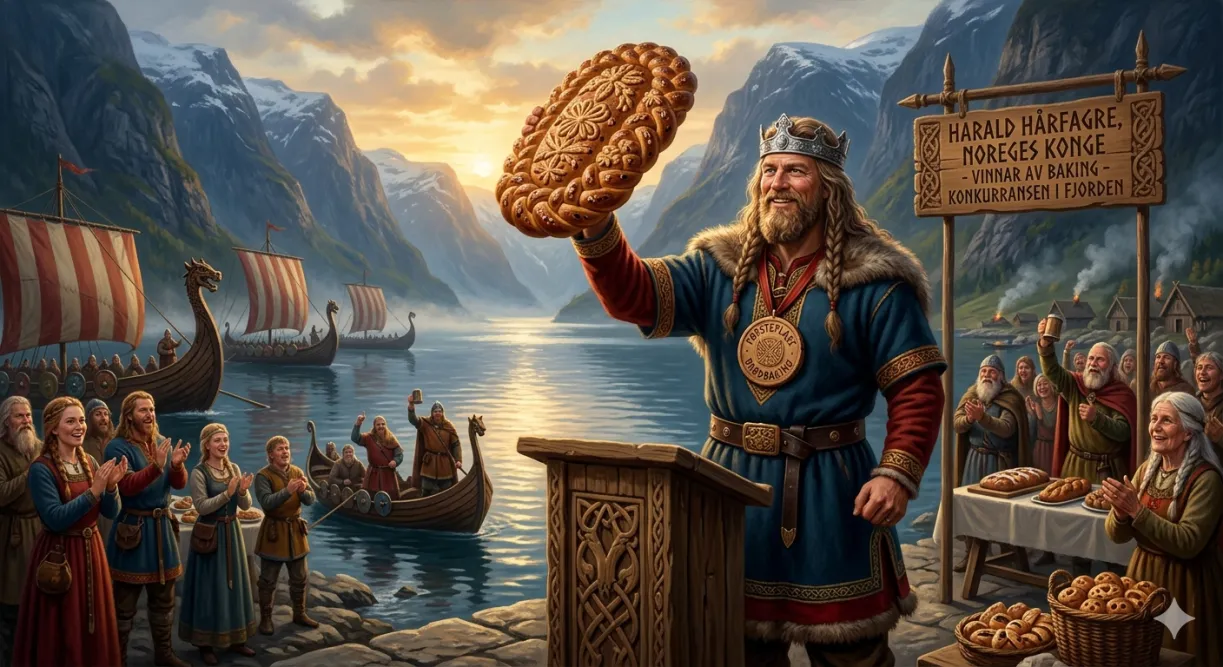
These stories as appealing to the young and old alike. You are going to learn a lot while laughing a lot. I loved going on a historic journey of unifying Norway (pardon me, unifying the ‘fragmented baking market of the 9th century Norway') with Harald Halfdansson and his own transformation from Harald Tangle-Hair to Harald Finehair. This is a truly original and unique book, a wonderful take on the beloved tales of the North.
The historical era of bakery expansion begins with the legendary Ragnar Lothbrok. In the traditional sagas, Ragnar was a raider. In this culinary universe, Ragnar (whose nickname "Hairy-Breeches" actually refers to his terrible habit of wiping flour on his coarse wool trousers) is the ultimate industry disruptor. He looked at the stagnant, flatbread-dominated markets of Scandinavia and saw limited profit margins.
Ragnar's "raids" were highly aggressive marketing campaigns. He flooded the English market with his dark, fermented loaves. His legacy was carried on by his famous son, Bjorn Ironside. Bjorn earned his legendary moniker not in battle, but because he was the only chef in Europe capable of pulling blistering hot cast-iron baking sheets out of a 600-degree oven using his bare hands.
Bjorn took the Lothbrok franchise south, navigating to the Mediterranean. He abandoned the heavy animal fats of the North in pursuit of the ultimate, fruity olive oils of Italy and Spain, inventing the Viking Age's first aggressively herb-crusted focaccia.
While the Lothbroks expanded the menu through franchising, other bakers were forced to innovate through sheer, desperate exile.

Erik the Red was a notoriously volatile baker with a terrible temper. He was named "The Red" due to his terrifyingly spicy, paprika-infused sourdough starter that burned the mouths of anyone who ate it. Erik was legally banished from Iceland not for murder, but for throwing a heavy marble rolling pin at a health inspector who criticized his sanitation protocols. Sailing west, Erik discovered a massive, freezing, glacier-covered island. Knowing he needed investors to fund his new commercial kitchen, he executed the greatest false-advertising campaign in culinary history. He named the freezing rock Greenland.
Erik's son, Leif Erikson, inherited his father's wanderlust but possessed a much sweeter palate. Frustrated by the lack of local sugars in Greenland, Leif sailed further west, accidentally discovering the coast of North America.
While the explorers were foraging for new ingredients, the Scandinavian Kings were focused on absolute, ruthless corporate consolidation.
Sweyn Forkbeard (so named because he insisted on mixing all his doughs with a bizarre, two-pronged metal whisk) was the pioneer of the hostile corporate takeover. Sweyn invaded England not for land, but to monopolize the grain supply. He instituted the infamous Danegeld-a crippling tax that demanded the English pay the Danes in thousands of pounds of premium, triple-sifted pastry flour.
When Sweyn died from consuming too much unbaked marzipan, his empire fell to his son, Cnut the Great.
Cnut was a visionary CEO who successfully merged the bakeries of England, Denmark, and Norway into one massive, terrifyingly efficient conglomerate: The North Sea Empire. Cnut standardized recipes across three countries, ensuring that a croissant baked in London possessed the exact same lamination as one baked in Oslo.
However, Cnut's absolute power bred legendary hubris. Believing himself to be the supreme master of culinary science, Cnut once famously staged a demonstration on the beach to prove to his sycophantic apprentices that he, the Emperor of the Ovens, was more powerful than the fundamental laws of baking chemistry.
While the Kings of Norway and Denmark waged corporate warfare over international grain monopolies, a fierce and chaotic rebellion was actively proofing on the fringes of the known culinary world. Enter the Free Bakers of Iceland. Having fled the oppressive, standardized menus and exorbitant flour taxes of the Scandinavian monarchs, these fiercely independent artisans established a libertarian baking utopia, and frequent dystopia, devoid of kings, CEOs, or executive chefs. The Icelandic Commonwealth was a rugged frontier of indie pop-ups, wild yeast experiments, and cutthroat local distribution turf wars. Disputes over pasty territory weren't settled by royal decree; they were aggressively litigated at the Althing, which served as both the ultimate outdoor food festival and the supreme culinary tribunal.
In stark contrast to the unregulated, chaotic indie scene of Iceland stood the legendary Jomsvikings, an ultra-militarized, hyper-disciplined brotherhood of mercenary caterers operating out of a heavily fortified fortress-kitchen known as Jomsborg. The Jomsvikings were the medieval world's premier tactical hospitality group. If a warlord needed to cater a three-day feast for a thousand angry, starving men in the middle of a blizzard, he hired the Jomsvikings. Their kitchen code was absolute and unforgiving: no baker under the age of eighteen, no unauthorized substitutions to the recipe, and absolutely no crying in the walk-in cold-retard chamber. To join their elite ranks, a prospective line cook had to prove his worth by performing a flawless, blindfolded lamination while being pelted with stale bagels by the senior staff.
But long before the Jomsvikings perfected their tactical catering, the ancient culinary world relied on freelance troubleshooters to handle disasters that went beyond mere burnt crusts or collapsed cakes. Chief among these was the legendary hero of the Geats, Beowulf. In this flour-dusted universe, Beowulf is not merely a monster hunter; he is the ultimate, bare-handed Health and Safety Enforcer.
Through the untamed, litigious indie pop-ups of the Icelandic Free Bakers, the fiercely militant kitchens of the Jomsvikings, and the epic, health-code-enforcing battles of Beowulf, this culinary reimagining proves that history's greatest heroes weren't just fighting for gold and glory; they were fighting, bleeding, and dying for the perfect crumb.
The golden age of the Viking baking monopolies came to a dramatic, bloody end in the year 1066, led by the ultimate culinary tyrant: Harald Hardrada ("Harald the Hard-Ruler").
Harald was the Gordon Ramsay of the eleventh century, a towering, screaming, terrifyingly strict Head Chef who had spent years baking in the elite Imperial Kitchens of Constantinople before returning to violently seize the Norwegian franchise. Harald believed that the English baking market was weak and in desperate need of his superior, heavy-handed management.
He launched a massive invasion fleet, landing in Northern England with thousands of hungry, heavily armed line cooks, ready to execute the ultimate hostile takeover against the English King, Harold Godwinson.
The two culinary armies met at Stamford Bridge.
The resulting clash was the most chaotic bake-off in history. The Norwegians fought with blistering heat and heavy dough, but the English had the advantage of local supply lines. Ultimately, Harald Hardrada's soufflé collapsed. The great tyrant was struck down, taking an arrow to the throat while aggressively critiquing an English archer's stance.
The Viking era of baking ended that day at Stamford Bridge. Just weeks later, the English would face a new culinary invasion from the South, the Normans, bringing with them William the Conqueror, strict French culinary terminology, and the terrifying complexity of puff pastry.
Odin's Baked Goods takes these sweeping, historical tragedies and masterfully reduces them to a perfect reduction sauce of humor and hubris. It reveals that whether you are a legendary warlord seeking to conquer an island, or a stressed-out line cook trying to perfectly temper chocolate before the morning rush, the human struggle is exactly the same: we are all just trying to keep our crusts from burning while the world burns around us.
After all, isn't it a little easier to live one's life with a wonderful ability to appreciate the humorous and the comical? This is a purely human trait perhaps handed down to us by Odin that day at his bakery. So, the book awaits its readers. As its back cover says, "The North mythology and key Viking sagas are here, kneaded, proofed, baked and covered with chocolate icing.
About Odin's Baked Goods
Odin's Baked Goods is a humorous, research-backed collection that reimagines Norse mythology, Viking sagas, and historical figures through the language of baking. Blending whimsical storytelling with respect for original sources, the book offers readers an entertaining and educational journey through the legends of the North.
A copy of the book can be purchased at https://www.amazon.com/dp/B0GYRTM6ML
Media Contact Information
http://www.genetodorovreads.com/
SOURCE: Evgueniy Todorov
View the original press release on ACCESS Newswire