How real-time profit tracking is becoming the defining factor between dropshipping stores that scale and those that quietly bleed money

Introduction
Dropshipping has lowered the barrier to starting an ecommerce business, but it has not lowered the barrier to running one profitably. Based on TrueProfit's analysis of over 1,200 dropshipping stores, only 1–5% of dropshippers ever reach consistent profitability — and the most common reason the rest fall short is not poor product selection or bad advertising. It is the inability to accurately track profit in real time.
TrueProfit, the #1 Net Profit Analytics Platform built for Shopify and ecommerce merchants, has identified a persistent gap in how dropshipping store owners measure financial performance. Most operators focus on revenue and return on ad spend (ROAS), while the costs that actually determine whether a business is making money — COGS, shipping fees, transaction charges, platform subscriptions, and ad spend — remain scattered across disconnected systems or ignored entirely.
This release explores why accurate profit tracking is non-negotiable for dropshipping stores, what costs are most commonly missed, and how TrueProfit is helping merchants close the gap between reported revenue and actual net income.
Why Dropshipping Profit Is Harder to Track Than It Looks
Dropshipping appears financially simple on the surface: sell a product at a higher price than the supplier charges and keep the difference. In practice, the cost structure is more layered than most new operators anticipate.
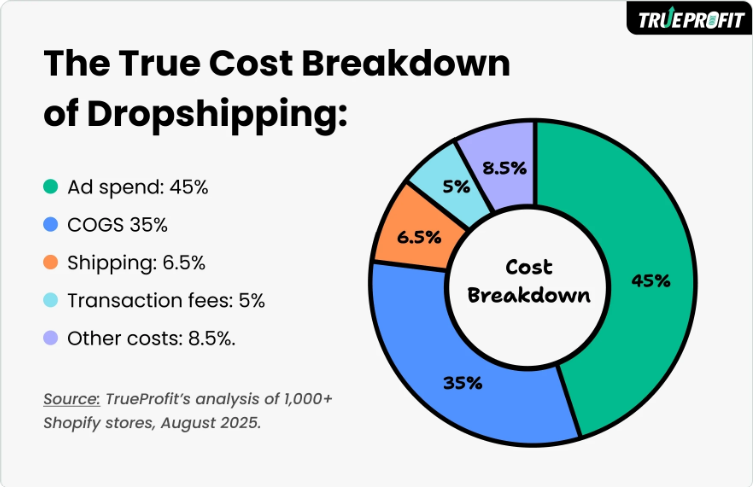
TrueProfit's analysis of 1,000+ Shopify stores (August 2025) found the average cost breakdown across dropshipping businesses: advertising spend accounts for roughly 45% of revenue, COGS 35%, shipping 6.5%, transaction fees 5%, and other operational costs around 8.5%. That leaves the average store with a thin margin — and any single cost category going untracked can turn a seemingly profitable month into a net loss.
Each of these cost categories is recorded in a different place. Supplier invoices sit in AliExpress or CJ Dropshipping. Ad spend lives in Meta Ads Manager or Google Ads. Payment processing fees appear in Shopify Payments or PayPal reports. Shipping costs vary by order weight, destination, and carrier. Without a system that consolidates all of them against every order, a store can generate strong top-line numbers while operating at a loss at the product level.
This problem compounds at scale. A store running paid ads can process hundreds of orders in a single day. Manual reconciliation becomes impossible at that volume, and by the time a merchant realizes a product or campaign is unprofitable, significant budget has already been spent.
The True Cost Structure of a Dropshipping Order
Understanding which costs matter — and where they come from — is the starting point for accurate profit tracking. A typical dropshipping order carries costs across four primary categories.
Cost of Goods Sold (COGS) is the supplier's price per unit, including any import duties or packaging charges. Tracking COGS manually is difficult because supplier prices fluctuate and vary by shipping option. Shopify allows merchants to enter product costs manually, but this approach does not account for price changes from suppliers or include shipping costs, which can vary significantly per order.
Shipping fees are the third-largest cost category for most dropshipping stores, sitting at around 6.5% of revenue on average. Standard shipping from China-based suppliers typically ranges from $1 to $5 per item, while US or EU-based fulfillment runs $3 to $10. Express options via DHL or FedEx can reach $15 to $30 per item. What makes shipping particularly difficult to track is that it varies by product weight, dimensional weight, shipping destination, and supplier location — meaning no two orders may carry the same cost.
Payment processing fees reduce net profit on every transaction. Stripe and PayPal charge 2.9% + $0.30 per transaction. Shopify Payments carries similar processing rates, but using a third-party gateway on top of Shopify adds an extra transaction fee of 0.5% to 2% depending on the plan — a cost that many merchants overlook entirely.
Advertising spend is the largest cost category at roughly 45% of revenue, and also the most variable. Facebook Ads and Google Ads costs fluctuate daily, making it difficult to assign accurate acquisition costs to individual orders without automated attribution.
The formula for dropshipping profit is straightforward in theory:
Net Profit = Revenue – COGS – Shipping – Ad Spend – Transaction Fees – Other Costs
The challenge is that each variable comes from a different data source and changes with every order.
Key Metrics That Determine Whether a Dropshipping Store Is Viable
Tracking revenue is a starting point, not an answer. The financial metrics that determine whether a dropshipping store is viable require a more granular view.
Net profit per order is the most critical metric: the amount left after subtracting the product cost, shipping fee, payment processing fee, and advertising spend attributed to that order. A product with a strong gross margin can still produce negative net profit if ad costs are high or shipping is inconsistent.
Net profit margin measures the percentage of revenue retained after all costs are deducted. A net margin between 10–20% is a strong benchmark for dropshipping. Below 10%, there is little room for error — a single bad campaign, a spike in supplier costs, or an uptick in returns can push the entire store into loss.
Profit by product reveals which SKUs are contributing positively to the bottom line and which are generating revenue that masks a net loss. This distinction is not visible in revenue-focused dashboards, and it is one of the most common reasons merchants scale losing products.
Ad spend vs. net profit provides a more accurate view than ROAS. A campaign with a 3x ROAS on a 30% gross margin product may be generating a net loss once shipping, transaction fees, and overhead are applied. Optimizing for profit rather than revenue per ad dollar changes which campaigns get scaled.
Customer Acquisition Cost (CAC) vs. Customer Lifetime Value (CLV) matters for stores with repeat buyers. Understanding how much it costs to acquire each customer relative to their long-term value is critical for deciding how aggressively to spend on acquisition.
Without visibility into all of these simultaneously, merchants are making scaling decisions based on incomplete data.
How TrueProfit Solves the Profit Tracking Problem for Dropshippers
TrueProfit was built to give Shopify merchants a single, accurate view of their true financial performance — not the revenue figure that looks good on a dashboard, but the net profit number that determines whether the business is actually viable.
The platform integrates directly with Shopify stores and syncs data from advertising platforms including Meta, Google, and TikTok Ads, as well as supplier platforms like AliExpress and CJ Dropshipping, and payment gateways. Every cost is consolidated against every order in real time, eliminating the need for merchants to cross-reference multiple dashboards or maintain manual spreadsheets.
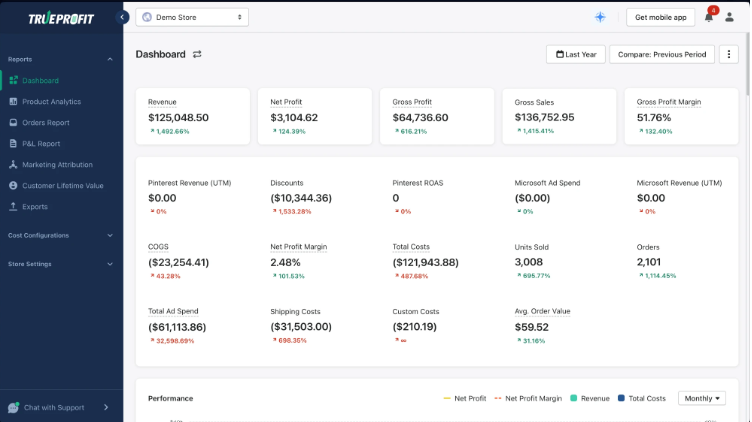
TrueProfit's core capabilities for dropshipping stores include:
Real-time net profit dashboard: Net profit, net profit margin, revenue, total costs, and COGS displayed live as orders come in — giving operators an accurate financial picture at any moment, not at the end of the month.
Net profit visibility at every level: Storewide performance, profit by individual product, and profit by ad channel — so merchants can identify exactly which products and campaigns are driving real returns, not just revenue.
Automatic cost tracking: COGS, advertising spend, shipping fees, transaction fees, and custom costs are all tracked and calculated automatically. No manual entry, no spreadsheets.
Profit-based marketing attribution: Rather than reporting ROAS, TrueProfit shows the actual net profit generated by each ad channel — enabling merchants to allocate budget based on what is genuinely profitable.
Complete P&L reporting: Weekly and monthly profit and loss statements that update automatically, giving merchants a clear record of business performance over time and a shareable report for investors or partners.
Customer Lifetime Value (CLV): Tracks the long-term revenue and profit contribution of each customer segment, helping merchants evaluate whether acquisition costs are justified by repeat purchase behavior.
Custom metrics and KPIs: Merchants can build and monitor any financial metric relevant to their specific business model.
Mobile app: Full profit visibility from any device, so operators can monitor performance without being tied to a desktop.
Instead of asking "how do I calculate dropshipping profit?", TrueProfit shifts the question to "how do I maximize it?" — by making the numbers available, accurate, and actionable at all times.
Merchant Success Stories
One fashion dropshipping store using TrueProfit discovered that its highest-revenue product was operating at a net loss on every order. The product had a competitive selling price that generated strong click-through rates and consistent sales volume, but the combination of high shipping costs from the supplier, a 2% Shopify transaction fee from using a third-party payment gateway, and above-average return rates made every sale a net negative. Without per-product profit tracking, the merchant had been scaling advertising spend on a losing SKU for two months.
After identifying the issue through TrueProfit's product-level profit analytics, the merchant renegotiated supplier terms, switched to Shopify Payments to eliminate the third-party transaction fee, and adjusted the retail price. The product moved from a net loss to a 14% net margin within one billing cycle.
A second operator running three concurrent Shopify stores across different niches used TrueProfit's multi-store dashboard to compare net profit performance across all three simultaneously. The analysis revealed that one store — the one with the lowest revenue — was generating the highest net profit margin, due to lower average ad spend and better supplier pricing. The merchant reallocated the budget toward that store and saw overall business profitability increase within 60 days.
Looking Ahead: Profit Visibility as a Competitive Requirement
As advertising costs on major platforms continue to rise and supplier pricing becomes less predictable, the margin for error in dropshipping is narrowing. Stores that were profitable in 2022 on the same product margins may find those same margins insufficient in 2026, when cost-per-click rates on Meta and Google have increased and consumer return rates have grown alongside a more competitive market.
TrueProfit's analysis of 1,200+ stores is clear on the separation: advanced dropshippers who make data-driven decisions based on net profit metrics consistently reach $10,000 to $50,000+ in monthly net income. Those operating without profit visibility — relying on revenue screenshots and manual spreadsheets — remain stuck in the $0–$2,000 beginner range regardless of how long they have been running.
The difference is not the product. It is the financial discipline to know the real numbers, in real time, and act on them.
Conclusion
Revenue is not profit, and for dropshipping stores operating in an increasingly competitive environment, the difference between the two is the difference between a business that scales and one that stalls. Accurate, real-time profit tracking — across COGS, shipping fees, ad spend, transaction fees, and every other cost — is no longer an optional upgrade. It is a baseline requirement for sustainable operation.
TrueProfit gives Shopify dropshipping merchants the tools to know exactly where every dollar goes, which products and channels are genuinely profitable, and how the business is performing at any given moment. With a 14-day free trial and a 5.0/5 rating across 770+ reviews on the Shopify App Store, TrueProfit has established itself as the standard for profit analytics in ecommerce.
Merchants ready to replace revenue speculation with real profit clarity can start at trueprofit.io.
Media Contact:
Company Name: TrueProfit
Contact Person: TrueProfit Partnership Team
Email: partners@trueprofit.io
City: Ho Chi Minh City
Country: Vietnam
Website: https://trueprofit.io