Quick Summary
Trading micro futures means buying or selling smaller-sized futures contracts that provide leveraged exposure to markets such as the S&P 500, Nasdaq-100, crude oil and Bitcoin. Micro contracts are designed to offer finer position sizing than their larger futures equivalents, but they still carry substantial risk.
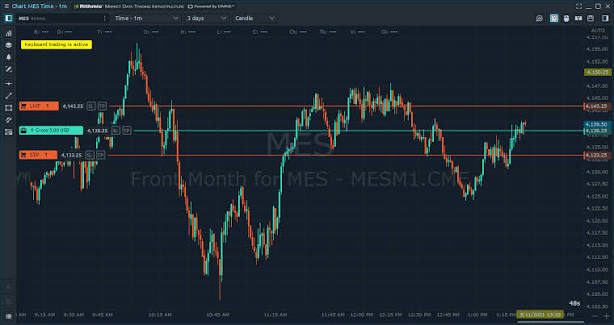
For example, CME Group's Micro E-mini S&P 500 futures contract, known as MES, has a contract multiplier of $5 times the S&P 500 Index and a minimum outright tick worth $1.25. Micro E-mini Nasdaq-100 futures, or MNQ, use a $2 multiplier and have a $0.50 minimum tick value.
For traders focused on short-term price action, understanding where orders are sitting and where transactions are actually taking place can be as important as watching price itself. Bookmap is a market visualisation and order-flow platform designed to display liquidity, traded volume and price structure in real time. It supports futures alongside other markets and can connect to multiple data and trading providers.
Key points:
- Micro futures provide smaller exposure than many standard or E-mini contracts.
- They remain leveraged derivatives, so smaller contract size does not mean low risk.
- MES, MNQ, MCL and MBT give traders access to equity indices, commodities and cryptocurrency futures.
- Margin requirements vary by contract, broker and whether a position is held intraday or overnight.
- Commissions, exchange fees, market-data costs and trading-platform costs should all be considered.
- Highly regarded order-flow tools such as Bookmap can help traders analyse visible liquidity, aggressive buying and selling, volume behaviour and potential areas of interest.
- No platform can predict future prices or remove trading risk.
Ready to explore micro futures using deeper market visibility? Get started with Bookmap and build your trading process around data rather than guesswork.
What Are Micro Futures?
Micro futures are exchange-traded futures contracts with smaller contract multipliers than their larger counterparts.
Like all futures, they are agreements whose value tracks an underlying financial market. Depending on the contract, the underlying market might be an equity index, commodity or cryptocurrency reference rate.
The primary attraction is position-size flexibility.
Instead of requiring a trader to accept the exposure of a larger futures contract, a micro contract can allow more gradual scaling. That can be useful for:
- practising risk management;
- trading smaller accounts;
- scaling into and out of positions;
- testing strategies with reduced nominal exposure;
- fine-tuning hedges;
- spreading risk across multiple entries.
However, micro futures are still leveraged financial products. A relatively small movement in the underlying market can create a material percentage gain or loss relative to the capital committed as margin.
That makes disciplined position sizing essential.
How to Trade Micro E-Mini Futures
Trading Micro E-mini futures generally involves five components: choosing a contract, opening an appropriate futures account, obtaining market data, developing a trading plan and managing each position according to predefined risk limits.
The most widely recognised Micro E-mini equity-index products include:
- MES – Micro E-mini S&P 500
- MNQ – Micro E-mini Nasdaq-100
- M2K – Micro E-mini Russell 2000
- MYM – Micro E-mini Dow
CME specifications list MES at $5 times the S&P 500 Index and MNQ at $2 times the Nasdaq-100 Index. Their minimum outright price fluctuation is 0.25 index points, equivalent to $1.25 per MES contract and $0.50 per MNQ contract.
A practical trading workflow is:
- Choose the market you understand. MES and MNQ behave differently despite both being US equity-index futures.
- Calculate the monetary value of your stop before entering.
- Identify the market context, including trend, range, volatility and major scheduled events.
- Analyse liquidity and order flow rather than relying solely on a candlestick pattern.
- Define your entry, invalidation level and target before executing.
- Keep position size consistent with your risk limits.
- Review the trade afterwards, including whether execution matched the plan.
Bookmap can add another dimension to this process by visualising changes in the order book alongside executed volume.
Investing in Micro Futures Contracts
Micro futures are generally better described as trading, hedging or gaining futures exposure rather than conventional long-term investing.
Unlike owning a share indefinitely, futures contracts expire. Traders may therefore need to close or roll positions when approaching expiration.
Micro futures can nevertheless be used for different objectives.
A trader might use them to:
- speculate on short-term market direction;
- express a medium-term market view;
- hedge exposure elsewhere in a portfolio;
- trade around economic announcements;
- access commodities without trading the physical asset;
- obtain regulated futures exposure to certain cryptocurrency markets.
The critical distinction is leverage.
If a futures broker requires only a portion of the contract's economic exposure to be posted as margin, both gains and losses are amplified relative to that deposit.
For that reason, futures should be approached as risk-managed derivatives rather than simply as a cheaper substitute for buying shares.
Micro Futures Trading Guide
A robust micro futures trading plan should answer several questions before any order is placed.
1. What market are you trading?
Start with one or two contracts rather than attempting to trade everything.
MES and MNQ may suit traders interested in US equity indices. MCL provides crude-oil exposure, while MBT offers CME-regulated Bitcoin futures exposure.
2. What is your time horizon?
A scalper may hold positions for seconds or minutes.
An intraday trader may hold from several minutes to several hours.
A swing trader may hold through multiple sessions, which can introduce different margin requirements and overnight risks.
3. Where is your trade invalidated?
The stop should represent the point where your original trading thesis is no longer valid—not simply the largest loss you feel comfortable tolerating after entering.
4. What does the order flow show?
Traditional charts show where price has traded. An order-flow platform can reveal additional information about displayed liquidity and executed transactions.
Bookmap's heatmap is designed to make historical and current liquidity easier to interpret visually, while volume tools can help traders assess how market participants react when key prices are tested.
5. How will you measure performance?
Track more than profit and loss.
Consider:
- average winning trade;
- average losing trade;
- win rate;
- expectancy;
- maximum drawdown;
- time of day;
- contract traded;
- setup quality;
- slippage;
- commission costs;
- adherence to your plan.
The objective is to determine whether a strategy has a repeatable edge after trading costs—not whether one individual trade succeeded.
Getting Started With Micro Futures
Beginners should prioritise process over profit.
A sensible progression is:
- Learn futures contract terminology.
- Understand tick size and tick value.
- Study margin and leverage.
- Select one liquid micro contract.
- Observe the market without trading.
- Use replay or simulated trading where appropriate.
- Record every simulated trade.
- Develop objective entry and exit criteria.
- Decide maximum risk per trade and per day.
- Only consider live trading when your process is consistent.
Bookmap provides educational material through its Learning Center, including videos, tutorials and live educational resources.
Want to learn how liquidity behaves before committing real capital? Get started with Bookmap and use market replay or simulation as part of your learning process where your setup supports it.
Futures Trading for Beginners
Futures can initially appear complicated because several concepts operate simultaneously: contract size, tick value, expiry, leverage, margin, commissions and market volatility.
The simplest definition is this:
A futures contract is a standardised exchange-traded derivative whose price is linked to an underlying market.
You do not normally pay the entire economic value of the contract upfront. Instead, margin is required to support the position.
That creates leverage.
For beginners, four rules matter particularly:
- Know exactly how much one tick is worth.
- Know how much you could lose at your planned stop.
- Never confuse broker margin with a recommended account size.
- Do not increase contract quantity simply because the broker permits it.
The fact that an account has enough available margin to open ten contracts does not mean trading ten contracts is prudent.
Derivatives Market Trading
Futures sit within the wider derivatives market alongside products such as options, forwards and swaps.
A derivative derives its value from something else.
That underlying reference might include:
- an equity index;
- crude oil;
- gold;
- interest rates;
- currencies;
- agricultural commodities;
- cryptocurrencies.
Exchange-traded futures have standardised specifications, including contract size, minimum price movement, expiry procedures and trading hours.
This standardisation can make them attractive to active traders because the relationship between market movement and profit or loss can be calculated precisely.
The difficulty is that derivatives can move quickly and leverage magnifies mistakes.
Successful participation therefore depends less on predicting every movement and more on managing uncertainty consistently.
Financial Market Speculation Strategies
There is no single micro futures strategy that works in every market regime.
Common approaches include:
Trend following
Traders attempt to participate when price establishes sustained directional momentum.
Mean reversion
The objective is to identify situations where price has moved away from a perceived area of fair value and may return towards it.
Breakout trading
Traders monitor defined ranges or important levels and act when price moves beyond them with sufficient confirmation.
Momentum trading
Positions are taken when order flow and price action demonstrate accelerating participation.
Liquidity-based trading
Rather than relying only on price patterns, traders analyse where significant resting liquidity appears, whether it remains in the book and how executed orders behave as price approaches it.
This is where Bookmap can be particularly useful. It is designed around liquidity and order-flow visualisation rather than treating the order book as a static ladder.
Whatever the approach, a strategy should specify entry criteria, exit criteria, invalidation, position sizing and conditions under which no trade should be taken.
Understanding Leveraged Financial Instruments
Leverage allows a trader to control market exposure greater than the cash posted as margin.
It is one of the main advantages and biggest risks of futures.
Imagine a trader is prepared to lose £100 on a trade. The relevant calculation is not simply whether the account has sufficient margin to open the position.
The trader also needs to know:
Number of ticks to stop × tick value × number of contracts = planned monetary risk
Transaction costs and potential slippage then need to be considered as well.
Leverage should therefore be treated as a risk-management responsibility rather than an invitation to maximise exposure.
Bookmap itself includes a clear futures risk disclosure noting that futures trading involves substantial risk and that traders may potentially lose all or more than their initial investment.
What Are the Margin Requirements for Micro Futures?
There is no universal micro futures margin requirement.
Margin varies according to:
- the contract;
- exchange requirements;
- broker policies;
- current volatility;
- whether the position is intraday or held overnight;
- account type;
- regulatory requirements.
Some futures brokers advertise relatively low intraday margins. These figures should not be interpreted as the amount of capital required to trade responsibly.
Margin determines whether a position can be opened or maintained. It does not determine an appropriate risk budget.
Exchange and broker margin schedules can also change quickly during periods of unusual volatility.
Before placing any trade, confirm current requirements directly with your broker.
For MCL, for example, CME describes the Micro WTI contract as one-tenth the size of its benchmark WTI futures contract and specifically highlights its smaller margin requirement relative to the larger product.
How Much Capital Is Needed to Day Trade Micro Futures?
There is no single account balance suitable for every micro futures trader.
The correct amount depends on:
- contract volatility;
- stop distance;
- number of contracts;
- maximum risk per trade;
- maximum daily loss;
- expected drawdown;
- brokerage margin;
- commissions and exchange fees.
Suppose a strategy requires a 20-tick stop and each tick is worth $1.25. One MES contract would represent $25 of price risk before commissions and slippage.
Increasing that position to four contracts would make the same stop represent $100.
This illustrates why risk-based position sizing is usually more useful than asking only what minimum deposit a broker accepts.
A well-capitalised account provides room for normal drawdowns, execution costs and changing margin requirements.
If the account is so small that one ordinary losing trade represents a large percentage of equity, the nominally smaller micro contract can still be too large.
Best Brokers for Micro E-Mini Contracts
The best micro futures broker depends on your priorities rather than one universal ranking.
Consider:
- futures commissions;
- exchange and clearing fees;
- intraday and overnight margin;
- order-routing quality;
- available market data;
- platform compatibility;
- customer service;
- withdrawal procedures;
- regulatory status;
- support for your country.
For traders intending to use Bookmap, connectivity matters as well.
Bookmap lists broker and platform relationships or connectivity involving providers such as NinjaTrader, Tradovate, Interactive Brokers and TradeStation, alongside futures data connections such as Rithmic and CQG.
Bookmap itself is a market-analysis and trading platform rather than a futures broker. Live brokerage services and market data are not automatically included with a Bookmap licence, so your complete setup may involve Bookmap plus a compatible broker and data provider.
What should you compare before choosing?
Do not choose a broker simply because it advertises the lowest day margin.
Evaluate the entire trading stack.
A slightly higher-cost provider with reliable data, stable execution and appropriate platform support may be more useful than the cheapest headline offer.
Micro Futures vs Standard Mini Futures Fees
Micro futures typically produce lower exposure per contract, but their costs do not always fall proportionally with their contract size.
That distinction matters.
If one larger contract can provide approximately the same exposure as several micro contracts, trading multiple micros can result in:
- more commission charges;
- more exchange fees;
- more clearing fees;
- potentially greater cumulative transaction costs.
Micro contracts may therefore be excellent for precision, but not automatically the cheapest method of obtaining equivalent exposure.
Their advantage is flexibility.
For example, a trader could potentially reduce a five-contract position one micro contract at a time instead of being forced to close a much larger unit of exposure.
When comparing products, calculate:
Total trading cost ÷ effective market exposure
rather than looking only at the commission advertised per contract.
Trading Micro E-Mini S&P 500 MES Contracts
MES is one of the most accessible contracts for traders learning US equity-index futures.
CME Group specifies the contract at $5 × the S&P 500 Index, with a minimum price fluctuation of 0.25 index points or $1.25 per contract.
That makes risk calculations relatively straightforward.
A five-point MES move equals:
5 index points × $5 = $25 per contract
before trading costs.
MES traders frequently monitor:
- the US cash-market open;
- previous session highs and lows;
- overnight highs and lows;
- economic releases;
- Federal Reserve events;
- large liquidity zones;
- volume around important price levels.
With Bookmap, traders can observe how displayed liquidity develops around these areas and how actual transactions respond as price approaches them.
The key is not to assume that a large visible order guarantees support or resistance. Orders can be modified or cancelled. Liquidity should be interpreted alongside executed volume, context and risk.
Day Trading Micro Crude Oil MCL Futures
Micro WTI Crude Oil futures use the ticker MCL.
CME Group specifies MCL at 100 barrels, compared with 1,000 barrels for standard WTI futures. The minimum tick is $0.01 per barrel, making one tick worth $1 per contract. MCL is financially settled.
Crude oil can react sharply to:
- inventory reports;
- OPEC-related developments;
- geopolitical events;
- supply disruptions;
- changes in demand expectations;
- US dollar movements.
This can produce attractive opportunities for active traders but also sudden volatility.
An MCL trader using order flow might watch for:
- liquidity appearing around previous highs or lows;
- absorption at heavily traded levels;
- rapid withdrawal of resting liquidity;
- aggressive buying or selling that fails to move price;
- changes in transaction speed near breakout levels.
Bookmap can help visualise these interactions, but it does not eliminate headline risk. Stops, sizing and daily loss limits remain essential.
Scalping Micro Nasdaq MNQ on NinjaTrader
MNQ is popular with short-term traders because the Nasdaq-100 can produce frequent intraday movement.
CME lists MNQ with a $2 × Nasdaq-100 Index multiplier and a 0.25-point minimum movement worth $0.50 per contract.
For scalpers, the low nominal tick value can make fine position sizing possible, although commissions and slippage become especially important when trading frequently.
Bookmap can be used alongside a NinjaTrader-based workflow.
Bookmap documents connectivity with NinjaTrader and provides guidance for setups involving data providers such as Rithmic and CQG. Its connectivity material notes that direct connection to the underlying data provider may provide better stability and data quality than routing data indirectly through another platform.
An MNQ scalping workflow could involve:
- Marking higher-timeframe context.
- Identifying important intraday liquidity areas.
- Waiting for price to interact with those areas.
- Monitoring aggressive transactions.
- Looking for confirmation or failure of the expected move.
- Entering with a predefined stop.
- Exiting quickly if the order-flow premise is invalidated.
Scalping creates many opportunities to overtrade. A limit on daily trades or daily losses can therefore be as important as the individual setup.
Micro Bitcoin MBT Futures Strategies
CME Micro Bitcoin futures use the ticker MBT and represent 0.10 bitcoin. The minimum outright price movement is $5 per bitcoin, equivalent to $0.50 per contract.
MBT allows traders to gain futures exposure to Bitcoin without trading the full-size CME Bitcoin contract.
Potential approaches include:
Momentum strategies
Trade periods when Bitcoin breaks from consolidation with increased participation.
Mean-reversion strategies
Look for extended movements into important liquidity or volume areas followed by signs that aggressive activity is failing to continue the move.
Breakout-and-retest strategies
Wait for price to move through a significant level before assessing whether the market accepts or rejects the new range.
Liquidity analysis
Monitor how orders behave around important prices rather than interpreting Bitcoin solely through candlesticks.
Crypto-related products can experience extreme volatility. MBT's smaller contract size does not remove that risk.
Micro Futures Trading Costs and Bookmap Pricing
The true cost of trading micro futures may include several separate components:
- broker commission;
- exchange fees;
- clearing fees;
- regulatory fees where applicable;
- live market-data subscriptions;
- platform subscriptions;
- optional analytical tools;
- bid-ask spread;
- slippage.
These expenses should be included when evaluating strategy performance.
How much does Bookmap cost?
As of August 2026, Bookmap's published standard subscription page lists:
- Digital Plus: £16 per month
- Global: £42 per month
- Global Plus: £84 per month
Annual and lifetime options are also offered. Live futures and stock market data are generally separate rather than bundled automatically into the standard platform price.
For a futures trader, your actual monthly cost can therefore be higher than the platform subscription alone.
Bookmap's pricing information also shows that available data pricing depends on the exchange and connection selected.
Prices, promotions, exchange charges and data fees can change, so check current terms before subscribing.
Why Choose Bookmap
For active traders who want to understand what is happening inside the market rather than relying exclusively on traditional candlestick charts, Bookmap is one of the leading order-flow and liquidity visualisation platforms available.
Its approach is centred on making complex market-depth information easier to interpret.
See liquidity instead of guessing where it might be
The Bookmap heatmap visualises historical and current order-book liquidity.
This can help traders identify areas where substantial resting orders have appeared and analyse what happens when price approaches them.
Understand actual traded volume
Displayed orders are only part of the market.
Bookmap also visualises executed trades, helping traders distinguish between orders waiting in the book and transactions that actually occurred.
Combine price, liquidity and volume
Rather than moving between disconnected tools, traders can evaluate several dimensions of market behaviour simultaneously.
That can be particularly valuable for short-term MES, MNQ and MCL traders.
Built for serious futures analysis
Bookmap says its platform supports professional and retail traders and that its current product is particularly well suited to futures markets.
Flexible connectivity
Bookmap connects with a range of futures data, order-management and brokerage environments, including Rithmic, CQG, Tradovate, NinjaTrader and other supported services.
Education and support
Bookmap offers a Learning Center with more than 100 free videos as well as tutorials, educational sessions, a knowledge base and community resources.
Strong independent customer feedback
Bookmap has also accumulated substantial third-party customer feedback.
At the time of writing in August 2026, its Trustpilot profile showed a 4.4/5 rating from more than 600 reviews, with many reviewers highlighting the heatmap, customer support, educational community and ability to understand buying and selling activity more clearly. As with any independent review platform, experiences vary, and prospective users should read both positive and critical Trustpilot reviews before deciding whether the product suits their workflow.
That balanced approach matters. Bookmap is a sophisticated analytical platform—not a guaranteed route to profitability.
Want to see whether order-flow analysis fits your trading style? Get started with Bookmap, explore the platform and speak to an expert about your preferred futures setup.
Micro Futures vs Alternative Trading Markets
Micro futures are not the only way to trade financial markets.
Micro futures vs CFDs
CFDs are broker-issued derivatives, while exchange-traded futures operate through centralised futures markets.
Futures provide standardised contract specifications and exchange-based order books. CFDs can offer flexible sizing but depend on the broker's pricing structure and product terms.
Micro futures vs ETFs
ETFs may be more appropriate for investors seeking straightforward long-term exposure without futures expiry dates.
Futures may appeal more to active traders who value leverage, nearly round-the-clock trading in many contracts and direct access to derivatives markets.
Micro futures vs larger futures
Larger contracts can be more capital-efficient on a transaction-cost-per-unit-of-exposure basis, while micro contracts provide greater sizing flexibility.
Bookmap vs traditional charts
Traditional charts organise historical price into candles, bars or lines.
Bookmap focuses more heavily on liquidity, order-book behaviour and executed volume.
They are not necessarily mutually exclusive. Many traders use conventional charts for broader structure and Bookmap for detailed execution analysis.
Accessing Micro Futures From the UK
UK traders can potentially access US-listed futures through brokers that accept UK clients and provide the required futures markets.
Availability depends on the broker, account eligibility, regulatory requirements and selected data package.
Bookmap itself is software rather than a brokerage account, so a typical setup may involve:
Bookmap + futures broker + compatible market-data connection
Bookmap can be installed on Windows and Mac, with Linux also described as functional although not officially supported in its connectivity documentation.
This means traders are not limited to a physical trading floor or US location. With an appropriate brokerage, data connection and computer setup, the platform can be accessed remotely.
Before funding an account, confirm that:
- the broker accepts residents of your jurisdiction;
- the desired CME or NYMEX products are available;
- live depth-of-market data is supported;
- the connection works with your preferred Bookmap configuration;
- total data, platform and execution costs are understood.
Which Asset Class Are You Looking to Trade, Such as Equity Indices, Commodities, or Crypto?
The best micro futures contract depends partly on the market you understand.
For equity indices, MES and MNQ are two widely followed choices.
For commodities, MCL provides smaller-sized WTI crude-oil exposure.
For cryptocurrency futures, MBT provides CME Bitcoin exposure at one-tenth of a bitcoin per contract.
Do not choose purely according to which market moves the most. Consider liquidity, volatility, trading hours, news sensitivity and how each contract behaves during your normal trading session.
Are You Interested in Intraday Scalping Strategies or Swing Trading?
Your holding period should influence both strategy and platform setup.
Scalpers generally care more about:
- order-book changes;
- execution speed;
- spread;
- transaction costs;
- immediate liquidity;
- short-term order flow.
Swing traders may focus more on:
- multi-session structure;
- economic trends;
- broader technical levels;
- overnight margin;
- event risk;
- contract expiry.
Bookmap can be useful for both approaches, but its detailed visualisation of liquidity and trading activity is particularly relevant to traders making short-term decisions.
Do You Need Broker Platform Recommendations or Margin Requirement Details?
Treat the broker, data provider and analytical platform as separate parts of your trading infrastructure.
A broker provides account and execution services.
A market-data provider supplies the information needed to view the market.
Bookmap provides the visualisation and analytical environment.
Some providers combine multiple functions, but costs and capabilities vary.
Before opening an account, compare:
- supported micro futures;
- intraday margin;
- overnight margin;
- commission schedule;
- exchange fees;
- market-depth availability;
- Bookmap compatibility;
- execution reliability;
- customer service.
If you need help establishing a compatible setup, speak to a Bookmap expert or support team before purchasing data subscriptions you may not need.
Frequently Asked Questions About Trading Micro Futures
Are micro futures good for beginners?
Micro futures can offer more manageable position sizing than larger futures contracts, which makes them useful for learning. They are not inherently safe, however. They remain leveraged derivatives and can generate significant losses if positions are oversized or poorly controlled.
Beginners should understand tick values, leverage, margin, expiration and risk management before live trading.
Can you make money trading micro futures?
It is possible to profit from micro futures, but profitability is never guaranteed.
A sustainable trading approach requires positive expectancy after commissions and slippage, controlled drawdowns and disciplined execution.
A platform such as Bookmap can provide more information about market behaviour, but information alone cannot guarantee profitable decisions.
Can I lose more than my account balance trading micro futures?
Futures carry substantial leverage, and losses can potentially exceed the capital initially committed to a position. Extreme volatility, gaps or execution issues can cause realised losses to differ from a planned stop.
Only capital you can afford to lose should be exposed to leveraged futures trading.
What is the easiest micro futures contract to trade?
There is no objectively easiest contract.
MES is frequently considered approachable because its tick value is relatively small and its underlying S&P 500 index is widely followed.
MNQ can offer greater movement but may also be more volatile.
The better choice is the contract whose behaviour, tick value and risk profile fit your strategy.
Do I need Bookmap to trade micro futures?
No. Micro futures can be traded through many futures platforms without Bookmap.
Bookmap is designed for traders who want deeper visibility into liquidity and order flow. It can complement conventional charting by showing how displayed orders and executed volume develop around price.
For traders whose strategy depends heavily on market depth, absorption, liquidity behaviour or short-term execution, that additional information may be especially valuable.
Can Bookmap predict where MES or MNQ will go next?
No.
Neither Bookmap nor any legitimate trading platform can reliably predict the next market movement.
Bookmap helps traders observe liquidity, volume and price structure so they can make more informed decisions. One Bookmap response to a Trustpilot reviewer specifically emphasised that the software is a market-visualisation platform rather than a market-prediction tool.
Can I trade micro futures through Bookmap?
Bookmap supports futures trading and connects with multiple compatible data and trading environments. The exact ability to place trades from Bookmap depends on the brokerage and connection being used. Its documentation covers integrations including Tradovate, TradeStation, NinjaTrader-related setups, Rithmic and CQG.
Check compatibility with your particular broker, account and data service before trading live.
Is Bookmap worth using for micro futures trading?
Bookmap is most relevant to traders who want to base decisions on more than conventional price charts.
Its heatmap, order-flow visualisation, volume information and futures connectivity can provide detailed context around MES, MNQ, MCL and other actively traded contracts.
Independent Trustpilot reviews frequently praise its heatmap, customer support and market visualisation, although some reviewers also criticise cost or usability.
The right question is therefore not whether every trader needs Bookmap, but whether visibility into liquidity and order flow improves your decision-making process.
Ready to find out? Get started with Bookmap, explore the available futures tools, or speak to an expert about building a setup around the micro futures markets you trade.
Futures risk warning: Futures trading involves substantial risk and is not suitable for every investor. Leverage can magnify both gains and losses, and traders may lose all or more than their initial investment. Past performance does not guarantee future results. Use only risk capital and independently verify current contract specifications, margin requirements, fees and product availability before trading.