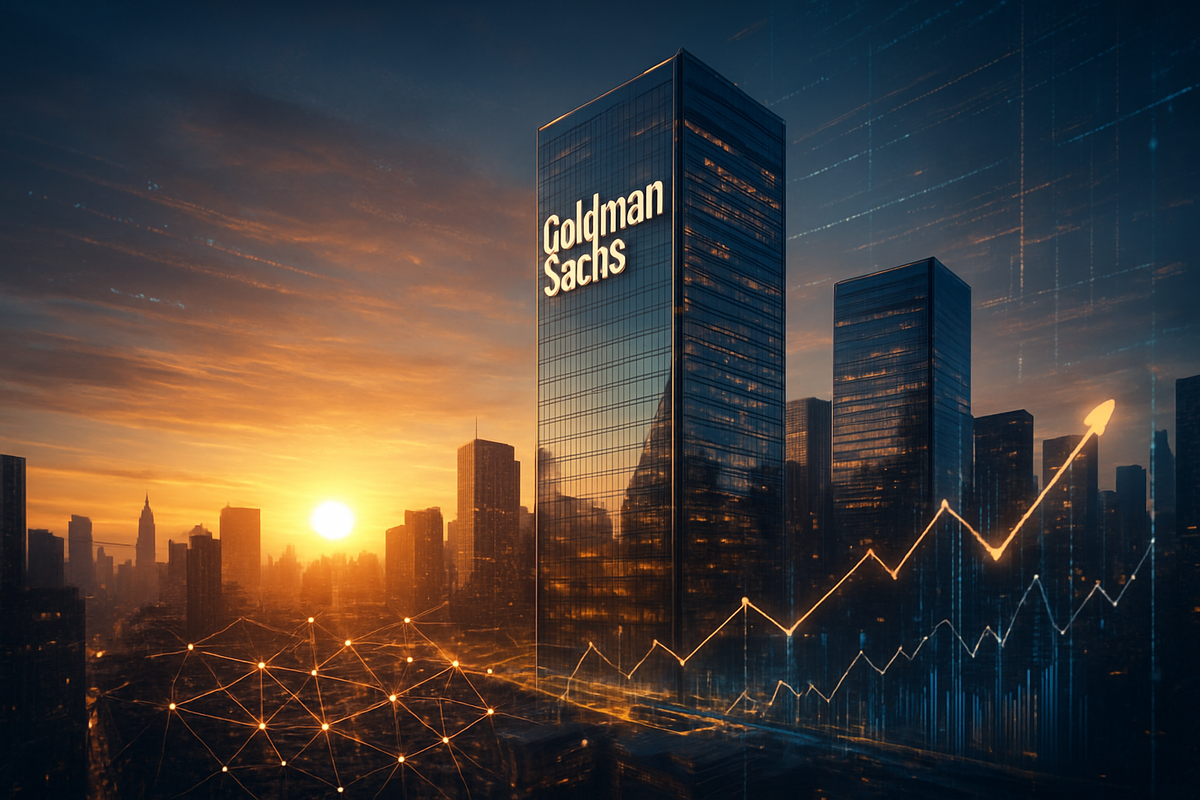
The financial world was sent into a frenzy last week as Goldman Sachs (NYSE: GS) reported a staggering fourth-quarter performance for 2025, significantly outstripping analyst predictions and signaling a robust return to form for the "Vampire Squid" of Wall Street. On January 15, 2026, the firm posted a diluted earnings per share (EPS) of $14.01, far exceeding the consensus estimate of $11.75. This monumental beat was propelled by a 25% surge in investment banking fees, a clear indication that the long-dormant dealmaking environment has finally awoken.
The immediate implications of this report were felt across the global markets, with Goldman’s stock price climbing 4.6% on the day of the announcement. Investors, who had been cautious throughout the previous year's volatile interest rate environment, viewed the results as a definitive validation of CEO David Solomon’s "Back-to-Basics" strategy. By pivoting away from consumer banking and doubling down on its core strengths in advisory and institutional trading, Goldman Sachs has positioned itself at the vanguard of a new era of capital markets activity.
A Blockbuster Quarter: The Return of the Dealmakers
The specifics of the fourth-quarter report paint a picture of a firm firing on all cylinders. Total net revenues for the period hit $13.45 billion, with net earnings rising 12% year-over-year to $4.62 billion. The most striking figure, however, was the $2.58 billion generated in investment banking fees—a 25% leap from the same period in 2024. This growth was largely driven by a massive 41% jump in advisory revenues, which reached $1.43 billion as long-delayed mergers and acquisitions (M&A) finally crossed the finish line.
The timeline leading up to this moment was defined by a steady build-up of the deal pipeline throughout late 2025. Following a period of relative stagnation, the fourth quarter saw a flurry of activity in the technology and energy sectors. Goldman’s equities trading division also set a record, bringing in $4.31 billion, a 25% increase fueled by high market volatility and renewed institutional interest in AI-related equities. Despite a $2.3 billion markdown related to the offloading of the Apple Card portfolio—a move that saw Apple (NASDAQ: AAPL) credit lines transition to a new partner—the firm managed to offset the impact through a $2.5 billion reserve release, netting a 46-cent benefit to the overall EPS.
Key players within the firm, including Solomon and President John Waldron, highlighted the "flywheel effect" currently taking place in the market. As interest rates stabilized and regulatory clarity emerged in late 2025, the firm’s advisory pipeline swelled to its highest level in four years. Market participants reacted with overwhelming optimism, as the results suggested that the "dealmaking winter" of the early 2020s had officially thawed, replaced by a high-velocity environment where strategic consolidation is once again the priority for global CEOs.
Winners and Losers in the Post-Earnings Landscape
Goldman Sachs (NYSE: GS) is undeniably the primary winner of this cycle, having successfully executed a strategic retreat from the retail banking sector. Its stock has become a bellwether for investment banking health, outperforming many of its peers. Close behind is Morgan Stanley (NYSE: MS), which also reported a significant 47% surge in investment banking revenue, proving that the high-end advisory model is currently the most lucrative place to be on Wall Street. These "pure-play" or advisory-heavy firms are thriving as capital markets reopen, benefiting from a lack of exposure to the slowing consumer credit sector.
Conversely, the picture is more complicated for JPMorgan Chase (NYSE: JPM). While still an industry titan, JPMorgan saw its shares dip nearly 4% following its own earnings report. The bank faced what analysts called "sticker shock" from the integration of the $20 billion Apple Card portfolio, which it acquired from Goldman at a discount but which required a $2.2 billion provision for credit losses. This highlights a growing divergence in the market: while Goldman and Morgan Stanley are riding the wave of institutional fees, diversified banks like JPMorgan and Citigroup (NYSE: C) are grappling with the rising costs and risks associated with massive consumer lending portfolios.
Other potential winners include boutique advisory firms such as Evercore (NYSE: EVR) and Lazard (NYSE: LAZ). As the M&A wave intensifies, these specialized players are expected to capture a significant share of the advisory fees that are now flooding back into the market. On the losing side, smaller regional banks that lack investment banking arms may find themselves squeezed between low net interest margins and a lack of fee-based revenue to offset the headwinds of a cooling retail economy.
The AI Super-Cycle and the Regulatory Tailwind
The wider significance of Goldman's blockbuster quarter cannot be overstated. It marks a fundamental shift in industry trends, where artificial intelligence (AI) has moved from a speculative buzzword to the primary driver of M&A activity. Goldman reported that a substantial portion of its advisory revenue came from "AI infrastructure" deals—specifically in the energy and utilities sectors, as companies scramble to acquire the power and data center capacity needed to support the AI revolution. This "innovation supercycle" is expected to underpin market activity for years to come.
Furthermore, the results are closely tied to a shifting regulatory landscape in the United States. Following the transition to the "Trump 2.0" administration, a more permissive antitrust environment has begun to take root. Regulators are increasingly favoring behavioral remedies over outright blocking of large mergers, which has unleashed a wave of "dream deals" that were previously considered too risky to attempt. This deregulatory stance has provided the confidence necessary for large-scale consolidations in the healthcare, technology, and energy sectors.
Historical precedents suggest that we are entering a "Goldilocks" period for investment banks. Similar to the post-2008 recovery or the 2021 post-pandemic surge, the current environment combines a massive buildup of private equity "dry powder"—estimated at $1.2 trillion—with a corporate world eager to restructure. The difference today is the speed of execution; Goldman’s record equities trading and surge in fees suggest that the market is operating at a much higher velocity than in previous cycles, driven by algorithmic trading and real-time global capital flows.
The Road Ahead: An IPO Renaissance and Strategic Pivots
Looking forward, the short-term outlook is dominated by the prospect of an "IPO Renaissance." With Goldman reporting its highest deal backlog in four years, several high-profile "mega-IPOs" are expected to hit the market in the first half of 2026. Names like OpenAI, SpaceX, and Anthropic are widely rumored to be preparing for public debuts, which would provide another massive windfall for Goldman’s underwriting business. This surge in public listings is likely to create a virtuous cycle, attracting more retail and institutional capital back into the equities market.
However, challenges remain on the horizon. Long-term strategic pivots will be required as firms navigate potential inflationary spikes and the geopolitical tensions that continue to simmer in Europe and Asia. Goldman Sachs must ensure that its retreat from consumer banking doesn't leave it too exposed to the cyclicality of capital markets. While the firm is currently reaping the rewards of its "back-to-basics" approach, any sudden market downturn or "black swan" event could test its resilience without the cushion of a large consumer deposit base.
The most likely scenario for the remainder of 2026 is one of high-volume, high-value dealmaking. Global M&A volumes are projected to reach $3.9 trillion for the full year, potentially surpassing the all-time records set in 2021. For Goldman Sachs, the challenge will be maintaining its lead in an increasingly competitive landscape where every major bank is now attempting to pivot back toward the lucrative advisory fees that GS has already secured.
A New Benchmark for Wall Street
In summary, Goldman Sachs' Q4 2025 performance is a watershed moment for the financial industry. By posting a $14.01 EPS and a 25% surge in investment banking fees, the firm has not only silenced its critics but has also set a new benchmark for what a focused, institutional-grade investment bank can achieve. The pivot away from consumer banking appears to have been perfectly timed to coincide with a resurgence in global M&A and a historic wave of AI-driven capital expenditure.
As the market moves forward, the focus will remain squarely on the health of the deal pipeline and the stability of the broader economic environment. Investors should watch closely for the performance of the upcoming IPOs and the integration of the Apple Card portfolio at JPMorgan, as these will serve as key indicators for the health of the financial sector. While risks such as inflation and geopolitical instability persist, the "Dealmaking Renaissance" of 2026 is officially underway, with Goldman Sachs firmly at the helm.
This content is intended for informational purposes only and is not financial advice.