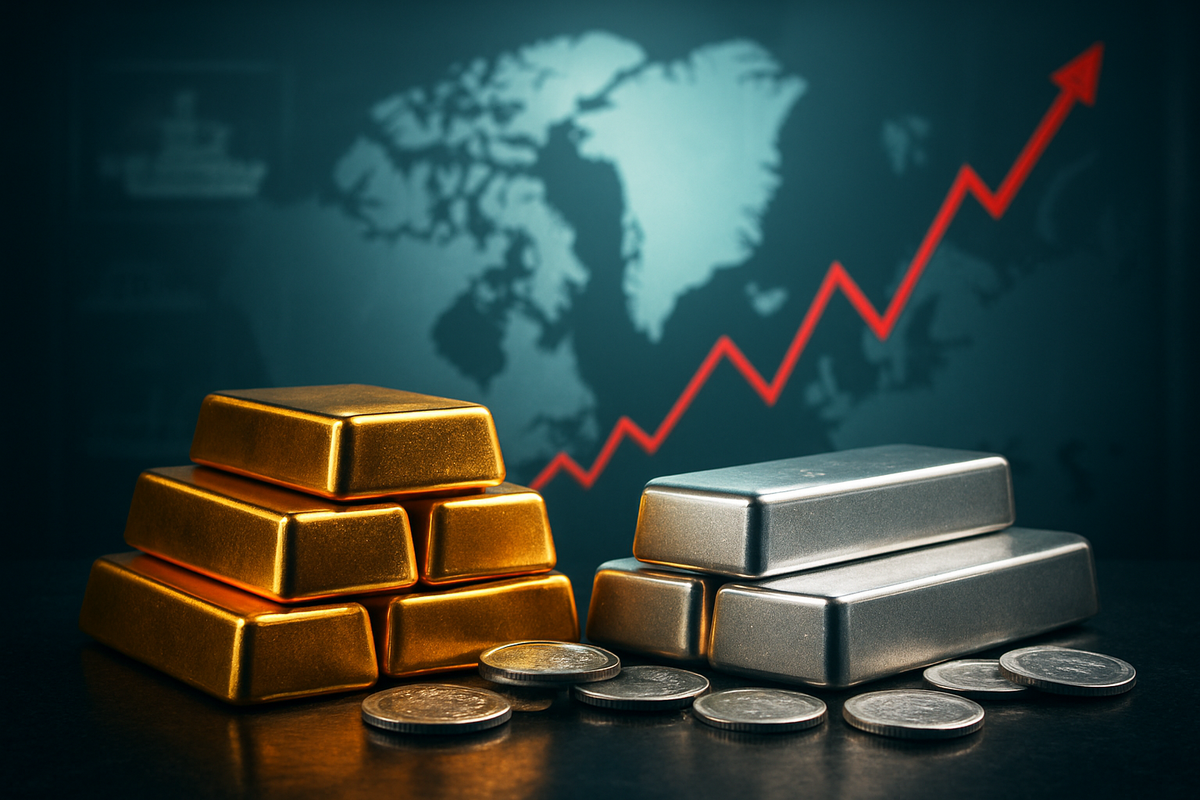
In a seismic shift for global financial markets, spot gold prices have surged to an unprecedented $4,700 per ounce, while silver has rocketed to a record $95 per ounce as of January 20, 2026. This massive flight to safe-haven assets follows President Trump’s bombshell announcement of a 10% blanket tariff on eight European nations—a move intended to pressure the continent into negotiating the sale of Greenland to the United States. The escalation has sent shockwaves through the commodities market, with investors abandoning traditional equities and currencies in favor of "hard money" as the specter of a full-scale transatlantic trade war looms.
The sudden spike in precious metals reflects a market gripped by geopolitical uncertainty. Silver, in particular, has outperformed even the most bullish forecasts, nearly touching the triple-digit milestone as industrial demand for green energy tech converges with a frantic retail rush for bullion. As the U.S. administration ties trade policy directly to territorial expansion, analysts warn that the global economic order is entering its most volatile phase since the mid-20th century.
The Greenland Gambit: Tariffs as a Tool for Territory
The current crisis began in earnest on January 17, 2026, when President Trump issued an executive order imposing a 10% tariff on all imports from Denmark, Norway, Sweden, France, Germany, the United Kingdom, the Netherlands, and Finland. The stated goal is to secure the acquisition of Greenland, which the administration has designated a "critical national security priority." The White House argues that Denmark’s control of the island is insufficient to protect the Arctic from rising Russian and Chinese military influence. The catalyst for the immediate move was a Danish-led NATO exercise, "Arctic Endurance," which Trump characterized as an "unnecessary provocation" on what he considers a strategic American frontier.
The timeline leading to this record-breaking market rally moved with startling speed. Following the January 17 announcement, the European Union immediately convened an emergency summit in Brussels, threatening to trigger its "Anti-Coercion Instrument" (ACI). This would allow for retaliatory tariffs on over €93 billion of U.S. goods, potentially targeting American aerospace, agricultural, and luxury sectors. By the morning of January 20, the rhetoric had escalated to the point where traders began pricing in a total breakdown of the post-WWII trade alliance, driving gold up by $250 in a single trading session.
Key stakeholders, including Danish Prime Minister Mette Frederiksen and EU Commission President Ursula von der Leyen, have issued a joint statement declaring that "Greenland is not for sale." However, the U.S. administration has signaled that the 10% tariff is merely a starting point, with a scheduled increase to 25% by June 1, 2026, if no progress is made on the "purchase agreement." This "buy-or-pay" diplomacy has left markets with little choice but to hedge against a prolonged period of economic isolationism.
Winners and Losers: Mining Giants Surge as Industrials Stumble
The primary beneficiaries of this geopolitical storm are the major precious metal producers, who are seeing their valuations reach levels once thought impossible. Newmont Corporation (NYSE: NEM), the world’s largest gold miner, has seen its stock price skyrocket as it projects record-breaking free cash flow for the first quarter of 2026. Similarly, Barrick Gold (NYSE: GOLD) has captured significant investor attention, recently announcing a 50% increase in its quarterly dividend to distribute the windfall from $4,700 gold to its shareholders.
Silver-focused companies are seeing even more dramatic gains due to the metal's dual role as a safe haven and an industrial necessity. Pan American Silver (NYSE: PAAS) and Agnico Eagle Mines (NYSE: AEM) have become favorite targets for institutional funds looking to capitalize on the $95 silver price. ETFs have also seen historic inflows; the SPDR Gold Shares (NYSEARCA:GLD) and the iShares Silver Trust (NYSEARCA:SLV) have reported record daily volume, with SLV up nearly 29% since the start of the year.
Conversely, the losers in this scenario are the heavy industrial and consumer-facing companies dependent on stable transatlantic trade. European automakers like Volkswagen (OTC:VWAGY) and BMW (OTC:BMWYY) have seen their shares crater on fears that the 10% tariff will decimate their American profit margins. Furthermore, U.S. tech companies that rely on European consumer markets are bracing for the EU’s retaliatory "Anti-Coercion" measures, which could include digital service taxes and import bans on high-tech components.
A New Era of Economic Coercion and Hard Assets
The current event marks a significant departure from traditional trade disputes, which are typically centered on industry protections or intellectual property. By using tariffs as a lever for territorial acquisition, the U.S. is redefining the boundaries of economic statecraft. This fits into a broader global trend of "deglobalization," where national security concerns take precedence over economic efficiency. The ripple effects are already being felt in the currency markets, where the Euro has hit a multi-year low against the dollar, further incentivizing the shift into gold and silver.
Historically, the only comparable events are the Nixon Shock of 1971 or the 1930s Smoot-Hawley Tariff Act. However, the 2026 Greenland crisis is unique because of the interconnectedness of modern supply chains. While gold has always been the "lender of last resort," its rise to $4,700 suggests that the market no longer views the U.S. Treasury or the Euro as sufficient hedges against systemic collapse.
Regulatory implications are also surfacing, as the EU considers implementing emergency capital controls to prevent further flight into precious metals and cryptocurrencies. In the U.S., there is growing pressure on the Federal Reserve to address the inflationary impact of the new tariffs, though the central bank finds itself in a difficult position: raising rates to fight inflation could further destabilize a global economy already reeling from trade war fears.
The Path Forward: $5,000 Gold or Diplomatic De-escalation?
In the short term, all eyes are on the upcoming February 1 deadline when the 10% tariffs are officially set to take effect. If no diplomatic breakthrough occurs before then, analysts at major investment banks are predicting that gold will comfortably clear the $5,000 mark. The potential for a "Black Swan" event—such as a formal European trade embargo against the U.S. or a U.S. naval blockade of Greenland’s ports—is no longer being dismissed by risk managers.
The long-term outlook depends on whether this is a temporary negotiation tactic or a permanent shift in U.S. foreign policy. If the Greenland acquisition becomes a multi-year struggle, we could see a permanent re-rating of precious metals. Companies may need to strategically pivot, with miners accelerating production at high-cost sites that were previously uneconomical, while manufacturers may be forced to "onshore" supply chains to avoid the escalating tariff walls between the U.S. and Europe.
A potential de-escalation scenario involves a "joint-management" agreement for Greenland's resources rather than a total sale, but the current rhetoric suggests that both sides are dug in. For investors, the challenge will be navigating the extreme volatility that comes with $95 silver; while the upside is significant, any sign of a diplomatic thaw could lead to a rapid correction in prices as the "fear premium" evaporates.
Market Outlook and Final Assessment
The record-breaking surge in gold and silver to $4,700 and $95 respectively is more than just a commodity rally; it is a clear signal that the market is pricing in a fundamental breakdown of the international trade order. The Greenland acquisition dispute has transformed from a quirky geopolitical footnote into the primary driver of global financial instability. For the first time in decades, the safety of the U.S. Dollar is being questioned in favor of the immutable security of precious metals.
Moving forward, the market will likely remain in a state of high tension. Investors should watch for the EU’s formal announcement of retaliatory lists and any change in the U.S. administration’s timeline for the 25% tariff hike. The "safe-haven" trade is currently the only game in town, but it is a crowded one. The lasting impact of this event may be the permanent establishment of gold and silver as the core pillars of a modern defensive portfolio.
As we move through the first quarter of 2026, the key indicators for the market will be the "Arctic Endurance" naval movements and the tone of the upcoming G7 summit. If diplomacy fails, the historic highs we see today for Newmont and Pan American Silver may only be the beginning of a much larger ascent into a new era of "hard asset" dominance.
This content is intended for informational purposes only and is not financial advice.