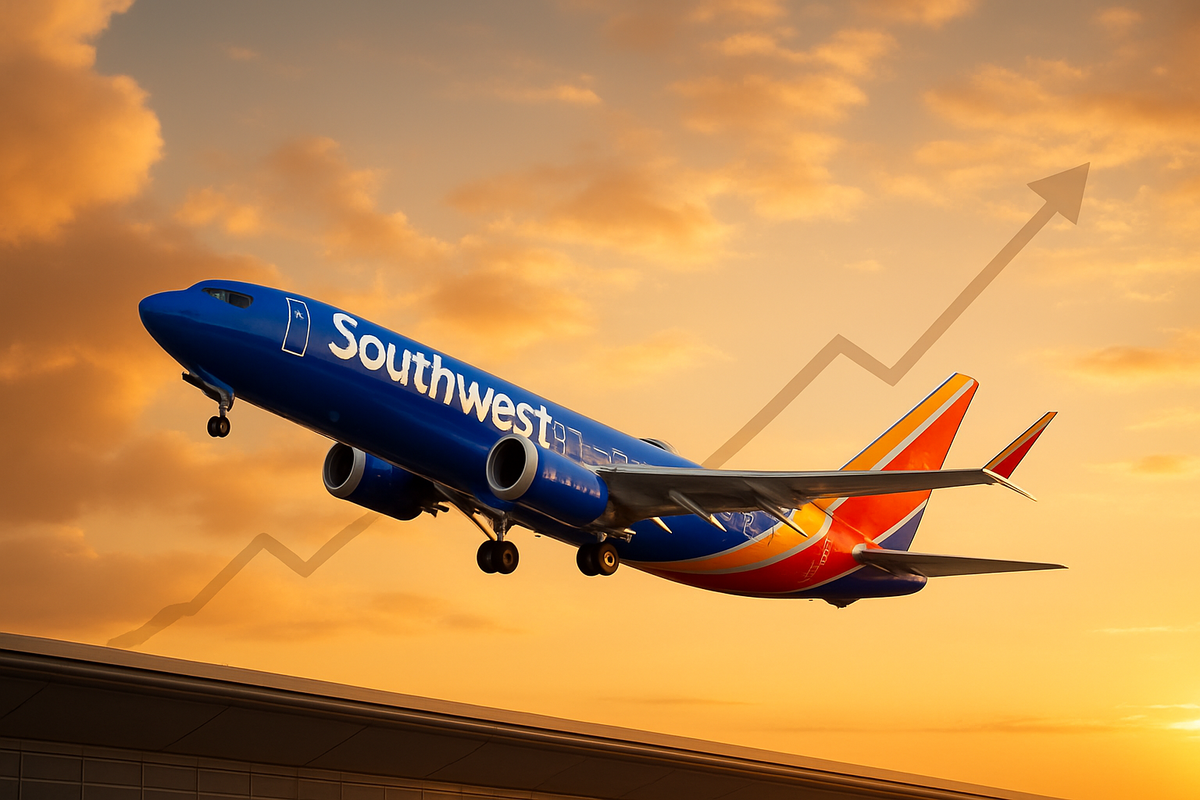
In a dramatic validation of its strategic pivot, Southwest Airlines Co. (NYSE: LUV) saw its stock price soar by 19% yesterday, January 29, 2026, marking its most significant single-day gain in years. The rally was ignited by a fourth-quarter earnings report that far exceeded Wall Street expectations, coupled with aggressive 2026 financial guidance and a modernized fleet expansion plan. Investors, who had long pressured the carrier to abandon its traditional low-cost model, responded with overwhelming enthusiasm as the airline closed at $45.95, a level not seen since the pre-pandemic era.
The surge signals a definitive turning point for the Dallas-based carrier, which spent much of 2025 navigating a high-stakes battle with activist investor Elliott Investment Management. By providing a 2026 earnings forecast that crushed analyst consensus, Southwest has signaled that its shift toward assigned seating, premium cabin options, and new fee structures is already yielding tangible results. This financial windfall suggests that the "New Southwest" is not just a marketing slogan, but a fundamental transformation of one of the world’s most iconic airline brands.
The Proof is in the Profits: A Record Guidance Upgrade
The catalyst for the historic rally was Southwest’s announcement of an adjusted earnings per share (EPS) guidance for 2026 of at least $4.00, a figure that nearly triples its 2025 performance and sits well above the $3.19 consensus previously held by analysts. CEO Bob Jordan, who survived calls for his resignation last year, credited the airline’s "multi-year modernization journey" for the robust outlook. The airline also projected a 9.5% increase in revenue per available seat mile (RASM) for the first quarter of 2026, indicating that the carrier is successfully extracting more value from its network despite a competitive domestic environment.
The financial update was paired with a massive fleet modernization strategy. Southwest confirmed it will take delivery of 66 Boeing 737-8 aircraft throughout 2026. This influx of fuel-efficient jets is part of a broader plan to retire roughly 60 aging Boeing 737-700 "Next-Generation" (NG) models, keeping the fleet size stable at approximately 800 aircraft while significantly lowering maintenance and fuel costs. Furthermore, the carrier provided a critical update on the long-delayed Boeing 737 MAX 7, noting that Federal Aviation Administration (FAA) certification is now expected by August 2026, which will allow Southwest to begin service with the smaller, highly efficient variant in early 2027.
The timeline leading to this week’s surge traces back to the October 2024 settlement with Elliott Management. Under the terms of that agreement, Southwest underwent a massive board refresh and committed to an "all-options-on-the-table" review of its business model. Throughout late 2025, the airline systematically dismantled decades-old traditions. On January 27, 2026, just two days before the earnings release, the carrier officially retired its famous open-seating policy in favor of assigned seats and introduced "Even More Room" premium sections, a move that analysts estimate could eventually generate over $1.5 billion in annual incremental revenue.
Winners and Losers: A Shift in the Competitive Landscape
The primary beneficiary of Southwest’s surge is undoubtedly its shareholder base, particularly Elliott Investment Management, which has seen its multi-billion-dollar bet on the carrier’s reform pay off handsomely. Beyond the boardroom, The Boeing Company (NYSE: BA) stands as a major winner. Despite its own recent production hurdles, Boeing’s relationship with Southwest remains the cornerstone of its narrow-body order book. Southwest's commitment to 672 total MAX orders ensures a steady pipeline of work for the aerospace giant through the end of the decade, providing much-needed stability as Boeing seeks to regain its footing.
Conversely, ultra-low-cost carriers (ULCCs) such as Frontier Group Holdings, Inc. (NASDAQ: ULCC) and Spirit Airlines, Inc. (NYSE: SAVE) may find themselves in a precarious position. For decades, Southwest occupied a unique middle ground, but its move toward premium seating and baggage fees brings it into direct competition with legacy carriers like Delta Air Lines (NYSE: DAL) while potentially siphoning away high-value customers who previously chose ULCCs only for price. As Southwest implements baggage fees for the first time in its history—part of a tiered fare structure—the "pure" low-fare market is shrinking, leaving budget-only airlines with fewer ways to differentiate themselves.
In the technology sector, providers of airline reservation and seating software are seeing a windfall. The transition from open seating to a complex assigned-seating and premium-upcharge model required Southwest to overhaul its entire digital infrastructure. Amadeus IT Group (OTC: AMADY) and other tech partners have been instrumental in this transition, highlighting a broader trend of airlines investing heavily in "retailing" capabilities rather than just transportation.
A Watershed Moment for the Airline Industry
Southwest’s pivot is being viewed as a case study in the evolution of the modern airline industry. For 54 years, the carrier defied the "hub-and-spoke" and "ancillary fee" models that defined its peers. Its capitulation to assigned seating and baggage fees marks the end of an era and suggests that in the post-pandemic world, even the most successful niche strategies must adapt to the demand for premium experiences. This shift reflects a broader industry trend where travelers are increasingly willing to pay for "amenitized" travel, moving away from the commoditization of the coach cabin.
The regulatory implications of Southwest's new fee structures are also being watched closely. The Department of Transportation (DOT) has recently stepped up its scrutiny of "junk fees" in the travel sector. While Southwest’s new baggage fees are transparently tied to its new "Basic Economy" fares, the carrier will likely face increased pressure from regulators to ensure that its new seating assignments do not unfairly penalize families or disabled passengers. However, the airline’s successful recovery from "Winter Storm Fern" in early January 2026—aided by new crew-scheduling software—has likely bought it significant goodwill with both the public and regulators.
Historically, Southwest’s move draws parallels to the 1980s and 90s, when legacy carriers like United Airlines (NASDAQ: UAL) attempted to launch "airlines within an airline" to compete with low-cost startups. The difference today is that the "startup" is now the industry titan, and its move is not a defensive side-project but a wholesale reinvention of its core product. If Southwest can maintain its legendary culture and employee relations while adopting these more mercenary financial tactics, it could set a new blueprint for profitable airline management in the mid-2020s.
The Horizon: Challenges and Opportunities for 2026 and Beyond
Looking ahead, the short-term focus for Southwest will be the seamless rollout of its "red-eye" flight schedule. By flying overnight—a first for the carrier—Southwest aims to increase aircraft utilization by as much as 15% without purchasing a single new plane. This move is critical to hitting the ambitious $4.00 EPS target. Strategic pivots of this scale are rarely without friction, and the market will be watching closely to see if the airline’s famously loyal "Rapid Rewards" members embrace the new assigned seating or if there is a cooling of the brand’s unique identity.
In the long term, the success of the expansion plan hinges on Boeing’s ability to deliver the 737 MAX 7. Southwest is the launch customer for this variant, and any further delays in FAA certification could jeopardize the airline's capacity targets for 2027. Management must also navigate the delicate balance of labor relations; while the stock surge is good for the company's 401(k) plans, the transition to a more complex service model will require significant buy-in from flight attendants and gate agents who were trained on the simpler "bags fly free" and "open seating" philosophy.
Closing Thoughts: A New Flight Path for Investors
The 19% jump in Southwest's stock is more than just a reaction to a strong earnings report; it is an endorsement of a fundamental change in the airline’s DNA. By successfully integrating activist-driven reforms with its own operational strengths, Southwest has positioned itself as a formidable competitor that can finally monetize its massive domestic scale as effectively as its legacy rivals. The $2.9 billion returned to shareholders via buybacks in 2025 has clearly set a floor for the stock, while the upgraded guidance has raised the ceiling.
As the market moves forward, investors should keep a sharp eye on two key metrics: the margin expansion resulting from the "Even More Room" seating rollout and the timeline for the MAX 7 certification. While the "New Southwest" era has started with a vertical climb, the challenge will be maintaining that altitude as the airline navigates the implementation of its most significant changes in half a century. For now, the message from Wall Street is clear: Southwest is back on course.
This content is intended for informational purposes only and is not financial advice.
Companies Mentioned:
- Southwest Airlines Co. (NYSE: LUV)
- The Boeing Company (NYSE: BA)
- Frontier Group Holdings, Inc. (NASDAQ: ULCC)
- Spirit Airlines, Inc. (NYSE: SAVE)
- Delta Air Lines (NYSE: DAL)
- United Airlines (NASDAQ: UAL)
- Amadeus IT Group (OTC: AMADY)