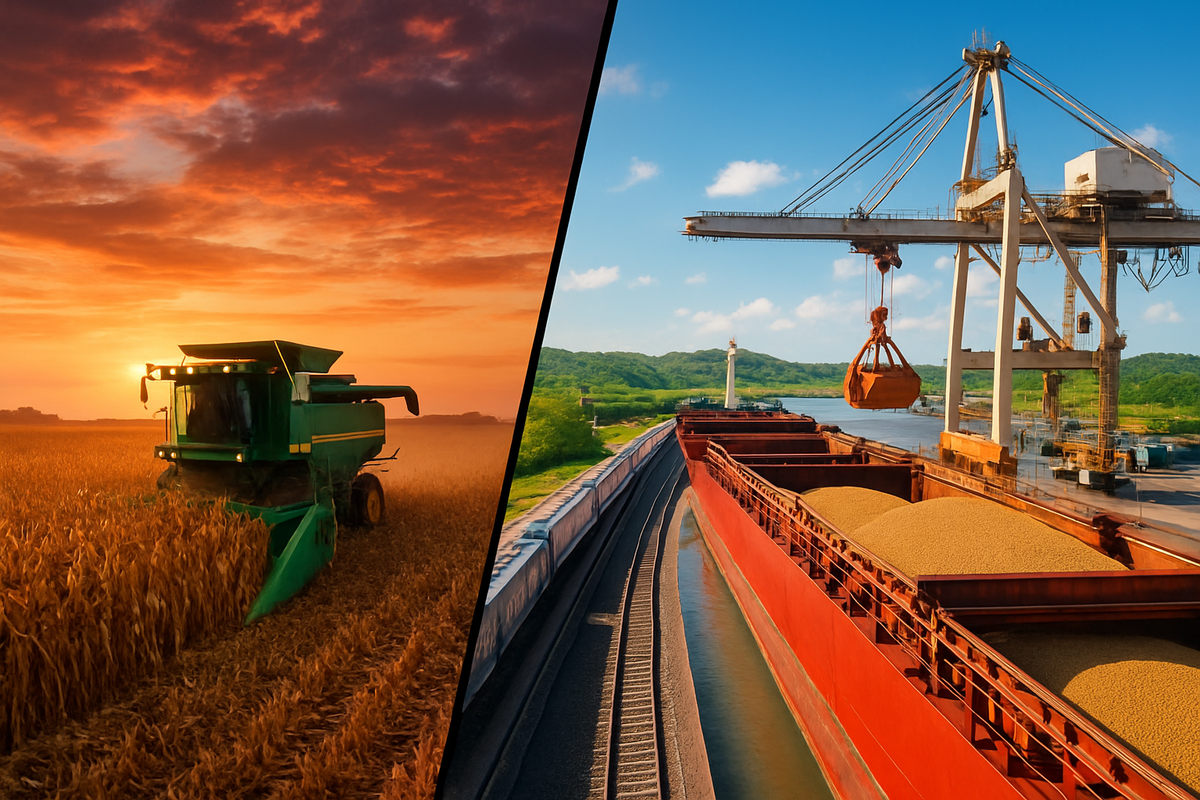
The release of the January 2026 Purdue University/CME Group Ag Economy Barometer has sent ripples through the commodities markets, revealing a significant erosion in farmer confidence regarding trade policy. For the first time in years, the optimism surrounding tariffs as a primary tool for economic leverage is wavering, as producers weigh the benefits of protectionism against the very real threat of losing permanent market share to a South American rival that is no longer just catching up—it is pulling ahead.
Sentiment Shifts as the 2026 Trade Deadline Looms
The December 2025 Ag Economy Barometer, released yesterday on January 6, 2026, serves as a sobering baseline for the year ahead. The headline index fell to 136, a three-point decline from November, driven almost entirely by a retreat in future expectations. While a staggering 75% of farmers still believe the U.S. agricultural economy is moving in the "right direction" broadly, the granular data tells a story of specific, localized fear. Confidence in tariff policy—long a cornerstone of rural political sentiment—dropped to 54%, down from 59% just two months ago. More telling is the doubling of "uncertainty" regarding long-term trade impacts, which now sits at 19%.
The primary catalyst for this unease is the "July 1 Deadline." Under the terms of the USMCA, the three member nations must conduct a joint review by July 1, 2026. Failure to reach a unanimous written extension would trigger a "sunset" clause, moving the agreement to a precarious cycle of annual reviews and a potential expiration in 2036. This "trade cliff" is occurring just as Brazil prepares to harvest a monstrous 177.7 million metric ton (MMT) soybean crop. U.S. farmers, who saw record corn yields in 2025, now face a global market where Brazil’s "Northern Arc" ports are operating at peak efficiency, siphoning off demand that traditionally flowed through the Mississippi River.
Winners and Losers in the New Global Grain Race
The shifting dynamics of 2026 are creating distinct paths for the giants of the agribusiness sector. Deere & Co (NYSE: DE) is currently navigating a complex landscape; while domestic demand for high-tech precision agriculture remains stable, the company has signaled a projected 5–6% decline in Brazilian sales for 2026. High interest rates in South America, coupled with fears of retaliatory tariffs on American machinery, have forced the equipment leader to brace for margin compression in its most vital growth market.
Conversely, the "ABCD" grain majors are pivoting toward the burgeoning "Bioeconomy" to offset thinning margins in traditional export trading. Archer-Daniels-Midland (NYSE: ADM) has aggressively moved into the Sustainable Aviation Fuel (SAF) space, aiming to transform 2026 into a year of structural reorganization. By exiting low-margin animal nutrition segments, ADM is betting that the premium for "green" feedstocks will insulate it from the volatility of the U.S.-China trade spat. Similarly, Bunge Global (NYSE: BG), now fully integrated with Viterra, is leveraging its massive Brazilian footprint to certify sustainable soybeans that command a 10–15% premium in European markets, effectively playing both sides of the Atlantic.
For Corteva (NYSE: CTVA), 2026 is a year of internal revolution. The company is on track to complete a massive corporate split into two independent entities by the second half of the year: one focused on "New Corteva" biologicals and crop protection, and a second "SpinCo" dedicated to advanced genetics. This move is designed to allow the genetics business to compete more nimbly with Brazilian seed firms that are rapidly developing climate-resilient varieties tailored for the Cerrado region.
Infrastructure: The Silent War for Efficiency
The competition between the U.S. and Brazil has moved beyond the field and into the dirt of major construction projects. In mid-2026, the Brazilian government is set to auction the concession for the Ferrogrão (EF-170) railway. This 930km "grain train" will connect the heart of Mato Grosso directly to the Amazonian ports, a move analysts believe could slash Brazilian freight costs by as much as 40%. This project represents a direct challenge to the U.S. inland waterway system, which has long been the gold standard for low-cost bulk transport.
To counter this, the U.S. is racing to modernize its aging infrastructure. The Lock and Dam 25 project on the Upper Mississippi is scheduled to reach a 100% design milestone by June 2026. This $732 million upgrade will replace a 600-foot lock with a 1,200-foot chamber, potentially reducing lockage times from two hours to just 30 minutes. However, with Brazil’s "Northern Arc" ports now handling 40% of their central exports, the U.S. advantage is no longer a given. The 2026 trade landscape is being defined by who can move a bushel of grain to Shanghai the cheapest, and for the first time in a generation, the answer may not be the United States.
The Path Forward: Strategic Pivots and Scenarios
As the spring 2026 planting season nears, U.S. farmers are expected to undergo a significant acreage reshuffle. Preliminary estimates suggest a shift of roughly 4 million acres away from corn and into soybeans, as producers chase the relative safety of domestic crush demand for renewable diesel. This "domestic-first" strategy is a defensive crouch against the possibility of a renewed trade war with China, which remains the world’s largest soybean importer but has increasingly turned to Brazil for its needs.
In the short term, the market will be hyper-focused on the July 1 USMCA review. A smooth extension would provide a massive relief rally for ag-related equities, while a failure to agree would likely lead to a "wait-and-see" freeze in capital expenditures across the Midwest. Long-term, the American agricultural sector must decide if it will continue to compete on bulk commodity volume or if it will fully commit to the "Bioeconomy" model, where value is derived from carbon intensity scores and traceability rather than simple tonnage.
Final Assessment: A Market in Transition
The events of early 2026 mark a definitive end to the post-pandemic era of agricultural trade. The U.S. is no longer the undisputed hegemon of the global grain market; it is now a co-competitor in a world where Brazil possesses both the land and the increasingly sophisticated logistics to dictate global prices. The decline in farmer sentiment recorded by Purdue University is not a sign of a failing industry, but rather a reflection of the intense pressure of this transition.
Investors should keep a close eye on three key indicators over the coming months: the status of the Ferrogrão auction in Brazil, the progress of the USMCA joint review in July, and the pace of SAF refinery build-outs in the U.S. Midwest. The "Trade Cliff" of 2026 is real, but it also offers a generational opportunity for companies and producers who can pivot from being simple "grain growers" to becoming the primary feedstock providers for the global energy transition.
This content is intended for informational purposes only and is not financial advice.