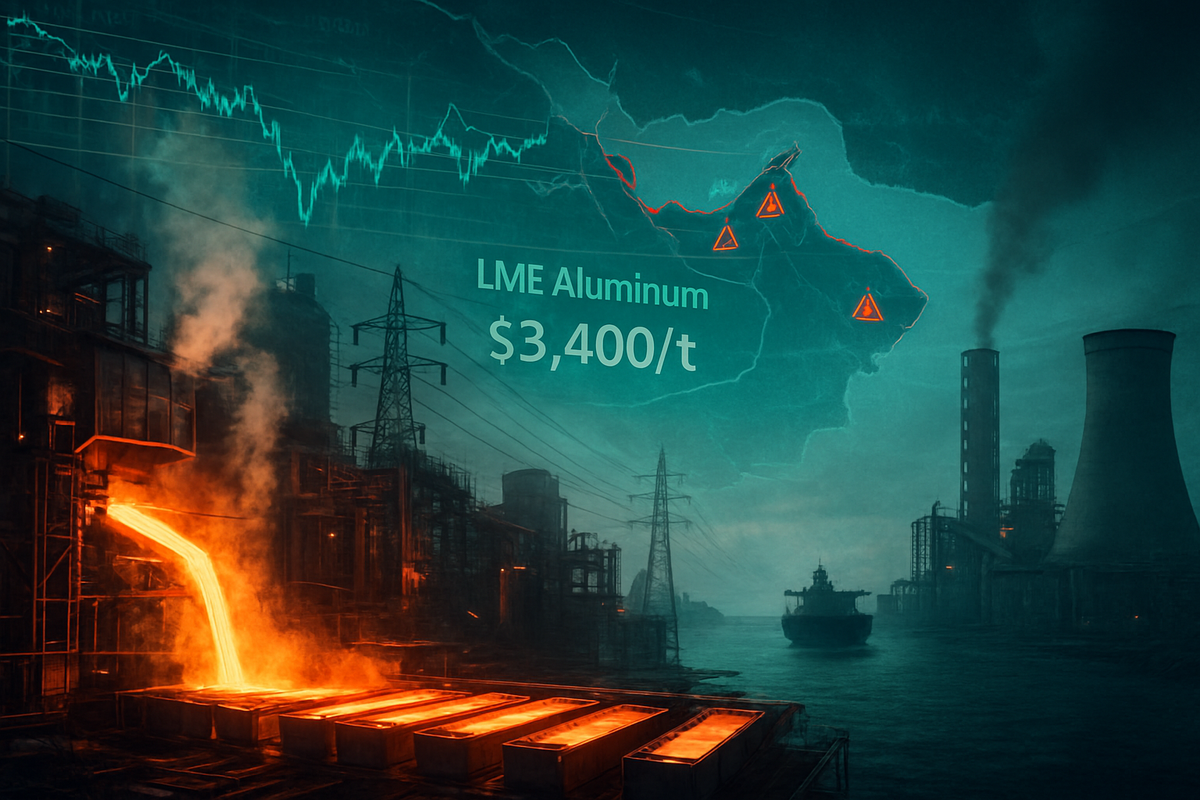
The global industrial metals market has been pushed to a breaking point this week as the escalation of conflict in the Middle East triggers a dual-pronged crisis of skyrocketing energy costs and fractured supply chains. As of March 18, 2026, aluminum prices on the London Metal Exchange (LME) have surged past $3,400 per tonne, a level not seen in years, as traders react to the effective closure of the Strait of Hormuz and the cascading impact on global smelting operations.
Often referred to as "solidified electricity" due to the immense power required for production, aluminum is bearing the brunt of the geopolitical storm. With energy accounting for nearly 40% of smelting costs, the 50% spike in natural gas prices across Europe and Asia has rendered many facilities economically unviable overnight. For the United States, which relies on the Middle East for roughly 20% of its primary aluminum imports, the sudden "stranding" of metal in the Persian Gulf is forcing a radical and costly reconfiguration of trade flows that threatens to disrupt the automotive and aerospace sectors.
A Perfect Storm: Blockades, Force Majeure, and the Smelting Shutdown
The current volatility traces back to the early weeks of 2026, following the rapid escalation of hostilities involving Iran. The defining moment for the metals market occurred earlier this month when the Strait of Hormuz—a chokepoint responsible for the transit of nearly 23% of the world’s aluminum supply outside of China—was declared a restricted zone. This immediately halted shipments from major regional producers, including Aluminium Bahrain (Alba) and the Qatalum refinery in Qatar, a joint venture involving Norsk Hydro (OTCMKTS: NHYDY).
By mid-March, the situation worsened as energy supplies to these regional smelters were diverted or cut, leading to multiple declarations of force majeure. This physical loss of approximately 5.14 million tonnes of annual primary aluminum capacity has created a structural deficit that analysts at JPMorgan warn could persist through the end of the year. The timeline of the crisis has been accelerated by the "AI Power Nexus" of 2025, where industrial smelters were already competing with high-voltage demand from massive AI data centers. The war-induced energy spike has acted as the final catalyst, forcing high-cost smelters in Europe, such as those operated by Alcoa (NYSE: AA) in Spain, to once again face the threat of permanent closure.
Corporate Fallout: Identifying the Winners and Losers in a High-Cost World
The impact of this crisis is deeply bifurcated across the industry. Century Aluminum (NASDAQ: CENX) has emerged as a primary beneficiary of the shifting trade landscape. With US domestic supply suddenly prioritized over shuttered Middle Eastern imports, Century has accelerated plans to bring its Mt. Holly plant in South Carolina back to 100% capacity by June 2026. Furthermore, the 50% tariffs on aluminum imports implemented in 2025 have acted as a protective barrier for domestic producers, allowing Century to capture record-high "Midwest Premiums" which have now surpassed $1.00 per pound.
Conversely, Norsk Hydro (OTCMKTS: NHYDY) faces significant headwinds. The shutdown of its Qatalum operations represents a massive blow to its primary metal output, forcing the company to pivot aggressively toward its European recycling and "low-carbon" aluminum segments to maintain revenue. Meanwhile, Rio Tinto (NYSE: RIO) finds itself in a complex middle ground. While its aluminum division benefits from higher LME prices and its "green" smelting technology, the increased cost of maritime freight—due to vessels rerouting around the Cape of Good Hope—is eating into margins for its global bauxite and alumina shipments. The added 10 to 14 days of transit time has tacked on an estimated $2 million in fuel costs per voyage, complicating the logistics for RIO's extensive Australian operations.
Geopolitical Realignment and the End of Globalization in Commodities
This event is not merely a temporary price spike; it represents a fundamental shift in how industrial metals are traded and valued. The "Iran Scenario" of 2026 fits into a broader trend of "friend-shoring" and the regionalization of supply chains that began in the early 2020s. The US trade flow is currently being redirected away from the Persian Gulf and toward India and Canada, though these alternatives come with significantly higher logistical costs.
Furthermore, the crisis highlights the growing conflict between the global "green transition" and geopolitical stability. Industrial metals like aluminum and copper—with copper hitting a staggering $13,000 per tonne this month—are essential for renewable energy infrastructure. However, the energy intensity of producing these metals means that a war-driven energy crisis directly undermines the transition it requires. This historical precedent mirrors the oil shocks of the 1970s, but with the added layer of a modern world that is more dependent than ever on high-voltage electricity for both heavy industry and digital infrastructure.
Navigating the Volatile Road Ahead
In the short term, the market remains braced for the possibility of aluminum reaching $4,000 per tonne if the blockade in the Middle East persists beyond the second quarter. Strategic pivots are already underway; US manufacturers in the automotive sector, such as Ford (NYSE: F) and General Motors (NYSE: GM), are being forced to explore alternative alloys or absorb massive cost increases that will likely be passed on to consumers. The reliance on domestic "recycled" or "secondary" aluminum is expected to hit record levels as the industry attempts to bypass the primary smelting bottleneck.
Long-term, this crisis may trigger a massive investment wave into modular nuclear reactors or dedicated renewable grids for industrial zones, specifically to insulate smelters from the volatility of the natural gas market. The strategic necessity of maintaining domestic smelting capacity has moved from a policy discussion to a matter of national security for the US and its allies.
Final Assessment: A Lasting Impact on Global Markets
The events of March 2026 serve as a stark reminder of the fragility of the globalized commodity model. The "Solidified Electricity" crisis has proven that in an era of geopolitical fragmentation, the cost of an industrial metal is tied as much to the safety of a shipping lane as it is to the purity of the ore. As supply chains scramble to adapt, the premium on localized, energy-secure production has never been higher.
Moving forward, the market will remain in a state of heightened sensitivity. Investors should closely monitor the "Midwest Premium" levels and any signs of a de-escalation in the Persian Gulf. However, even if the conflict subsides, the structural changes to trade routes and the lessons learned about energy dependency are likely to keep metal prices elevated for the foreseeable future. The era of cheap, globally-sourced industrial inputs appears to have reached a definitive conclusion.
This content is intended for informational purposes only and is not financial advice.