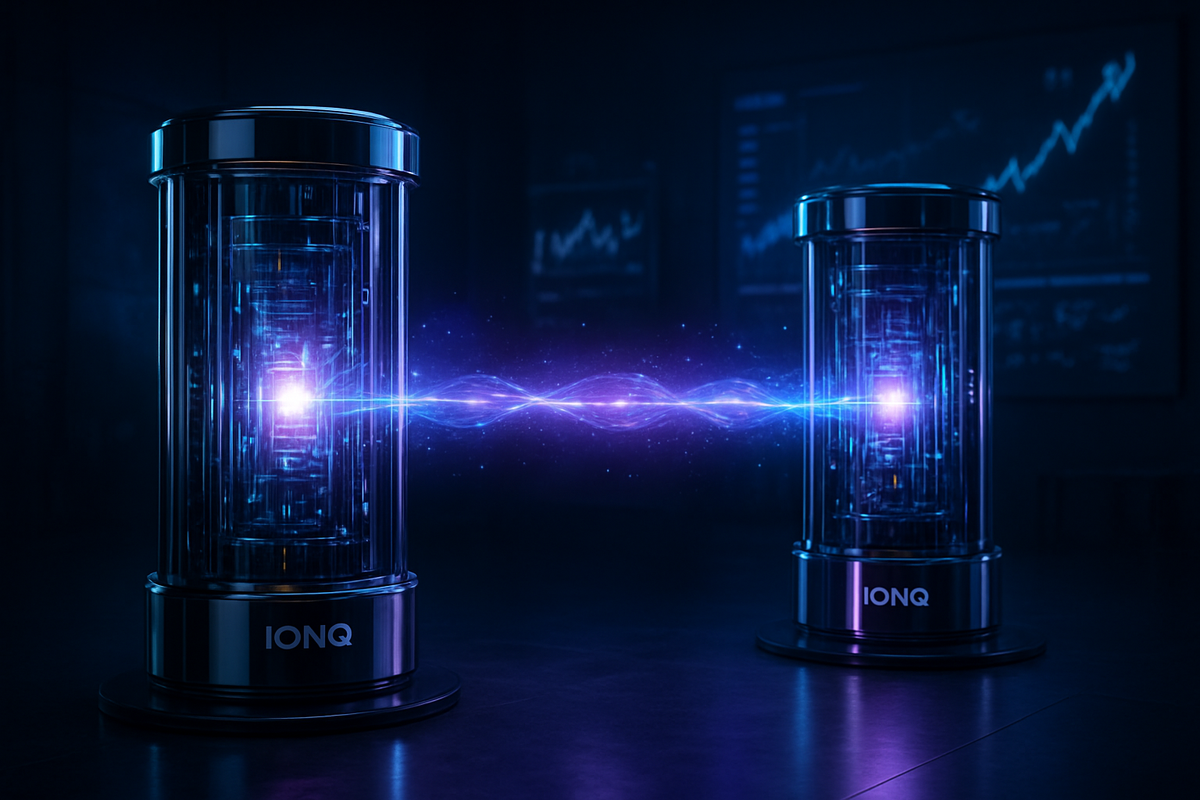
The quantum computing industry reached a historic turning point this week as IonQ, Inc. (NYSE: IONQ) successfully demonstrated the world’s first photonic interconnection between two independent trapped-ion systems. This technical milestone, announced on April 14, 2026—coinciding with World Quantum Day—is being hailed by researchers and investors alike as the "Holy Grail" of quantum scalability. By proving that discrete quantum processing units (QPUs) can be networked into a single, cohesive computational fabric, IonQ has effectively solved one of the most persistent bottlenecks in the race toward fault-tolerant, large-scale quantum computers.
The market response was immediate and forceful. Shares of IonQ surged over 14% in heavy trading, acting as a catalyst for a broader "Quantum Spring" across the sector. Investors, previously wary of the "quantum winter" that characterized much of the early 2020s, rushed back into the space, lifting the valuations of competitors and pure-play hardware providers. The surge underscores a shifting sentiment on Wall Street: quantum computing is no longer viewed as a speculative laboratory experiment, but as an infrastructure-ready industry on the cusp of commercial explosion.
Scaling the Unscalable: Inside the Milestone
The technical feat achieved by IonQ (NYSE: IONQ) involves a process known as "remote entanglement." In a collaborative effort with the Air Force Research Laboratory (AFRL), IonQ engineers managed to generate, transmit, and detect photons that successfully linked two separate trapped-ion systems. This allowed for qubits in one machine to be entangled with qubits in another, maintaining a record-breaking 99.99% two-qubit gate fidelity across the networked systems. To achieve this, the company utilized specialized quantum memories fabricated from quantum-grade synthetic diamond, which act as buffers to store quantum information without losing coherence—a necessary component for networking processors over distance.
This breakthrough did not occur in a vacuum. It follows years of iterative progress and a series of strategic government partnerships. Leading up to this moment, IonQ was selected for DARPA’s Heterogeneous Architectures for Quantum (HARQ) program, which aims to develop a "Quantum Shared Backbone" (QSB). The QSB is designed to link different qubit modalities, such as trapped ions and superconducting qubits, into unified national networks. Yesterday’s announcement served as the ultimate proof-of-concept for the HARQ initiative, providing a concrete timeline for DARPA’s vision of a distributed quantum internet.
Industry reaction has been overwhelmingly positive. Analysts at major firms like Cantor Fitzgerald noted that the demonstration of photonic interconnects moves IonQ from a "single-chip" company to a "modular-system" company. Historically, quantum computers have been limited by the physical constraints of a single chip—heat, wiring density, and magnetic interference made scaling beyond a few hundred qubits nearly impossible. By proving that multiple systems can work together as one, IonQ has paved the way for a "scale-out" architecture similar to modern data centers.
Winners of the "Quantum Spring"
While IonQ (NYSE: IONQ) led the charge with its 14% gain, the ripple effects were felt across the entire quantum ecosystem. D-Wave Quantum Inc. (NYSE: QBTS) saw its shares climb approximately 13%, bolstered by its own strong fundamental performance. D-Wave recently reported sequential bookings growth of over 400%, totaling $32 million year-to-date in 2026. As IonQ validates the scalability of trapped-ion systems, investors are increasingly betting that D-Wave’s annealing technology will find complementary roles in optimization tasks within these larger quantum networks.
Rigetti Computing, Inc. (Nasdaq: RGTI) also enjoyed a significant lift, with shares rising 12% following the debut of its 108-qubit system earlier in the month. The success of IonQ’s interconnect technology has increased speculation that Rigetti’s superconducting qubits could eventually be integrated into the DARPA-led Quantum Shared Backbone. Meanwhile, Quantum Computing Inc. (Nasdaq: QUBT) jumped 9%, as the company’s focus on quantum-ready software and photonic sensing became more relevant in a world where quantum networking is now a proven reality.
The big-tech sector also played a role in the rally. Nvidia Corporation (Nasdaq: NVDA), though not a pure-play quantum firm, saw its "Ising" open-source AI model—designed to accelerate quantum error correction—become a central part of the day's narrative. Analysts suggested that the convergence of Nvidia’s AI-driven error correction and IonQ’s hardware creates a "Goldilocks" scenario for the industry, where hardware and software are finally maturing at the same pace.
A New Era of Distributed Computation
The significance of IonQ’s (NYSE: IONQ) achievement extends far beyond stock price movements; it represents a fundamental shift in the industry's architectural philosophy. For the past decade, the industry was locked in a "scale-up" race, trying to pack as many qubits as possible onto a single processor. This approach often led to diminishing returns as noise and interference increased. IonQ’s "scale-out" success suggests that the future of quantum computing will look more like the internet—a modular, distributed network of processors that can be expanded indefinitely.
This shift mirrors historical precedents in classical computing, specifically the move from monolithic mainframes to distributed server clusters. Just as the development of Ethernet enabled the modern cloud, photonic interconnects could become the "Ethernet of Quantum." This allows for a more resilient and flexible infrastructure, where different types of quantum computers can handle specific parts of a complex problem, all while linked through a quantum-secure backbone.
Furthermore, the involvement of the U.S. government through AFRL and DARPA signals that quantum computing has reached the level of "national critical infrastructure." As geopolitical tensions continue to drive investment in secure communications and advanced cryptography, the ability to network quantum systems provides a strategic advantage. This high-level government backing acts as a de facto "stamp of approval" for the sector, likely encouraging further institutional investment from pension funds and sovereign wealth funds that had previously stood on the sidelines.
The Path to 2030: Commercialization and Challenges
In the short term, the focus for IonQ (NYSE: IONQ) and its peers will shift from laboratory milestones to commercial production. The company is now under pressure to prove that it can manufacture these interconnect-ready systems at scale. Strategic pivots toward "Quantum-as-a-Service" (QaaS) are expected, with IonQ likely expanding its cloud partnerships to offer distributed quantum power to enterprise clients. The company has projected a revenue target of $1.2 billion by 2030, a goal that now looks significantly more achievable given the successful demonstration of modular scaling.
However, challenges remain. While the hardware has proven it can connect, the software layers required to manage distributed quantum tasks are still in their infancy. New operating systems and compilers will need to be developed to handle "remote entanglement" across a network. Furthermore, the high cost of synthetic diamond memories and specialized photonic equipment could keep the price of entry high for non-government entities. Investors should watch for upcoming announcements regarding high-volume manufacturing partnerships or breakthroughs in lower-cost quantum networking materials.
Long-term, the success of photonic interconnects opens the door for "Quantum Data Centers." We may soon see facilities where hundreds of IonQ (NYSE: IONQ) or Rigetti (Nasdaq: RGTI) processors are linked to solve problems in drug discovery, material science, and climate modeling that are currently impossible for even the world’s most powerful supercomputers. The next 18 to 24 months will be a period of intense capital expenditure as these companies race to build out the first generation of networked quantum infrastructure.
Closing Thoughts on the Quantum Surge
The events of mid-April 2026 have effectively ended the debate over whether quantum computing can scale. IonQ’s (NYSE: IONQ) successful photonic interconnection of two independent systems provides a clear roadmap for the industry’s future: modular, networked, and distributed. The resulting 14% jump in IonQ shares, along with gains in D-Wave (NYSE: QBTS), Rigetti (Nasdaq: RGTI), and Quantum Computing Inc (Nasdaq: QUBT), reflects a market that is finally pricing in the long-term utility of quantum technologies.
Moving forward, the market will likely reward companies that can demonstrate not just qubit count, but "networkability" and error-correction capability. Investors should keep a close eye on further DARPA contract awards and the integration of AI models like Nvidia’s (Nasdaq: NVDA) Ising into quantum hardware workflows. The "Quantum Spring" has arrived, and while the road to full profitability remains long, the technical foundation for a quantum-powered future is now firmly in place.
This content is intended for informational purposes only and is not financial advice