Date: December 26, 2025
Introduction
As we approach the end of 2025, few retail entities command the level of consumer loyalty and investor reverence as Costco Wholesale Corporation (NASDAQ: COST). Often described as a "cult favorite" among both suburban families and Wall Street fund managers, Costco has transcended the typical retail category to become a bellwether for consumer spending health. In an era where e-commerce dominance and inflationary pressures have dismantled traditional brick-and-mortar players, Costco’s warehouse club model remains not just resilient, but thriving. This article examines the internal mechanics, historical journey, and future trajectory of a company that has turned the simple act of bulk-buying into a global financial powerhouse.
Historical Background
The Costco story is one of calculated evolution and retail rebellion. The company traces its spiritual roots to 1976, when Sol Price opened the first Price Club in San Diego, pioneering the membership warehouse concept. In 1983, James Sinegal—a protégé of Price—and Jeffrey Brotman opened the first Costco warehouse in Seattle, Washington.
The two companies, Price Club and Costco, eventually merged in 1993 to form PriceCostco, though the company reverted to the Costco Wholesale Corporation name in 1997. From its inception, the company broke the rules of retail by refusing to spend on advertising, focusing instead on high volumes and ultra-low prices. By 1995, the launch of the "Kirkland Signature" private label cemented its reputation for quality, transforming the company from a mere wholesaler into a global brand curator.
Business Model
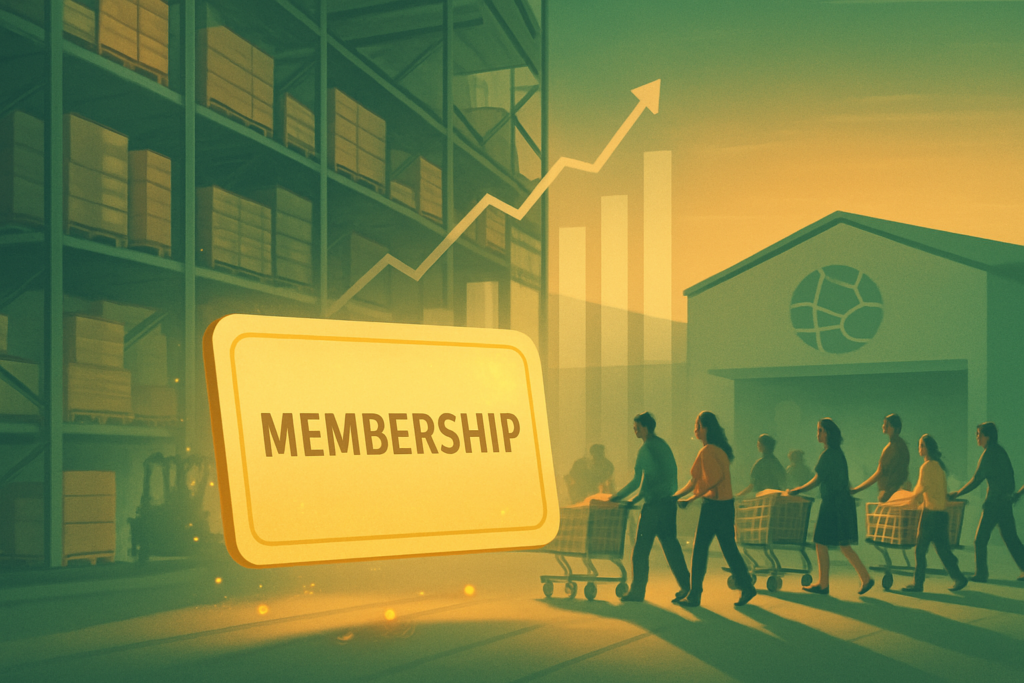
Costco operates on a distinct "membership-first" business model. Unlike traditional retailers that aim for high margins on individual items, Costco operates at razor-thin margins—often just enough to cover operating costs—while generating the lion’s share of its profit from annual membership fees.
Key pillars of the model include:
- Membership Fees: As of late 2024, approximately 70% of the company’s operating income is derived from membership dues.
- Limited SKU Strategy: While a typical supermarket carries 30,000 to 40,000 items, Costco stocks only about 4,000. This curated selection grants the company immense bargaining power with suppliers and ensures high inventory turnover.
- The Treasure Hunt: By rotating luxury items (like high-end watches or designer handbags) alongside daily staples, Costco creates an "act now" shopping psychology that encourages frequent visits.
- Vertical Integration: Through Kirkland Signature and its own poultry and logistics operations, Costco controls its supply chain to keep prices suppressed regardless of market volatility.
Stock Performance Overview
Costco’s stock has been a hallmark of compounding wealth over the last decade.
- 10-Year View: Since 2015, the stock has grown from approximately $140 to its current levels, significantly outperforming the S&P 500.
- 5-Year View: The stock benefited immensely from the "pandemic bulk-buy" era and the subsequent inflationary period, as consumers sought value.
- Recent Performance (2024-2025): 2024 was a banner year for COST, with shares gaining nearly 40% as the company announced its first membership fee hike in seven years. In February 2025, the stock reached an all-time high of approximately $1,072. While there has been a minor valuation "reset" in late 2025 as interest rates stabilized, the stock remains a top performer in the consumer staples sector.
Financial Performance
Costco’s fiscal year 2025 results highlight a machine operating at peak efficiency.
- Revenue: Total net sales reached $275.2 billion, an 8.2% increase year-over-year.
- Net Income: The company reported $8.1 billion in net income, translating to $18.21 per diluted share.
- Margins: Operating margins remain characteristically slim at roughly 3.5%, while the company maintains a robust cash position, allowing for periodic special dividends—a favorite among long-term shareholders.
- Valuation: The stock currently trades at a trailing Price-to-Earnings (P/E) ratio in the 45x–50x range. While high for a retailer, this "Costco Premium" reflects the high predictability of its membership revenue.
Leadership and Management
In 2024, Costco underwent a significant leadership transition. Ron Vachris, a 40-year company veteran who famously began his career as a forklift driver, took the helm as CEO, succeeding Craig Jelinek. This transition has been seamless, as Vachris embodies the company’s internal culture of "continuity and frugality."
Assisting Vachris is CFO Gary Millerchip, who joined from Kroger in early 2024, replacing the legendary Richard Galanti. This new duo has maintained the company’s conservative financial posture while slowly accelerating digital transformation and international logistics investments.
Products, Services, and Innovations
Costco’s innovation is often invisible to the naked eye, focusing on supply chain efficiency rather than flashy technology.
- Kirkland Signature: This private label now accounts for over 33% of total sales (approximately $86 billion in 2024). It serves as a defensive moat against brand-name price hikes.
- Costco Next: A growing digital platform that allows members to purchase directly from suppliers at "Costco prices," expanding the inventory without requiring warehouse shelf space.
- Services Expansion: From travel and insurance to pharmacy and optical, Costco continues to embed itself into every facet of its members' lives, increasing the "stickiness" of the membership.
Competitive Landscape
Costco operates in a fiercely competitive environment but maintains a distinct demographic advantage.
- Walmart (NYSE: WMT) / Sam’s Club: Sam’s Club is the closest direct competitor. While Sam's has made strides in digital integration and Scan-and-Go technology, Costco maintains higher average household income levels among its members and superior renewal rates.
- BJ’s Wholesale Club (NYSE: BJ): A smaller regional player that offers more pack-size flexibility but lacks Costco's global purchasing power.
- Amazon (NASDAQ: AMZN): While Amazon dominates in convenience, Costco wins on unit pricing and the "physical discovery" experience that e-commerce has yet to replicate.
Industry and Market Trends
The retail sector in 2025 is defined by "Value Polarization." As the middle class seeks to stretch their dollars, the warehouse club model has gained market share from traditional grocers.
- Bulk Buying Resilience: Even as inflation cooled throughout 2025, the consumer habit of buying in bulk has remained, driven by a permanent shift toward home-based consumption.
- Supply Chain Localization: Following the disruptions of the early 2020s, Costco has invested heavily in localized logistics and owned distribution centers to mitigate global shipping volatility.
Risks and Challenges
Despite its dominance, Costco faces several headwinds:
- Valuation Compression: Trading at nearly 50x earnings, any slowdown in comparable-store sales or membership growth could lead to a significant stock price correction.
- Digital Lag: While improving, Costco’s e-commerce experience still lags behind Amazon and Walmart. The company must balance its "in-warehouse experience" with the growing demand for frictionless digital shopping.
- Labor Costs: As a company that prides itself on paying above-market wages and providing excellent benefits, rising labor costs and potential unionization efforts in the broader retail sector remain a monitoring point.
Opportunities and Catalysts
- International Expansion: With only seven warehouses in China as of late 2025, the growth potential in Asia remains massive. The company’s ability to replicate its culture in diverse markets like Japan, South Korea, and Sweden provides a long runway for growth.
- Membership Fee Revenue: The full impact of the September 2024 fee increase (Gold Star to $65, Executive to $130) is flowing through the 2025 and 2026 financials, providing a direct boost to the bottom line.
- Advertising Potential: While Costco avoids traditional advertising, the data it holds on its 130+ million members represents an untapped "Retail Media" goldmine should management choose to leverage it.
Investor Sentiment and Analyst Coverage
Wall Street sentiment remains "Overweight" on COST. Analysts emphasize the company’s 90%+ membership renewal rate as a source of safety in a volatile macro environment. Institutional ownership remains high at approximately 69%, with giants like Vanguard and BlackRock holding significant stakes. Retail sentiment is equally strong, with "Costco enthusiasts" often viewing the stock as a core "buy and hold forever" position in their portfolios.
Regulatory, Policy, and Geopolitical Factors
As a global retailer, Costco is subject to a complex web of regulations:
- Trade Policy: Given its high volume of imported goods, changes in tariffs—particularly between the U.S. and China—can impact Kirkland Signature’s pricing.
- Sustainability Mandates: New 2025 regulations regarding plastic packaging and carbon footprints in the EU and North America are forcing Costco to innovate its packaging and logistics networks.
- Antitrust: While not a primary target like Big Tech, the sheer size of Costco and its impact on local grocery ecosystems keeps it within the peripheral vision of regulatory bodies.
Conclusion
Costco Wholesale Corporation (NASDAQ: COST) enters 2026 as a titan of efficiency. Its simple yet profound strategy—selling high-quality goods at the lowest possible prices while charging for the privilege of entry—has created a financial fortress. While the stock’s premium valuation requires nerves of steel for new investors, the company's fundamentals, bolstered by a recent fee hike and aggressive international expansion, remain peerless. For investors, the key metric to watch in 2026 will be the success of new warehouse openings in the Chinese market and the continued digital evolution of the "Costco Next" platform.
This content is intended for informational purposes only and is not financial advice.