Electric vehicle manufacturer Rivian (NASDAQ: RIVN) announced better-than-expected revenue in Q3 2026, with revenue up 38.3% year on year to $2.16 billion. Its GAAP loss of $0.63 per share was 12.6% above analysts’ consensus estimates.
For more on Rivian, read our free full research report.
Rivian (RIVN) Q3 2026 highlights:
- Revenue $2.16 billion vs S&P analysts’ consensus estimates of $2.06 billion (38.3% year-on-year growth, 4.8% beat)
- EPS (GAAP) -$0.63 vs analysts’ consensus estimates of -$0.72 (12.6% beat)
- Adjusted EBITDA -$435 million (-20.2% margin, 27.7% year-on-year growth)
- EBITDA guidance -$1.8 billion at the midpoint for the full year, above analysts’ consensus estimates of -$1.89 billion
- Adjusted EBITDA margin -20.2%, up from -38.6% in the same quarter last year
- Free cash flow -$1.12 billion compared to -$421 million in the same quarter last year
- Sales volumes rose 45.8% year on year (31.8% in the same quarter last year)
- Market capitalization $16.9 billion
RJ Scaringe, Rivian Founder and CEO, said: “We had great results with R2 becoming our best selling vehicle by volume in the third quarter. Customer and media feedback on R2 has been exceptional. Regarding our technology roadmap, our autonomy platform is progressing rapidly, and we are super excited about Point to Point. We are laying the foundations for a future that we believe will be fully electric, autonomous and AI defined. I could not be more excited about the opportunity ahead for Rivian.”
Revenue growth
A company’s long-term revenue performance is one signal of its overall quality. Even a weak business can perform well for one or two quarters, but a high-quality one grows for years. Rivian’s 57.7% annualized revenue growth over the last four years was strong. Its growth beat the average industrials company and shows its offerings resonate with customers.
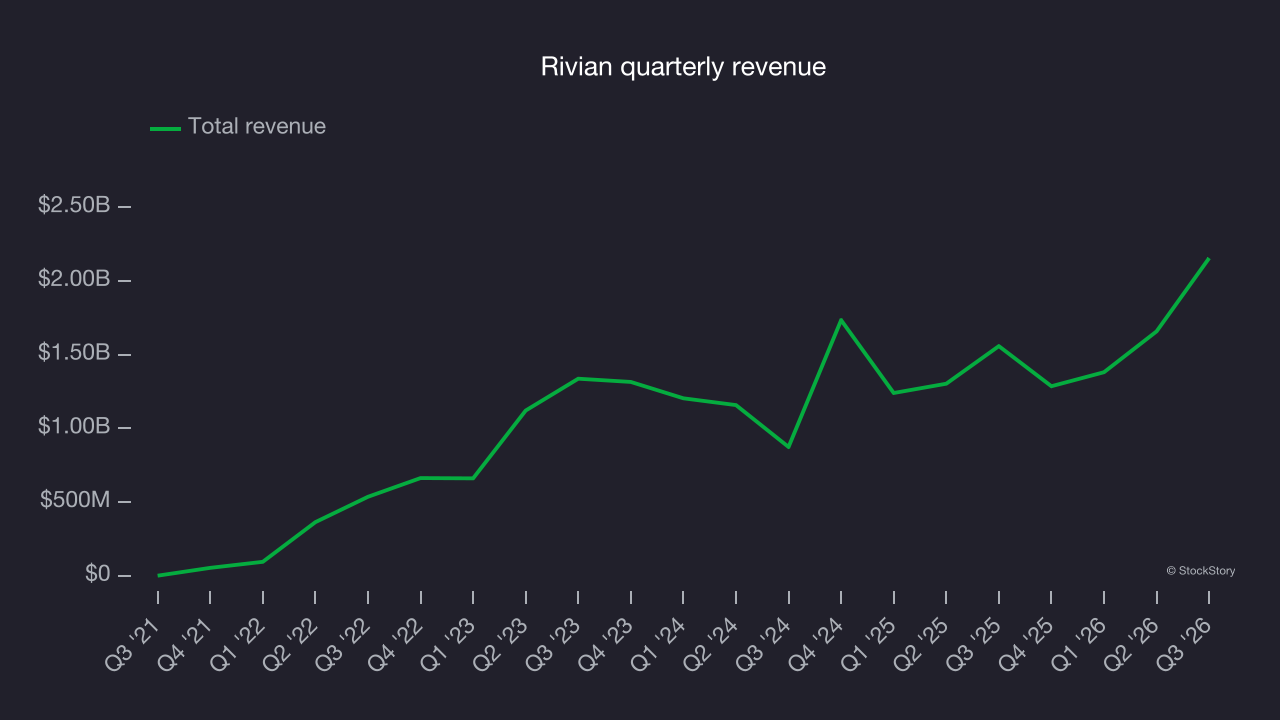
Long-term growth matters the most, but within industrials, a stretched historical view may miss cycles, industry trends or a company capitalizing on catalysts such as a new contract win or a successful product line. Rivian’s annualized revenue growth of 19.3% over the last two years is below its four-year trend, but the results still suggest healthy demand. 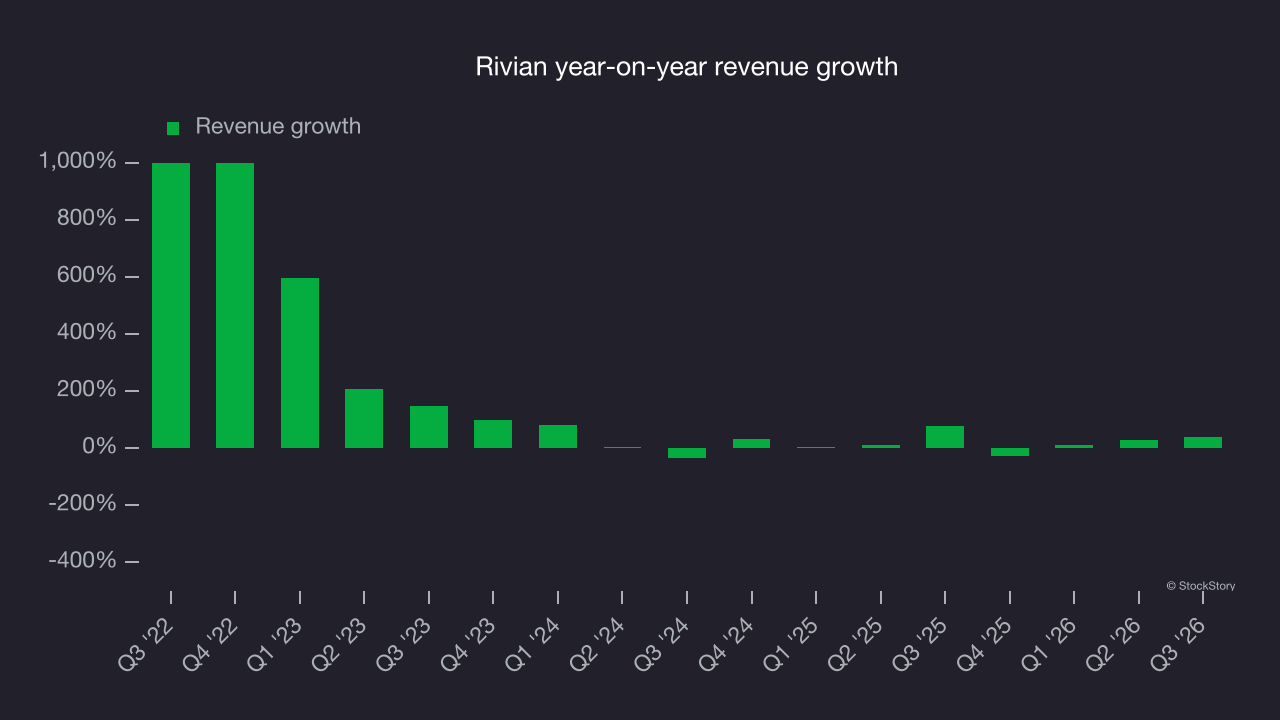
The number of vehicles delivered helps explain the company’s revenue dynamics and reached 19,248 in the latest quarter. Over the last two years, Rivian’s vehicles delivered grew by 5.7% annually. Revenue growth outpaced deliveries growth, indicating that price increases contributed to growth. 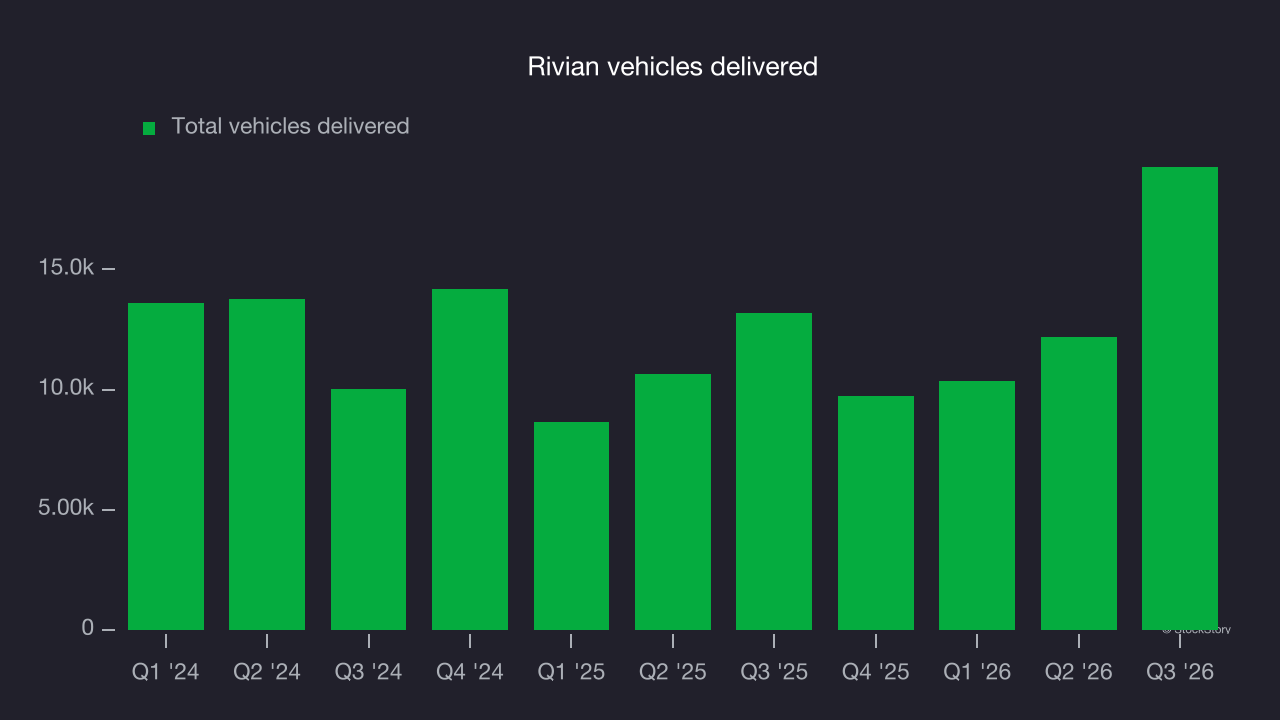
This quarter, Rivian reported strong year-on-year revenue growth of 38.3%, and its $2.16 billion of revenue exceeded Wall Street’s consensus estimates by 4.8%.
Looking ahead, sell-side analysts expect revenue to grow 70.1% over the next 12 months, according to S&P, an improvement versus the last two years. This substantial projected growth implies its newer products and services will fuel better top-line performance.
Operating margin
Operating margin is an important measure of profitability as it shows the portion of revenue left after accounting for all core expenses, from the cost of goods sold to advertising and wages. It’s also useful for comparing profitability across companies with different levels of debt and tax rates because it excludes interest and taxes.
Rivian’s high expenses have contributed to an average operating margin of negative 119% over the last five years. Unprofitable industrials companies require extra attention because a downturn could expose their vulnerabilities. It’s hard to be confident that the business can endure a full cycle.
On the positive side, Rivian’s operating margin rose over the last five years, as its revenue growth provided operating leverage. Still, it will take much more for the company to reach long-term profitability.
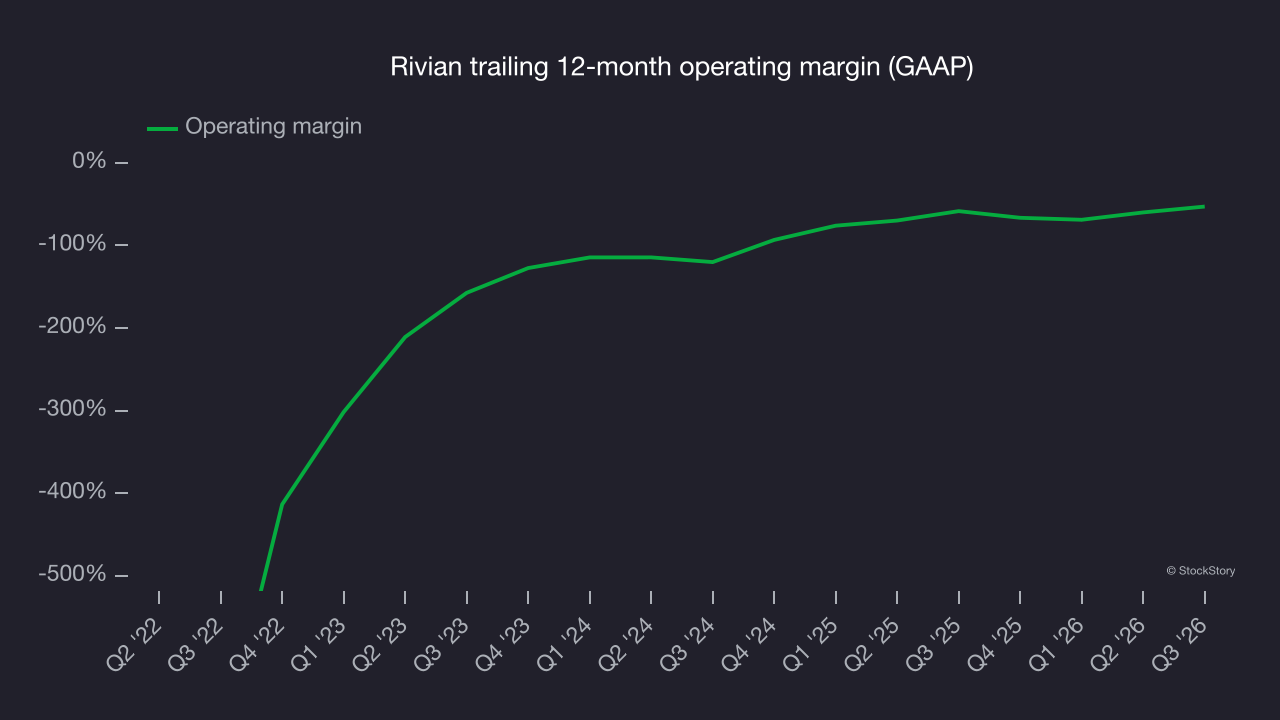
In Q3, Rivian generated a negative 40.9% operating margin.
Earnings per share
Revenue trends explain a company’s historical growth, but the long-term change in earnings per share (EPS) points to the profitability of that growth. For example, a company could inflate its revenue through excessive spending on advertising and promotions.
Although Rivian’s full-year earnings are still negative, it reduced its losses and improved its EPS by 38.5% annually over the last five years. The next few quarters will be critical for assessing its long-term profitability. An inflection point would be welcome soon, especially since it recently diluted shareholders by forming a $5.8 billion joint venture with Volkswagen in November 2024.
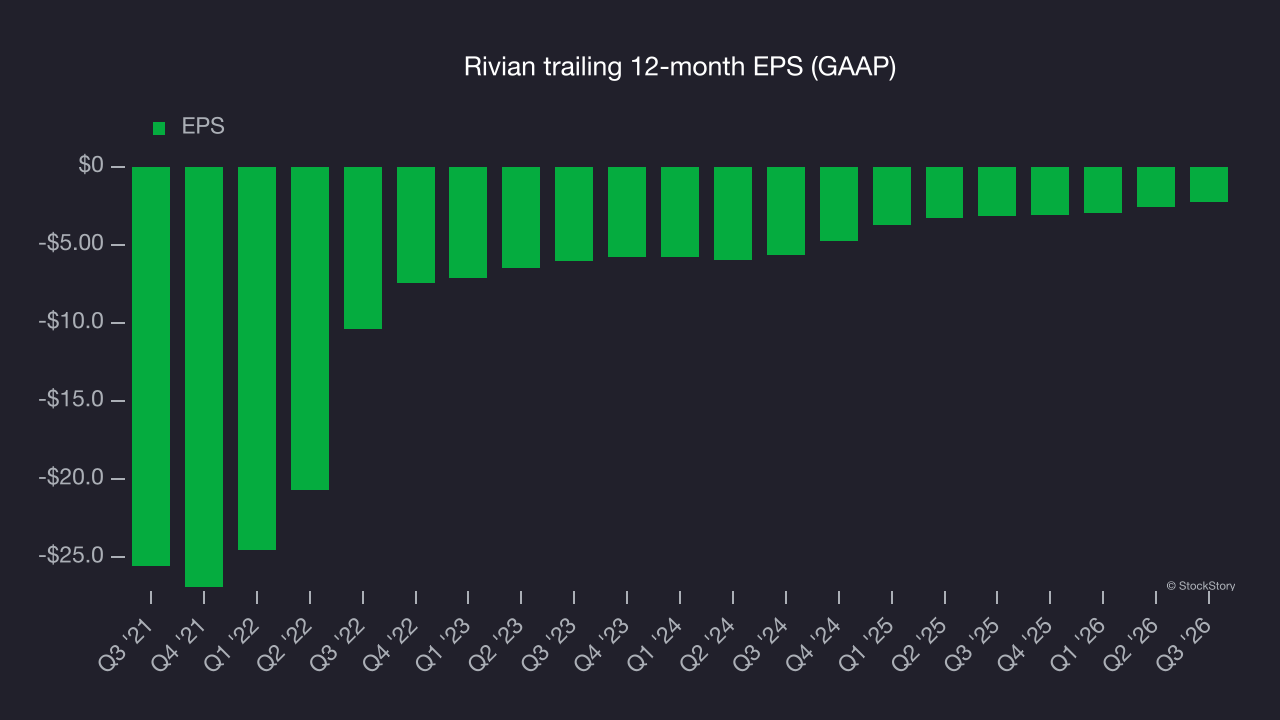
Like with revenue, we analyze EPS over a shorter period to see if we are missing a change in the business.
For Rivian, its two-year annual EPS growth of 36.8% was lower than its five-year trend. Still, growth was good, and a future acceleration would be welcome.
In Q3, Rivian reported EPS of negative $0.63, up from negative $0.96 in the same quarter last year. EPS comfortably beat analysts’ consensus estimates, a positive result for shareholders. Over the next 12 months, Wall Street expects Rivian to perform poorly. Analysts forecast its full-year EPS will decline from negative $2.25 to negative $2.41, according to S&P.
Key takeaways from Rivian’s Q3 results
Rivian delivered wide beats on both EBITDA and revenue against analysts’ consensus estimates, giving its Q3 results some clear positives. Shares rose 4.8% to $12.05 immediately after the release.
Rivian may have had a good quarter, but that alone doesn’t determine whether the stock is a buy. The latest quarter is only one piece of the longer-term business quality picture. Quality, when combined with valuation, can help determine if the stock is a buy. For more on Rivian, read the full research report here (it’s free).