Manufacturing company Illinois Tool Works (NYSE: ITW) beat Wall Street’s revenue expectations in Q4 CY2025, with sales up 4.1% year on year to $4.09 billion. Its GAAP profit of $2.72 per share was 1.2% above analysts’ consensus estimates.
Is now the time to buy Illinois Tool Works? Find out by accessing our full research report, it’s free.
Illinois Tool Works (ITW) Q4 CY2025 Highlights:
- Revenue: $4.09 billion vs analyst estimates of $4.06 billion (4.1% year-on-year growth, 0.7% beat)
- EPS (GAAP): $2.72 vs analyst estimates of $2.69 (1.2% beat)
- EPS (GAAP) guidance for the upcoming financial year 2026 is $11.20 at the midpoint, missing analyst estimates by 0.6%
- Operating Margin: 26.5%, in line with the same quarter last year
- Free Cash Flow Margin: 21%, down from 25.3% in the same quarter last year
- Organic Revenue rose 1.3% year on year (miss)
- Market Capitalization: $76.65 billion
“ITW delivered a solid finish to the year, marked by more than four percent revenue growth and a seven percent increase in GAAP earnings per share. As a result of our disciplined execution across all seven segments, we expanded both operating margin and income to record levels in the quarter,” said Christopher O’Herlihy, President and Chief Executive Officer.
Company Overview
Founded by Byron Smith, an investor who held over 100 patents, Illinois Tool Works (NYSE: ITW) manufactures engineered components and specialized equipment for numerous industries.
Revenue Growth
A company’s long-term sales performance can indicate its overall quality. Even a bad business can shine for one or two quarters, but a top-tier one grows for years. Over the last five years, Illinois Tool Works grew its sales at a tepid 5% compounded annual growth rate. This was below our standard for the industrials sector and is a poor baseline for our analysis.
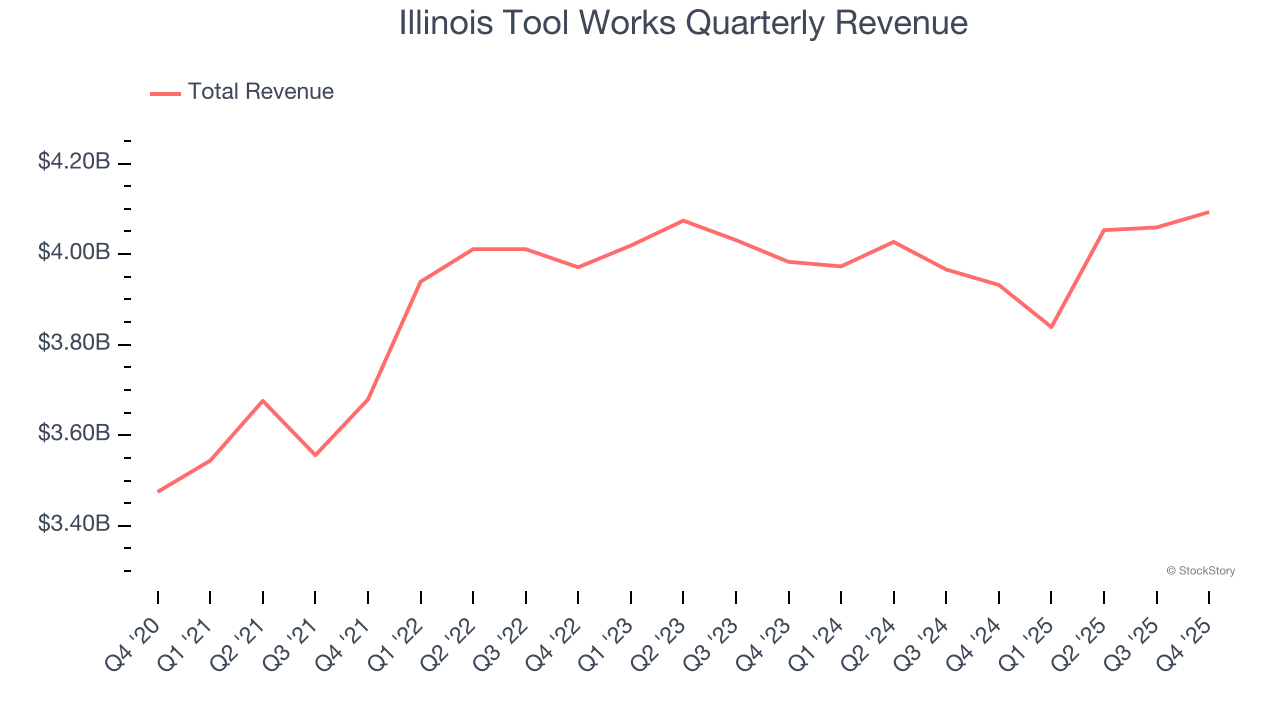
We at StockStory place the most emphasis on long-term growth, but within industrials, a half-decade historical view may miss cycles, industry trends, or a company capitalizing on catalysts such as a new contract win or a successful product line. Illinois Tool Works’s recent performance shows its demand has slowed as its revenue was flat over the last two years. 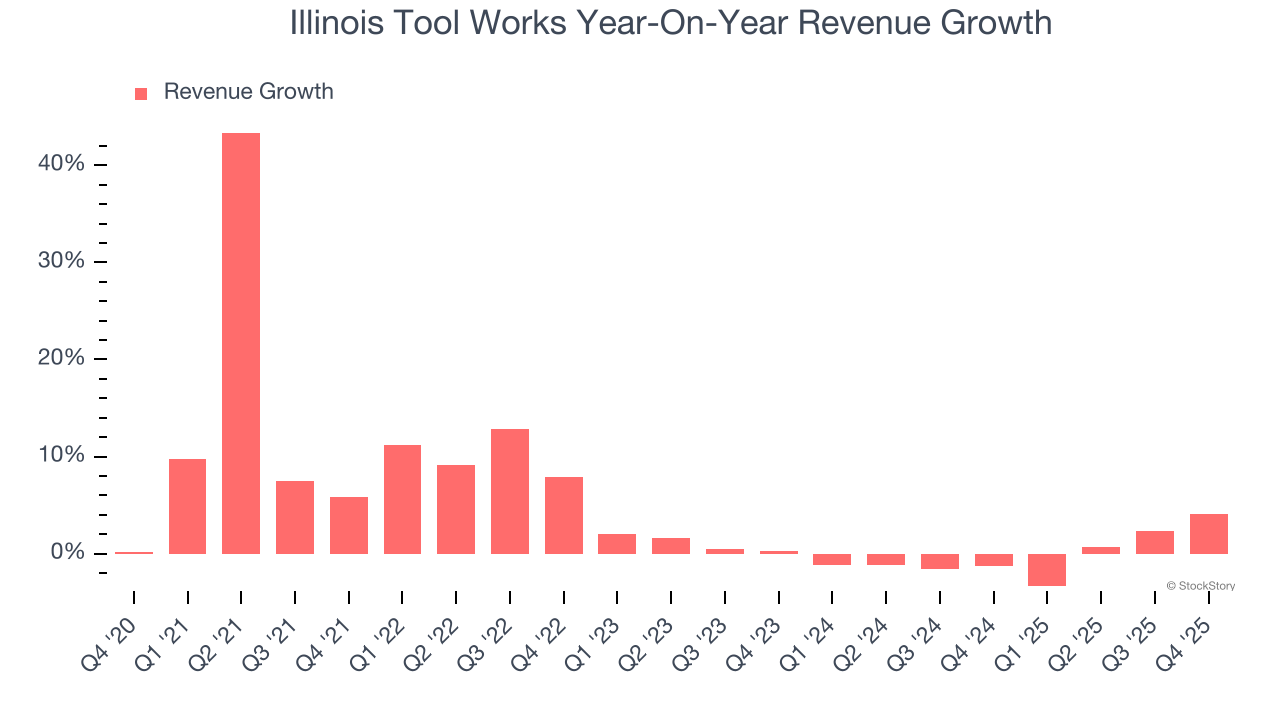
We can better understand the company’s sales dynamics by analyzing its organic revenue, which strips out one-time events like acquisitions and currency fluctuations that don’t accurately reflect its fundamentals. Over the last two years, Illinois Tool Works’s organic revenue was flat. Because this number aligns with its two-year revenue growth, we can see the company’s core operations (not acquisitions and divestitures) drove most of its results. 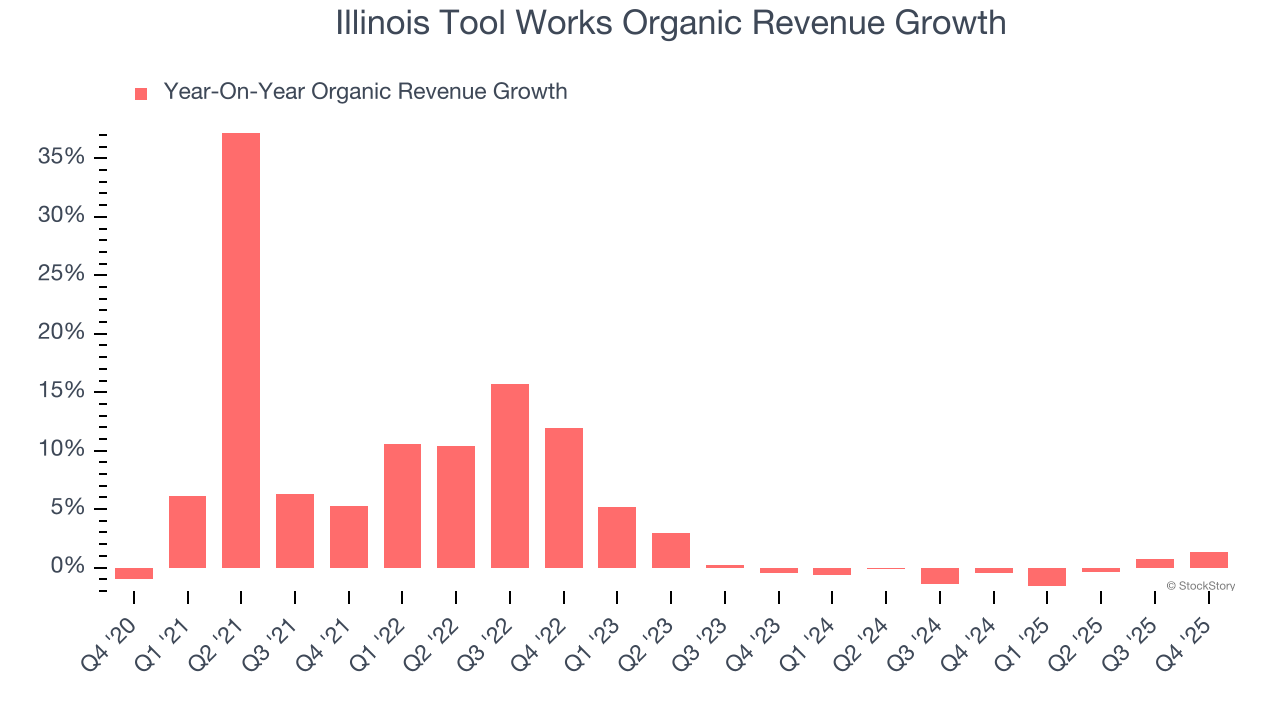
This quarter, Illinois Tool Works reported modest year-on-year revenue growth of 4.1% but beat Wall Street’s estimates by 0.7%.
Looking ahead, sell-side analysts expect revenue to grow 3% over the next 12 months. While this projection indicates its newer products and services will catalyze better top-line performance, it is still below average for the sector.
While Wall Street chases Nvidia at all-time highs, an under-the-radar semiconductor supplier is dominating a critical AI component these giants can’t build without. Click here to access our free report one of our favorites growth stories.
Operating Margin
Illinois Tool Works has been a well-oiled machine over the last five years. It demonstrated elite profitability for an industrials business, boasting an average operating margin of 25.2%. This result isn’t surprising as its high gross margin gives it a favorable starting point.
Analyzing the trend in its profitability, Illinois Tool Works’s operating margin rose by 2.2 percentage points over the last five years, as its sales growth gave it operating leverage.
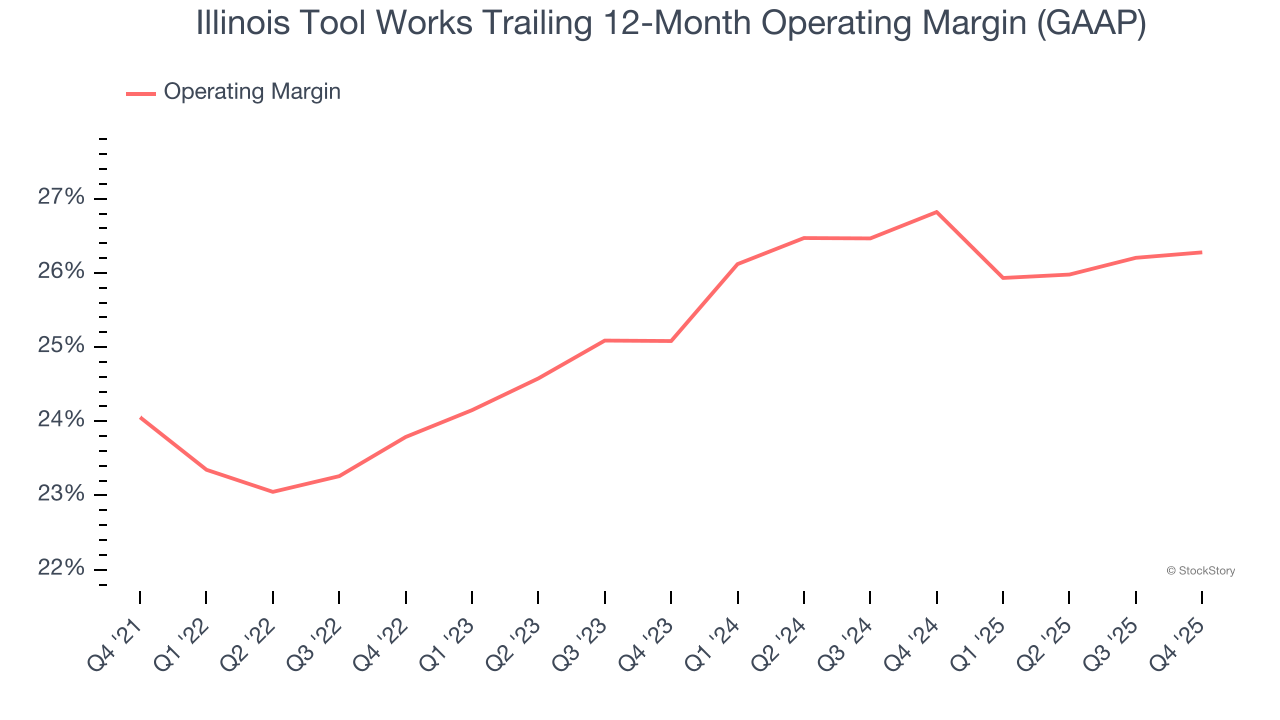
This quarter, Illinois Tool Works generated an operating margin profit margin of 26.5%, in line with the same quarter last year. This indicates the company’s cost structure has recently been stable.
Earnings Per Share
We track the long-term change in earnings per share (EPS) for the same reason as long-term revenue growth. Compared to revenue, however, EPS highlights whether a company’s growth is profitable.
Illinois Tool Works’s EPS grew at a decent 9.6% compounded annual growth rate over the last five years, higher than its 5% annualized revenue growth. This tells us the company became more profitable on a per-share basis as it expanded.
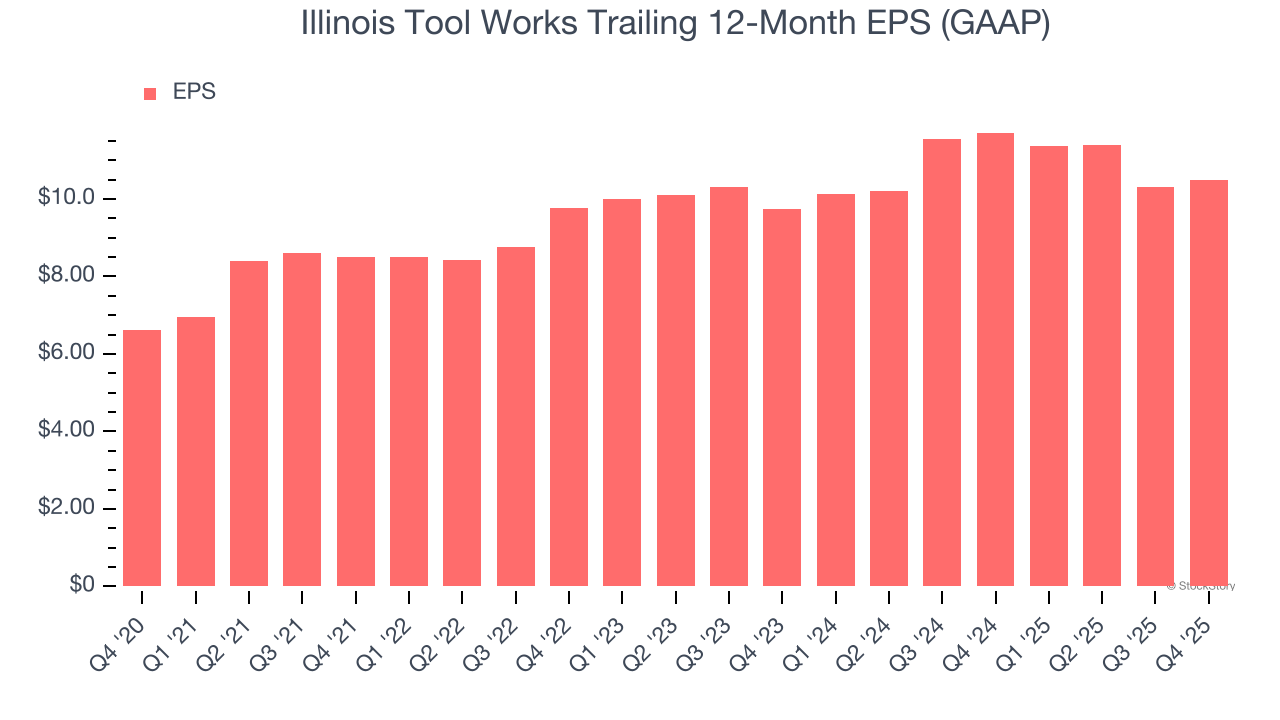
We can take a deeper look into Illinois Tool Works’s earnings quality to better understand the drivers of its performance. As we mentioned earlier, Illinois Tool Works’s operating margin was flat this quarter but expanded by 2.2 percentage points over the last five years. On top of that, its share count shrank by 8.8%. These are positive signs for shareholders because improving profitability and share buybacks turbocharge EPS growth relative to revenue growth. 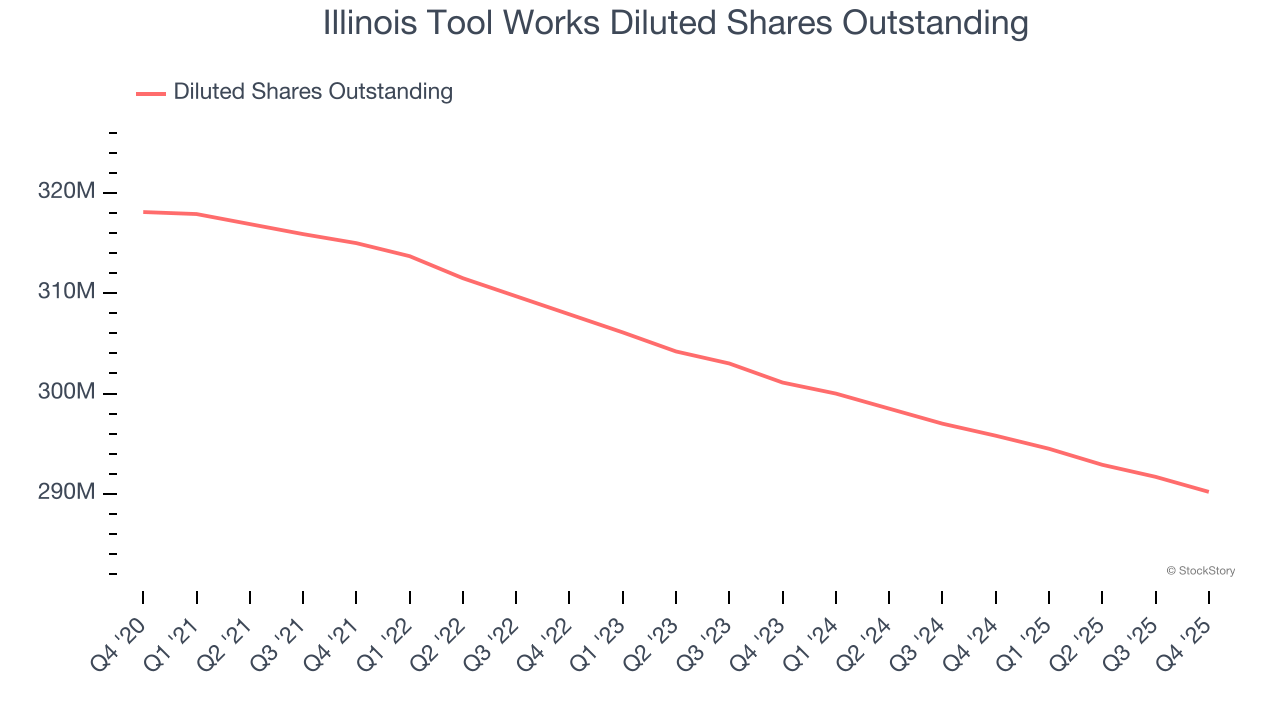
Like with revenue, we analyze EPS over a shorter period to see if we are missing a change in the business.
For Illinois Tool Works, its two-year annual EPS growth of 3.8% was lower than its five-year trend. We hope its growth can accelerate in the future.
In Q4, Illinois Tool Works reported EPS of $2.72, up from $2.54 in the same quarter last year. This print beat analysts’ estimates by 1.2%. Over the next 12 months, Wall Street expects Illinois Tool Works’s full-year EPS of $10.49 to grow 6.5%.
Key Takeaways from Illinois Tool Works’s Q4 Results
It was good to see Illinois Tool Works narrowly top analysts’ revenue expectations this quarter. On the other hand, its full-year EPS guidance slightly missed. Zooming out, we think this was a mixed quarter. The stock remained flat at $263.94 immediately following the results.
So should you invest in Illinois Tool Works right now? The latest quarter does matter, but not nearly as much as longer-term fundamentals and valuation, when deciding if the stock is a buy. We cover that in our actionable full research report which you can read here (it’s free).