As demand for faster, more flexible digital content grows, the AI 3D model generator has become a key tool for designers, developers, and creative teams. Tripo Studio, developed by Tripo AI, sits at the center of this shift by offering an integrated environment for turning ideas, images, and text into usable 3D assets. Rather than positioning itself as a shortcut that replaces creators, Tripo focuses on reducing repetitive technical work so users can spend more time refining concepts and visual quality.
From Experimental Tech to Practical Creative Infrastructure
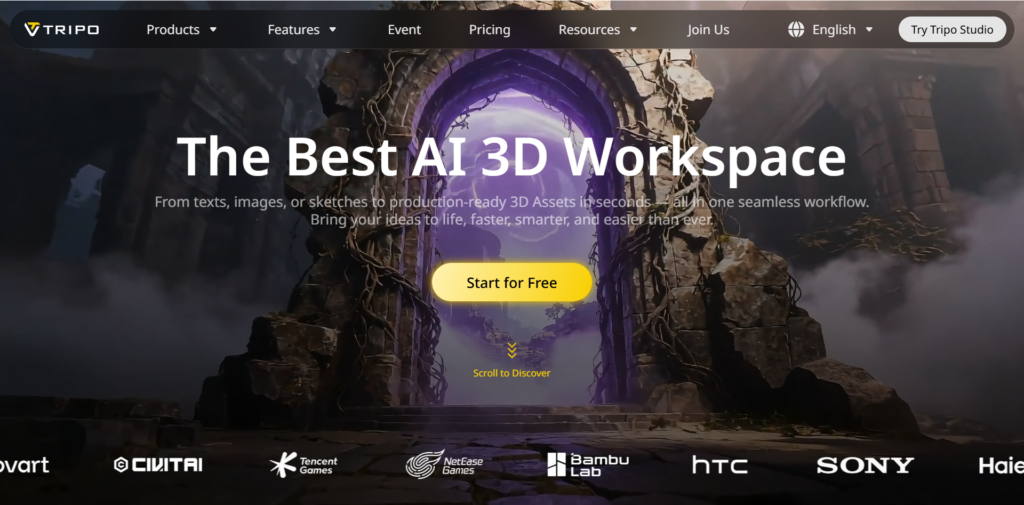
The rise of AI-driven 3D tools did not happen overnight. Early systems often produced visually interesting but impractical meshes, with poor topology or limited editability. Tripo Studio was designed around a different assumption: that generated models must fit into existing production pipelines, not sit outside them.
Instead of isolating generation from editing, Tripo treats generation as the first step in a longer creative process. Users are encouraged to refine geometry, adjust structure, and improve textures after generation. This philosophy is especially relevant for professionals who need assets that can be animated, optimized, or integrated into games and interactive experiences.
In this sense, Tripo positions itself not just as a 3D AI generator, but as a bridge between automation and traditional 3D craftsmanship.
Core Modeling Features Inside Tripo Studio
- Image to 3D Model
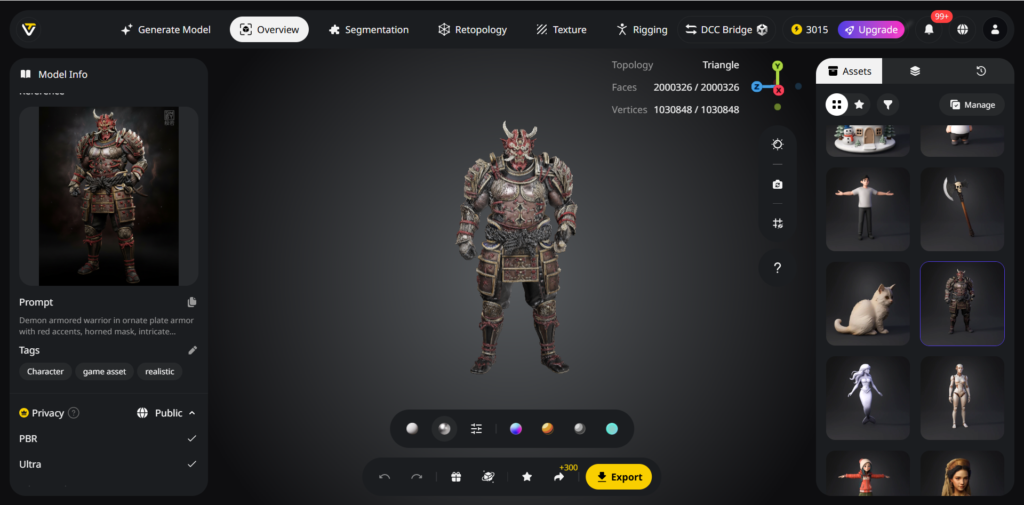
Tripo allows users to generate 3D assets from reference images, supporting workflows often described as 2D Image to 3D model conversion. After uploading an image, creators can further guide the result using text instructions and built-in editing tools, adjusting proportions or details to better match their intent.
For best results, Tripo recommends avoiding images with messy backgrounds, overly flat visual information, or incomplete subjects. Clear lighting, distinct silhouettes, and well-defined forms help the system infer depth and structure more accurately.
The Image to 3D Model approach makes image-based generation a starting point rather than a fixed outcome.
- Text to 3D Model
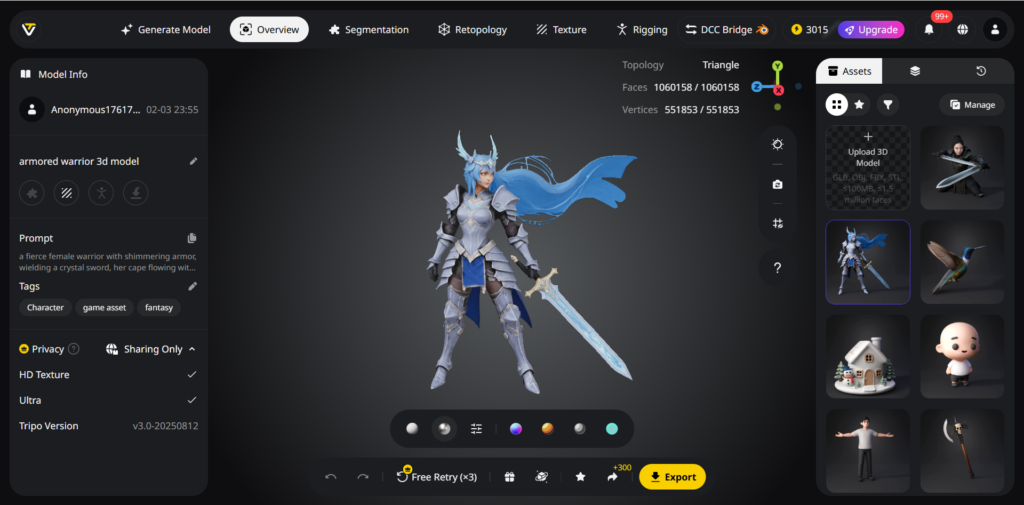
With the Text to 3D Model feature, users describe what they want to create in natural language, and Tripo translates that description into a 3D form. This method is especially useful during early ideation, when no reference images exist yet.
By refining prompts or regenerating variations, creators can explore multiple forms quickly before settling on a direction. Within the broader AI 3D model generator landscape, this capability reduces the gap between imagination and a tangible 3D draft.
- Intelligent Segmentation
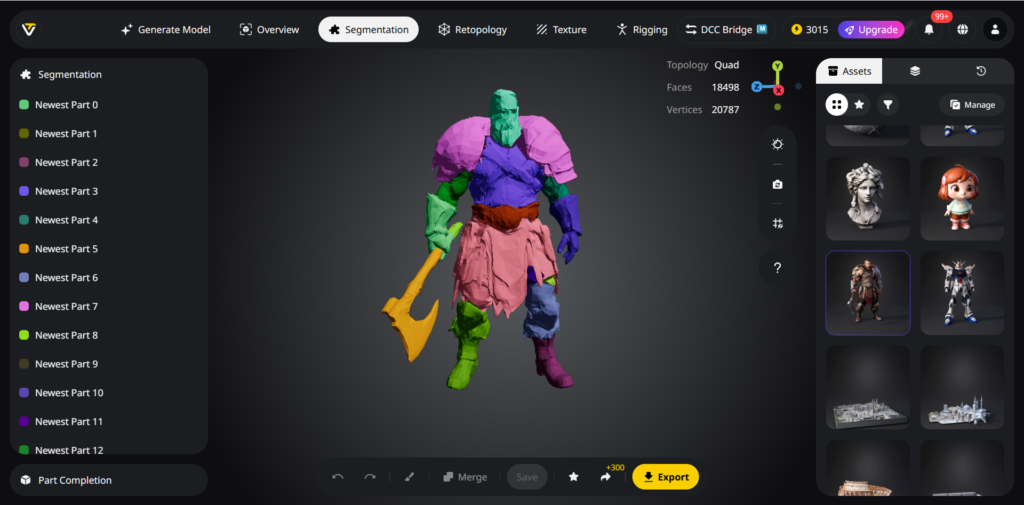
Tripo’s intelligent segmentation feature allows a generated model to be split into editable parts. Each segment can be modified independently, making it easier to adjust proportions, replace elements, or refine specific areas.
Segmentation also supports partial completion, enabling users to regenerate or enhance only certain sections of a model rather than starting over entirely. This modular approach aligns well with professional editing workflows and avoids unnecessary rework.
- Smart Retopology
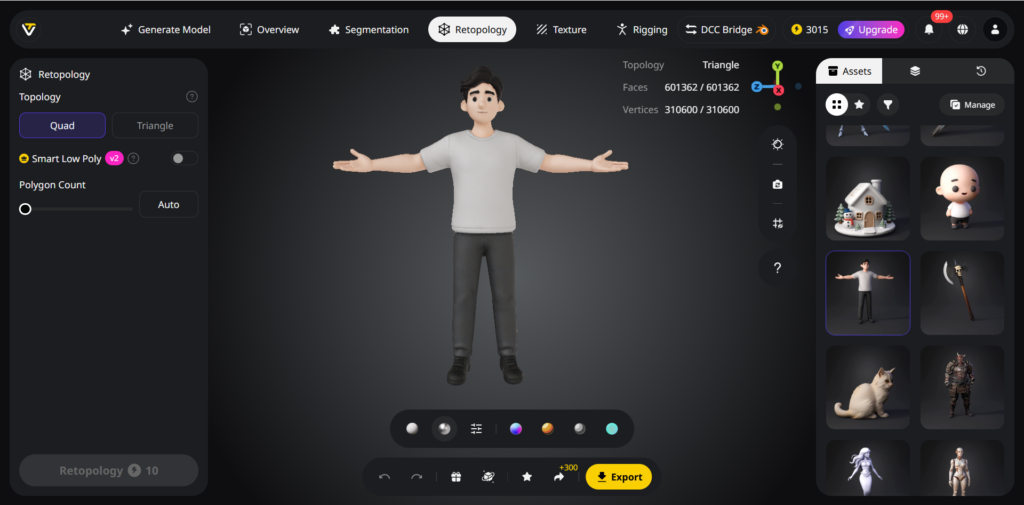
Clean topology is essential for animation, deformation, and efficient rendering. Tripo includes smart retopology options that let users remesh models with either quad-based or triangle-based geometry.
Quad topology is generally better suited for animation and detailed editing, while triangle topology preserves surface detail and is often preferred for static assets. Tripo also offers a Smart Low Poly option, creating simplified meshes that are easier to edit and optimize.
These options can be selected during generation or applied afterward, giving users flexibility if project requirements change. Whether refining a concept model or preparing assets for real-time use, retopology helps align structure with purpose.
- AI Texturing
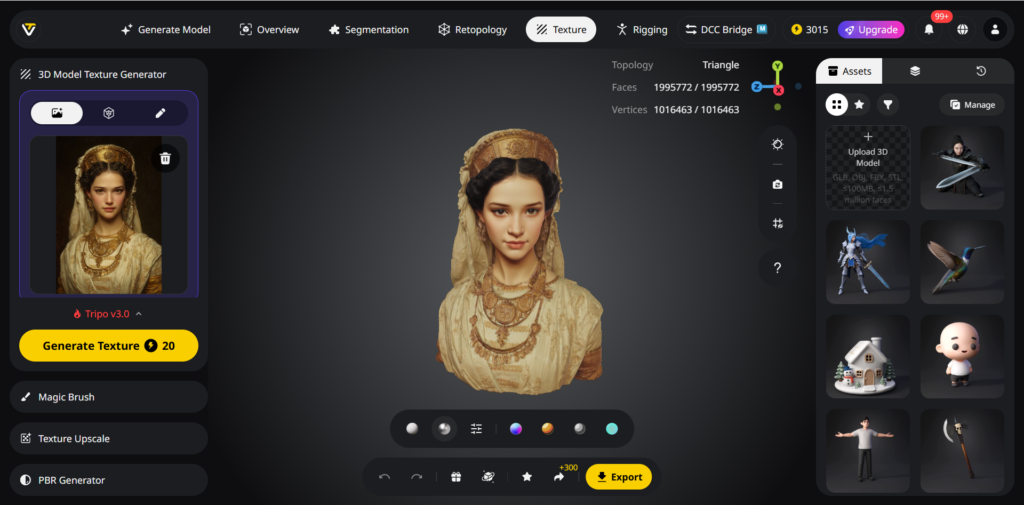
The AI texturing module integrates texture generation, editing, upscaling, and PBR workflows into a single system. Users can upload reference images or describe surface qualities in text to guide the look of materials.
The Magic Brush tool enables localized edits, while the PBR generator creates materials with physically accurate reflectance properties for realistic rendering. This unified approach reduces the need to move between multiple applications when refining surface detail.
- AI Auto Rigging
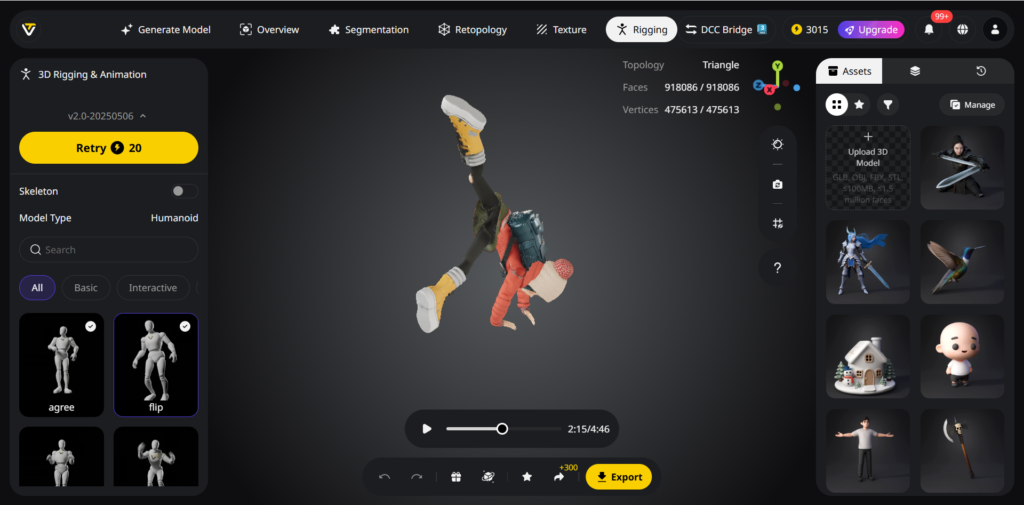
Rigging is often a time-consuming step in character creation. Tripo’s auto-rigging feature automatically prepares models with skeletal structures and generates ready-to-use animations.
This capability allows creators to test movement, proportions, and deformation early in the process. For teams working under tight deadlines, auto rigging can significantly shorten the path from static model to animated asset.
- Model Stylization
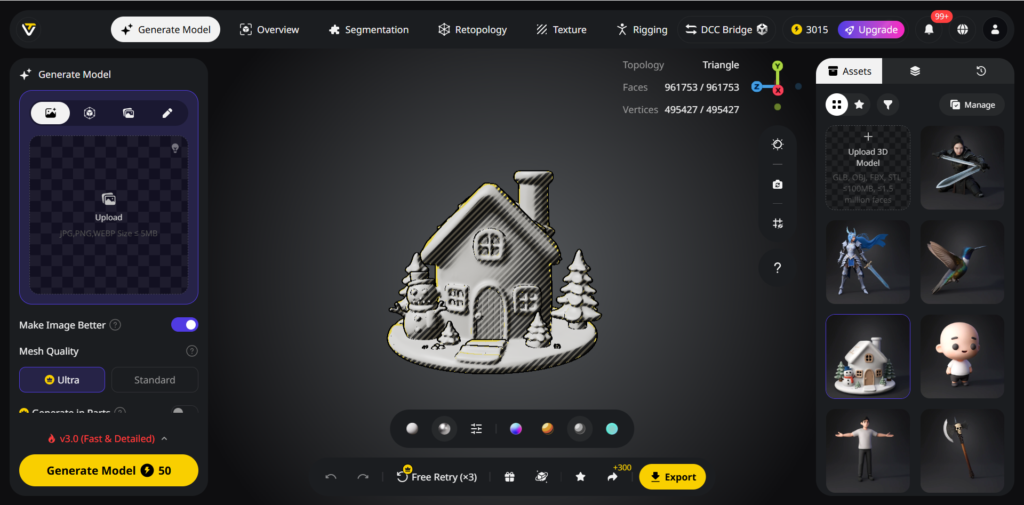
Beyond realism, Tripo supports a range of stylization options, including cartoon, sketch, and hologram styles. These presets help users quickly explore different visual directions without manually rebuilding geometry or textures. Stylization is particularly useful for concept development, marketing visuals, or projects where a distinct aesthetic matters more than physical accuracy.
Tripo 3.0: Algorithmic Improvements Behind the Scenes
Tripo Studio’s current capabilities are supported by the Tripo 3.0 algorithm, which focuses on improving geometry quality, structural consistency, and generation stability. Compared to earlier iterations, this version emphasizes cleaner topology and better alignment between prompts, images, and output models.
Rather than prioritizing speed alone, the algorithm balances efficiency with usability, ensuring that generated assets are suitable for further refinement. This evolution reflects a broader shift in the AI 3D model generator space—from novelty outputs to production-ready results.
Image Generation Options for Better References
Tripo Studio supports multiple AI-powered image generation options that help creators produce high-quality reference visuals before proceeding with 3D creation. These image models each offer distinct strengths to suit different creative needs and make your 2D to 3D workflow smoother.
Nano Banana—Enhanced Image Inputs
Nano Banana is an advanced image optimization model that refines and cleans up your reference visuals before they are used in 3D generation. By producing sharper, more controllable images with cleaner edges and better structure, it reduces the need for manual cleanup and helps Tripo build higher-quality 3D meshes from those inputs. This step is especially useful when starting from rough sketches, low-resolution photos, or images with distracting backgrounds.
GPT-4o—Multimodal Understanding for Smart Visuals
GPT-4o brings multimodal understanding to image generation, meaning it can interpret both text and image prompts together to produce refined visuals. When used as a reference generator inside Tripo Studio, it helps ensure that the images reflect your creative intent more precisely and naturally, especially for complex or detailed concepts.
Flux Kontext—Consistency Across Asset Sets
Flux Kontext focuses on maintaining contextual coherence across multiple generated images or assets. This is particularly helpful if you are creating an entire set of characters or props that need to share a consistent style, proportions, or level of detail. Flux Kontext helps eliminate mismatches and keeps your image references aligned, which translates into more cohesive 3D results.
By offering these three generation pathways, Tripo gives creators flexible tools for producing stronger image references, which in turn improves the outcomes when feeding those visuals into the AI 3D model generator workflow.
AI and the Future of 3D Creation
The future of 3D content creation is unlikely to be fully automated or fully manual. Instead, it will rely on systems that combine algorithmic assistance with human judgment. Tools like Tripo Studio illustrate how this balance can work in practice.
By focusing on editability, pipeline integration, and realistic production needs, Tripo demonstrates how an AI 3D model generator can function as a creative partner rather than a black box. As industries continue to demand faster iteration without sacrificing quality, platforms built around flexibility and transparency are likely to define the next phase of 3D workflows.