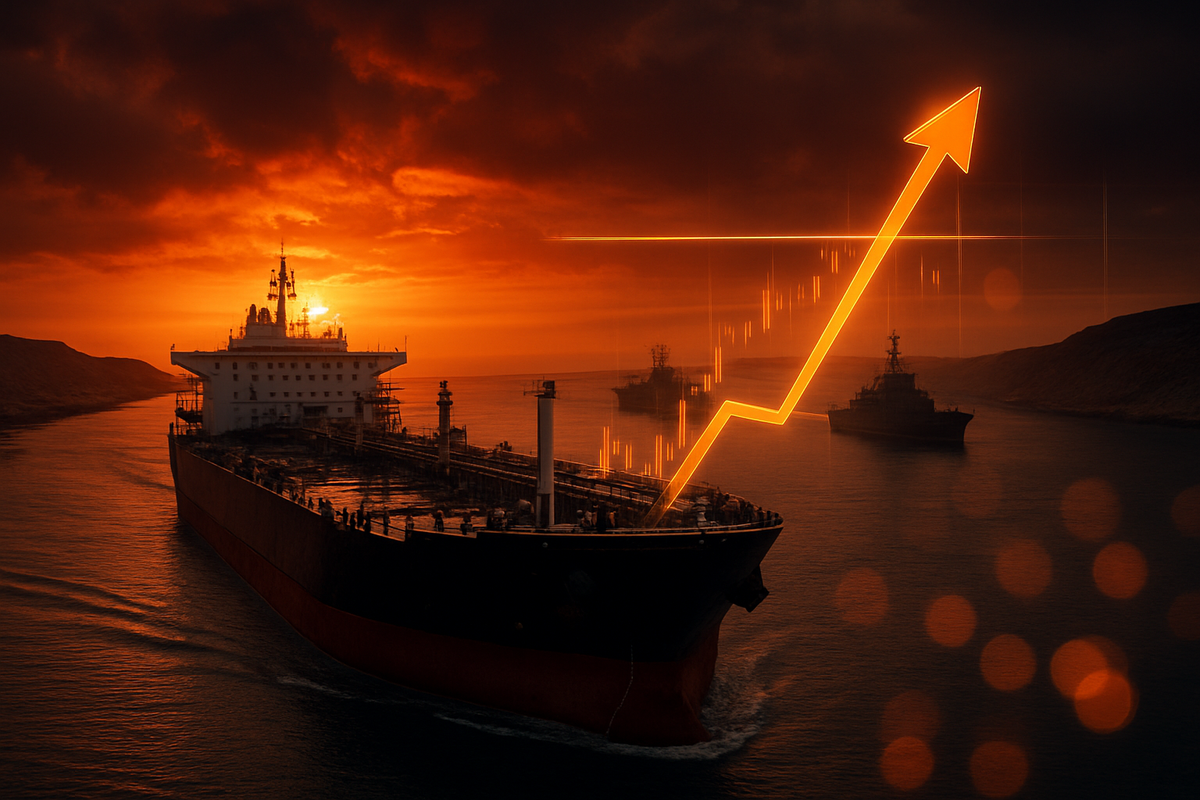
As of March 25, 2026, the energy markets are witnessing a seismic shift as West Texas Intermediate (WTI) crude oil completes a blistering 19% rally from its late February lows. Currently hovering near $78 per barrel, WTI has touched a 14-month high, driven by a volatile cocktail of escalating Middle Eastern hostilities and renewed fears of a structural supply deficit. Investors and commodity traders are now laser-focused on the $78.10 resistance level, a technical threshold that many believe could act as the gateway to the $80-$84 price range.
The immediate implications of this breakout extend far beyond the trading pits of the NYMEX. For a global economy still grappling with the tail-end of inflationary pressures, the sudden surge in energy costs threatens to complicate central bank pivot strategies. As the United States Oil Fund (NYSE Arca:USO) sees a surge in volume, the market is pricing in a "war premium" that hasn't been this pronounced in over two years, signaling a shift from a demand-driven narrative to one dominated by existential supply risks.
The Geopolitical Tinderbox: From Retaliation to Risk
The catalyst for this recent price action can be traced back to late February 2026, when a series of tit-for-tat military engagements between the U.S., Israel, and Iran broke a period of relative regional stability. Following reports of intercepted drone strikes and targeted operations against high-value strategic assets, the geopolitical risk profile for oil shifted overnight. The timeline escalated rapidly through mid-March, as diplomatic channels appeared to fray, leading to a "flight to quality" in the commodities sector.
At the heart of the current anxiety is the Strait of Hormuz, the world’s most critical maritime chokepoint. Market analysts estimate that nearly 20-25% of the world’s seaborne oil passes through this narrow waterway. Recent rhetoric from Tehran suggesting a potential blockade or "disruption of navigation" in response to Western sanctions has sent shockwaves through the industry. Unlike previous "saber-rattling" episodes, the current military posturing in the Gulf has led to a significant spike in maritime insurance premiums and a reluctance among tanker fleets to transit the area without naval escorts.
Stakeholders, including the International Energy Agency (IEA) and OPEC+ leadership, are monitoring the situation with increasing alarm. While OPEC+ has officially maintained its production quotas, the "invisible hand" of geopolitical risk is doing the work of supply cuts. The market's reaction has been swift, with WTI clearing psychological hurdles at $72 and $75 with ease, culminating in the current testing of the $78 mark.
Energy Giants Surge While Transport Takes the Hit
The direct beneficiaries of this bullish breakout are the major integrated oil companies, whose margins expand rapidly in a rising-price environment. Exxon Mobil (NYSE: XOM) and Chevron (NYSE: CVX) have both seen their share prices trend toward 52-week highs as investors bet on record-breaking upstream profits. Occidental Petroleum (NYSE: OXY), with its significant domestic footprint and leveraged exposure to WTI prices, has also emerged as a top performer during this 19% rally, benefiting from the reduced relative risk of U.S.-based production compared to Middle Eastern assets.
Conversely, the "losers" in this scenario are the fuel-intensive sectors, most notably the commercial airlines. Higher jet fuel prices are a direct drag on earnings, and the suddenness of the rally has caught many hedging strategies off guard. Delta Air Lines (NYSE: DAL) and United Airlines Holdings (NASDAQ: UAL) have faced downward pressure as analysts recalibrate fuel cost assumptions for the upcoming summer travel season. Similarly, transport and logistics giants like FedEx (NYSE: FDX) are seeing their operating margins squeezed, raising concerns that these costs will soon be passed on to consumers in the form of "fuel surcharges."
For the broader market, the winners also include renewable energy firms and electric vehicle manufacturers like Tesla (NASDAQ: TSLA), as high gasoline prices historically accelerate the consumer shift away from internal combustion engines. However, the short-term reality remains that a $5-$10 jump in crude prices acts as a de facto tax on the global consumer, potentially dampening discretionary spending across the board.
Wider Significance: A Return to Energy Insecurity?
This event marks a potential pivot point in the mid-decade energy narrative. For much of 2025, the market was defined by "lower for longer" sentiment, driven by slowing Chinese demand and robust non-OPEC production. The 2026 breakout upends that thesis, suggesting that geopolitical fragility remains the ultimate arbiter of energy prices. Historically, this mirrors the supply shocks of 1973 and 1979, albeit in a world that is far more interconnected and reliant on "just-in-time" energy delivery.
The ripple effects are reaching the halls of the Federal Reserve and the European Central Bank. If oil sustains levels above $80, the "last mile" of inflation could become an insurmountable hill, potentially forcing interest rates to stay higher for longer. This creates a challenging environment for regional banks and the housing market, which were both banking on a sequence of rate cuts throughout 2026. Furthermore, the reliance on the Strait of Hormuz highlights the ongoing strategic vulnerability of the "global energy transition," which still requires a stable fossil-fuel base to fund its multi-trillion-dollar infrastructure shift.
Regulatory and policy implications are also mounting. In Washington, there is renewed pressure to replenish the Strategic Petroleum Reserve (SPR), which remains at historically low levels following the releases of previous years. The Biden administration (or its successor in this 2026 timeline) faces the difficult choice of tapping into dwindling reserves now to cool prices or holding them in case a full-scale blockade of Hormuz becomes a reality.
The Path to $84: Scenarios and Strategic Pivots
As we look toward the final days of March, the technical setup for WTI is historically significant. The "golden cross" observed on daily charts, combined with the 19% momentum, suggests that the $78.10 level is the last major hurdle. A decisive daily close above this mark is expected to trigger a wave of algorithmic buying, likely propelling the commodity into the $80-$84 range within weeks.
If geopolitical tensions de-escalate, we could see a rapid "mean reversion" toward the $70 support level. However, a strategic pivot is already underway among major energy consumers. Corporations are increasingly looking toward long-term fixed-price energy contracts and accelerating their "de-risking" from Middle Eastern supply chains. For investors, the "short-term" play involves energy-heavy ETFs, while the "long-term" challenge involves navigating a world where energy security is no longer a guarantee but a premium commodity.
Potential scenarios range from a "contained conflict" where prices stabilize near $85, to a "Hormuz closure" scenario that many analysts fear could push WTI well into triple digits. In either case, the market of 2026 is waking up to the reality that the era of cheap, stable energy may be taking a backseat to the realities of a fractured geopolitical landscape.
Market Outlook and Final Thoughts
The 19% rally in WTI crude oil since late February is more than just a technical breakout; it is a manifestation of the world's deepening geopolitical fault lines. By reaching a 14-month high near $78, crude has signaled that the risk premium is back with a vengeance. The critical focus now remains on the $78.10 resistance level—a breach here would likely validate the move into the $80s and force a widespread reassessment of global economic growth projections for the remainder of the year.
Investors should maintain a high degree of vigilance in the coming months. Key indicators to watch include not just the "headline" military developments in the Middle East, but also the weekly inventory reports from the Energy Information Administration (EIA) and the rhetoric from OPEC+ regarding their "spare capacity." If the Strait of Hormuz remains a credible threat, the "floor" for oil prices has likely shifted permanently higher. Moving forward, the market will be defined by its ability to balance this heightened risk with the ever-present reality of a global economy that still runs on oil.
This content is intended for informational purposes only and is not financial advice.