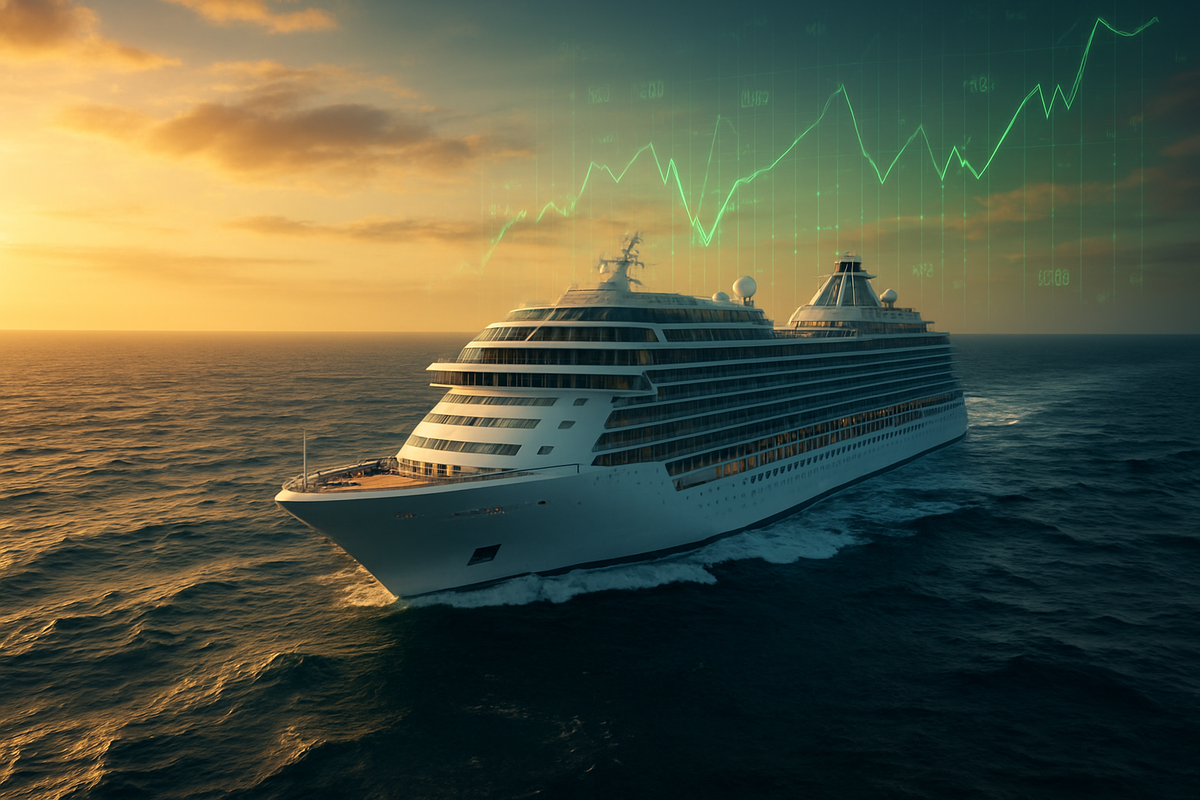
As of April 7, 2026, the global travel and leisure sector is witnessing a high-stakes tug-of-war between unprecedented consumer demand and intense geopolitical instability. Following a tumultuous March that saw energy prices skyrocket due to the outbreak of "Operation Epic Fury"—a localized but intense conflict involving U.S. and Iranian forces—travel stocks have begun a tentative but significant rebound. Investors are currently weighing the impact of $111-per-barrel oil against a cruise industry that has already booked over 85% of its 2026 capacity at record-high pricing.
The current market sentiment is one of "cautious optimism," fueled by rumors of a potential ceasefire in the Middle East that sparked a massive "buzzer-beater" rally on March 31. While the S&P 500 spent much of the first quarter in the red, the travel sector, led by stalwarts like Royal Caribbean Cruises Ltd. (NYSE: RCL) and Carnival Corporation & plc (NYSE: CCL), is emerging as a critical barometer for consumer resilience in a high-inflation, high-volatility environment.
The March Meltdown and the April Awakening
The road to this week's rebound was paved with significant anxiety. In late February 2026, the sudden escalation of maritime tensions in the Middle East sent shockwaves through the leisure industry. For cruise lines, which are essentially floating cities, the immediate implication was a dual threat: rising fuel surcharges and potential rerouting of lucrative European and Mediterranean itineraries. By mid-March, the sector had shed nearly 15% of its market capitalization as WTI crude oil breached the $110 mark for the first time in nearly two years.
However, the narrative shifted during the final week of March. Despite the geopolitical noise, the industry’s fundamental data remained startlingly strong. On March 28, Carnival Corporation (NYSE: CCL) released a Q1 earnings report that, while cautious on guidance, confirmed that booking volumes were at an all-time high. This disconnect—between a scary geopolitical map and a consumer base that refused to cancel vacations—created a "spring-loaded" effect. When the first credible reports of diplomatic de-escalation surfaced on April 2, the sector surged, with some names gaining 8% in a single trading session.
Key players like Royal Caribbean CEO Jason Liberty and Carnival’s Josh Weinstein have spent the last month emphasizing "operational agility." Their strategy has been to lean into private destinations, such as Perfect Day at CocoCay, which insulate the companies from regional instability elsewhere. This focus on "destination control" has become the primary defense mechanism against the volatility that defined the early months of 2026.
Winners and Losers in the High-Seas Rebound
While the tide is rising, it is not lifting all boats equally. Royal Caribbean Cruises Ltd. (NYSE: RCL) has emerged as the clear thoroughbred of the sector. Trading near $273.00, RCL has successfully leveraged its "Icon-class" fleet to command premium pricing that offsets fuel spikes. With a recently reinstated dividend of $1.50 per share and a massive $2.0 billion stock buyback program announced in early 2026, RCL is attracting institutional "flight-to-quality" capital. Its cleaner balance sheet, with debt reduced to roughly $18 billion, provides a cushion that its competitors lack.
Conversely, Carnival Corporation & plc (NYSE: CCL) continues to struggle with the weight of its pandemic-era debt, which still hovers near $24 billion. While its operational performance is stellar—reporting 85% of 2026 capacity is already spoken for—the company’s lack of aggressive fuel hedging has left it more exposed to the "Epic Fury" energy spike than its peers. For CCL, the rebound is a fight for margin preservation rather than pure expansion, and the stock remains volatile near the $25.00 mark as investors wait for more aggressive debt retirement.
Meanwhile, Norwegian Cruise Line Holdings Ltd. (NYSE: NCLH) finds itself in a challenging "laggard" position. Trading around $19.37, NCLH is currently undergoing a structural turnaround following a leadership shakeup in February. The company has faced criticism for execution gaps in its Caribbean strategy and a net leverage ratio that remains stubbornly high at 5.3x. In the broader travel space, Booking Holdings Inc. (NASDAQ: BKNG) recently executed a historic 25-for-1 stock split on April 6, 2026, signaling a move to court retail investors who were previously priced out of its $4,000+ shares, further heating up competition for travel dollars.
A K-Shaped Recovery in the Travel Landscape
The 2026 rebound highlights a broader industry trend: the "K-shaped" travel recovery. While middle-to-low-income households are feeling the pinch of 3% inflation and rising fuel costs—leading to shorter, budget-conscious trips—the luxury and "experience-first" segments are booming. This trend is visible in the divergent paths of cruise lines and budget hotels. Travelers are increasingly "swapping shopping carts for suitcases," prioritizing high-end experiences like Antarctic expeditions or private island stays over traditional retail consumption.
Historically, the cruise industry has been more resilient to oil price shocks than airlines, primarily due to the longer lead times of their bookings and the ability to adjust onboard spending opportunities. This precedent is holding true in 2026. While major carriers like Delta Air Lines, Inc. (NYSE: DAL) and United Airlines Holdings (NASDAQ: UAL) have been forced to trim schedules due to airspace closures and jet fuel costs, the cruise lines have simply shifted their "floating assets" to safer, more profitable waters in the Western Hemisphere.
Furthermore, the current situation draws comparisons to the 2022-2023 recovery period, but with a critical difference: the industry is no longer fighting for survival; it is fighting for efficiency. Regulatory oversight regarding carbon emissions is also tightening in 2026, forcing companies to accelerate their transition to Liquefied Natural Gas (LNG) and shore-power capabilities. Those who invested early in green tech, like Royal Caribbean, are seeing lower regulatory costs, providing another layer of stability in an unstable market.
The Horizon: What Lies Ahead for Investors
Looking toward the second half of 2026, the primary challenge will be sustaining pricing power if the "ceasefire" rumors fail to materialize. If energy prices remain above $110, even the most efficient cruise lines will eventually have to pass those costs onto the consumer, potentially testing the limits of demand. Short-term, investors should expect continued "headline risk" as the situation in the Middle East evolves.
However, the long-term outlook remains robust. Global passenger volume is projected to hit a record 38.9 million by the end of the year. For the industry to maintain its momentum, a strategic pivot toward "value-based luxury" will be required. We may see more consolidation among smaller cruise lines or niche travel providers who cannot withstand the dual pressures of high interest rates and fuel volatility. Market opportunities are likely to emerge in the "expedition" and "wellness" cruise segments, which are currently seeing the highest year-over-year growth.
Summary and Market Outlook
The April 2026 rebound in travel and leisure stocks is a testament to the enduring appeal of "escape" in an era of geopolitical turmoil. The key takeaway for investors is the divergence in fiscal health between industry leaders; while the entire sector is benefiting from a surge in bookings, the winners are those with the balance sheet strength to return capital to shareholders while navigating high operational costs.
Moving forward, the market will be hyper-focused on three metrics: fuel hedging positions, debt-to-equity ratios, and the sustainability of record-high yields. For those holding (NYSE: RCL), the focus is on growth and dividends. For (NYSE: CCL) and (NYSE: NCLH) investors, the focus remains on the "long grind" of deleveraging. In a world where volatility is the new constant, the cruise industry’s ability to sell "stability and sunshine" remains its greatest asset, but investors must keep a weather eye on the geopolitical horizon.
This content is intended for informational purposes only and is not financial advice.