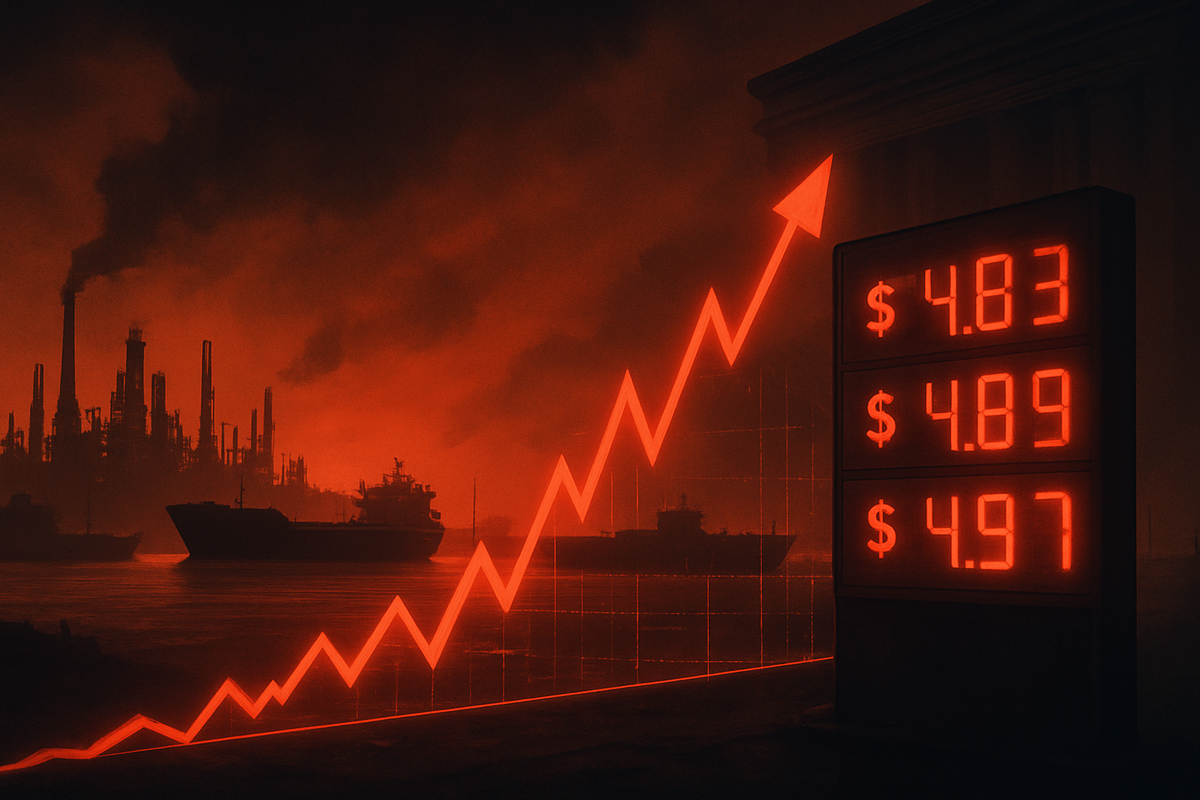
As the sun sets on April 9, 2026, the financial world is bracing for what could be the most consequential economic data release of the decade. Tomorrow morning, April 10, the Bureau of Labor Statistics will release the March Consumer Price Index (CPI) report—the first official measure to fully account for the dramatic spike in energy prices following the sudden escalation of conflict in the Middle East. With the Strait of Hormuz effectively shuttered and global crude supplies strangled, economists are warning that the "inflation monster" many thought had been tamed in late 2025 is back with a vengeance.
The immediate implications are stark: a "hot" print tomorrow could not only end talk of interest rate cuts by the Federal Reserve but could force Chair Jerome Powell to put a rate hike back on the table for the first time in years. Wall Street is currently pricing in a significant jump in headline inflation, with estimates ranging from 3.1% to 3.7% year-over-year. As gasoline prices at the pump surge past the $4.00 national average, the data will serve as a definitive verdict on whether the U.S. economy can withstand this new geopolitical shock or if a "higher-for-longer" interest rate regime is here to stay.
The Energy Catalyst: A Timeline of the March Spike
The road to tomorrow’s anticipated inflationary surge began on February 28, 2026, with the commencement of "Operation Epic Fury," a military escalation in the Middle East that rapidly destabilized the world’s most critical energy corridor. By the first week of March, the Strait of Hormuz—the narrow waterway through which 20% of the world’s oil and 25% of its liquefied natural gas (LNG) flows—was declared a restricted zone, effectively halting commercial traffic.
The reaction in the energy markets was instantaneous. Brent Crude, which had been trading comfortably in the mid-$70s throughout much of 2025, surged past $120 per barrel in less than three weeks. West Texas Intermediate (WTI) followed suit, breaking the psychological $100 barrier on March 15. This was not merely a futures market panic; it translated directly to the consumer. The March CPI report is expected to show that gasoline costs accounted for nearly 0.6 percentage points of the total monthly increase, a staggering weight that threatens to overshadow cooling prices in other sectors like used vehicles and electronics.
Beyond the pumps, the "secondary heat" of this energy shock is already being felt in grocery aisles. Wholesale food transport costs have risen in tandem with diesel prices, leading analysts to forecast a "hot" print for the food-at-home component of the CPI. While core inflation—which excludes volatile food and energy—is expected to remain relatively stable at around 2.7%, the fear among policymakers is that these persistent headline pressures will eventually bleed into service costs and wage demands, creating a classic inflationary spiral.
Winners and Losers in a $100-Oil Economy
The resurgence of inflation and high energy prices has created a sharp divide across the stock market. Leading the charge among the "winners" are the integrated oil majors. ExxonMobil (NYSE: XOM) has seen its stock hover near all-time highs as its massive production capacity and vertical integration allow it to capture nearly every cent of the price surge. Similarly, Chevron (NYSE: CVX) has emerged as a preferred safe haven for investors, buoyed by its recent integration of high-margin assets and a commitment to return $20 billion to shareholders via buybacks in 2026. These energy titans are currently the primary engines of cash flow in an otherwise jittery market.
On the other side of the ledger, the airline industry is reeling from a massive "fuel shock." Jet fuel prices have nearly doubled since the end of 2025, now averaging roughly $4.88 per gallon. This spike has forced major carriers like Delta Air Lines (NYSE: DAL) to drastically revise their profit guidance. Despite owning its own refinery, Delta recently announced a 3.5% reduction in capacity for the second quarter of 2026 to mitigate rising costs. Other major players, including American Airlines (NASDAQ: AAL) and United Airlines (NASDAQ: UAL), are facing billions in unbudgeted fuel expenses, which will likely lead to higher ticket prices and lower operating margins throughout the summer travel season.
Retailers and consumer discretionary companies are also under the microscope. Companies that rely on heavy logistics and shipping, such as Amazon (NASDAQ: AMZN), are facing increased delivery surcharges. Meanwhile, the average consumer’s "disposable income" is being eaten away at the gas station, suggesting that tomorrow’s CPI report may be the precursor to a broader slowdown in consumer spending for non-essential goods.
Broader Significance and Historical Echoes
The significance of tomorrow’s report extends far beyond the gas pump; it represents a fundamental challenge to the "soft landing" narrative that dominated 2025. This event draws uncomfortable comparisons to the energy shocks of 1973 and 2022, where geopolitical instability forced the Federal Reserve’s hand. Historically, when headline inflation spikes as sharply as it has in March, the Fed has been forced to prioritize price stability over economic growth, often at the cost of a recession.
In the current landscape, the Fed’s policy implications are profound. Only three months ago, traders were pricing in multiple rate cuts for 2026. Now, those expectations have been erased. Futures markets show a 98% probability that the Fed will hold rates steady at 3.50%–3.75% in April, but a headline CPI reading above 3.5% could force the committee to discuss a "preventative hike." This shift in policy would ripple through the housing market, potentially pushing mortgage rates back toward 7.5% or 8%, further dampening a real estate sector that was just beginning to show signs of life.
Furthermore, this event highlights the fragility of global supply chains in an era of geopolitical fragmentation. The closure of the Strait of Hormuz has forced a re-evaluation of energy security, with regulatory bodies in the U.S. and EU already calling for accelerated investment in domestic production and alternative energy sources. However, those transitions take years, and the immediate inflationary reality is one that cannot be solved by policy alone as long as the conflict continues.
What Comes Next: Strategic Pivots and Scenarios
In the short term, the market will likely see a period of intense volatility as it digests tomorrow’s data. If the CPI print meets or exceeds the high-end estimate of 3.7%, we can expect a "sell-off" in tech and growth stocks, which are sensitive to higher interest rates. Conversely, a reading below 3.0%—though unlikely—would be hailed as a massive victory for the economy's resilience. Investors should look for strategic pivots by corporations, such as renewed cost-cutting measures and a shift toward "defensive" positioning in sectors like healthcare and utilities.
Looking toward the summer of 2026, the primary question is whether the energy crisis is a "flash in the pan" or a long-term structural shift. If the conflict in the Middle East is resolved and shipping lanes reopen, inflation could retreat as quickly as it arrived. However, a prolonged stalemate could lead to "inflation expectations" becoming unanchored, forcing the Fed to keep interest rates high well into 2027.
The emergence of "green inflation" or "greenflation" is another potential scenario. As the high cost of fossil fuels makes the transition to renewables more attractive, the sudden surge in demand for materials like copper and lithium could create a secondary wave of inflation. Companies that can pivot their energy sourcing or offer high-efficiency logistics solutions will likely emerge as the new market leaders in this volatile environment.
The Wrap-Up: What to Watch on Friday Morning
Tomorrow’s March CPI report is more than just a data point; it is a stress test for the global economy. The key takeaway for investors is that the era of low, predictable inflation has been interrupted by geopolitical reality. The "energy-led" nature of this inflation means that traditional Fed tools may be blunt instruments, capable of crushing demand but unable to fix a broken supply line in the Middle East.
Moving forward, the market will be hyper-focused on the Federal Reserve’s commentary following the report. Investors should watch for any shift in tone from previously "dovish" officials toward a more "hawkish" stance. The relationship between oil prices and the 10-year Treasury yield will be the most critical indicator of market sentiment in the coming weeks.
As we await the 8:30 AM release, the consensus is clear: the Middle East conflict has rewritten the economic playbook for 2026. Whether this is a temporary hurdle or the start of a multi-year inflationary cycle will depend on tomorrow’s numbers and the geopolitical developments in the weeks to follow. For now, the world watches the oil tickers and the inflation charts, waiting for the first definitive look at the true cost of "Operation Epic Fury."
This content is intended for informational purposes only and is not financial advice.