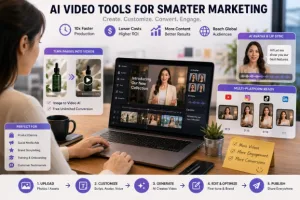
Marketing teams face a persistent tension: video is the most effective format for driving engagement, conversions, and brand recall – and it is also the most expensive and time-consuming to produce at scale. A single professionally produced product video can easily run thousands of dollars. A brand campaign with multiple video variants across platforms can stretch budgets and timelines to the breaking point.
AI video tools have changed this calculus. In 2026, businesses of every size are using AI to produce marketing videos faster, at a fraction of traditional costs, and with the kind of volume that used to require an in-house production studio. This is not about replacing creative talent – it is about removing production bottlenecks so your team can focus on strategy, messaging, and results.
The Economics of AI Video Production
Traditional video production follows a predictable cost structure: equipment, location, talent, crew, editing, revisions. Even a simple 60-second product video can require multiple shoot days, outsourced editing, and rounds of stakeholder feedback that drag the timeline across weeks.
AI video tools compress this timeline into hours – sometimes minutes – and slash the associated costs by an order of magnitude. The savings come from several directions:
- No physical production: No cameras, no lighting rigs, no studio rental, no travel.
- No talent scheduling: AI avatars and voice synthesis replace on-camera talent and voiceover artists.
- Instant revisions: Change a script, swap a product image, adjust the pacing – all in minutes, not days.
- Infinite variants: Produce platform-optimized versions, A/B test creatives, and localize for multiple markets without multiplying costs.
For a mid-market brand spending $50,000 annually on video content, adopting AI production tools can reduce that line item by 60 to 80 percent while increasing total output volume. That is not a marginal improvement – it is a structural change in how marketing budgets are allocated.
Product Showcase Videos at Scale
Product videos consistently outperform static images in e-commerce conversion rates. Shoppers who watch a product video are significantly more likely to add to cart and complete a purchase. The problem for most businesses has been logistics: photographing a product is manageable, but filming every SKU in motion is not.
AI image-to-video tools solve this by turning existing product photography into dynamic showcase content. A single high-quality product photo becomes a rotating 360-degree view, a feature-highlight video with animated callouts, or a lifestyle clip that places the product in a moving scene.
Platforms that provide image to video ai free unlimited conversion are particularly valuable for e-commerce teams managing large catalogs. When you have hundreds or thousands of SKUs, per-video pricing models become impractical. Unlimited generation means you can produce video assets for your entire inventory without spreadsheet-level cost tracking on every asset. The economics shift from “which products deserve video” to “every product gets video.”
Brand Videos Without the Production Overhead
Brand storytelling traditionally required significant production investment – location shoots, professional crews, post-production teams. AI tools have made it possible for brands to create polished, narrative-driven promotional content with dramatically lighter production footprints.
The key capabilities that make this work:
AI-generated B-roll: Instead of shooting supplementary footage, AI can generate contextual visuals that match the tone and message of your brand narrative. Need drone-style footage of a city skyline for a corporate values video? AI generates it. Need atmospheric slow-motion clips for an emotional brand story? AI delivers.
Consistent visual identity: Leading AI video platforms allow you to lock in brand colors, typography, logo placement, and visual style preferences so every piece of content feels native to your brand, regardless of who on the team produces it.
Multi-format delivery: A single brand video brief can automatically generate versions optimized for YouTube (16:9 horizontal), Instagram and TikTok (9:16 vertical), and LinkedIn (1:1 square) – with attention-grabbing hooks tailored to each platform’s consumption patterns.
AI Virtual Presenters: The Face of Scalable Video
One of the most practical applications for business marketing is the AI virtual presenter. Instead of scheduling executives, hiring on-camera talent, or coordinating voiceover sessions, marketing teams can deploy AI avatars that deliver scripted content with natural speech and synchronized facial expressions.
Use cases that businesses are already adopting:
- Product walkthroughs and demos: An AI presenter explains features while the product is shown on screen, creating a guided experience that outperforms text-based documentation.
- Internal communications: CEO updates, training modules, and company announcements delivered in video format without pulling leadership into a recording studio.
- Customer onboarding: Welcome videos and tutorial sequences that feel personal without requiring one-to-one production effort.
- Multi-language marketing: Record one script, localize the text into a dozen languages, and generate presenter videos where the avatar appears to speak each language natively.
The technology behind the synchronization – AI lip sync – is what makes these presenters convincing. When mouth movements precisely match the audio track, viewers focus on the message rather than the medium. Many marketing teams start experimenting through a lip sync ai online free no sign up tool that requires no account creation – a low-risk way to test how AI presenter content resonates with their specific audience before committing to a full production workflow.
Scaling Content Across Channels
Marketing in 2026 means publishing across six to ten channels minimum – website, email, YouTube, Instagram, TikTok, LinkedIn, programmatic ads, connected TV, and more. Each channel has different format requirements, audience expectations, and content consumption patterns.
Manually producing channel-specific video for every campaign is not sustainable. AI tools make it feasible by handling format adaptation and variant generation automatically. A product launch that previously produced three video assets (hero video, social cut, product demo) can now generate twenty-plus variants – different lengths, aspect ratios, hooks, CTAs, and localized versions – without proportional increases in time or cost.
This volume advantage compounds over time. Brands that produce more video content learn faster about what resonates with their audience. They accumulate more performance data. They optimize more aggressively. The AI tooling does not just reduce cost – it accelerates the marketing learning loop.
Getting Started: A Practical Framework
For marketing teams evaluating AI video tools, the most successful adoption patterns follow a phased approach:
Phase 1 – Augment existing assets: Start by converting your best-performing static content into video. Product photos, infographics, testimonial quotes, blog post highlights – feed them through AI animation tools and measure the engagement lift.
Phase 2 – Replace outsourced production: Identify video projects currently going to external agencies or freelancers and shift a portion to AI production. Compare output quality, turnaround time, and cost per asset.
Phase 3 – Expand to new formats: Once your team is comfortable with the tools, use AI to create video content for channels and formats you previously could not justify. That webinar recap, that customer success story, that weekly product update – content that was too expensive to produce now becomes feasible.
Phase 4 – Build a content engine: Integrate AI video production into your marketing calendar as a standing capability. Define templates, establish brand guidelines within the tools, and train team members so video production becomes a routine function rather than a special project.
The Competitive Reality
The brands winning on social media, in paid advertising, and across digital channels in 2026 share a common characteristic: they produce more video content than their competitors. AI tools have made video production volume a choice rather than a budget constraint.
The question for marketing leaders is not whether AI video tools will become part of the production stack – they already have. The question is whether your team adopts them now, builds institutional knowledge, and gains the efficiency advantage, or whether you are playing catch-up six months from now while competitors have already optimized their workflows and accumulated months of performance data.
The technology is ready. The cost barrier has collapsed. The only remaining variable is execution.