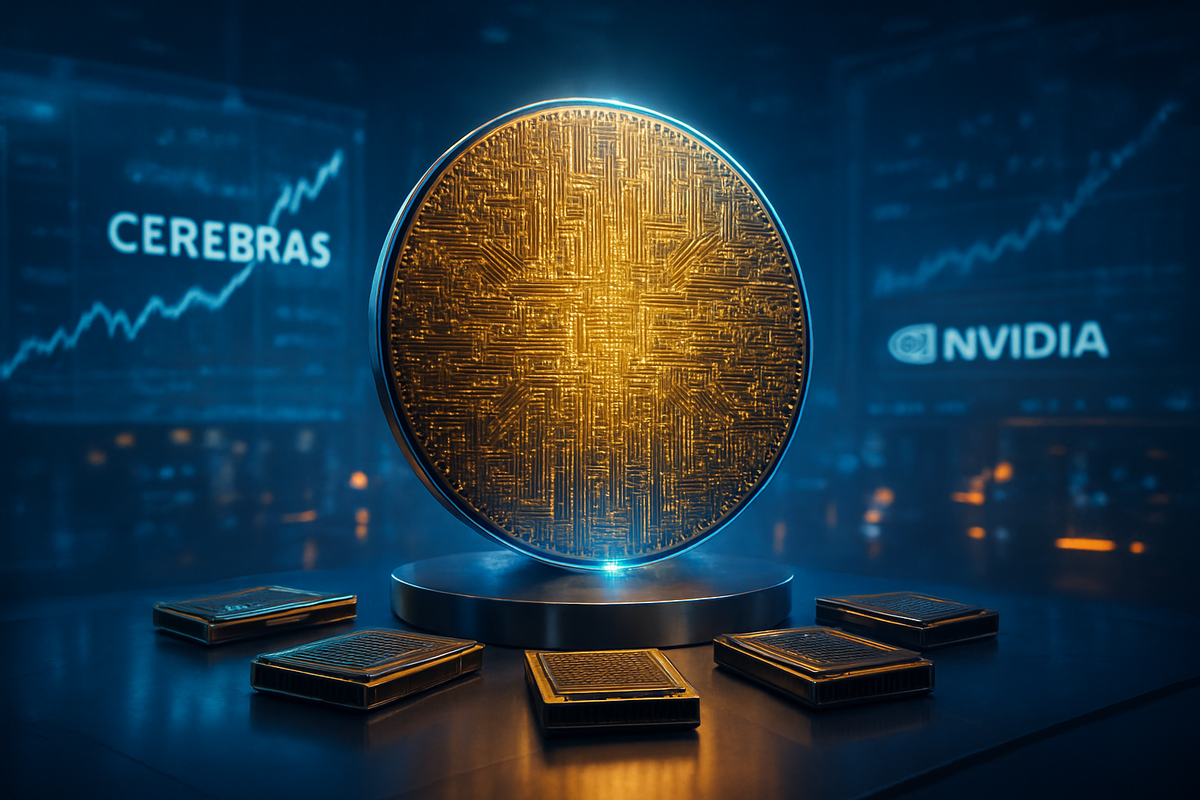
As of January 15, 2026, the artificial intelligence landscape is bracing for its most significant structural shift since the debut of ChatGPT. Cerebras Systems, the Silicon Valley unicorn known for its radical "wafer-scale" computing, has officially signaled its intent for a blockbuster Initial Public Offering (IPO) in the second quarter of 2026. Targeting a valuation that analysts estimate could reach $22 billion, the company is positioning itself not just as another chipmaker, but as the first credible existential threat to the market dominance of NVIDIA (NASDAQ: NVDA).
The immediate implications of this IPO filing are profound. For years, the AI industry has been tethered to the "GPU-cluster" model, where thousands of small chips are stitched together to power massive models. Cerebras’ entry into the public markets validates a competing vision: a single, dinner-plate-sized processor that keeps the entire AI model on one piece of silicon. With a massive $10 billion partnership with OpenAI already in its pocket, Cerebras is moving from a technical curiosity to a foundational pillar of the global AI infrastructure, forcing a revaluation of the entire semiconductor sector.
From Technical Audacity to Market Reality
The journey to the 2026 IPO has been a gauntlet of technical and geopolitical hurdles. In late 2024 and throughout 2025, Cerebras’ public debut was stalled by a rigorous federal security review (CFIUS) concerning its deep financial ties with the UAE-based firm G42. However, by early 2026, the company successfully restructured its investor base, moving G42 out of its primary stakeholder list to satisfy U.S. regulators and clear the path for its Nasdaq listing.
At the heart of Cerebras’ momentum is the Wafer-Scale Engine 3 (WSE-3). While NVIDIA's Blackwell architecture relies on interconnecting multiple chips, the WSE-3 is the world’s largest single processor, featuring 4 trillion transistors and 900,000 AI-optimized cores. The technical specs are staggering: it provides 7,000 times the memory bandwidth of NVIDIA’s flagship HBM3e systems. This architectural advantage has allowed Cerebras to claim "Inference Speed" leadership, running the latest Llama-4 models up to 21 times faster than equivalent NVIDIA clusters.
The market reaction has been one of intense anticipation. Historically, Cerebras was criticized for "customer concentration," with G42 accounting for nearly 80% of its revenue. That narrative shifted decisively in mid-2025 when the company secured a landmark deal to provide 750 megawatts of compute power to OpenAI through 2028. This deal, coupled with major contracts from IBM (NYSE: IBM) and the U.S. Department of Energy, has transformed Cerebras into a diversified infrastructure powerhouse with estimated 2025 revenues exceeding $1 billion.
Winners and Losers in the Post-GPU Era
The rise of Cerebras creates a new set of dynamics for the industry's heavyweights. OpenAI emerges as a primary winner; by backing an architectural rival to NVIDIA, they have gained significant leverage and a low-latency "speed king" for their real-time "agentic AI" services. Similarly, TSMC (NYSE: TSM) stands to benefit as the sole manufacturer capable of producing Cerebras' massive wafers, even as the company competes with Apple and NVIDIA for limited advanced-node capacity.
However, the "Big Three" legacy chipmakers are feeling the pressure to adapt. NVIDIA (NASDAQ: NVDA) remains the dominant leader with its CUDA software moat, but the Cerebras IPO signals that raw hardware performance for inference is becoming the new battleground. In a defensive move, NVIDIA recently acquired startup Groq for $20 billion to integrate deterministic scheduling into its upcoming "Rubin" platform. Meanwhile, AMD (NASDAQ: AMD) has doubled down on its Instinct MI450 accelerators, focusing on HBM4 memory to bridge the bandwidth gap that Cerebras has so aggressively exploited.
The losers in this scenario are likely the smaller AI chip startups that lack the scale to compete with a newly capitalized Cerebras. We have already seen the beginning of a massive consolidation wave; Intel (NASDAQ: INTC) finalized its $1.6 billion acquisition of SambaNova in early 2026 to bolster its Gaudi 4 roadmap. For these smaller players, the window to remain independent is rapidly closing as Cerebras and the "Big Three" move to lock up the remaining hyperscale contracts.
The Significance of the "Inference Flip"
The timing of the Cerebras IPO is no accident. It coincides with what industry experts call the "Inference Flip"—the point in early 2026 where global spending on running AI models (inference) officially surpassed spending on training them. While NVIDIA GPUs remain the gold standard for training, Cerebras’ wafer-scale architecture is purpose-built for the low-latency requirements of inference. For real-time applications where milliseconds matter—such as autonomous agents or live translation—Cerebras’ ability to keep a model "on-chip" provides a physics-based advantage that traditional GPU clusters struggle to match.
This shift also feeds into the "Sovereign AI" trend. Nations such as Japan and Morocco are increasingly seeking "AI-in-a-box" solutions to build national supercomputers without the complexity of managing thousands of discrete GPUs. Cerebras’ CS-3 systems, which pack the power of a small data center into a single rack, are becoming the preferred choice for these sovereign projects. This move toward localized, efficient compute represents a departure from the centralized cloud-model that dominated the early 2020s.
Furthermore, the IPO highlights the growing importance of the "cost-per-token" metric. In 2026, the market has moved away from "GPU at any price" toward operational efficiency. Cerebras claims its systems cost 32% less to operate than NVIDIA's Blackwell for the same inference workload. This economic pressure is forcing a rethink of data center design, with liquid cooling and specialized power delivery—necessitated by Cerebras’ massive chips—becoming the new industry standard.
What Comes Next: The Path to the Public Market
Looking ahead, the next six months will be critical for Cerebras as it prepares its S-1 filing. The short-term focus will be on the execution of the OpenAI contract and the stabilization of its CSoft software stack. To truly challenge NVIDIA, Cerebras must prove that developers can transition away from CUDA without significant friction. If Cerebras can demonstrate that its "software-defined" hardware is as easy to program as it is fast, the IPO could see significant oversubscription from institutional investors.
Strategic pivots are also expected. Cerebras is likely to expand its cloud-based "Inference API," allowing developers to rent wafer-scale performance without purchasing the hardware. This would put them in direct competition with cloud titans like Microsoft (NASDAQ: MSFT) and Broadcom (NASDAQ: AVGO), the latter of which is facilitating custom ASIC designs for hyperscalers like Meta Platforms (NASDAQ: META). The long-term challenge will be maintaining their lead as NVIDIA prepares to ship its "Rubin" GPUs in late 2026, which are expected to adopt many of the on-chip memory features that once made Cerebras unique.
A New Era for AI Infrastructure
The Cerebras IPO marks the end of the "GPU-only" era of AI development. It represents a maturation of the market where architectural diversity is no longer a luxury but a necessity for scaling the next generation of trillion-parameter models. By successfully navigating geopolitical scrutiny and securing a massive commercial pipeline, Cerebras has proven that there is room for a specialized, high-performance challenger at the top of the semiconductor food chain.
For investors, the key takeaways are clear: the AI trade is moving beyond the "training" phase and into a high-stakes battle for "inference efficiency." The success of the Cerebras IPO will serve as a bellwether for the health of the broader tech sector and the public's appetite for hardware innovation. Watch closely for the S-1 details—specifically the company's manufacturing yields and its ability to scale beyond its "Big Three" anchor customers. In the coming months, the battle for the future of compute will move from the laboratory to the trading floor.
This content is intended for informational purposes only and is not financial advice.