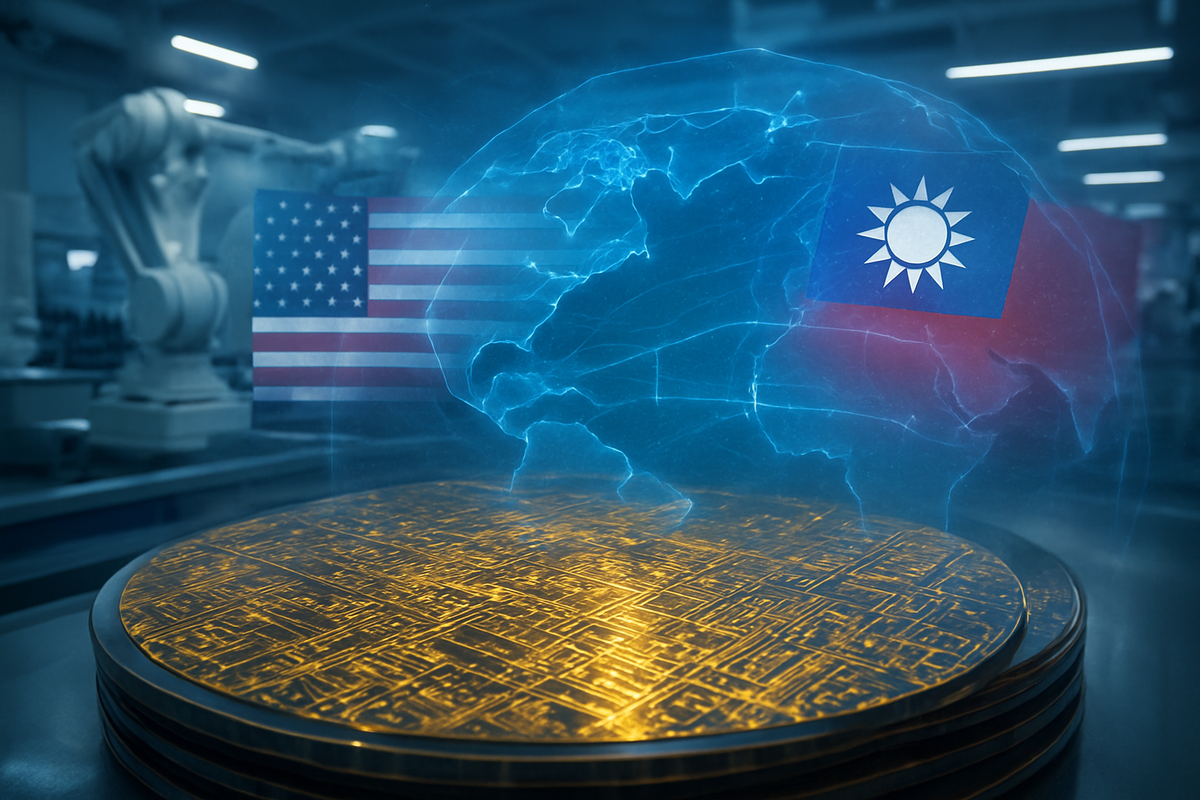
In a move that marks a definitive shift in the global technological balance of power, the United States and Taiwan officially signed a landmark expansion of the U.S.-Taiwan Initiative on 21st-Century Trade on January 15, 2026. Dubbed the "Silicon Pact," this $500 billion semiconductor trade and investment agreement is designed to aggressively "friend-shore" the world’s most advanced chip manufacturing capabilities, effectively creating a "Domestic Silicon Shield" within the United States. The deal promises to relocate a significant portion of the semiconductor supply chain from the volatile Taiwan Strait to American soil, securing the future of artificial intelligence, defense systems, and consumer electronics.
The immediate implications of the pact are staggering: Taiwan has committed to at least $250 billion in direct investments for U.S.-based production, while the Taiwanese government will provide an additional $250 billion in state-backed credit guarantees to help smaller suppliers migrate. For the market, this represents a massive liquidity injection into the U.S. industrial base and a fundamental restructuring of how technology is taxed and traded across the Pacific.
A New Era of Economic Integration
The finalization of the Silicon Pact on January 15, 2026, follows years of incremental negotiations that began in 2022. While earlier phases of the U.S.-Taiwan Initiative on 21st-Century Trade focused on administrative hurdles and non-tariff barriers, this new "Phase 2" expansion tackles the heart of the tech economy: capital, capacity, and customs. Led by U.S. Commerce Secretary Howard Lutnick and Taiwan Vice Premier Cheng Li-chiun, the agreement formalizes a reciprocal tariff reduction, lowering the rate on Taiwanese goods from 20% to 15%, placing Taiwan on par with key allies like Japan and South Korea.
A central pillar of the pact is the introduction of preferential Section 232 treatment for semiconductor firms. Under these "Silicon Shield" provisions, companies building factories in the U.S. are granted duty-free import quotas for equipment and materials based on their planned domestic production capacity. Specifically, firms can import up to 2.5 times their planned U.S. output during the construction phase, transitioning to a permanent 1.5-times allowance once operational. This mechanism is designed to offset the higher costs of American labor and construction, making domestic manufacturing competitively viable for the first time in decades.
Initial market reactions have been overwhelmingly positive for the semiconductor sector, though shadowed by geopolitical concerns. The signing was preceded by a White House proclamation on January 14, which imposed a 25% tariff on certain advanced AI chips to incentivize domestic assembly—while simultaneously providing immediate carve-outs for firms participating in the new trade pact. This "carrot and stick" approach has effectively forced the hand of global tech giants, ensuring that the U.S. becomes the primary hub for high-end logic chip production.
Winners and Losers in the New Chip Order
The primary beneficiary of the pact is undoubtedly the Taiwan Semiconductor Manufacturing Company (NYSE: TSM). The world's largest contract chipmaker has already signaled an expansion of its Arizona "mega-cluster" to a staggering 11-factory footprint. With a projected 2026 capital expenditure of up to $56 billion, TSMC will leverage the pact’s tariff-free allowances to import the high-precision machinery needed to bring 2-nanometer and sub-2-nanometer production to the U.S. by 2028.
For equipment manufacturers like Applied Materials, Inc. (Nasdaq: AMAT) and ASML (Nasdaq: ASML), the deal is a catalyst for record-breaking order books. The pact removes long-standing duties on the specialized tools required for extreme ultraviolet (EUV) lithography, facilitating a rapid build-out of new fabs. Conversely, Intel Corporation (Nasdaq: INTC) faces a complex landscape. While the deal increases competition for specialized talent in the U.S., Intel is expected to benefit from "spillover" demand for advanced packaging services, as the overall domestic ecosystem reaches the critical mass necessary to support its proprietary Foveros technology.
Design leaders such as NVIDIA Corporation (Nasdaq: NVDA) and Advanced Micro Devices, Inc. (Nasdaq: AMD) are also positioned as major winners. The pact provides a stable regulatory pathway for these companies to ship advanced AI processors globally while benefiting from the 15% tariff cap on components manufactured in Taiwan. However, firms that have lagged in diversifying their manufacturing base away from mainland China may find themselves at a disadvantage, facing the "stick" of the U.S. government's 100% tariff threats for non-participating entities.
Geopolitical Friction and 'Friend-Shoring'
The Silicon Pact is the most aggressive application of "friend-shoring" to date, aiming to reduce U.S. vulnerability to a potential blockade of Taiwan. By targeting a goal to relocate 40% of Taiwan’s semiconductor supply chain to the U.S. by 2030, Washington is effectively attempting to decouple critical technology from Chinese influence. This strategy fits into a broader industry trend where national security and economic policy are now inextricably linked.
The regulatory implications are profound. The pact essentially creates a two-tiered market: one for "secure" supply chains under the Silicon Pact umbrella and another for the rest of the world. Historically, this level of economic integration between the U.S. and Taiwan is unprecedented, surpassing the scope of previous bilateral trade agreements. It signals that the U.S. is willing to use its massive domestic market as leverage to reshape global trade patterns, prioritizing supply chain resilience over pure cost-efficiency.
Beijing has wasted no time in condemning the agreement, labeling it "economic plunder" and a violation of the "One China" principle. The pact has already led to increased military posturing in the Taiwan Strait, as China views this deep economic integration as a move toward de facto Taiwanese independence. For the global market, this creates a paradox: while the pact secures the supply chain against a potential conflict, the very act of signing it may increase the short-term risk of such a conflict occurring.
The Road Ahead: 2026 and Beyond
In the short term, investors should expect a surge in construction and capital equipment stocks as the first wave of the $500 billion investment hits the ground in states like Arizona, Ohio, and Texas. The strategic pivot for many tech companies will now involve "localization 2.0"—not just building factories, but relocating the entire ecosystem of chemical suppliers, wafer manufacturers, and testing facilities to North America.
Long-term possibilities include the potential for a "Phase 3" of the initiative, which could expand into biotechnology and clean energy, using the Silicon Pact as a blueprint. However, the market must also brace for the logistical challenges of such a massive industrial undertaking. Labor shortages in high-tech manufacturing and potential inflationary pressures from the "on-shoring" process remain significant hurdles that could slow the pact's ambitious timeline.
As the implementation phase begins, the success of the pact will depend on how quickly the "Silicon Shield" can be operationalized. If the U.S. can successfully reach its target of producing 20% of the world’s logic chips by 2030, it will have achieved one of the most significant industrial policy victories in a generation.
Final Assessment: A Transpacific Tech Fortress
The signing of the Silicon Pact on January 15, 2026, is a watershed moment for the global economy. It represents the transition from a globalized, "just-in-time" supply chain to a regionalized, "just-in-case" model centered on national security. The key takeaway for investors is that the semiconductor industry is no longer just a cyclical technology sector; it is now the front line of global geopolitics, with the U.S. and Taiwan acting as a unified front.
Moving forward, the market will be characterized by heavy state intervention and massive capital reallocation. Investors should keep a close watch on the quarterly capital expenditure reports of TSMC (NYSE: TSM) and the progress of the Arizona mega-cluster. Any delays in construction or shifts in the tariff exemptions could send ripples through the entire tech sector.
Ultimately, the Silicon Pact is about more than just chips; it is about the survival of the high-tech economy in an era of great power competition. While the costs of this transition are high, the cost of inaction—a total disruption of the global chip supply—is now deemed by both Washington and Taipei to be far higher.
This content is intended for informational purposes only and is not financial advice