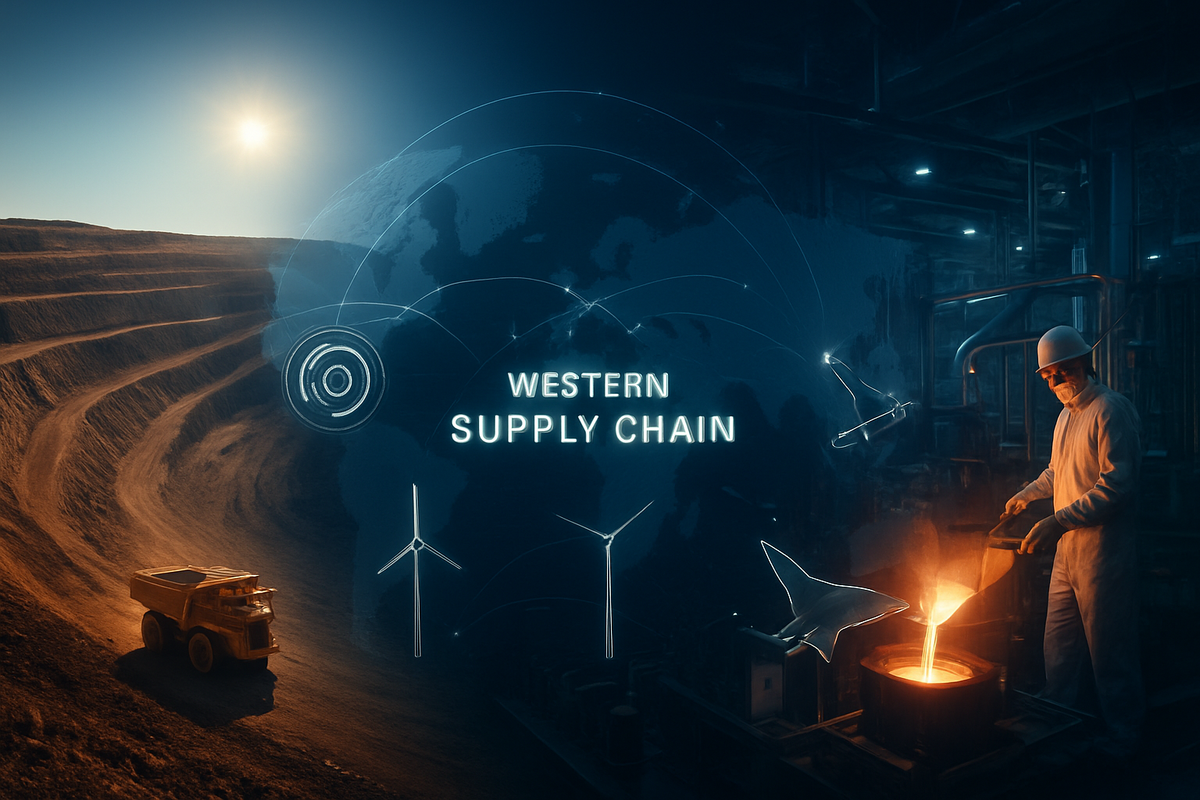
In a landmark move that signals a decisive shift in the global critical minerals landscape, U.S. uranium and rare earths leader Energy Fuels Inc. (NYSE American: UUUU) (TSX: EFR) has announced a definitive agreement to acquire Australian Strategic Materials Ltd (ASX: ASM) for approximately $300 million (A$447 million). The deal, announced on January 20, 2026, aims to establish the first fully integrated "mine-to-metal" rare earth element (REE) supply chain entirely independent of Chinese processing, marking a significant milestone for Western economic and national security.
The acquisition comes at a critical juncture as Western nations accelerate efforts to decouple their high-tech and defense industries from Chinese state-controlled suppliers. By absorbing ASM’s advanced downstream processing capabilities and its massive Dubbo resource project, Energy Fuels is positioning itself as the primary alternative for automotive and defense contractors who require a secure, "China-free" source of the permanent magnets essential for electric vehicles (EVs), wind turbines, and advanced weaponry.
Breaking the Bottleneck: The Road to Integration
The deal is structured as a Scheme of Arrangement, with Energy Fuels offering a staggering 121% premium over ASM’s closing price on the day of the announcement. This massive valuation gap underscores the scarcity of ready-to-scale rare earth processing assets outside of China. Under the terms, ASM shareholders are set to receive 0.053 Energy Fuels shares for each ASM share they hold, plus a special dividend. Following the merger, which is expected to close in late June 2026, ASM shareholders will retain a roughly 5.8% stake in the newly expanded Energy Fuels.
The timeline leading to this consolidation has been driven by several years of geopolitical tension and industrial necessity. Since 2024, the U.S.-Australia Critical Minerals Taskforce has been laying the groundwork for such cross-border collaborations. Energy Fuels has spent the last two years pivoting from a pure-play uranium producer into a diversified critical minerals giant, centered around its White Mesa Mill in Utah. Meanwhile, ASM had successfully commissioned its Korean Metals Plant (KMP) but faced the high capital hurdles typical of mid-tier miners trying to scale into a global processing power. This merger effectively marries Energy Fuels' deep capital reserves and U.S. footprint with ASM’s proven metallization technology and Australian mineral wealth.
Winners, Losers, and Market Realignments
The immediate winners in this transaction are undoubtedly the shareholders of Australian Strategic Materials Ltd (ASX: ASM), who saw their equity value more than double overnight. Beyond the financial gains, the Australian mining sector stands to benefit from increased U.S. investment in the Dubbo Project, a multi-decade resource of rare earths, zirconium, and niobium. For Energy Fuels Inc. (NYSE American: UUUU), the victory lies in the acquisition of ASM’s proprietary "metallization" technology. This intellectual property allows for the conversion of rare earth oxides into high-purity metals and alloys—a step in the supply chain where China currently holds a near-total monopoly.
On the other side of the ledger, Chinese processing giants like China Rare Earth Group may see their long-term leverage over Western markets begin to erode. While China still controls the vast majority of the world's heavy rare earth processing, the Energy Fuels-ASM combination creates a blueprint for other Western firms to follow. Competitors such as MP Materials Corp. (NYSE: MP), which currently ships much of its concentrate to China for processing, may find themselves under increased pressure from investors and regulators to match Energy Fuels’ level of vertical integration or risk losing lucrative government defense contracts.
A Geopolitical Shift in Critical Mineral Policy
This $300 million acquisition is more than a simple corporate merger; it is an enactment of modern industrial policy. The move fits perfectly into the broader trend of "friend-shoring," where strategic supply chains are moved to allied nations to mitigate the risk of trade weaponization. For years, the rare earths market has been plagued by price volatility and export restrictions from Beijing. By creating a corridor that spans Australia (mining), South Korea (initial processing), and the United States (final alloying and manufacturing), Energy Fuels is effectively building a "fortress supply chain" for the West.
The regulatory environment is also shifting to favor such deals. In the United States, the Department of Defense and the Department of Energy have issued a series of grants and tax incentives under the Inflation Reduction Act and the Defense Production Act specifically aimed at domesticating magnet production. This acquisition allows Energy Fuels to capture these incentives more effectively than any of its peers. Historically, the rare earths industry was decimated in the 1990s when Chinese production flooded the market; however, today’s landscape is different. The current strategic imperative for "green" and "secure" minerals means that price is no longer the only factor for buyers like Tesla, Inc. (NASDAQ: TSLA) or Lockheed Martin Corp. (NYSE: LMT), who are now prioritizing ESG compliance and supply reliability.
The Path Forward: From Utah to South Korea
In the short term, Energy Fuels faces the complex task of integrating its operations across three continents. The most anticipated next step is the construction of the "American Metals Plant" (AMP) in the United States. Utilizing ASM’s technology, the AMP is projected to produce 2,000 tonnes of alloy per year, which would satisfy a significant portion of the U.S. defense sector's current requirements. Investors will be watching closely for the final approvals from the Australian Foreign Investment Review Board (FIRB) and the Federal Court of Australia, which are expected by mid-2026.
Longer-term, the challenge will be scaling the Dubbo Project in New South Wales. While the resource is vast, the capital expenditure required for full-scale mining operations is substantial. Energy Fuels will likely seek further government-backed financing or long-term off-take agreements with major automakers to de-risk the project’s development. If successful, the company could become the "Standard Oil" of the rare earths space, controlling every step from the ground to the finished magnet, a feat no Western company has achieved in decades.
Closing the Loop on Mineral Security
The acquisition of ASM by Energy Fuels represents a watershed moment for the global energy transition. It demonstrates that Western capital is finally ready to pay a significant premium to secure the raw materials and technical expertise required to break free from foreign monopolies. For the market, this deal sets a new benchmark for the valuation of downstream processing assets and signals that the "critical minerals race" has moved from the prospecting phase into the infrastructure and production phase.
Moving forward, investors should monitor the progress of the Korean Metals Plant’s expansion and the specific details of Energy Fuels’ upcoming American Metals Plant. As the 2026 deadline for various U.S. domestic content requirements for EVs approaches, the value of "Made-in-USA" (or "Made-by-Allies") rare earth metals is only likely to climb. Energy Fuels has not just bought a mining company; it has purchased a seat at the head of the table for the next generation of industrial manufacturing.
This content is intended for informational purposes only and is not financial advice.