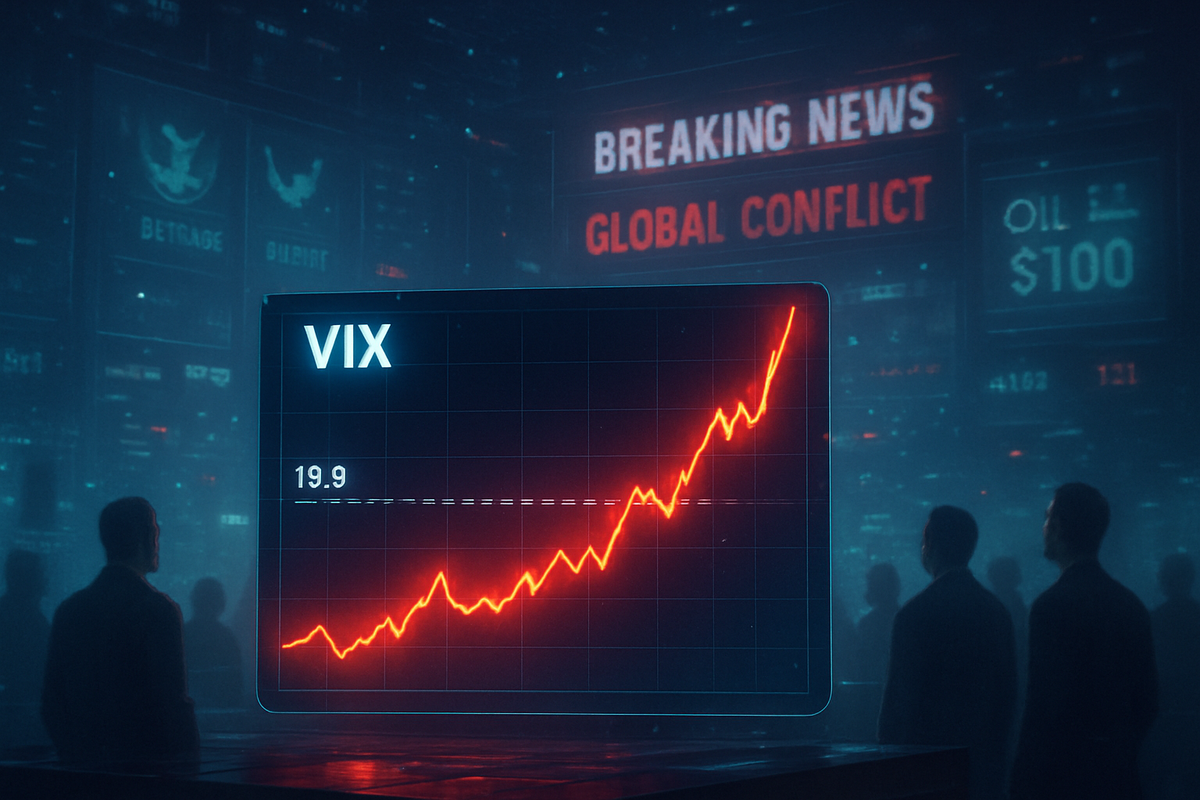
The relative tranquility that characterized the start of 2026 has evaporated, replaced by a sharp and sudden return of market volatility. In early March, the CBOE Volatility Index (VIX), often referred to as Wall Street's "fear gauge," breached the critical 19.9 level—a psychological and technical tripwire that has historically signaled a shift from complacency to high-alert status. This spike was accompanied by a collapse in retail investor sentiment, with the CNN Fear & Greed Index plunging to a near-identical 19.97 reading, firmly embedding the market in "Extreme Fear" territory as of March 18, 2026.
The immediate implications are a massive rotation of capital out of the high-growth technology sector and into the "real economy" defenses of energy and aerospace. With Brent crude oil prices surging past $100 per barrel due to a sudden escalation of military operations in the Middle East, investors are now grappling with a dual-threat environment: a geopolitical "war premium" and a Federal Reserve that finds itself cornered by the specter of stagflation. The 19.9 VIX print was not merely a number; it was the warning shot that ended the AI-driven rally of the previous year.
Geopolitical Escalation and the End of Complacency
The primary catalyst for this sudden volatility surge was the launch of "Operation Midnight Hammer" on February 28, 2026. This coordinated military effort by U.S. and Israeli forces targeted Iranian missile and drone infrastructure following a series of maritime provocations. The retaliatory blockade of the Strait of Hormuz by Iranian forces has effectively cut off a significant portion of the world's oil supply, sending shockwaves through global energy markets. By the first week of March, the VIX had spiked from its mid-teens baseline to hit 19.9, eventually climbing as high as 31.77 on March 9 as the severity of the blockade became clear.
While the Middle East remains the epicenter of current market anxiety, it is far from the only pressure point. In Eastern Europe, the Russia-Ukraine conflict has entered a delicate "moment of truth" in its fifth year, with rumors of forced territorial concessions in the Donbas region creating a secondary layer of uncertainty. Simultaneously, maritime clashes in the South China Sea involving the Philippines—the 2026 ASEAN Chair—and Chinese sovereignty claims have forced the U.S. to stretch its naval assets thin, raising fears of a security vacuum in the Pacific that could disrupt global semiconductor trade.
Retail investors, who had spent much of late 2025 betting on a "soft landing" and a series of Federal Reserve rate cuts, have been blindsided by this convergence of risks. According to the AAII Sentiment Survey for the week ending March 11, bearish sentiment among individual investors surged to 46.4%, up from 35.5% just two weeks prior. This rapid deterioration in sentiment suggests a massive de-risking event is underway, as retail participants move away from speculative "meme" stocks and high-beta growth names toward traditional safe havens.
The Great Rotation: Winners and Losers in a Volatile World
In this high-volatility regime, the market has clearly bifurcated. The primary "winners" are concentrated in the defense and energy sectors. Lockheed Martin (NYSE: LMT) and Northrop Grumman (NYSE: NOC) have seen their shares hit record highs as global defense budgets are adjusted for a multi-theater conflict scenario. Palantir Technologies (NYSE: PLTR), a retail favorite, has rebounded 14% this month as its "AIP" and "Maven Smart System" are reportedly being utilized for real-time battlefield analysis in current conflicts, validating the company's long-term value proposition to the defense establishment.
The energy sector has also become a fortress for capital. ExxonMobil (NYSE: XOM) and Chevron (NYSE: CVX) have outperformed the broader S&P 500 significantly in March, with Chevron up 22% year-to-date. These giants are benefiting not only from the higher price of crude but also from a renewed focus on domestic production security. Meanwhile, volatility-tracking products like the VIX Short-Term Futures ETF (BATS:VXX) have seen their highest trading volumes since 2024 as traders scramble to hedge against further spikes.
Conversely, the "losers" of the 19.9 VIX spike are the high-multiple technology stocks that dominated the 2025 rally. Microsoft (NASDAQ: MSFT) has entered a technical bear market, down 27% from its peaks, as investors question the return on investment for massive AI capital expenditures in a world where energy costs are skyrocketing. Retail "meme" stalwarts like AMC Entertainment (NYSE: AMC) have fared even worse, hitting new 52-week lows as liquidity dries up and debt refinancing costs become prohibitive. Even GameStop (NYSE: GME) remains under pressure as the market pivots away from speculative assets toward "real assets."
Stagflation and the Federal Reserve's Policy Dilemma
This spike in volatility fits into a broader trend of "geopolitical multiplexing," where multiple regional conflicts occur simultaneously, making it impossible for the Federal Reserve to rely on traditional economic models. The Fed, led by Jerome Powell in his final year, currently maintains interest rates in the 3.5%–3.75% range. However, the oil shock has created a "stagflationary" nightmare: a softening labor market evidenced by a weak February jobs report, combined with "sticky" inflation driven by energy prices.
Historically, the VIX hitting the 20 level has often forced the Fed's hand, prompting "dovish" pivots to support market liquidity. However, the current scenario is more reminiscent of the 1970s oil shocks than the 2008 financial crisis. If the Fed cuts rates to support the slowing economy, they risk fueling energy-driven inflation. If they hold rates steady or hike to combat inflation, they risk a deeper recession. This policy paralysis is a major driver of the "Extreme Fear" seen in retail sentiment, as the usual "Fed Put"—the idea that the central bank will always step in to save the markets—is no longer guaranteed.
Furthermore, the 2026 ASEAN tensions add a regulatory layer to this volatility. If trade routes in the South China Sea are further restricted, we may see the return of supply-chain-driven inflation, which was thought to be a relic of the post-pandemic era. This would further complicate the Fed’s path and likely keep the VIX elevated in a "new normal" range of 18–25 for the foreseeable future, rather than returning to the complacency of the mid-teens.
The Road Ahead: Potential Scenarios for the Coming Months
In the short term, the market's direction will be dictated almost entirely by the Strait of Hormuz. If a diplomatic resolution is reached and oil prices stabilize back toward the $80 range, we could see a "relief rally" that pulls the VIX back below 15. However, if military operations escalate or if Iran successfully maintains its blockade for an extended period, the VIX could easily test the 40 level, a height not seen since the major shocks of years past.
Strategically, public companies will likely pivot toward "resilience" rather than "growth." This means high-growth tech firms may announce further cost-cutting measures and a slowdown in AI infrastructure spending to preserve cash. For investors, the emergence of "safe-haven paradoxes" must be monitored. For instance, while Gold (NYSEARCA:GLD) traditionally rises during fear, it has faced headwinds in March 2026 due to a strengthening U.S. Dollar and high interest rates. This suggests that "safe havens" are no longer a monolith and require a more nuanced approach.
The likely scenario for the remainder of Q2 2026 is one of "grinding uncertainty." The markets are currently pricing in a protracted conflict, but they have not yet priced in a full-blown global recession. Retail investors should prepare for a period of heightened intraday swings, where news of a single drone strike or a subtle change in Fed rhetoric can cause 2-3% moves in the major indices within minutes.
Summary and Investor Outlook
The spike in the VIX to 19.9 and the corresponding drop in retail sentiment to "Extreme Fear" mark the definitive end of the 2025 bull run. The convergence of military conflict in the Middle East, ongoing tensions in Eastern Europe and Asia, and a cornered Federal Reserve has created an environment where volatility is the only certainty. Key takeaways for investors include the necessity of diversifying into defensive "backbone" industries like defense and energy while remaining cautious about the valuation of high-growth technology names.
Moving forward, the market will remain hyper-sensitive to any headlines regarding the Strait of Hormuz and the March 18th FOMC meeting minutes. The 19.9 level on the VIX served as a critical "tripwire," and its breach suggests that the floor for volatility has been raised. Investors should watch for whether the VIX can sustain itself above 20; a prolonged stay at these levels usually precedes a fundamental re-rating of equity valuations across the board. In this new era of 2026, the era of easy gains and low volatility is, for now, a thing of the past.
This content is intended for informational purposes only and is not financial advice.