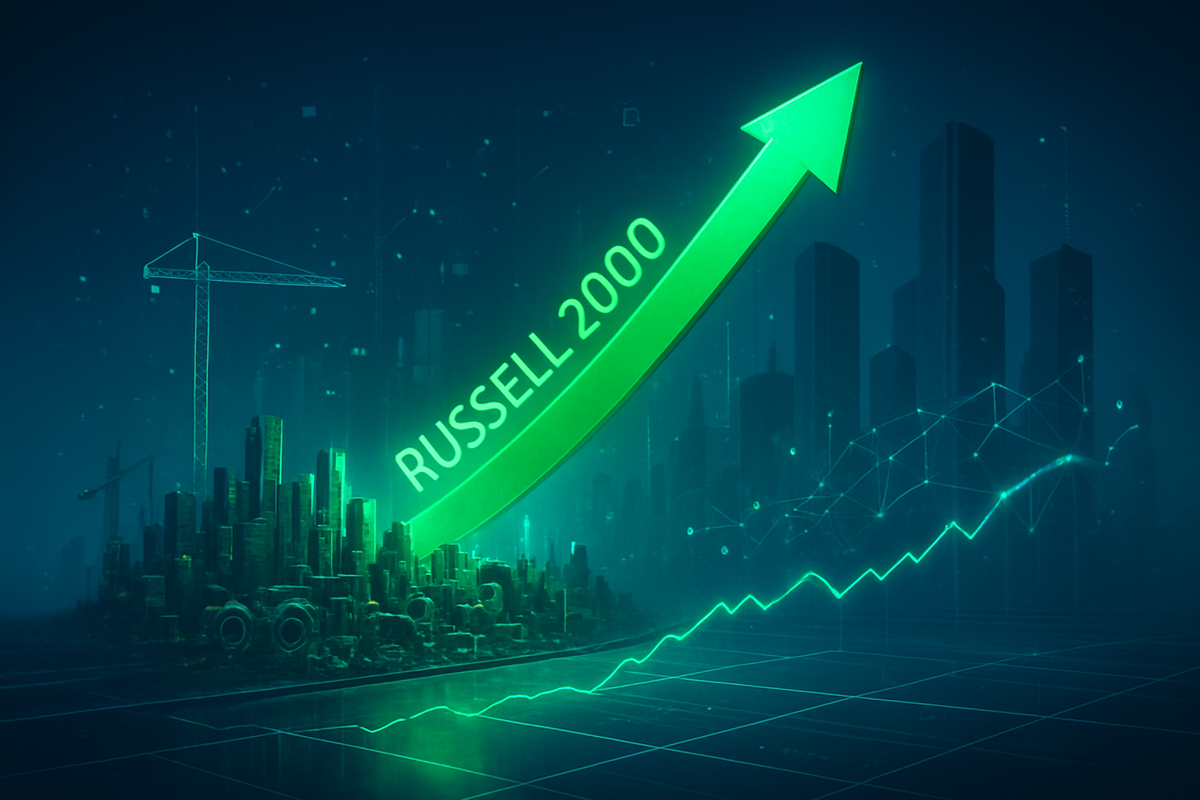
As of March 20, 2026, the long-awaited "Great Rotation" in the financial markets has shifted from a theoretical forecast to an undeniable market reality. For the first time in over a decade, the broad-based Russell 2000 index is significantly outperforming the heavyweights of the S&P 500 and the tech-laden Nasdaq-100. Year-to-date, the Russell 2000 has surged nearly 8%, while the S&P 500 has languished with a modest 1.5% gain, marking a definitive regime change in equity leadership.
This structural shift represents a massive migration of capital out of the "Magnificent Seven" mega-caps and into the long-neglected "real economy" stocks of the small-cap universe. Driven by a historic valuation gap, a stabilizing interest rate environment, and a pivot in the artificial intelligence narrative from hardware infrastructure to software application, the 2026 rally is redefining investor portfolios across the globe.
The Coiled Spring: A 25-Year Valuation Extreme
The seeds of this rotation were sown in late 2024 and throughout 2025 as the valuation disconnect between small and large companies reached a 25-year extreme. By the start of 2026, the Russell 2000 was trading at a forward price-to-earnings (P/E) ratio of approximately 18x, while the S&P 500 hovered near 26x—a discount of over 30%. Historically, small-cap stocks have commanded a premium due to their higher growth potential; however, years of "higher-for-longer" interest rates had compressed their multiples to levels not seen since the dot-com era.
The primary catalyst for the breakout was the Federal Reserve’s successful orchestration of a "soft landing." Following a series of incremental rate cuts throughout 2025, the Federal Funds Rate now sits in the 3.50% to 3.75% range. This easing cycle has provided vital relief for small-cap companies, which typically carry more floating-rate debt than their cash-rich mega-cap counterparts. Furthermore, the passage of the "One Big Beautiful Bill Act" (OBBBA) in mid-2025—a sweeping fiscal package focused on domestic infrastructure and reshoring—has injected billions into American manufacturing, directly benefiting the domestically focused firms that dominate the Russell 2000.
Initial market reactions in the first quarter of 2026 have been characterized by "breadth expansion." While the trillion-dollar giants are facing "AI capex fatigue" as investors demand immediate returns on massive infrastructure spending, small-cap industrials and regional banks are seeing record inflows. Market participants are increasingly viewing small-caps as a "coiled spring," ready to unwind as earnings growth for the Russell 2000 is projected to outpace the S&P 500 by nearly double digits this year.
Winners and Losers: Quality Over Quantity
The 2026 rotation is not a "rising tide lifts all boats" scenario; rather, it is a flight to "Quality Small-Caps." Companies with strong balance sheets and tangible links to the domestic infrastructure boom are the primary beneficiaries. Comfort Systems USA (NYSE: FIX) has emerged as a standout winner, transitioning from a traditional HVAC contractor into a mission-critical provider of cooling solutions for the ongoing data center construction surge. With a record $11.9 billion backlog entering 2026, the company exemplifies the "picks and shovels" play of the current era.
Similarly, Sterling Infrastructure (NASDAQ: STRL) is reaping the rewards of the semiconductor reshoring wave, with its "E-Infrastructure" segment seeing 25% projected growth as it builds the foundations for new domestic chip fabrication plants. In the financial sector, regional banks like HBT Financial (NASDAQ: HBT) and Five Star Bancorp (NASDAQ: FSBC) are thriving. These institutions are benefiting from a stabilizing yield curve and a resurgence in small-business loan demand, which has revitalized local economies that were previously stifled by high borrowing costs.
Conversely, the "losers" of this rotation are the overcrowded mega-cap names that dominated the previous decade. NVIDIA (NASDAQ: NVDA) and Microsoft (NASDAQ: MSFT), while still fundamentally strong, have seen their stock prices plateau as the market recalibrates. The narrative has shifted away from the companies building AI chips toward the companies using AI to drive productivity. Small-cap software firms like PROS Holdings (NYSE: PRO), which utilizes AI for dynamic pricing, and BigBear.ai (NYSE: BBAI), which provides predictive analytics for federal defense, are now catching the eyes of growth-hungry investors looking for the next leg of the AI revolution.
A Historical Parallel: The Post-Dot-Com Era
The current market environment draws striking comparisons to the period between 2000 and 2006. Following the collapse of the dot-com bubble, small-caps entered a multi-year period of significant outperformance as the market moved away from speculative tech and toward profitable, domestic-oriented businesses. The 2026 rotation mirrors this "regime change," signaling an end to the era of extreme market concentration where a handful of stocks dictated the entire index's movement.
Beyond historical precedents, this event signals a broader shift in industrial policy. The OBBBA fiscal stimulus has institutionalized "onshoring" as a permanent trend, creating a tailwind for the "Real Economy"—the manufacturers, builders, and local lenders that make up the backbone of the Russell 2000. This has significant regulatory implications, as the focus of the SEC and other bodies has moved toward ensuring market liquidity for smaller issuers, further encouraging institutional participation in the small-cap space.
What Comes Next: The "Agentic" Shift and Powell’s Successor
As we look toward the second half of 2026, the short-term focus will shift to the leadership of the Federal Reserve. Chairman Jerome Powell’s term is set to expire in May 2026, and the nomination of his successor will be a pivotal moment for small-cap momentum. A "dovish" appointment could accelerate the rotation, while a more "hawkish" pick might introduce temporary volatility.
Strategically, investors are expected to pivot toward "Agentic AI" applications—software that acts autonomously to solve business problems. Companies like Rezolve AI (NASDAQ: RZLV) are positioned to capitalize on this, as they scale from infrastructure to implementation. The long-term challenge for the Russell 2000 will be maintaining this earnings momentum; if small-caps can prove that their current growth is structural rather than cyclical, the "Great Rotation" could easily extend through the end of the decade.
Summary of the New Market Regime
The Great Rotation of 2026 has fundamentally altered the investment landscape. The primary takeaways are clear: the era of mega-cap dominance is giving way to a more diversified, domestic-led market rally. The combination of historical valuation discounts, a more favorable interest rate environment, and significant fiscal tailwinds has created a "perfect storm" for the Russell 2000.
Moving forward, the market is likely to reward "quality value"—companies with strong cash flows and clear paths to AI implementation. Investors should keep a close watch on regional bank earnings and industrial backlogs, as these will serve as the bellwethers for the continued health of the rotation. While the volatility associated with a transition in Fed leadership looms, the structural foundation for small-cap outperformance appears firmer than it has been in a generation.
This content is intended for informational purposes only and is not financial advice.