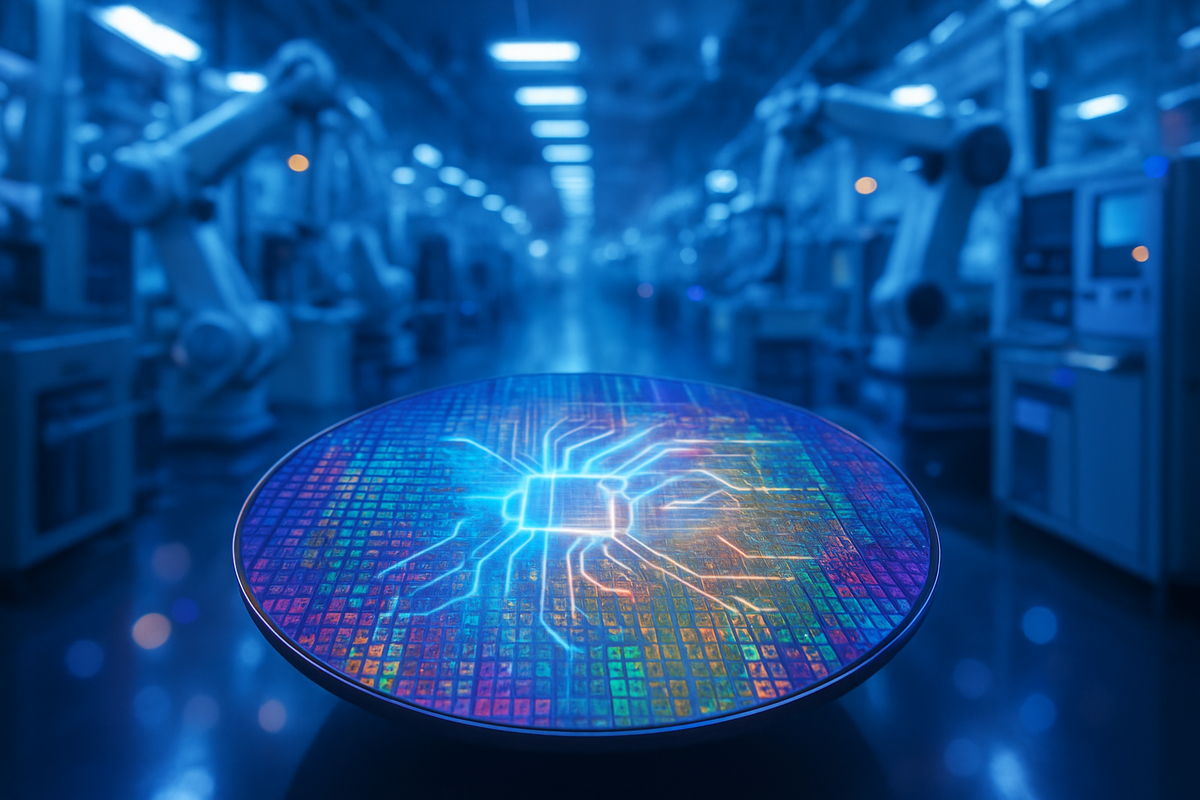
The eyes of the global financial community are fixed on Hsinchu, Taiwan, as Taiwan Semiconductor Manufacturing Company (NYSE: TSM) prepares to pull back the curtain on its first-quarter earnings for 2026. Scheduled for release on April 16, the report follows a period of unprecedented expansion for the world’s most critical chipmaker. With pre-announced sales already clocking in at a record $35.7 billion, investors are anticipating a powerhouse performance that could redefine the ceiling for the semiconductor industry in the AI age.
The stakes could not be higher. Market analysts are forecasting a staggering 55% year-over-year surge in earnings per share (EPS), driven by a "perfect storm" of demand for artificial intelligence infrastructure and the initial commercial rollout of the company's next-generation 2-nanometer (2nm) process. As the market closes on April 15, the options market is pricing in a volatile post-earnings move of between 5% and 7%, reflecting a "make or break" sentiment for the technology sector’s current rally.
A Record-Breaking Quarter and the Leap to 2nm
TSMC’s road to this moment has been defined by a relentless acceleration in high-performance computing (HPC) demand. The company’s preliminary revenue data for the first three months of 2026 showed consolidated sales of approximately $35.71 billion (NT$1.134 trillion), a 35.1% increase compared to the same period last year. This performance was capped by a historic month in March, where revenue jumped more than 45% year-over-year. This surge is widely attributed to the "unabated" appetite for AI accelerators, which now account for over 55% of the company's total revenue—a significant shift from just two years ago when mobile chips were the primary driver.
The most critical development leading into this earnings call is the official commencement of the "2nm Era." In January 2026, TSMC began mass production of its N2 (2nm) node at its Fab 20 and Fab 22 facilities. This transition is not merely a shrink in size but a fundamental shift in transistor architecture, moving from the long-standing FinFET design to Gate-All-Around (GAA) nanosheet technology. Early reports suggest that despite the complexity of this shift, initial yields have reached a healthy 65% to 80%. This technological lead has allowed TSMC to command a premium price for its newest wafers, reportedly exceeding $30,000 each, cementing its dominant pricing power in a market with no viable leading-edge alternatives.
Winners and Losers in the Foundry Wars
The 2026 landscape has seen a major shift in the hierarchy of TSMC’s clientele. Nvidia (NASDAQ: NVDA) is expected to be the primary winner, with analysts projecting the AI giant could officially overtake Apple (NASDAQ: AAPL) as TSMC’s largest customer by revenue this year. Nvidia's latest architectures, including the Vera Rubin series, have secured massive capacity on the new 2nm nodes, ensuring its continued dominance in the data center market. Meanwhile, Advanced Micro Devices (NASDAQ: AMD) has utilized the transition to N2 to "leapfrog" its competition, using TSMC’s advanced packaging and 2nm tech to power its Instinct MI400 accelerators, which are currently challenging Nvidia for market share in the enterprise AI space.
On the other side of the ledger, Apple (NASDAQ: AAPL) finds itself in a newly competitive environment. While it remains the "anchor" customer for the upcoming A20 chips in the iPhone 18, it no longer enjoys the exclusive pricing and priority it once commanded. The sheer scale of AI demand means Apple must now compete for floor space at TSMC’s fabs against the massive budgets of data center titans. Furthermore, Intel Corporation (NASDAQ: INTC) continues to face a dual-edged sword; while it is using TSMC for some of its leading-edge tiles to stay competitive, its own "Intel 14A" process node is racing to catch up to TSMC’s N2, making this earnings report a benchmark for how far behind Intel’s foundry services might actually be.
The Global AI Super-Cycle and Geopolitical Balancing
The broader significance of TSMC’s Q1 results extends far beyond a simple revenue beat. The semiconductor industry has reached what experts call a "structural divergence." While legacy segments like mid-range smartphones and PCs have stabilized, the "Physical AI" trend—AI integrated into robotics, autonomous vehicles, and edge devices—is creating a secondary wave of demand. TSMC’s projected $52 billion to $56 billion capital expenditure budget for 2026 is an industry-wide signal that the AI super-cycle is expected to last through the decade. This massive investment is primarily funneled into advanced nodes, including the early development of the 1.6nm (A16) process.
Historically, TSMC’s earnings have served as a bellwether for the global economy, and the 2026 report is no different. However, the company is now navigating a much more complex geopolitical map than in years past. With its Arizona "Fab 21" and Japan "JASM" facilities now in various stages of high-volume production, the costs of geographical diversification are beginning to weigh on margins. Analysts will be listening closely for updates on whether the "geopolitical premium"—the higher cost of manufacturing outside Taiwan—is being successfully passed on to customers or if it will begin to erode TSMC’s industry-leading 60%+ gross margins.
What to Watch: The Roadmap to 1.6nm and Beyond
Looking ahead, the immediate focus will be on TSMC’s guidance for the second quarter and the sustainability of its 2nm ramp. While the current quarter’s numbers are largely "baked in" due to the pre-announcement, the trajectory of the N2 node will dictate the stock’s performance for the remainder of 2026. A key strategic pivot to watch is the company's focus on "Silicon Photonics" and advanced 3D packaging (CoWoS), which are becoming the primary bottlenecks for AI chip production. If TSMC can demonstrate that it has successfully expanded packaging capacity, it could unlock a new leg of growth for its customers.
Investors should also keep an eye on the A16 (1.6nm) roadmap. As competitors like Samsung Electronics (OTC: SSNLF) attempt to regain ground with their own GAA implementations, TSMC’s ability to stay ahead on the next iteration of nanosheet technology will be vital. Potential challenges include the escalating costs of electricity and water in Taiwan, as well as the ongoing talent shortage in the global semiconductor sector. The market will be sensitive to any signs that the massive $50 billion+ CapEx plan might be scaled back, which could signal a cooling of the AI fever.
Summary and Investor Takeaways
In conclusion, TSMC’s Q1 2026 report is expected to be a landmark event that confirms the company’s status as the indispensable foundation of the AI era. With revenue of $35.7 billion and an EPS expected to rise by 55%, the financial health of the "World’s Foundry" appears robust. However, the 5% to 7% move expected by the options market suggests that perfection is already priced in. For the stock to move higher, management must provide a flawless outlook for the 2nm transition and reassure investors that the high costs of global expansion will not dilute the company’s legendary profitability.
Moving forward, investors should watch for the balance of power between Nvidia and Apple as TSMC’s top clients, the yield rates of the new GAA architecture, and any updates on the 1.6nm timeline. As we move into the second half of 2026, TSMC remains the primary beneficiary of the AI revolution, but its ability to navigate the complexities of "Physical AI" and global manufacturing will determine if it can maintain its trillion-dollar valuation in a rapidly evolving market.
This content is intended for informational purposes only and is not financial advice.