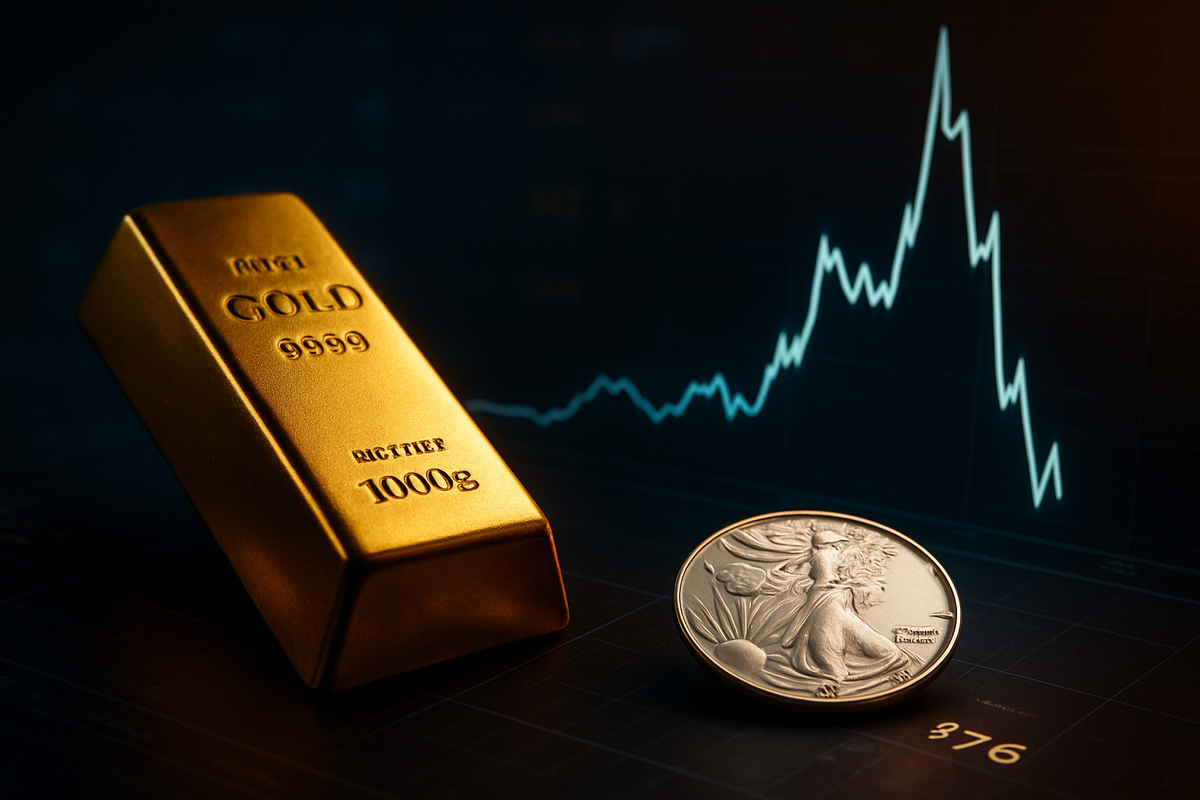
The global precious metals market has entered a period of unprecedented turbulence, characterized by record-breaking highs followed by stomach-churning declines. After gold shattered all previous records to hit a staggering peak of approximately $4,380 per ounce in early 2026, the market was gripped by a sharp correction that wiped out billions in paper wealth in a matter of weeks. This volatility has left investors questioning whether the "super-spike" has concluded or if a new, more sustainable boom is just beginning to take shape under the stewardship of Western institutional capital.
As of April 6, 2026, the narrative surrounding the yellow metal is shifting. While central banks, traditionally the bedrock of gold demand, show signs of fatigue—most notably with the Bangko Sentral ng Pilipinas considering a massive divestment—Wall Street is stepping in to fill the void. Analysts at Goldman Sachs (NYSE: GS) have signaled that the next phase of the gold rally will not be driven by sovereign reserves alone, but by a structural "stickiness" in private sector demand, even as silver battles to reclaim the $76 per ounce level after its own parabolic journey earlier this year.
The journey to $4,380 per ounce was paved with geopolitical dread and a tightening liquidity environment. Throughout late 2025 and into the first quarter of 2026, escalating tensions between the U.S. and Iran, combined with persistent friction in Eastern Europe, created a "fear premium" that propelled gold from the $3,000 range into uncharted territory. This reached a fever pitch in mid-February 2026 when gold touched its all-time high, momentarily making it the best-performing asset class of the decade.
However, the peak was short-lived. In March 2026, a "liquidity-driven" correction took hold. As the U.S. dollar surged to multi-year highs and interest rates remained stubbornly elevated to combat lingering inflation, institutional investors began liquidating their gold holdings to cover margin calls and rebalance portfolios. The correction saw gold prices tumble nearly 15% from their peak before finding a tentative floor. The current market environment on this April 6 is one of high-stakes anticipation; with a crucial 10-day extension on geopolitical negotiations set to expire, traders are watching the $4,400 resistance level with bated breath, preparing for either a "Safe-Haven" spike or a further retreat based on upcoming economic data.
The primary winners in this volatile environment have been the major silver producers and diversified mining houses that managed to optimize their cost structures before the price surge. First Majestic Silver (NYSE: AG) and SSR Mining (NASDAQ: SSRM) both reported exceptional first-quarter gains, with the former seeing its stock rise nearly 29% as it benefited from the spillover demand in the silver market. Meanwhile, the VanEck Gold Miners ETF (NYSEARCA: GDX) has managed to outperform the broader S&P 500, despite the March sell-off, signaling that equity investors are still betting on the miners’ ability to generate massive free cash flow at these price levels.
On the losing side, companies with high energy and labor exposure have struggled to turn the record prices into record profits. Industry giants like Newmont (NYSE: NEM) and Barrick Gold (NYSE: GOLD) have been forced to revise their 2026 guidance upward for operational expenses, tempering the enthusiasm of their shareholders. Additionally, financial institutions that were caught short during the January-to-February "blow-off top" faced significant losses, leading to the "forced liquidations" seen in instruments like the iShares Silver Trust (NYSEARCA: SLV) during the subsequent March crash.
The broader significance of this volatility lies in a fundamental shift in market psychology. For years, the "Gold Trade" was dominated by Eastern central banks—China, India, and Turkey—accumulating reserves to diversify away from the U.S. dollar. However, the Bangko Sentral ng Pilipinas has recently become a bellwether for a potential trend reversal among smaller central banks. With their gold holdings reaching 13% of total reserves—well above their 8-12% target—the Philippine central bank is reportedly considering a significant sale to capitalize on the record prices.
Contrast this with the analysis from Goldman Sachs, which suggests that the "Next Gold Boom" will be Western-led. The firm points to the fact that Western Exchange-Traded Funds (ETFs) have added over 500 tonnes of gold since the start of 2025. This move by Wall Street family offices and high-net-worth individuals to treat gold as a "sticky" store of value outside the traditional financial system represents a historical precedent similar to the stagflationary era of the late 1970s. As silver attempts to break the $76/oz "fractal shift" level, it acts as a high-beta proxy for this broader institutional thirst for tangible assets.
Looking ahead, the market faces two distinct paths. In the short term, the expiration of the U.S.-Iran negotiation window today, April 6, 2026, could serve as a massive catalyst. If a diplomatic solution is reached, gold may retest the $4,100 support level as the geopolitical risk premium evaporates. Conversely, a failure in talks could send gold toward Goldman Sachs’ ambitious year-end target of $5,400 per ounce. Silver investors are similarly on edge; a sustained close above $76/oz is projected to activate technical targets between $82 and $88 by the end of the second quarter.
For the mining sector, the challenge will be managing the "inflation of the hills"—the rising cost of fuel and machinery that often follows a commodity boom. Strategic pivots toward automation and renewable-powered mines will likely be the differentiating factor for companies like Fresnillo (LSE: FRES) and Pan American Silver (NYSE: PAAS) as they navigate this high-price, high-cost environment.
In summary, the gold market is no longer just a barometer of fear; it has become a battleground between sovereign sellers and institutional buyers. The peak of $4,380 per ounce was a milestone that signaled gold’s return to the center of the global financial conversation. While the volatility has been punishing for some, the underlying thesis of a "Wall Street boom" suggests that the secular bull market remains intact, even if the players have changed.
Investors should closely monitor the $76/oz level in silver as a leading indicator for the broader precious metals complex. In the coming months, the focus will likely shift from central bank reserve updates to the weekly flow data of Western ETFs. As the world navigates a landscape of high debt and geopolitical realignment, the "relic" of gold is proving to be more relevant than ever.
This content is intended for informational purposes only and is not financial advice