Global hospitality company Marriott (NASDAQ: MAR) reported Q3 2026 results beating Wall Street’s revenue expectations, with revenue up 8% year on year to $7.01 billion. Its non-GAAP profit of $3.02 per share was 6% above analysts’ consensus estimates.
For more on Marriott, read our free full research report.
Marriott (MAR) Q3 2026 highlights:
- Revenue $7.01 billion vs S&P analysts’ consensus estimates of $6.93 billion (8% year-on-year growth, 1% beat)
- Adjusted EPS $3.02 vs S&P analysts’ consensus estimates of $2.85 (6% beat)
- Adjusted EBITDA $1.51 billion vs analysts’ consensus estimates of $1.47 billion (21.6% margin, 2.7% beat)
- Adjusted EPS guidance Management raised its full-year adjusted EPS guidance to $12.11 at the midpoint, a 3.2% increase
- EBITDA guidance $6.09 billion at the midpoint for the full year, above analysts’ consensus estimates of $6.02 billion
- Operating margin 18.2%, in line with the same quarter last year
- RevPAR $146.29 at quarter end, down 17.3% year on year
- Market capitalization $104.1 billion
"Our global scale, compelling portfolio of brands, industry-leading Marriott Bonvoy loyalty program and dedicated associates, together with our robust development pipeline and disciplined execution, give us confidence in our ability to deliver sustainable, long-term growth."
Revenue growth
A company’s long-term revenue performance is one signal of its overall quality. Even a bad business can perform well for one or two quarters, but a top-tier one grows for years. Over the last five years, Marriott grew its revenue at an 18.8% annual rate. Though this growth is acceptable on an absolute basis, revenue growth alone is not enough to assess the consumer discretionary sector, which can display significant earnings volatility. The bar for the sector is particularly high, reflecting the non-essential and hit-driven nature of the products and services offered. Additionally, the five-year compound annual growth rate starts around Covid, when revenue was depressed before rebounding.
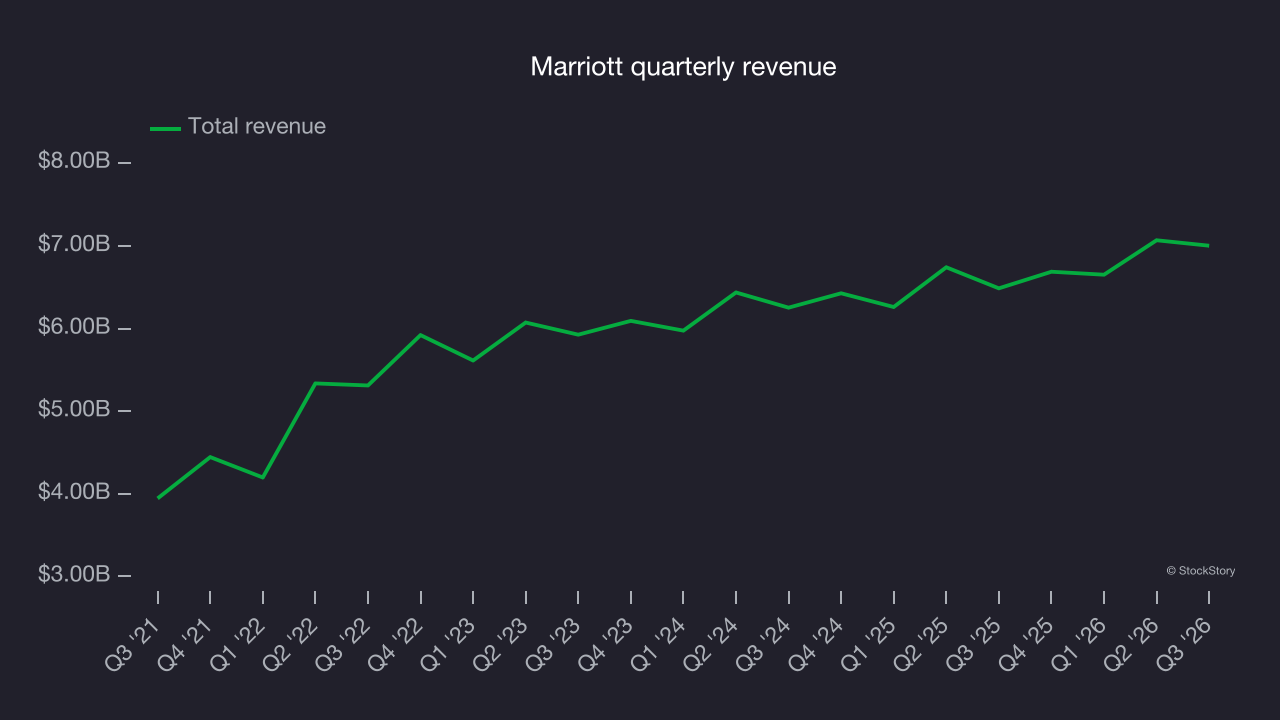
Long-term growth matters most, but within consumer discretionary, a stretched historical view may miss a company riding a successful new property or trend. Marriott’s recent performance shows its demand has slowed as its annualized revenue growth of 5.2% over the last two years was below its five-year trend. Decelerating revenue growth in the sector warrants caution, as it could signal changing consumer tastes aided by low switching costs. 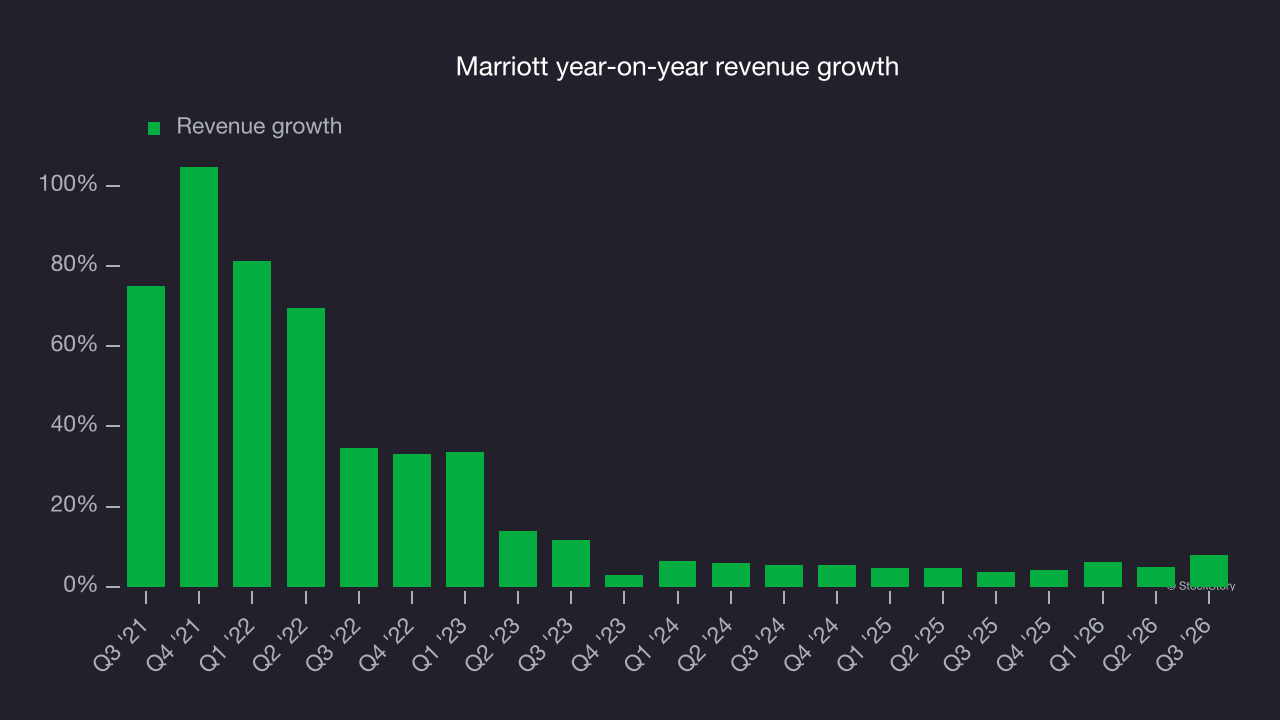
We can better understand the company’s revenue dynamics by analyzing its revenue per available room, which was $146.29 this quarter and is a key metric accounting for daily rates and occupancy levels. Over the last two years, Marriott’s revenue per room averaged an underwhelming 1.9% year-on-year growth. Revenue growth outpaced this metric, indicating that revenue from other areas like restaurants, bars and amenities outperformed its room bookings. Hotels sometimes pursue ancillary revenue growth because they are price takers in room revenue. 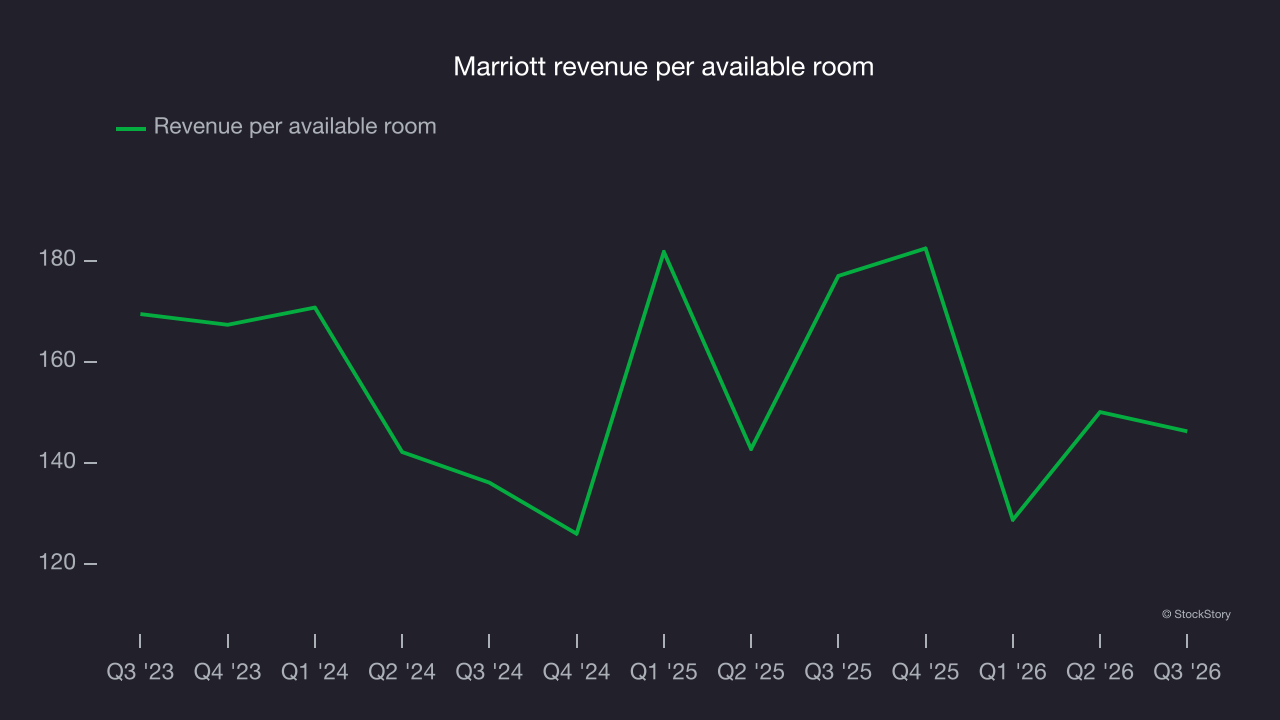
This quarter, Marriott reported year-on-year revenue growth of 8%, and its $7.01 billion of revenue exceeded Wall Street’s consensus estimates by 1%.
Looking ahead, sell-side analysts expect revenue to grow 6% over the next 12 months, according to S&P, similar to its two-year rate. This uninspiring projection indicates its newer products and services will not yet accelerate its revenue growth.
Operating margin
Marriott’s operating margin has been largely unchanged over the last 12 months, but ideally, economies of scale and cost efficiency would lift margins over time.
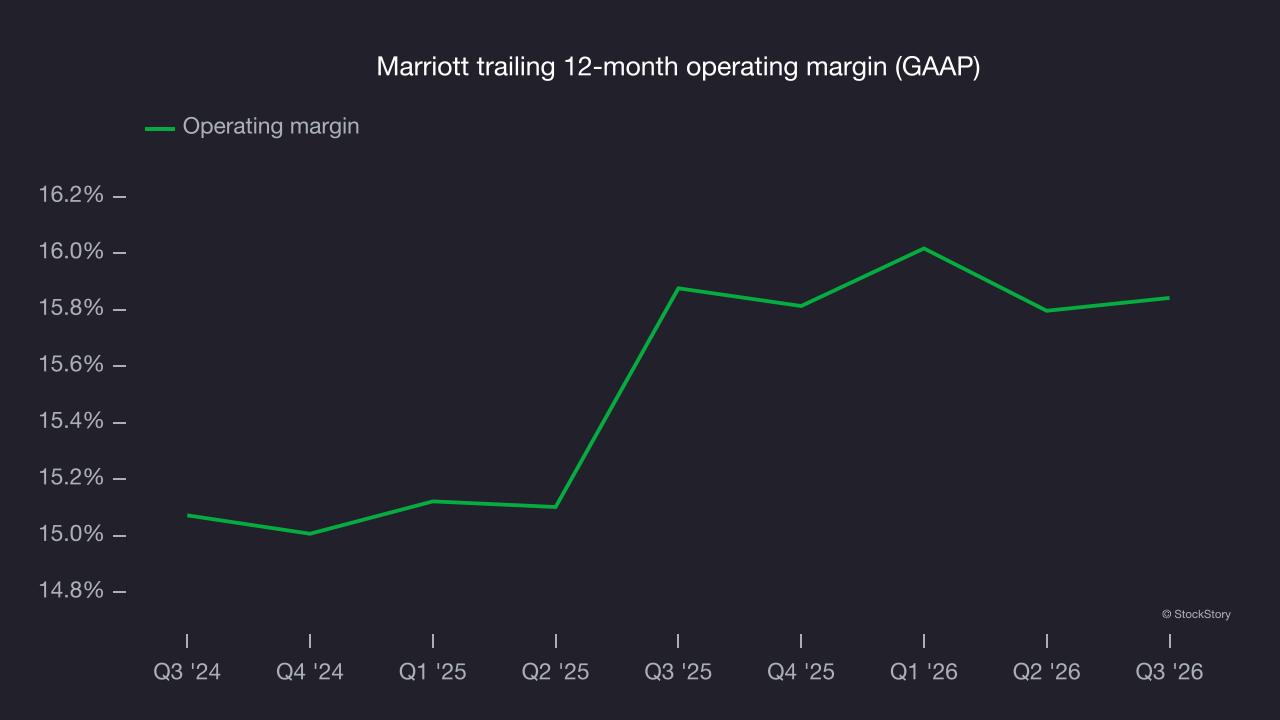
In Q3, Marriott generated an operating margin of 18.2%, in line with the same quarter last year. This indicates the company’s overall cost structure has been relatively stable.
Earnings per share
Revenue trends explain a company’s historical growth, but the long-term change in earnings per share (EPS) points to the profitability of that growth. For example, a company could inflate its revenue through excessive spending on advertising and promotions.
Marriott’s EPS grew at a 41.9% compounded annual growth rate over the last five years, higher than its 18.8% annualized revenue growth. This indicates the company became more profitable on a per-share basis as it expanded.
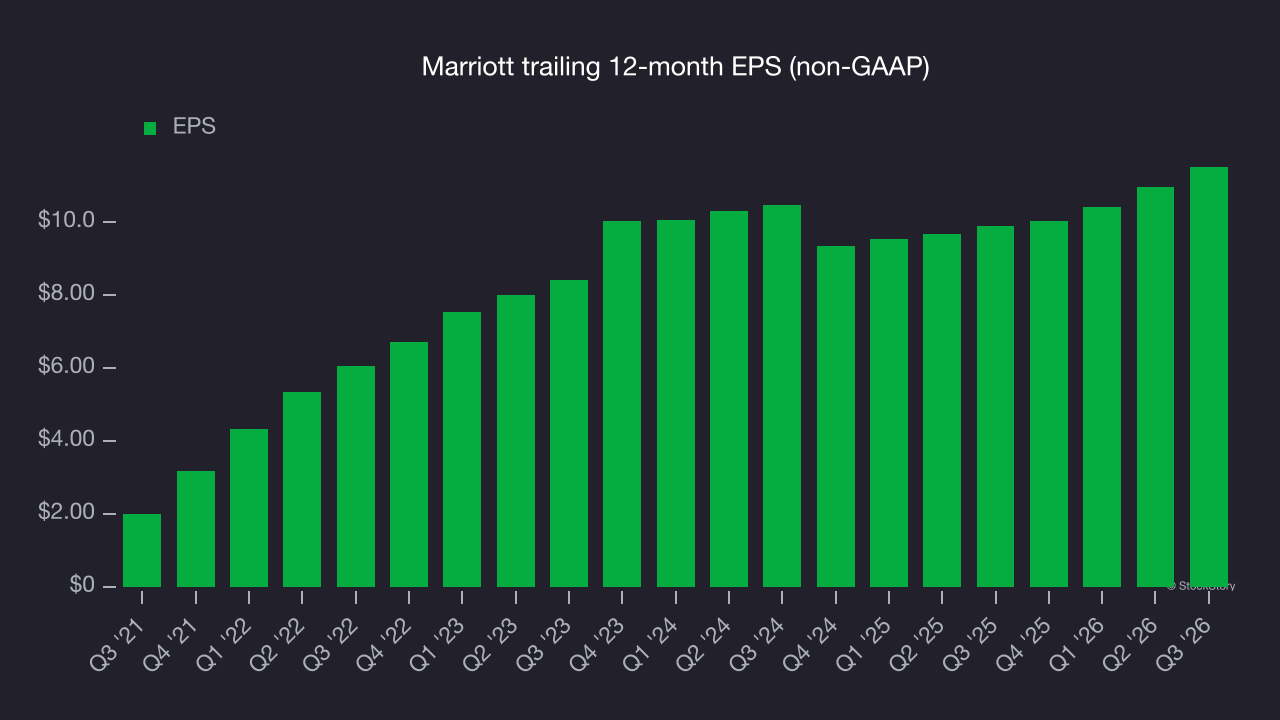
In Q3, Marriott reported adjusted EPS of $3.02, up from $2.47 in the same quarter last year. The result beat analysts’ consensus estimates by 6%. Over the next 12 months, Wall Street expects Marriott’s full-year EPS to grow 10.9% from $11.51 to $12.77, according to S&P.
Key takeaways from Marriott’s Q3 results
Marriott delivered a solid quarter, with EPS topping Wall Street’s consensus estimates and next-quarter EBITDA guidance also coming in above analysts’ expectations. Shares rose 2.6% to $409.65 immediately after the results.
Should you invest in Marriott now? The latest quarter is only one piece of the longer-term business quality puzzle. Quality, when combined with valuation, can help determine if the stock is a buy. For more on Marriott, read the full research report here (it’s free).